Tsatsral Wind Spirits Myth Meaning & Symbolism
A myth of primal wind spirits, their binding by the Sky Father, and the eternal covenant between the wild soul and cosmic order.
The Tale of Tsatsral Wind Spirits
In the time before time, when the world was a raw and breathing thing, the sky was not a dome but a vast, open throat. From it poured the first breath—not gentle, but a screaming, formless chaos. These were the Tsatsral, the unborn spirits of the wind. They were not one, but a legion of desires without mind: the shriek that scours rock, the sigh that steals warmth, the gale that uproots the ancient Sülde. They danced across the naked earth, a whirlwind of pure potential and pure destruction. There was no song in them, only noise. No path, only erasure.
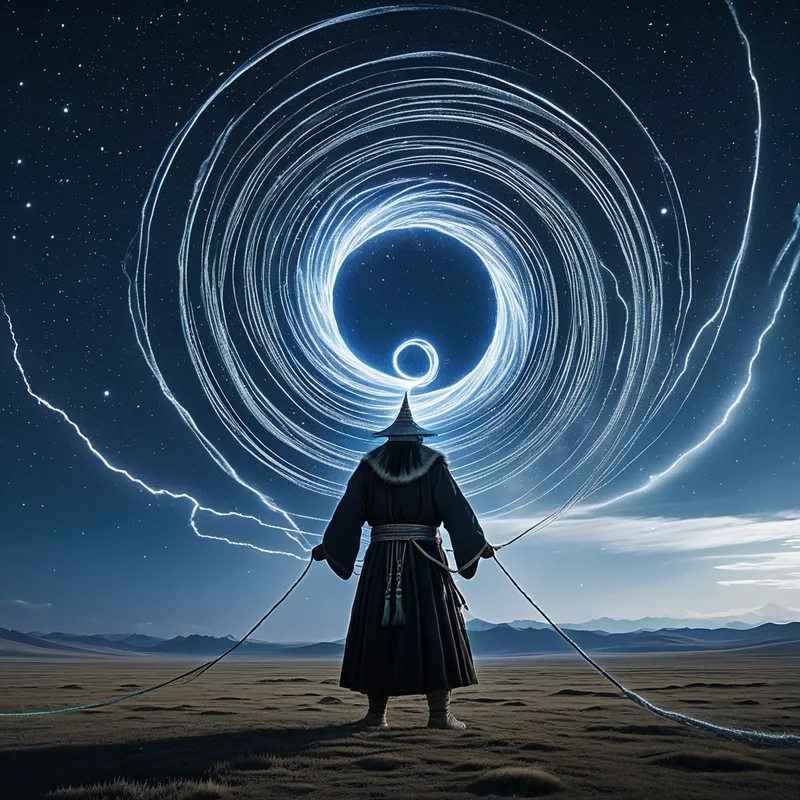
The great Tengri, the Sky Father, looked upon this formless tumult. He saw not malice, but a terrible loneliness, a spirit-energy that knew only its own wild wanting. It could not build, only scatter. It could not bless, only blast. The earth lay barren beneath its capricious touch. So Tengri, from the substance of the first twilight, forged a lasso not of rope, but of ordered starlight and the silent paths of planets.
He cast this net across the vault of heaven. The Tsatsral howled in fury, feeling the first constraint, the first shape imposed upon their infinite freedom. They coiled and struck like serpents of air, but the celestial bonds held. Tengri did not destroy them. Instead, he spoke a covenant into the storm. His voice was the rumble of distant thunder, the law beneath the chaos.
“You are power,” he intoned, “but without direction, you are nothing. You are movement, but without a Salkin, you are oblivion. I give you a name. I give you a season. I give you a purpose. You shall be the breath that seeds the clouds, the hand that shapes the dune, the messenger between my sky and the Etugen’s breast. But in return, you must listen. You must answer when called by the pure of heart, by those who know the old words.”
The spirits raged, but within the binding, they felt something new: a pattern. A rhythm. Their chaotic screams began to differentiate into the roar of the spring thaw wind, the whisper of the autumn grass, the steady push of the herdsman’s guiding breeze. They were given stations—the Four Directions—and specific duties. The wild, unified chaos shattered into a chorus of specific winds, each with a spirit, a name, and a role in the great order. They became the vital, restless breath of the world, bound by sacred law to a purpose greater than their own wildness.
Cultural Origins & Context
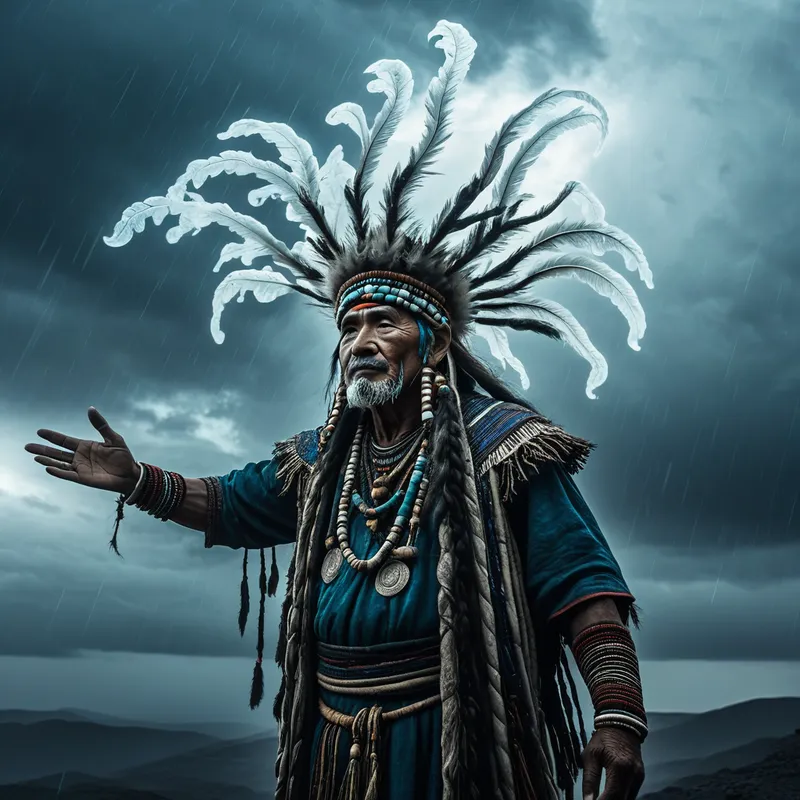
This myth originates from the deep well of Tengrism, the ancient spiritual worldview of the steppe nomads. It was not a story written in books, but one etched into the landscape itself—felt in the destructive fury of the Zud and the life-giving breeze of a summer pasture. It was passed down by shamans (Böö) and elders around evening fires, its telling often invoked to explain the capricious yet essential nature of the wind.
Its societal function was profound. In a culture utterly dependent on and exposed to the elements, the myth served as a psychological and ecological model. It explained the terrifying power of storms not as random evil, but as a fundamental, spirited force that had been integrated into a cosmic balance. It provided a framework for interaction: the wind was not just weather, but a conscious entity with which one could negotiate, show respect, and even commune through ritual and Khiimori. The myth taught that even the most chaotic forces have a place in the sacred order, and that humanity’s role is to understand that order and speak to it with respect.
Symbolic Architecture
The Tsatsral represent the raw, unintegrated psychic [energy](/symbols/energy “Symbol: Energy symbolizes vitality, motivation, and the drive that fuels actions and ambitions.”/) of the unconscious—the storm of impulses, emotions, talents, and drives that exist before the imposition of [consciousness](/symbols/consciousness “Symbol: Consciousness represents the state of awareness and perception, encompassing thoughts, feelings, and experiences.”/) (Tengri). They are pure potential, but also pure destructiveness, capable of scouring the [landscape](/symbols/landscape “Symbol: Landscapes in dreams are powerful symbols representing the dreamer’s emotional state, personal journey, and the broader context of life situations.”/) of the nascent ego.
The binding is not a imprisonment, but an initiation. Chaos must be given form to become creative; the wild spirit must be named to become a soul.
Tengri’s lasso of [starlight](/symbols/starlight “Symbol: Starlight represents distant guidance, celestial inspiration, and the connection between cosmic order and human creativity, often symbolizing hope, beauty, and artistic vision.”/) symbolizes the organizing principle of the Self. It is law, [rhythm](/symbols/rhythm “Symbol: A fundamental pattern of movement or sound in time, representing life’s cycles, emotional flow, and universal order.”/), and [purpose](/symbols/purpose “Symbol: Purpose signifies direction, meaning, and intention in life, often reflecting personal ambitions and core values.”/)—the cosmic order that transmutes random energy into directed force. [The covenant](/symbols/the-covenant “Symbol: A sacred, binding agreement between parties, often with divine or societal significance, representing commitment, obligation, and mutual responsibility.”/) represents the fundamental pact of individuation: the wild, inner elements agree to serve a larger, conscious totality, and in return, they are granted [identity](/symbols/identity “Symbol: Identity represents the sense of self, encompassing personal beliefs, cultural background, and social roles.”/), meaning, and a channel for their power. The differentiated winds symbolize the [sublimation](/symbols/sublimation “Symbol: Transforming base impulses into creative or socially acceptable outlets, often seen in artistic expression.”/) of raw complexes (rage, [passion](/symbols/passion “Symbol: Intense emotional or physical desire, often linked to love, creativity, or purpose. Represents life force and deep engagement.”/), restless energy) into specific, useful psychological functions—the focused will, the inspiring [idea](/symbols/idea “Symbol: An ‘Idea’ represents a spark of creativity, innovation, or realization, often emerging as a solution to a problem or a new outlook on life.”/), the cleansing [catharsis](/symbols/catharsis “Symbol: A profound emotional release or purification through artistic expression, often involving intense feelings of relief and transformation.”/).

The Dreamer’s Resonance
To dream of the Tsatsral is to experience the somatic and psychic reality of unbound inner forces. The dreamer may be in a landscape battered by a senseless, screaming gale that threatens to tear their house (ego-structure) apart. They may feel themselves scattered, unable to think or hold a coherent form. This is the psyche signaling a state of being overwhelmed by undifferentiated emotion or impulse—a Zud of the soul.
Conversely, dreaming of speaking to the wind, or of a wild but specific breeze carrying a message, indicates the beginning of this integrative process. The chaotic energy is starting to take on a nameable quality—this is the wind of my grief, that is the gust of my repressed anger. The dreamer is in the process of “calling” these spirits, of engaging with them consciously, which is the first step toward Tengri’s covenant. The body may feel restless, electric, or breathless during such dreams, mirroring the somatic reality of these psychic storms.

Alchemical Translation
The myth of the Tsatsral is a perfect allegory for the alchemical solve et coagula—dissolve and coagulate. First, one must confront the dissolved, chaotic state of the inner Tsatsral: the whirlwind of unresolved trauma, unbounded creativity, or anarchic emotion that disrupts life.
The modern individual’s “Tengri” is the conscious, observing Self that must forge a lasso not of suppression, but of compassionate understanding and intentionality.
The binding is the coagula: the act of giving form to the formless. This is the work of therapy, art, ritual, or deep reflection—naming the winds. “This rage is not me; it is a wind that blows through me. I will give it a direction, a purpose—perhaps the energy to set a boundary.” The covenant is the ongoing relationship of inner governance. One does not eliminate the stormy passions; one learns their seasons, their directions, and their uses. The rebel spirit (Tsatsral) is not killed but enlisted in service of the sovereign whole (the integrated Self). The triumph is not calm, but a dynamic, spirited harmony where every inner gale has its place in the ecology of the soul.
Associated Symbols
Explore related symbols from the CaleaDream lexicon:
- Wind — The primary substance and actor of the myth; represents raw psychic energy, spirit, change, and the invisible forces that shape both landscape and soul.
- Chaos — The primordial state of the Tsatsral; the undifferentiated, creative-destructive potential of the unconscious that precedes order and form.
- Order — Embodied by Tengri and the celestial lasso; the cosmic and psychological principle that structures chaos into a meaningful, functional system.
- Sky — The domain of Tengri and the origin of the wind; represents consciousness, the father principle, law, and the vast container of all phenomena.
- Whirlwind — The manifest form of the unbound Tsatsral; a symbol of emotional or mental turmoil, scattering of energy, and destructive potential.
- Spirits — The Tsatsral themselves; personifications of natural and psychological forces, indicating an animistic worldview where everything possesses consciousness.
- Journey — The transformation of the Tsatsral from chaos to ordered function; mirrors the soul’s journey from fragmentation to integration.
- Ritual — The act of calling upon or negotiating with the wind spirits; represents the conscious practices (internal or external) that engage with unconscious forces.
- Shadow — The Tsatsral can be seen as a collective shadow aspect—the wild, untamed, and potentially destructive parts of the psyche that must be integrated.
- Rebirth — The outcome of the binding; the chaotic winds are reborn as purposeful, named entities, symbolizing the rebirth of psychic energy into service of the Self.
- Mountain — The Sülde, the world mountain; represents stability, the axis mundi, and the earthly counterpart that withstands and is shaped by the wind’s force.
- Bridge — The covenant between Tengri and the Tsatsral; creates a bridge between chaos and order, the unconscious and consciousness, spirit and law.