
Triple Goddess Myth Meaning & Symbolism
A myth of the land's spirit manifest as three sisters, revealing the cycles of life, power, and the sacred contract of rightful rule.
The Tale of the Triple Goddess
Listen. The wind carries it from the hollow hills. The stones remember. Before the high kings, before the iron, there was the Land, and she was alive. She did not speak in words of men, but in the sigh of the barley, in the roar of the stag, in the silent turning of the stars. And when a man would be king, he did not take the crown; he went to meet her. He went to be chosen.
So it was for the prince, weary from battle and the weight of expectation. His father’s hall was ashes, his claim contested by steel and spite. A druid, eyes like deep wells, spoke the old law: “Seek the Sovereignty. She who is the realm itself. Find her at the place of the world’s navel, where the waters of sight gather.”
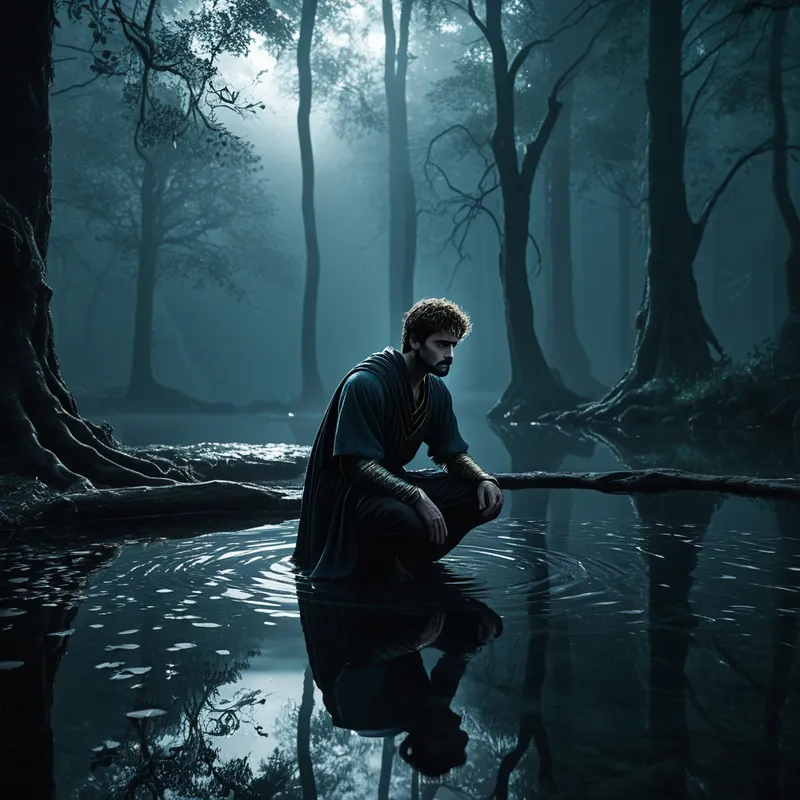
Through forests that whispered his fears, over mountains that tested his breath, he journeyed. He came to a lake, black and still as polished obsidian, cradled in the bowl of the oldest hills. Mist clung to the water, and the air tasted of damp earth and cold stone. He was alone, and in that aloneness, he felt the immense, watching presence of the place.
A ripple, not from wind. From the center of the lake, a figure emerged. A maiden, her hair the colour of fresh rushes, her eyes holding the unblinking curiosity of a hind. She waded ashore, water beading on skin like dawn light. She held out a cup, carved from a single piece of pale wood. “Drink,” she said, her voice the sound of a spring bubbling from rock. He drank. The water was cold and sweet, and it filled him with a fierce, clean vitality, the longing for beginnings.
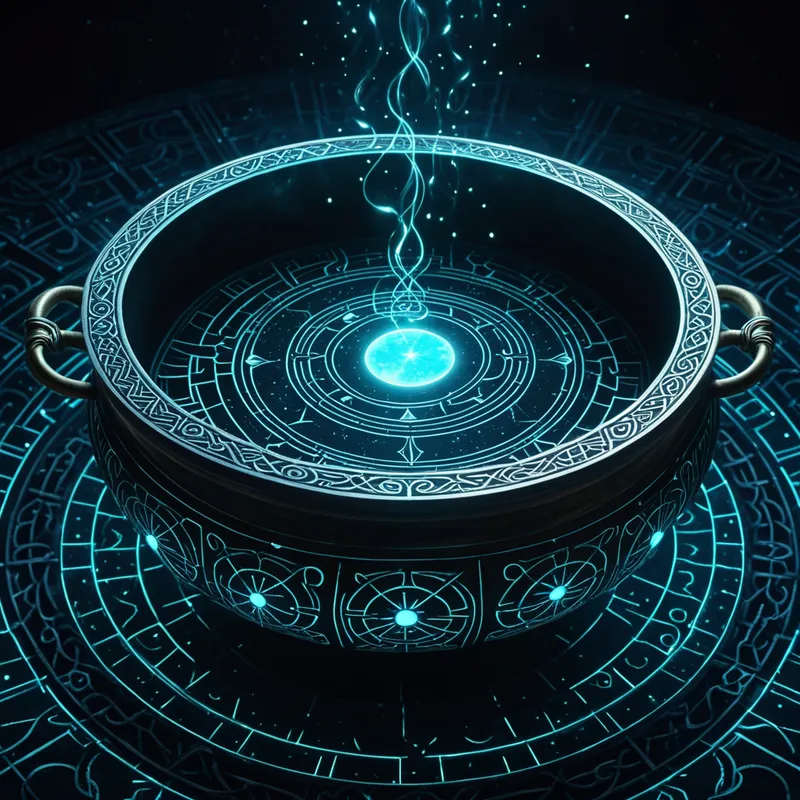
As he lowered the cup, she was gone. In her place stood a woman in the full flower of her strength. A queen, her brow crowned with woven hawthorn, her gaze steady and assessing as a falcon’s. In her hands was a different cup, of polished bronze, intricate with spirals. “Drink,” she commanded, her voice the rustle of ripe wheatfields. He drank. This was deep, complex, like mead and memory. It carried the weight of judgment, the heat of passion, the solidity of law.
She too faded into the mist. Then came the third. An ancient crone, her back bent like a weathered tree, her eyes holding the depth of star-filled nights. Her hands, knotted and strong, offered a cup of simple, dark clay, cracked with age. “Drink,” she whispered, her voice the dry rustle of last autumn’s leaves. He drank. This was bitter, like crushed herbs and cold earth. It tasted of endings, of quiet wisdom, of the peace that comes only after surrender.
He sank to his knees, the visions of the three faces swirling within him—the promise, the power, the peace. The mist over the lake coalesced into a single, towering form, at once all three and none. The voice that spoke was the land itself: “You have drunk of my essence—the wellspring, the flowering, the root. The king and the land are one. Rule with the maiden’s hope, the mother’s strength, and the crone’s wisdom. Fail, and the rivers will sour and the stones will reject your feet.”
He opened his eyes. He was on the lakeshore, but the sun was high, and in his heart was a quiet, unshakeable certainty. He returned, and where he walked, the people saw not just a man, but the shadow of the threefold goddess upon him. The land itself seemed to affirm him, and his kingship was born not of conquest, but of sacred union.
Cultural Origins & Context
This mythic pattern, less a single story than a deep cultural template, permeates the Celtic world from Ireland to Gaul. We know it not from a singular, canonical text—the ancient Celts transmitted wisdom orally—but from fragments preserved in later medieval Irish and Welsh literature, such as the Mythological Cycle and the tales of the Lebor Gabála Érenn. The encounter with the Sovereignty goddess is a recurring motif in the inauguration rituals of kings.
The tellers were the fili and bards, keepers of history and sacred lore. Their function was not mere entertainment but the preservation of cosmic order. By reciting the myth of the king’s marriage to the land, they were performing a sympathetic magic, reaffirming the essential contract between the people, their ruler, and the animate world they inhabited. The goddess was the land: its fertility, its justice, its ultimate authority. A king’s legitimacy flowed from this divine feminine source, making his rule a sacred stewardship rather than a secular tyranny.
Symbolic Architecture
At its heart, the myth presents a profound map of consciousness, framed through the feminine principle. The Triple Goddess is not three separate entities but a triune expression of a single, complete reality: the lifecycle of all things—beginning, maturity, ending—and the facets of a whole psyche.
The Maiden is potential, the unformed question, the intuitive spark. She is the psychic energy in its state of pure becoming. The Mother is manifestation, the formative power, the nurturer and the judge. She is the energy applied in the world, creating and sustaining form. The Crone is dissolution, wisdom, the release of form. She is the energy of introspection, transformation, and the return to essence.
Psychologically, the myth dramatizes the encounter with the Anima in its totality. For the (traditionally male) hero-king, facing the goddess in her three aspects represents the necessity of integrating the full spectrum of the feminine within his own psyche—not just the inspirational muse (Maiden) or the comforting partner (Mother), but most challengingly, the transformative, death-dealing wisdom of the Crone. His “marriage” is an inner union, a state of psychological wholeness where he gains sovereignty over his own inner kingdom.
The Dreamer’s Resonance
When this mythic pattern stirs in the modern dreamer, it signals a profound encounter with the archetypal feminine and the call to inner sovereignty. One might dream of three sisters, a triple-faced figure, or sequentially encountering women of different ages who offer gifts or tests.
Dreaming of the Maiden often coincides with new beginnings, creative impulses, or a vulnerable, exploratory phase of life. There is a somatic sense of opening, curiosity, but also potential naivete. Dreaming of the Mother can relate to phases of great responsibility, nurturing projects or relationships, or confronting one’s own capacity for power and judgment. The body may feel strong, burdened, or abundantly fertile. Dreaming of the Crone is a hallmark of deep transition, loss, or the necessity of letting go. It can be unsettling, accompanied by somatic sensations of cold, stillness, or hollowing out, but it points toward essential wisdom being forged in the dark.
The full sequence—the offering and acceptance from all three—in a dream suggests a critical rite of passage. The dreamer is being asked to acknowledge and integrate all phases of their own being, to accept the gifts and the bitter draughts of their life’s journey, and in doing so, claim authentic authority over their own destiny.

Alchemical Translation
The myth is a perfect allegory for the alchemical process of individuation. The hero’s journey to the liminal lake is the nigredo—the descent into the unconscious, the state of confusion and “blackening.” The threefold offering is the albedo—the washing in the lunar, feminine waters, the separation and clarification of the core components of the self.
Drinking from the three cups represents the conscious assimilation of life’s full spectrum: the sweet potential, the complex actuality, and the bitter necessity of transformation.
The final, integrated vision of the goddess and the resulting inner certainty signify the rubedo—the dawn of the “philosophical gold,” the achieved state of psychic sovereignty. The king is no longer a prince driven by external ambition (the burnt hall, the contested claim) but a vessel for a transpersonal authority. In modern terms, this is the shift from living by the persona—the mask society expects—to living from the Self, the central, archetypal core of one’s being. The “land” that flourishes under this rule is the individual’s own life: relationships, work, and creative spirit become fertile, ordered, and resilient, because they are rooted in a sacred contract with the deepest layers of their own soul.
Associated Symbols
Explore related symbols from the CaleaDream lexicon: