Tree of Paradise Myth Meaning & Symbolism
The story of a primordial garden, a sacred tree of knowledge, and the fateful choice that defines the human condition of consciousness and exile.
The Tale of the Tree of Paradise
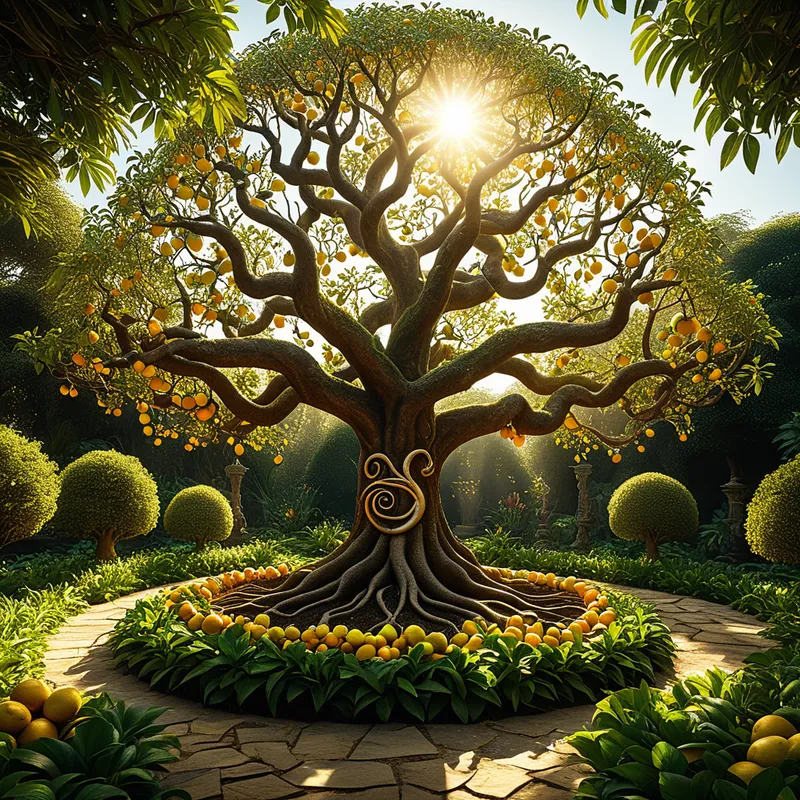
In the beginning, before time was counted, there was a sound. It was not a sound of thunder or of wind, but a Word, spoken into the formless deep. And from that Word, a garden bloomed in the east, a place called Eden. Rivers of crystal cleaved [the earth](/myths/the-earth “Myth from Hindu culture.”/), watering a soil so rich it dreamed forth every good tree pleasant to the sight and sweet to the taste.
And in the very heart of this garden, where the light fell as if from a different sun, the Creator planted two trees. One was the [Tree of Life](/myths/tree-of-life “Myth from Kabbalistic culture.”/). Its leaves whispered of forever, its sap was the very essence of unbroken being. The other was the Tree of the Knowledge of Good and Evil. It stood apart, its fruit glowing with a dangerous, inner luminescence, a beauty that held a question at its core.
Into this tapestry of life, the Creator breathed. From the red clay, a man, Adam, took shape. And from the man’s own side, a woman, Eve, was drawn forth. They were naked and unashamed, moving through the garden in a state of pure participation, speaking with the cherubim and naming the creatures without a shadow of doubt. One law was given, a single boundary in their boundless world: “You may eat of every tree, but of the Tree of the Knowledge of Good and Evil, you shall not eat, for on the day you eat of it, you shall surely die.”
Now, the most subtle of all the creatures in the garden was the serpent. It coiled upon a branch of the forbidden tree, its scales catching the dappled light. “Has God truly said,” it whispered, its voice like dry leaves rustling, “that you shall not eat of any tree?” The woman corrected the serpent, but the seed was planted. The whisper continued, weaving a new possibility. “You will not die. For God knows that on the day you eat of it, your eyes will be opened, and you will be like gods, knowing good and evil.”
She looked at the tree anew. The fruit was good for food, a delight to the eyes, and desirable to make one wise. The whisper became a roar in her blood. She took. She ate. She gave to her man, and he ate.
And in that moment, [the world](/myths/the-world “Myth from Tarot culture.”/) fractured. The light itself changed, becoming harsh and revealing. Their eyes were opened, and they saw their own nakedness—not as wholeness, but as vulnerability. They heard the sound of the [Ruach Elohim](/myths/ruach-elohim “Myth from Abrahamic culture.”/) walking in the garden in the cool of the day, and for the first time, they hid, stitching fig leaves into crude garments. When the Voice called, “Where are you?” it was not a question of location, but of state. The man blamed the woman, the woman blamed the serpent, and the serpent had no words left, only a curse.
And so, exile began. They were driven out from the garden, lest they stretch out their hands again and take from [the Tree of Life](/myths/the-tree-of-life “Myth from Kabbalistic culture.”/), and live forever in this broken state. Before them, the east gate was sealed, guarded by a flaming sword that turned every way. Behind them, the two trees stood silent in the heart of a paradise now lost, their roots drinking from the same sacred ground.
Cultural Origins & Context
This foundational narrative is found in the opening chapters of Genesis. Its origins are woven from the ancient Near Eastern tapestry, sharing motifs with Mesopotamian myths of primordial gardens and lost golden ages. For the ancient Israelites, however, this was not merely an etiological tale but the prologue to their entire covenant history. It was recited, studied, and debated as the answer to the most profound human questions: Why is there suffering? Why do we feel separate from the world and from God? What is the origin of death and toil?
It functioned as the bedrock of a worldview that understood human existence as fundamentally relational—first to the divine, then to each other, and finally to the earth itself. The story was transmitted orally long before being codified in written scripture, serving as a communal memory of a rupture that explained the present condition. It established the core theological framework of free will, moral consequence, and a creation that is fundamentally good yet tragically fractured by human choice.
Symbolic Architecture
The myth’s power lies not in historical literalism but in its profound symbolic [truth](/symbols/truth “Symbol: Truth represents authenticity, honesty, and the quest for knowledge beyond mere appearances.”/). The Garden is the [prima materia](/myths/prima-materia “Myth from Alchemical culture.”/) of the [soul](/symbols/soul “Symbol: The soul represents the essence of a person, encompassing their spirit, identity, and connection to the universe.”/)—a state of unconscious unity with [the Self](/myths/the-self “Myth from Jungian culture.”/). The two trees represent the fundamental poles of existence.
The Tree of Life is the symbol of unbroken participation in being, of eternal, cyclical nature where life, death, and rebirth are a seamless whole, untouched by the judgment of a separate “I.”
The [Tree](/symbols/tree “Symbol: In dreams, the tree often symbolizes growth, stability, and the interconnectedness of life.”/) of [Knowledge](/symbols/knowledge “Symbol: Knowledge symbolizes learning, understanding, and wisdom, embodying the acquisition of information and enlightenment.”/) is the [archetype](/symbols/archetype “Symbol: A universal, primordial pattern or prototype in the collective unconscious that shapes human experience, behavior, and creative expression.”/) of [consciousness](/symbols/consciousness “Symbol: Consciousness represents the state of awareness and perception, encompassing thoughts, feelings, and experiences.”/) itself. To eat its [fruit](/symbols/fruit “Symbol: Fruit symbolizes abundance, nourishment, and the fruits of one’s labor in dreams.”/) is to enact the [birth](/symbols/birth “Symbol: Birth symbolizes new beginnings, transformation, and the potential for growth and development.”/) of [the ego](/myths/the-ego “Myth from Jungian culture.”/)—the psychological act of [separation](/symbols/separation “Symbol: A spiritual or mythic division between realms, states of being, or consciousness, often marking a transition or loss of connection.”/), [reflection](/symbols/reflection “Symbol: Reflection signifies self-examination, awareness, and the search for truth within oneself.”/), and judgment. It is the [moment](/symbols/moment “Symbol: The symbol of a ‘moment’ embodies the significance of transient experiences that encapsulate emotional depth or pivotal transformations in life.”/) the [psyche](/myths/psyche “Myth from Greek culture.”/) looks at itself and says “I am,” thereby creating the duality of self and other, good and evil, sacred and profane. The “[death](/symbols/death “Symbol: Symbolizes transformation, endings, and new beginnings; often associated with fear of the unknown.”/)” that follows is not a physical cessation, but the death of unconscious wholeness. The [serpent](/symbols/serpent “Symbol: A powerful symbol of transformation, wisdom, and primal energy, often representing hidden knowledge, healing, or temptation.”/), often later demonized, is in the ancient text simply “the most subtle.” It represents the [trickster](/symbols/trickster “Symbol: A boundary-crossing archetype representing chaos, transformation, and the subversion of norms through cunning and humor.”/) [archetype](/symbols/archetype “Symbol: A universal, primordial pattern or prototype in the collective unconscious that shapes human experience, behavior, and creative expression.”/), the necessary catalyst that provokes evolution. It is the questioning voice of the unconscious itself, pushing the [psyche](/myths/psyche “Myth from Greek culture.”/) toward the painful but necessary acquisition of consciousness.
The [exile](/symbols/exile “Symbol: Forced separation from one’s homeland or community, representing loss of belonging, punishment, or profound isolation.”/) from the garden is, therefore, not a [punishment](/symbols/punishment “Symbol: A dream symbol representing consequences for actions, often tied to guilt, societal rules, or internal moral conflicts.”/) but an inevitable consequence. One cannot remain in unconscious [paradise](/symbols/paradise “Symbol: A perfect, blissful place or state of being, often representing ultimate fulfillment, harmony, and transcendence beyond ordinary reality.”/) once consciousness has dawned. The flaming sword is both a [barrier](/symbols/barrier “Symbol: A barrier symbolizes obstacles, limitations, and boundaries that prevent progression in various aspects of life.”/) and a protector, ensuring the nascent, fragile ego must now [journey](/symbols/journey “Symbol: A journey in dreams typically signifies adventure, growth, or a significant life transition.”/) through the world of time, experience, and conflict—the only [realm](/symbols/realm “Symbol: The symbol of ‘Realm’ often signifies the boundaries of one’s consciousness, experiences, or emotional states, suggesting aspects of reality that are either explored or ignored.”/) where consciousness can be tempered and, perhaps, redeemed.
The Dreamer’s Resonance
When this myth stirs in the modern dreamer, it often manifests as a profound somatic and psychological crossroads. You may dream of a beautiful, walled garden you can see but never enter, representing a longed-for state of psychic innocence you have outgrown. You may dream of being offered a radiant fruit, a glowing book, or a key, and feel a tremendous tension between desire and a deep, instinctual prohibition.
These dreams signal a critical threshold in the individuation process. The “eating of the fruit” in a dream parallels a waking-life moment where you are integrating a difficult truth, accepting a painful but necessary responsibility, or becoming conscious of a shadow aspect of yourself. The somatic experience is often one of both exhilaration and profound shame or anxiety—the very feeling of “eyes being opened.” You are, in essence, re-enacting the primordial choice to know, even if that knowledge brings exile from a simpler, more comfortable state of ignorance. The dream is the psyche’s way of ritualizing this inevitable, painful, and absolutely necessary step toward greater consciousness.

Alchemical Translation
The alchemical journey begins in the [nigredo](/myths/nigredo “Myth from Alchemical culture.”/), the blackening, which corresponds precisely to the exile from the garden—the state of confusion, suffering, and alienation. The myth models the entire opus. The initial, unconscious unity (the Garden) must be dissolved so that consciousness (the Knowledge) can be extracted. This is a violent, necessary rupture.
The work of the modern soul is not to lament the exile or to fantasize about a literal return to innocence, but to undertake the long journey back toward the center with conscious eyes wide open.
This is the alchemical citrinitas and albedo—the whitening and yellowing—where we work through the moral complexities and dualities we have ingested. We must metabolize [the fruit of knowledge](/myths/the-fruit-of-knowledge “Myth from Abrahamic culture.”/), transforming its raw, judgmental binaries (good/evil) into wisdom. The ultimate goal, the [rubedo](/myths/rubedo “Myth from Alchemical culture.”/) or reddening, is not a return to the original garden, but the conscious reconciliation of the two trees. It is to approach the center once more, not as a naive innocent, but as an integrated being who has traversed the world. The flaming sword at the gate is then recognized not only as a barrier but as the transformative fire of the spirit itself, which purifies the ego. The seeker aims not to steal immortality in a state of fractured consciousness, but to earn, through the long work of the soul, the right to partake of the Tree of Life as a conscious, responsible co-creator. The paradise that is lost is reborn, not as a place, but as a state of being—a [sacred marriage](/myths/sacred-marriage “Myth from Alchemy culture.”/) within the soul between the boundless life of the Self and the hard-won knowledge of the ego.
Associated Symbols
Explore related symbols from the CaleaDream lexicon: