Tower of Babel Myth Meaning & Symbolism
A unified humanity builds a tower to heaven, provoking divine wrath that scatters them and confounds their single language into a multitude.
The Tale of Tower of Babel
In the beginning, after the great waters had receded, the whole earth was of one language and one speech. And the children of men, migrating from the east, found a plain in the land of Shinar, and they settled there. The soil was rich, the sky vast, and a singular ambition kindled in their collective heart—a fire not of malice, but of a profound, unified will.
They said to one another, their voices a single, resonant chorus, “Come, let us make bricks, and burn them thoroughly.” And they had brick for stone, and slime for mortar. The kilns glowed day and night, filling the air with the scent of baking clay and hot bitumen. “Come,” they declared, their vision crystallizing, “let us build us a city and a tower, whose top may reach unto heaven; and let us make us a name, lest we be scattered abroad upon the face of the whole earth.”
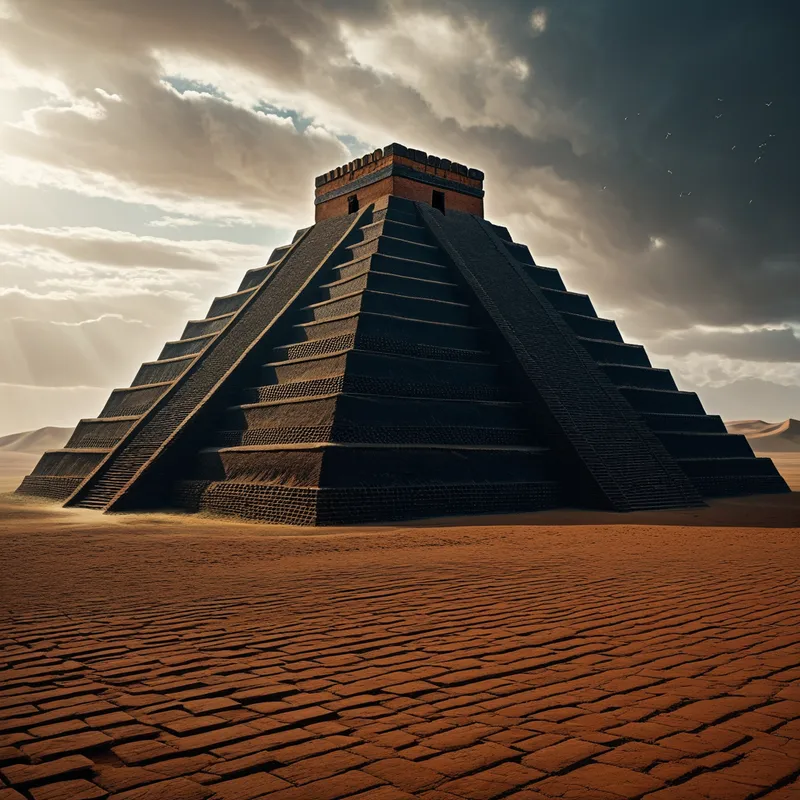
And so they built. Shoulder to shoulder, they labored. The tower rose, a monstrous ziggurat of human making, tier upon tier ascending into the blue. It was a mountain of their own creation, a ladder of baked earth pointing defiantly at the firmament. The sound was a symphony of industry: the thud of bricks, the slap of mortar, the unified chant of thousands. They sought to touch the divine realm, to anchor their unity in stone, to become as gods, not through rebellion but through a magnificent, collective act of creation.
Then Yahweh came down to see the city and the tower which the children of men had built. And the Lord did not see a marvel, but a peril. “Behold,” the voice of the divine thrummed, “the people are one, and they have all one language; and this they begin to do: and now nothing will be restrained from them, which they have imagined to do.”
In that moment, a divine judgment was woven into the fabric of reality, not with thunder, but with a subtle, terrifying magic. “Come,” said Yahweh, “let us go down, and there confound their language, that they may not understand one another’s speech.”
The confusion fell like a silent fog. A mason called for a brick, and the word that left his lips was a guttural, alien sound to the man beside him. The architect’s grand instruction dissolved into nonsense. The unified chant shattered into a cacophony of frantic, incomprehensible babble. Panic, cold and profound, replaced purpose. Frustration turned to suspicion, then to anger. The beautiful, terrible tower stood unfinished, a monument to a shattered dream. And Yahweh scattered them abroad from thence upon the face of all the earth: and they left off to build the city. Therefore is the name of it called Babel; because the Lord did there confound the language of all the earth.

Cultural Origins & Context
The tale is found in the Book of Genesis, a foundational text of the Israelite tradition, and serves as an etiological myth—a story explaining the origin of a phenomenon, in this case, the diversity of human languages and the dispersion of peoples. It functions as a bridge between the primeval history of the world (Creation, Flood) and the patriarchal narratives of Abraham. Scholars often place its composition during the Babylonian Exile, a time when the Israelites were intimately familiar with the great ziggurats of Mesopotamia, like the famed Etemenanki. The story, therefore, can be read as a profound theological and cultural critique: human empires that seek to glorify themselves through monumental architecture are ultimately fragile and doomed to fragmentation before the sovereignty of God. It was a story told to reinforce identity, to explain a world of “others,” and to caution against the hubris of collective human power unchecked by divine authority.
Symbolic Architecture
The Tower is not merely a building; it is the psyche’s monument to its own undifferentiated state. It represents the ego’s inflation, the attempt to storm heaven—the realm of the Self, of wholeness—through sheer will and technical prowess, bypassing the necessary relationship with the divine.
The Tower is the psyche’s attempt to build a staircase to wholeness, forgetting that wholeness must descend; it cannot be seized.
The “one language” symbolizes a state of unconscious unity, where no true individuality or inner dialogue exists. It is a pre-conscious paradise that is also a prison, for in it, no real consciousness can be born. The divine “descent” and the confounding of speech is not a punishment in the psychological sense, but a necessary catastrophe that forces differentiation. It is the painful birth of consciousness itself. The scattering is the diaspora of the psyche’s contents—complexes, archetypes, conflicting drives—that must now be recognized, named, and related to. Babel is the origin of the inner conflict that makes individuation possible.

The Dreamer’s Resonance
To dream of the Tower of Babel is to dream of a profound communication breakdown at the core of one’s being. The dreamer may be in a situation—a relationship, a career, a creative project—that began with glorious unity of purpose but has descended into chaotic misalignment. Somaticly, this often manifests as a tightness in the throat (unspoken words), a pressure in the head (conflicting thoughts), or a feeling of being pulled in multiple directions.
Psychologically, it signals a confrontation with the “confounded” parts of the self. The dreamer is experiencing the Babel moment internally: the inner critic speaks one language, the inner child another; ambition shouts down intuition; logic cannot parse the poetry of emotion. The dream is a snapshot of the psyche’s necessary fragmentation, urging the dreamer to stop trying to rebuild the old, monolithic tower of a false, unified self and instead begin the slow, humble work of learning the many languages of their own soul.

Alchemical Translation
The alchemical process mirrored here is separatio—the essential, often violent separation of elements that must occur before any higher synthesis (coniunctio) can be achieved. The myth models the first, brutal stage of individuation: the shattering of the persona, the comfortable but limiting “one language” of our adapted social self.
The alchemy of Babel is the fermentation of unity into diversity, so that a higher, conscious unity—a Pentecost of the soul—may one day be possible.
The modern individual’s “Tower” is any monolithic identity or project built to “make a name for ourselves” and avoid the necessary scattering—the facing of our inner contradictions and shadows. The divine intervention is the call of the Self, which disrupts our egoic plans to force growth. The path forward is not to lament the lost single language, but to become a polyglot of the psyche. It is to translate the rage of the shadow, the poetry of the anima/animus, and the logic of the persona. We are tasked not with rebuilding the Tower, but with building a living city within ourselves, where all our scattered, confounded parts can find a voice and, ultimately, learn to communicate in the silent language of the whole.
Associated Symbols
Explore related symbols from the CaleaDream lexicon:
- English
- Gigantic
- Brick
- Condo
- Crowded
- Biggest
- Architecture
- Rally
- Mob
- Stacked Books
- Futuristic Cityscape
- Stacking Blocks
- Sky High Tower
- Rooftop Terrace
- Ant Hill
- Crowded Office
- Crumbling Building
- Giant Jenga
- Revolutionary Broadsheet
- Novelty Dictionary
- Tattered Blueprint
- Scaffolding
- Index Card Tower
- Constructivist Tower
- Monolithic Tower
- Cylindrical Structure
- Folly
- Concrete Jungle
- Cyberpunk Complex
- Futuristic Citadel
- Ziggurat
- Sky-high Apartment
- Sky-High Penthouse
- Shattered Glass Mountain
- Architectural Marvel
- Skyline Tower
- Skyscraper Window
- Construction Crane
- Skyscraper Reflection
- City Skyline
- Crumbled Obelisk
- Cathedral Spire
- Tower of Babel
- Steeple
- System Crash
- App Overload
- Data Overload
- Static
- Dissonance
- Franchise
- Governmental Control
- Constitutional Crisis
- Lexicon
- Accent
- Dialect
- Translation
- Jargon
- Spire
- Inflation
- Tar
- Overload
- Prominence
- Collapsing