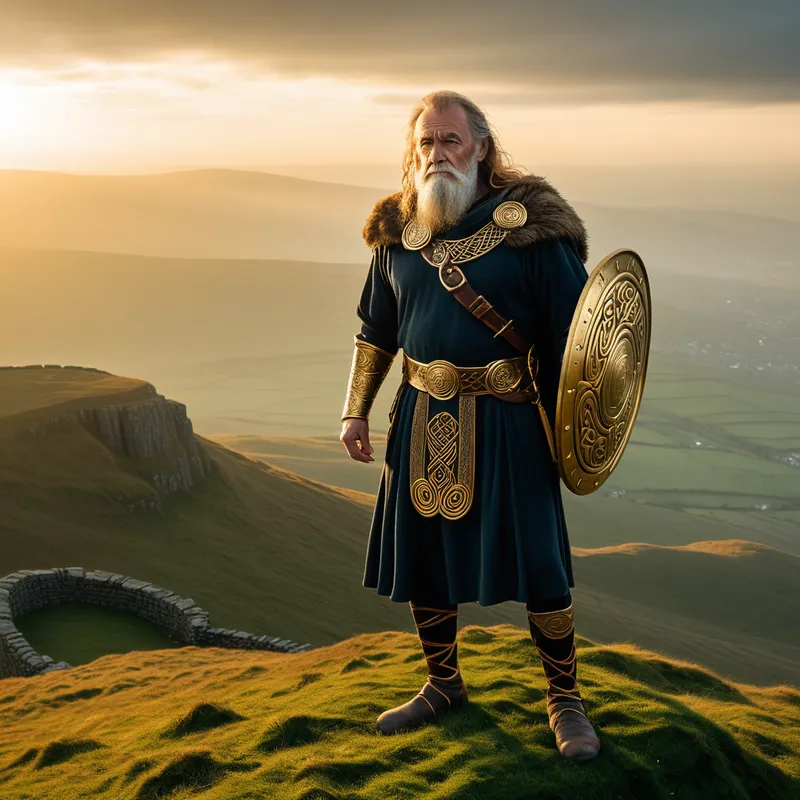
Torc Myth Meaning & Symbolism
A myth of a sacred neck-ring forged from divine breath and mortal sacrifice, binding the wearer to the land, sovereignty, and a terrible, transformative fate.
The Tale of Torc
Listen. [The wind](/myths/the-wind “Myth from Various culture.”/) does not just blow across the green hills; it carries whispers from [the hollow hills](/myths/the-hollow-hills “Myth from Celtic culture.”/), from the time when [the world](/myths/the-world “Myth from Tarot culture.”/) was raw and the gods walked close. This is the whisper of the Torc.
In the days when the [Otherworld](/myths/otherworld “Myth from Celtic culture.”/) was a breath away, there was a king whose reign was as brittle as winter ice. The land groaned under his rule; the rivers ran thin, and the cattle gave sour milk. His name is lost, for names have power, and his power was failing. In his despair, he sought the Druí, who sat by the Source of all waters.
“The land rejects me,” the king cried. “The very stones curse my footsteps.”
The Druí, his eyes like deep pools, spoke not to the king, but to the air. “Sovereignty is not taken. It is given. And it demands a price heavier than a mountain.”
He instructed the king to gather the three sacred things: ore from the heart of a lightning-struck hill, offered freely by [the earth](/myths/the-earth “Myth from Hindu culture.”/); the breath of a willing Gobae, who would forge without sleep or sustenance; and a sacrifice from the king himself—not of a bull or a slave, but of his own certainty, his own unburdened life.
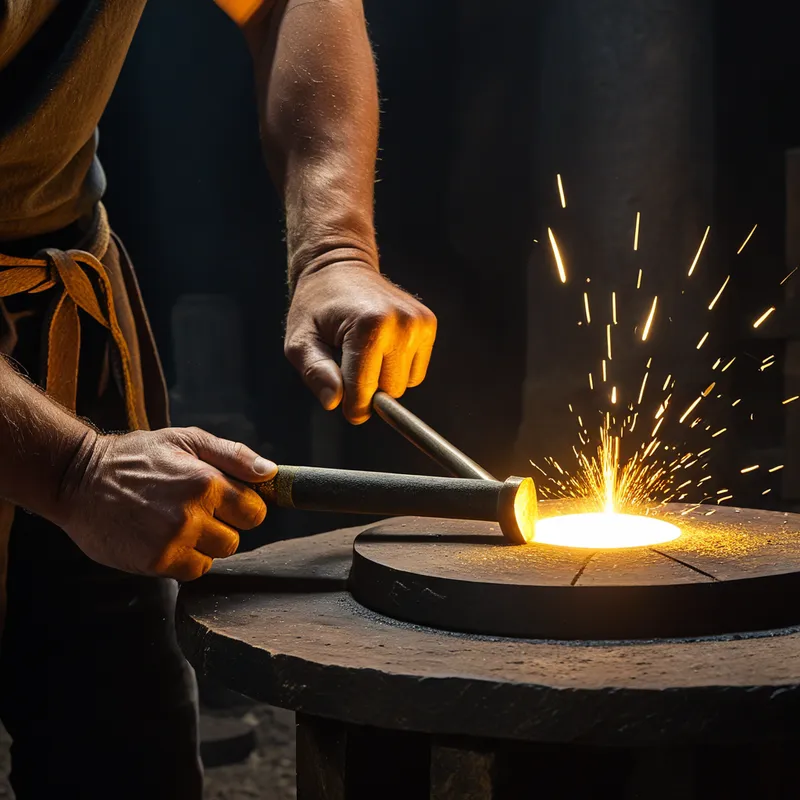
The Gobae, a man whose arms were mapped with the scars of his craft, took the ore. For nine days and nine nights, he worked the bellows, the fire reflecting the turmoil in the king’s soul. He did not hammer mere metal; he hammered the king’s doubt, his fear, his fleeting courage into a band of gleaming gold. As he worked the final twist, he breathed upon it—a breath that held all the songs of mastery and all the weariness of creation. That breath lived in the gold.
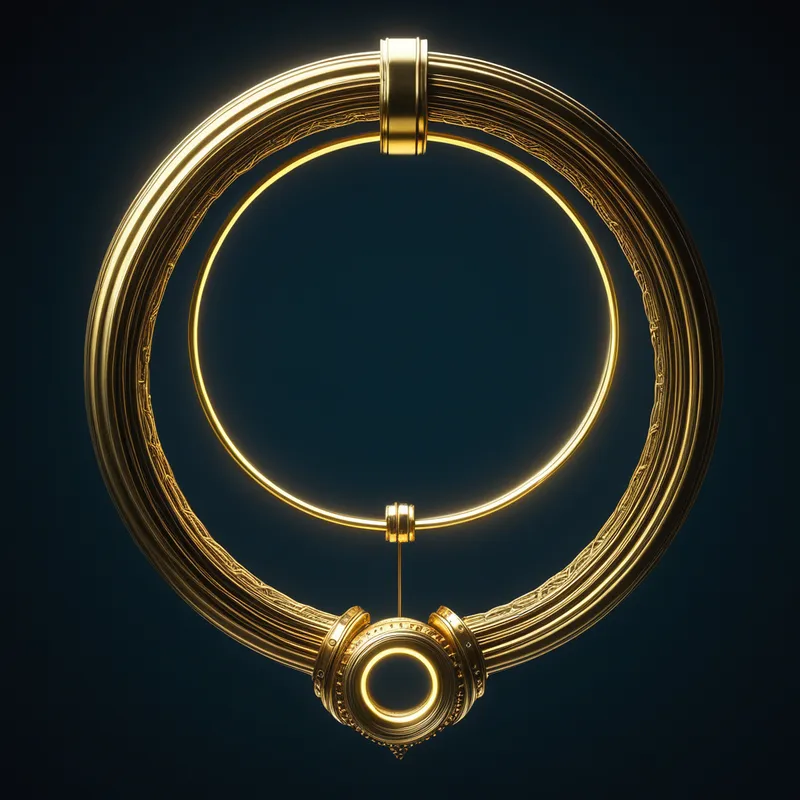
The torc was complete. It was not jewelry; it was a presence. It hummed with a low, terrestrial song. The Druí presented it in the center of the Ráth, at the stone where the land’s pulse was strongest.
“Place it upon your neck,” said the Druí, his voice grave. “But know this: it will fit only if your spirit fits the land. It will grant you the strength of the bedrock and the wisdom of the oldest oak. But it will also bind you. Your joy will be the land’s abundance; your sickness, its blight. Your life and this circle are now one.”
The king, desperate, reached for the torc. As his fingers touched the cool gold, a jolt like a heartbeat of the earth shot through him. He lifted it. It was impossibly heavy, yet it felt like a part of him that had been missing. He placed it around his neck. The metal did not clasp; it flowed, closing seamlessly, a perfect, unbreakable circle.
In that moment, the king felt the roots of the hills. He heard the sorrow of the barren cow and the secret conversations of streams. The weight was immense, a glorious, terrifying burden. The land sighed, and the next morning, green shoots pierced the hard ground. The king ruled, but he was no longer a man ruling a land. He was a man in conversation with a living entity, bound by a circle of breath, sacrifice, and gold. His myth became not one of conquest, but of a perpetual, sacred negotiation.
Cultural Origins & Context
The myth of the Torc is not a single, standardized narrative from a ancient text, but a thematic tapestry woven from archaeological fact, later Irish and Welsh literature, and the interpretative work of comparative mythology. The physical torc is one of the most iconic artifacts of the Celtic Iron Age, found from Gaul to Britain. It was far more than adornment; it was a badge of divine authority, martial prowess, and noble status, often depicted on gods like the Dagda or Taranis.
This myth likely lived in the oral tradition maintained by the Druí and fili, the poet-seers. It functioned as a sacred charter for kingship. Tales like the Irish “Lebor Gabála Érenn” and the Welsh “Mabinogion” are saturated with the concept of sacred sovereignty—a goddess or a land itself choosing and marrying the king. The torc serves as the physical, immutable symbol of this contract. Its myth explained why kingship was both supremely powerful and tragically vulnerable: the ruler was the literal embodiment of the realm’s fortune.
Symbolic Architecture
At its core, the torc is a [symbol](/symbols/symbol “Symbol: A symbol can represent an idea, concept, or belief, serving as a powerful tool for communication and understanding.”/) of the ultimate [paradox](/symbols/paradox “Symbol: A contradictory yet true concept that challenges logic and perception, often representing unresolved tensions or profound truths.”/): the binding that liberates, the burden that empowers. It represents the [moment](/symbols/moment “Symbol: The symbol of a ‘moment’ embodies the significance of transient experiences that encapsulate emotional depth or pivotal transformations in life.”/) of conscious engagement with a [fate](/symbols/fate “Symbol: Fate represents the belief in predetermined outcomes, suggesting that some aspects of life are beyond human control.”/) or a [responsibility](/symbols/responsibility “Symbol: Responsibility in dreams often signifies the weight of duties and the expectations placed upon the dreamer.”/) larger than the individual self.
The torc is the circle of consequence, forged from the raw material of choice and the breath of intent. To wear it is to accept that one is no longer an isolated “I,” but a nexus in a web of life.
Psychologically, the torc represents the ego’s [covenant](/symbols/covenant “Symbol: A binding agreement or sacred promise between parties, often carrying deep moral, spiritual, or social obligations and consequences.”/) with [the Self](/myths/the-self “Myth from Jungian culture.”/) (in Jungian terms). The [king](/symbols/king “Symbol: A symbol of ultimate authority, leadership, and societal order, often representing the dreamer’s inner power or external control figures.”/)‘s initial, brittle ego (his personal rule) is insufficient. He must offer up his “certainty”—his narrow, self-serving [identity](/symbols/identity “Symbol: Identity represents the sense of self, encompassing personal beliefs, cultural background, and social roles.”/)—to be melted down in the forge of necessity (the [crisis](/symbols/crisis “Symbol: A crisis symbolizes turmoil, urgent challenges, and the need for immediate resolution or change.”/)). The new shape that emerges, the torc, is the symbolic [structure](/symbols/structure “Symbol: Structure in dreams often symbolizes stability, organization, and the framework of one’s life, reflecting how one perceives their environment and personal life.”/) of a mature [personality](/symbols/personality “Symbol: Personality in dreams often symbolizes the traits and characteristics of the dreamer, reflecting how they perceive themselves and how they believe they are perceived by others.”/): it has [weight](/symbols/weight “Symbol: Weight symbolizes burdens, responsibilities, and emotional loads one carries in life.”/) (responsibility), value (integrity), and is a circle (wholeness). However, this wholeness is not comfortable. It is a binding to the totality of one’s being, including the neglected, shadowy, and collective elements (the suffering land).
The three sacred components are key: [Earth](/symbols/earth “Symbol: The symbol of Earth often represents grounding, stability, and the physical realm, embodying a connection to nature and the innate support it provides.”/)‘s ore (the unconscious, instinctual [foundation](/symbols/foundation “Symbol: A foundation symbolizes the underlying support systems, values, and beliefs that shape one’s life, serving as the bedrock for growth and development.”/)), the Smith’s [breath](/symbols/breath “Symbol: Breath symbolizes life, vitality, and the connection between the physical and spiritual realms.”/) (focused [consciousness](/symbols/consciousness “Symbol: Consciousness represents the state of awareness and perception, encompassing thoughts, feelings, and experiences.”/) and creative will), and the King’s sacrifice (the surrender of the old ego). The myth states that sovereignty—true [authority](/symbols/authority “Symbol: A symbol representing power structures, rules, and control, often reflecting one’s relationship with societal or personal governance.”/) over one’s [life](/symbols/life “Symbol: The symbol of ‘Life’ represents a journey of growth, interconnectedness, and existential meaning, encompassing both the joys and challenges that define human experience.”/)—only arises from this alchemical [combination](/symbols/combination “Symbol: A combination in dreams often signifies the blending of various aspects of oneself or different life situations.”/).
The Dreamer’s Resonance
When the symbol of the torc appears in modern dreams, it rarely manifests as a historical artifact. More often, it is felt as a sensation: a constriction around the neck, a weight on the collarbones, or the sight of a luminous collar, crown, or unbreakable chain. This is the [psyche](/myths/psyche “Myth from Greek culture.”/) signaling a profound encounter with the archetype of the Ruler.
The dreamer may be at a life threshold—accepting a major leadership role, becoming a parent, committing to a creative project that demands everything, or finally facing a long-avoided personal truth. The torc’s appearance marks the moment the dreamer’s psyche is presenting the “contract.” The somatic feeling of tightness is the resistance of the smaller self, [the ego](/myths/the-ego “Myth from Jungian culture.”/), fearing the loss of its unbound freedom. The feeling of weight is the dawning awareness of the real, and often beautiful, responsibility that comes with stepping into one’s full authority.
A dream of willingly putting on a torc, despite its weight, indicates a conscious acceptance of this individuation process. A dream of trying to remove a torc that will not break speaks to the inescapable nature of a commitment or truth one has already integrated. The torc in a dream asks: What have you agreed to? What larger life are you now bound to serve?

Alchemical Translation
The myth of the Torc is a precise map for the process of psychic transmutation, or individuation. It models the shift from being a subject in the world to being a responsible co-creator with the world of one’s own psyche and life.
[The first stage](/myths/the-first-stage “Myth from Alchemical culture.”/) is the Recognition of Barrenness (the failing king, the infertile land). This is the depressive, stuck feeling that signals the old way of being is no longer viable. The ego must admit its insufficiency.
The second is the Gathering at the Forge. This is the hard, conscious work—therapy, artistic practice, deep reflection—where the raw materials of one’s experiences (the ore) are assembled. The Smith’s breath is our focused attention and will, applied over a sustained, sacrificial period (the nine nights).
The alchemical fire is not kind; it burns away the dross of illusion. The hammer is not gentle; it shapes through repeated, forceful confrontation with reality.
The third is the Binding Covenant. This is the critical, often terrifying, moment of commitment. Putting on the torc is the act of saying “yes” to the integrated Self, with all its glorious and terrible knowledge. It is accepting that your inner state will now directly manifest in your “kingdom”—your relationships, work, and health. Your depression will blight your projects; your integrity will make them flourish. You are bound to this truth.
Finally, there is the Rule of the Bound King. This is life after individuation. It is not a state of effortless bliss, but of authentic engagement. One rules not from a throne of domination, but from a center of connected responsibility. The weight of the torc is always there, a reminder of the covenant, but it is also the source of one’s true strength and legitimacy. The circle is closed, the psyche is unified, and the individual becomes a true sovereign—not over others, but in faithful service to the vast, living territory of the Self.
Associated Symbols
Explore related symbols from the CaleaDream lexicon: