Tlahuizcalpantecuhtli Dawn Star Myth Meaning & Symbolism
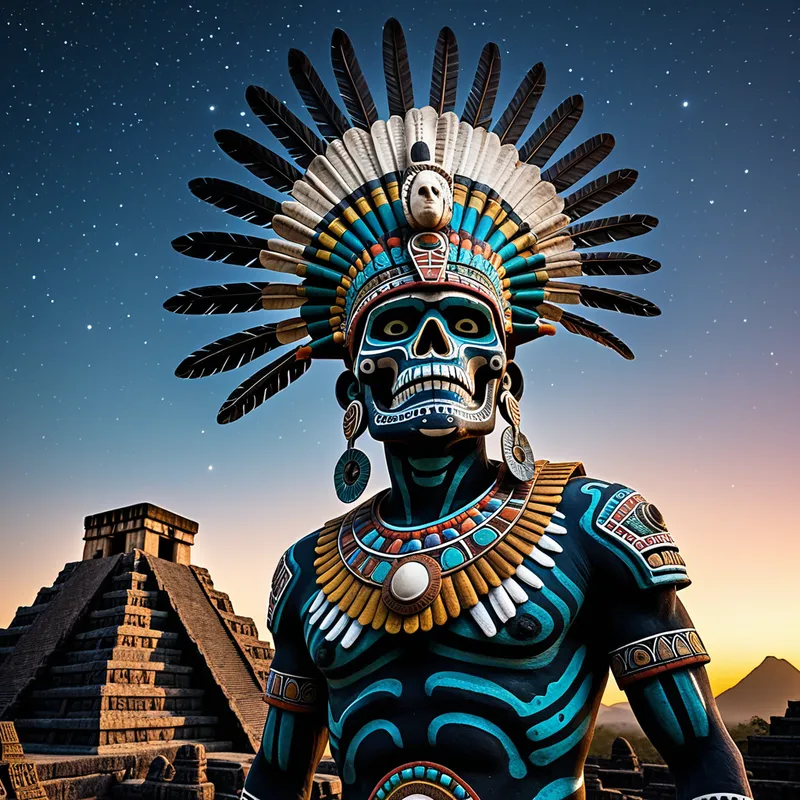
The god of the Morning Star, whose failed assault on the Sun led to his transformation into the god of frost, embodying the dangerous, liminal light of dawn.
The Tale of Tlahuizcalpantecuhtli Dawn Star
Listen. The world was young, and the Fifth Sun, Tonatiuh, had just been set into motion by the terrible sacrifice at Teotihuacan. His light was new, raw, and hungry, demanding the very essence of life to keep his journey across the sky. But before his first full ascent, in that breathless, grey moment between the death of night and the birth of day, another power stirred.
He was Tlahuizcalpantecuhtli, the Dawn Star. He was not a gentle herald. He was a lord, a warrior, a piercing light that preceded the sun not to welcome it, but to challenge it. From the eastern sky, he watched this new, blazing sovereign claim the throne of heaven. A cold fury settled in his stellar heart. This upstart light, born of mortal-like gods and desperate magic, would not dictate the order of things. The true lord of the dawn would decide.
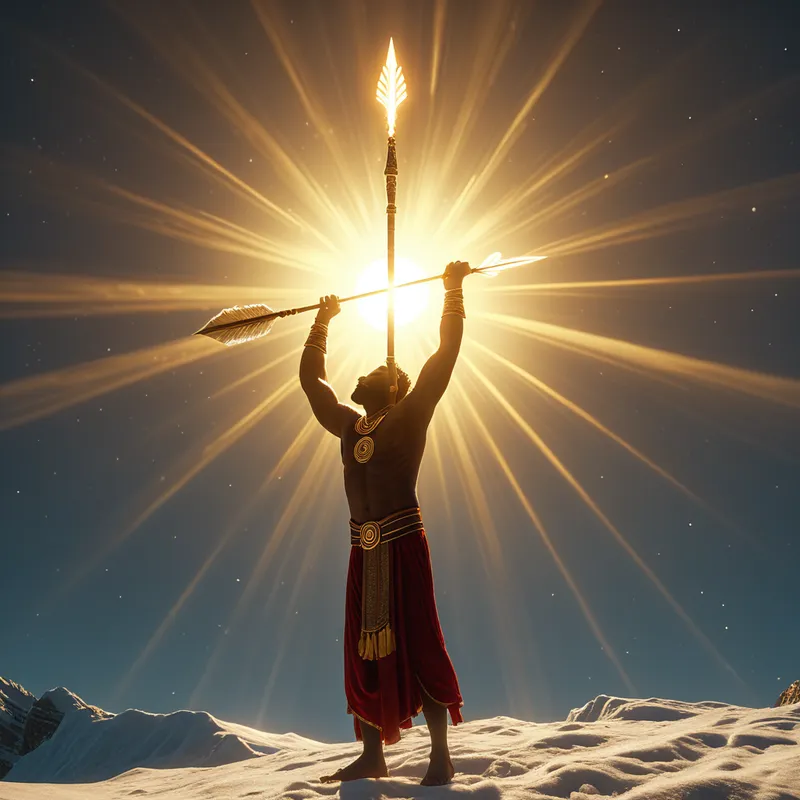
Gathering the essence of the fading night and the sharp, clear air of the world’s first morning, Tlahuizcalpantecuhtli shaped a weapon. It was not of stone or wood, but of concentrated dawn itself—a dart of chilling, focused starlight. He took his atlatl, the tool of hunters and warriors, and drew back his arm. The sky held its breath. Below, the earth was silent, still damp with primordial dew.
With a cry that was the sound of a star tearing through the fabric of the sky, he launched his projectile. It flew true, a streak of vengeful silver aimed directly at the heart of the rising Sun. It was an act of cosmic rebellion, an attempt to slay the day in its cradle.
But Tonatiuh, though newborn, was the Sun. He was the central fire around which all else must turn. As the deadly dart approached, he did not dodge. He turned. He raised his own shield, the Nahui Ollin, the symbol of perpetual motion and sacrificial energy. The star-dart struck not flesh, but this blazing symbol of destiny—and it shattered.
The force of his own deflected wrath turned back upon the Dawn Star. The power of the Sun, mingled with his own intent, struck Tlahuizcalpantecuhtli with irresistible force. It did not destroy him. It transmuted him. The lord of the piercing morning light was frozen in that moment of failed ambition. His fiery essence was quenched, his warrior’s heat drawn out, replaced by a profound, still cold.
Where the radiant star-god stood, now stood Itztlacoliuhqui, the Curved Obsidian Blade of Frost. His form became skeletal, hardened like ice. His gaze, once sharp and focused, became the blind, indiscriminate chill that withers crops and steals breath. He was cast down, not into darkness, but into a new, bitter domain: the killing frost, the drought, the barren cold that comes unexpectedly, even on a clear day. His rebellion was over, his nature forever changed by the very sovereign he sought to overthrow.
Cultural Origins & Context
This myth originates from the Nahua peoples, most famously recorded by the Florentine Codex compiled by Bernardino de Sahagún. It was not merely a story but a cosmological explanation embedded in the Tonalpohualli and the movements of the heavens. As the planet Venus, Tlahuizcalpantecuhtli’s cycles of disappearance and reappearance as Morning and Evening Star were meticulously tracked, his phases governing periods of augury and danger.
The myth was likely recited by Tlamatinime (wise ones) and priests. Its societal function was multifaceted: it explained the origin of frost and agricultural blight, personifying a very real threat to survival. More profoundly, it established a celestial hierarchy and a theology of consequence. It taught that even divine will could fail against a greater, established cosmic order (the Sun’s journey), and that such rebellion resulted not in annihilation, but in a transformative, often punitive, new identity. The dawn was not a benign time, but a moment of supreme danger and potential judgment, presided over by a complex, wrathful, and ultimately fallen deity.
Symbolic Architecture
Tlahuizcalpantecuhtli embodies the peril of the liminal—the threshold state. He is the light that is not yet the Sun, the hope that can turn to ice, the ambition that precedes a fall. His story is not one of evil, but of catastrophic misalignment. He represents the ego’s brilliant, piercing insight that believes it can usurp the central, life-giving Self (the Sun).
The Dawn Star is the moment of brilliant, misguided certainty that strikes at the heart of one’s own becoming.
His transformation into Itztlacoliuhqui is key. The frost god is not a different entity, but the same energy turned inward and frozen. The aggressive, outward-projecting attack becomes a passive, pervasive coldness—the psychological state of bitterness, cynicism, emotional frigidity, and stagnation that follows a failed, prideful venture. The weapon meant for another becomes the condition of one’s own soul.
The atlatl and dart symbolize directed intention and the projection of will. Their failure and rebound illustrate the fundamental law of psychic energy: an attack launched from a place of envy or challenge to one’s own core nature will inevitably boomerang, transforming the attacker. The Sun’s shield, the Nahui Ollin, represents the immutable, dynamic law of the central Self, which demands sacrifice and integration, not rebellion.

The Dreamer’s Resonance
When this myth patterns a modern dream, it often manifests as sequences of brilliant but failed actions. The dreamer may experience shooting a perfect arrow that curves away, throwing a punch that meets no resistance, or shouting a vital truth that emerges as silent frost. The somatic sensation is one of sudden, profound cold—a chill in the chest or a freezing of the limbs at the moment of intended action.
Psychologically, this signals a confrontation with a “Dawn Star” complex: a part of the psyche that is radiant, capable, and precocious, but fundamentally misaligned with the individual’s deeper life direction (the Sun). It is the ambitious career move fueled by envy, the relationship pursued to conquer rather than connect, the creative project begun to spite a rival. The dream is a revelation of the frost that follows—the emotional winter, the creative drought, the cold shoulder one gives to one’s own life after such a failure. The dreamer is witnessing their own divine rebellion and its chilling consequences.

Alchemical Translation
The individuation process modeled here is the transmutation of the rebel into a necessary force. The goal is not to rehabilitate Tlahuizcalpantecuhtli to try again, but to integrate Itztlacoliuhqui. The frost god is not a villain to be defeated, but a frozen potential to be thawed and understood.
The alchemical work is to breathe warmth into the frozen curse, to discover the gift hidden in the frost.
The first step is recognizing the “Dawn Star” impulse—those moments where our actions, though seemingly powerful, are attacks on our own solar center, driven by a need to usurp a wholeness we have not yet earned. The failed assault is a necessary humiliation, the shattering of the ego’s dart against the Self’s shield.
The transformation into “frost” represents the ensuing period of introspection and coldness. This is the nigredo, the blackening, the winter of the soul. The alchemical task is to sit with this frost, not to flee its barrenness. Within Itztlacoliuhqui’s icy form lies the quality of discernment. Frost kills the weak and the over-extended; it is nature’s ruthless edit. Psychologically, this translates to the cold, clear eye that cuts away false ambitions, sentimental attachments, and inflated self-images. The killing frost of failure reveals what is truly hardy and essential in us.
To integrate this is to reclaim the Dawn Star’ piercing clarity but in service to the Sun, not in rebellion against it. It is to become the sharp, cold air of dawn that brings clarity, not death. The rebel’s energy is redirected from attacking the center to defining the boundary, from usurping the light to revealing, by contrast, where true warmth and life must be cultivated. One becomes the guardian of the threshold, understanding its dangers intimately, having been transformed by them.
Associated Symbols
Explore related symbols from the CaleaDream lexicon:
- Star — The core essence of Tlahuizcalpantecuhtli as a celestial body, representing a brilliant, distant, and often cold point of guidance or fixation that is not the central Sun.
- Dawn — The liminal, dangerous time he lords over, symbolizing a threshold of potential that holds both the promise of a new day and the risk of a fatal misstep.
- Lightning — The sudden, piercing, and destructive attack he launches at the Sun, embodying a flash of divine wrath or misguided brilliance that seeks to split the established order.
- Frost — His transformed state as Itztlacoliuhqui, representing the emotional and spiritual coldness, stagnation, and barrenness that follows a failed, prideful rebellion.
- Sacrifice — The fundamental law of the Sun’s world that the Dawn Star rebels against, and the process he himself undergoes through his transformation, a forced offering of his original nature.
- Rebirth — His change from star-god to frost-god, a form of rebirth into a new, albeit punitive, archetypal role within the cosmic order.
- Shadow — The Dawn Star embodies a divine shadow—a brilliant, capable, but antagonistic force that challenges the ruling consciousness (the Sun) and must be integrated in a transformed state.
- Ritual — The myth explains and underpins ritual observations of Venus cycles and propitiations to avert the frost and drought he brings.
- Warrior — His primary aspect as a celestial combatant who engages in a doomed, cosmic duel to define the hierarchy of the heavens.
- Chaos — His attack represents a chaotic impulse against the established solar order, a brief eruption of stellar anarchy that is ultimately subdued and transformed.
- Order — The solar principle of Tonatiuh that ultimately defeats and subsumes the rebel’s chaos, reasserting the cosmic law of sacrifice and central authority.
- Journey — The myth encapsulates a failed journey of usurpation, followed by a fall and a new, static existence, mirroring the perilous journey of the soul toward alignment.