Tithonus Myth Meaning & Symbolism
A Trojan prince granted immortality by the gods, but not eternal youth, who ages endlessly into a withered husk, a prisoner of time.
The Tale of Tithonus
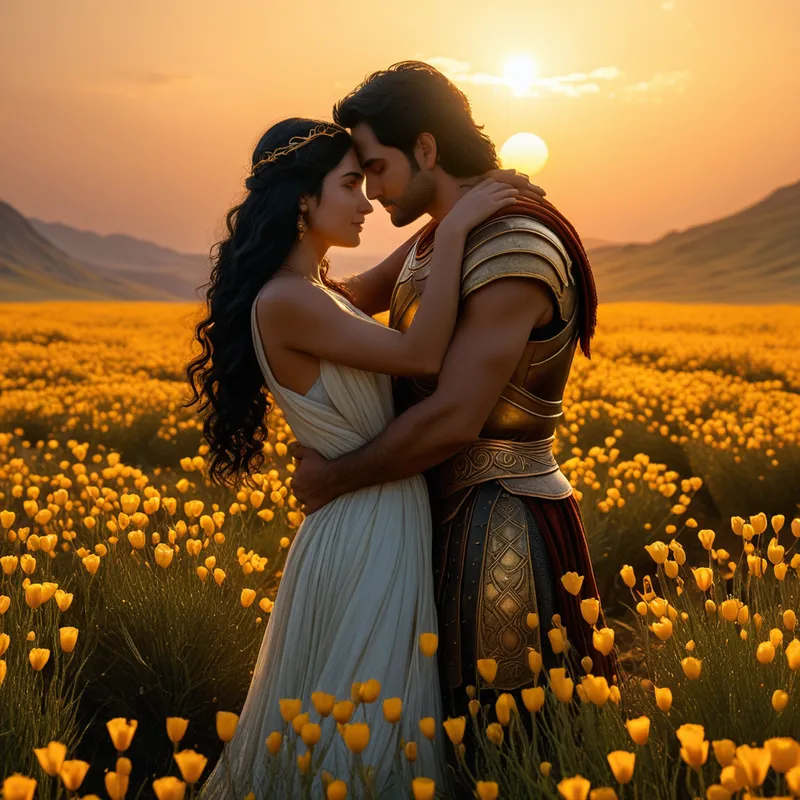
Listen, and hear the story of a love that outlasted the sun, but could not outrun time. In the age when gods walked with mortals in the saffron light of first dawn, there lived a prince of Troy, Tithonus. His beauty was not of the fierce, warlike kind, but of the earth itself—dark hair like fertile soil, a presence as steady and captivating as an ancient cypress.
His radiance caught the eye of none other than Eos, the Dawn herself. Each morning, she rose from her bed beside Helios, painting the sky with rosy fingers. And each morning, her gaze would fall upon the world below, lingering on the mortal prince. A longing, fierce and desperate, took root in her immortal heart—a terror of the fleeting moment, of watching his vibrant life wither and fade in the mere blink of her eternal existence. She could not bear it.
So, with a passion that shook the stars, Eos descended. She swept Tithonus from the plains of Troy, carrying him to the eastern edge of the world, to her own palace where the day is born. There, they loved in a perpetual, golden twilight. But the shadow of his mortality lay between them like a cold sword. Weeping, Eos went before the throne of Zeus, father of gods and men. She fell to her knees, her light dimmed by mortal grief. “Grant him immortality,” she begged, her voice the sound of light breaking. “Let him live forever with me. I cannot be the Dawn in a world where he is dust.”
Zeus, moved by her tears or perhaps amused by the request, nodded. His word was law, and the boon was granted. Tithonus would not die.
Eos returned, triumphant, her heart a soaring bird. For years, decades, it was as she dreamed. But she, in her desperate, loving haste, had forgotten the precise wording of her prayer. She had asked for athanasia, deathlessness. She had not asked for aeibesia, eternal youth.
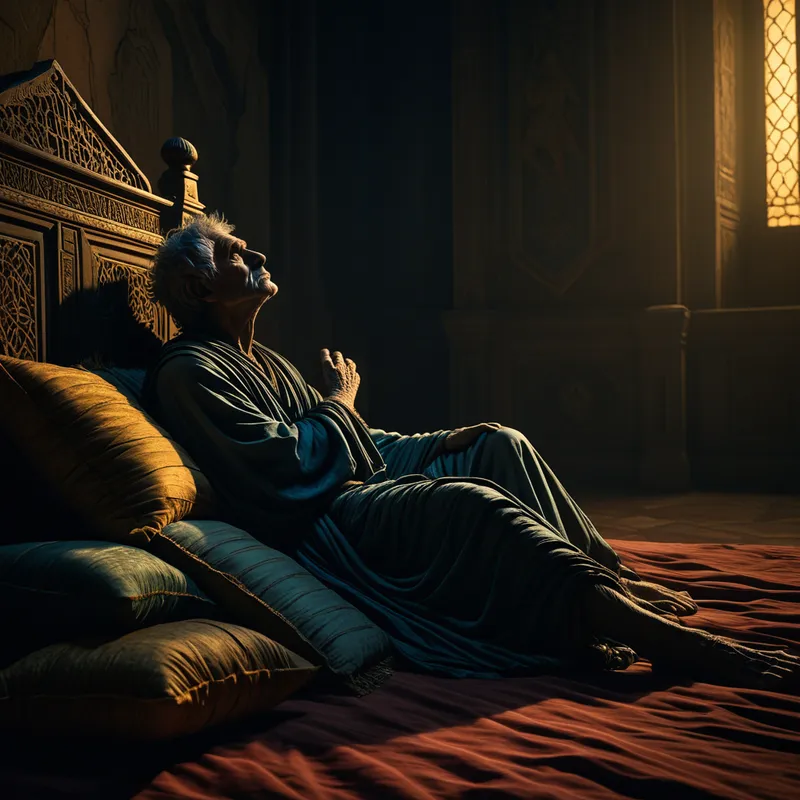
The first grey hair was a curiosity. The first stiffness in the limb, a passing concern. But the process did not stop. While Eos remained the eternally fresh, rosy-armed goddess, Tithonus continued to age. The strong shoulders bowed. The dark hair thinned and turned to silver, then to white. His clear eyes clouded. His step became a shuffle. The prince became an old man, then a very old man. Still, he lived.
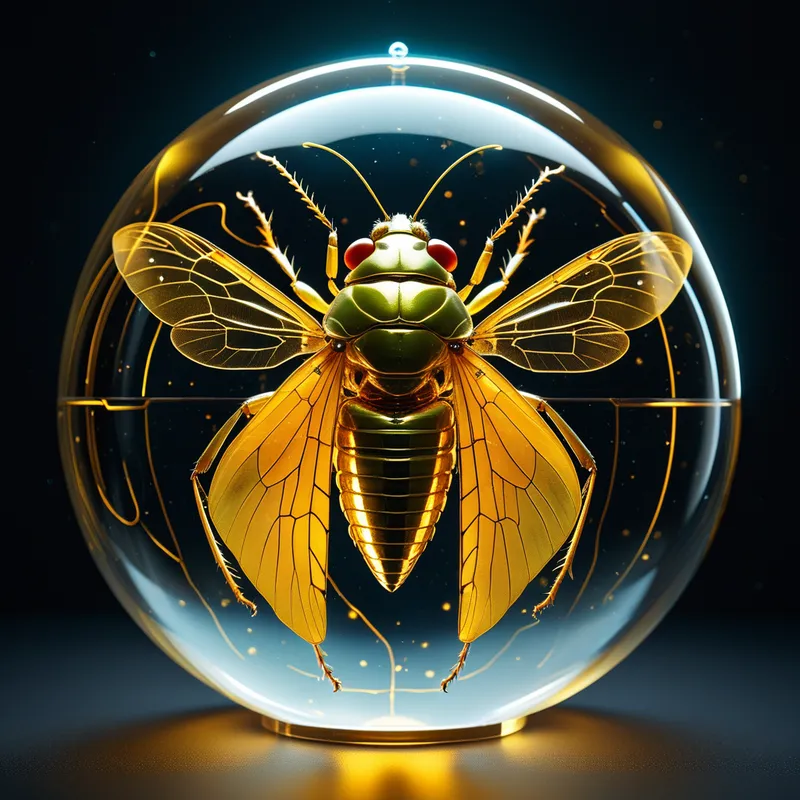
He shriveled, year upon century, his body consuming itself but unable to find the release of death. His voice, once rich, faded to a meaningless whisper, then to a dry, incessant rasp. In horror and pity, Eos finally transformed him. She turned his desiccated form into a cicada, a creature that sings with a relentless, shrill voice, a being that sheds its skin but does not truly die. And there, in the gardens of the dawn, the cicada that was Tithonus chirps on, a tiny, desperate echo of a love that asked for everything and received a curse.
Cultural Origins & Context
The myth of Tithonus is a fragment of the vast poetic tapestry of early Greek epic, most famously preserved in the Homeric Hymn to Aphrodite and later echoed in the poetry of Sappho and Mimnermus. It belongs not to the grand, public narratives of the Iliad, but to the more intimate, lyrical tradition that explored the painful, asymmetrical relationships between gods and mortals. These stories were told not just to explain natural phenomena (like the cicada’s song) but to articulate fundamental, existential boundaries.
The myth served as a powerful cultural caution. In a worldview where the primary distinction was between the deathless gods and dying men, Tithonus became the ultimate warning against transgressing that order. His story functioned as a check on hubris, but not the hubris of a warrior. It was the hubris of a desire—the mortal desire for godhood, and the divine desire to possess a mortal utterly. It was recited to remind listeners that the human condition, with its defined arc of growth, maturity, and decay, is not a flaw to be fixed, but a sacred, if tragic, structure of meaning. To remove death is to unravel the self.
Symbolic Architecture
At its core, the myth of Tithonus is an archetypal portrait of incomplete transformation. It is the nightmare of a process arrested halfway, a psychic state where one has left the shore of mortal limitation but never reaches the continent of divine wholeness.
Tithonus is the soul that achieves permanence without renewal, a statue of itself, weathering but never changing form.
Eos represents the divine impulse, the awakening consciousness (Eos) that falls in love with a beautiful, temporal aspect of the psyche (Tithonus). She is the part of us that desires to make a fleeting inspiration, a peak experience, or a youthful state of being permanent. Her fatal error is to petition for preservation, not for evolution. Zeus, as the ruling principle of cosmic order, grants the literal request but not the holistic solution, enforcing a brutal, literalistic law.
The aging process is the central symbol. Aging is not merely physical decay; it is the accumulation of experience without integration, the burden of memory without the alchemy of wisdom. Tithonus becomes a prison of his own accumulating past. His final transformation into a cicada is profoundly ambiguous: is it a mercy or a further curse? The cicada lives underground for years, then emerges to sing a frantic, brief song before dying. Tithonus sings forever, his song stripped of joy, reduced to a mechanical, unending signal—the ego’s empty noise after the self has vanished.
The Dreamer’s Resonance
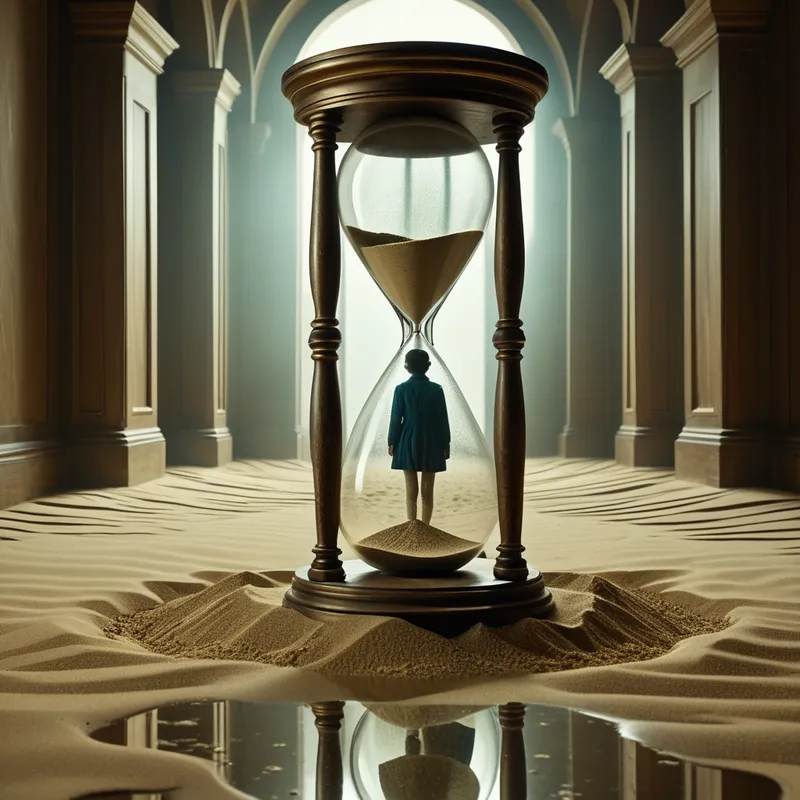
When this myth stirs in the modern unconscious, it rarely appears as a classical tableau. Instead, one dreams of being trapped in a role, a job, or a relationship that has long since lost its vitality. One dreams of looking in a mirror and seeing oneself aging rapidly, while feeling internally stagnant. There is a profound somatic sensation of shriveling—of energy draining, of voice becoming faint and ignored, of feeling like a ghost in one’s own life.
To dream the Tithonus pattern is to experience the psyche’s warning of spiritual atrophy. It signals a process where an adaptation or a persona, once vital and beautiful, has been granted “immortality” through rigid identification (“This is who I am”). The dreamer is undergoing the psychological equivalent of aging without dying: they are accumulating burdens, responsibilities, and repetitive patterns without the necessary inner deaths and rebirths that allow for growth. The feeling is one of existential fatigue, of being cursed to continue a story whose meaning has evaporated.
Alchemical Translation
The alchemical journey implied by this myth is not one of gaining immortality, but of achieving the right relationship with time and decay. The prima materia is the beautiful, temporal ego-state (Tithonus). The divine impulse (Eos) must not seek to petrify it, but to submit it to the full cycle of transformation.
The goal is not to avoid the nigredo, the blackening and dissolution, but to pass through it completely, trusting it is part of the work.
The first step is the recognition of the incomplete prayer. Where in our lives have we asked only for preservation, for safety, for the cessation of pain, instead of asking for the harder gift of true metamorphosis? The “boon” of security becomes the “curse” of stagnation. The alchemical operation required is solutio—a dissolution. This is the death Tithonus was denied. Psychologically, it is the voluntary surrender of a rigid identity, the allowing of a cherished self-image to “die” so that its essence can be reconstituted.
Eos’s final act—turning him into a cicada—holds a cryptic key. In alchemy, the insect often symbolizes the volatile spirit, the anima. Perhaps the transformation is not the end, but a necessary, if horrific, intermediate stage. The incessant chirping is the psyche’s nagging, unresolved complex. The modern individual’s task is to listen to that shrill, trapped sound within—the repetitive complaint, the fixed idea—and not flee from it. By consciously containing this “Tithonus-complex,” by acknowledging the part of oneself that feels eternally aging and unloved, one begins a new prayer. This prayer is not to Zeus, but to the deeper Self. It asks not for preservation, but for the grace of completion: the courage to fully disintegrate, so that from the discarded husk, something new and authentic can finally emerge, not immortal, but whole.
Associated Symbols
Explore related symbols from the CaleaDream lexicon: