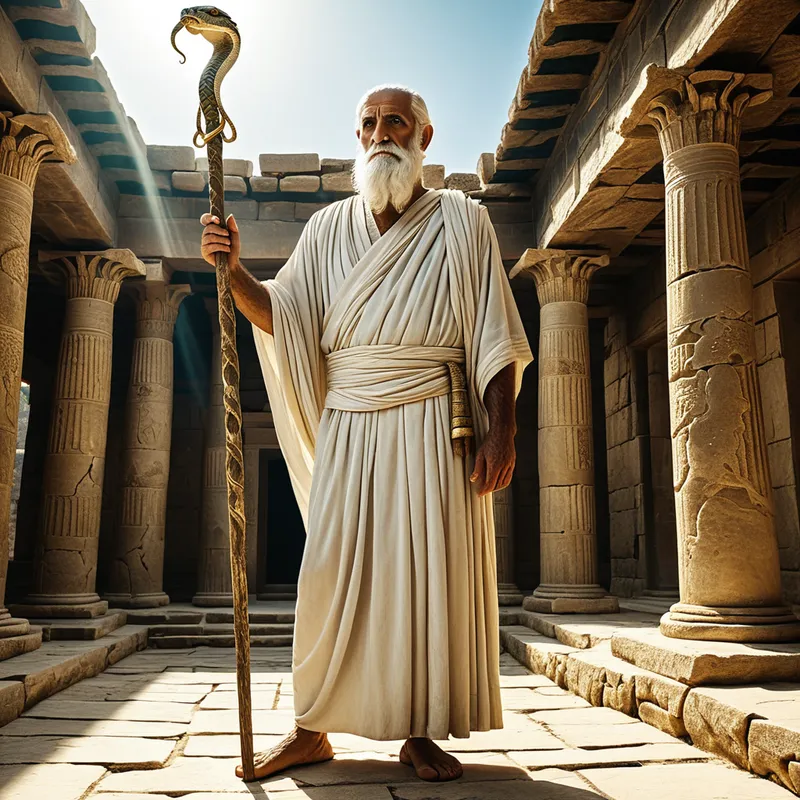
Tiresias Myth Meaning & Symbolism
A blind Theban prophet, transformed into a woman for seven years, who gained ultimate insight into the nature of both sexes and the will of the gods.
The Tale of Tiresias
Hear now the tale of the one who saw by not seeing, the man who became woman, the mortal who spoke truth to gods. In the heart of Thebes, where the air hummed with the whispers of fate, there walked a man named Tiresias.
His story begins not in a city, but on the wild, [thyme](/myths/thyme “Myth from Greek culture.”/)-scented slopes of Mount Cyllene. The young Tiresias, staff in hand, was traversing a sacred grove when [the world](/myths/the-world “Myth from Tarot culture.”/) shifted. Before him, in a shaft of dappled sunlight, two great serpents—emblems of [the earth](/myths/the-earth “Myth from Hindu culture.”/)’s deepest mysteries—were locked in sacred coupling. A shock, a revulsion, a sudden impulse seized him. His staff came down, striking the entwined creatures, violating a divine mystery. In that instant, [the world](/myths/the-world “Myth from Tarot culture.”/) inverted. His body, his very essence, was unmade and remade. Where a man had stood, a woman now stood, feeling the weight of a different life in her bones.
For seven years, Tiresias lived this life. She knew the touch of a lover, bore children, carried the intimate knowledge of womanhood in her blood and breath. Then, fate led her back to that same grove. Again, the serpents appeared, coiled in their eternal dance. Remembering, understanding now the profundity she had once disturbed, she struck them once more. The world rippled, and the man Tiresias returned, but he was no longer the man who had left.
This double knowledge made him a vessel for a quarrel of the gods. The mighty Zeus</ab title=“Queen of the Olympian gods, goddess of marriage”>Hera argued fiercely: who took more pleasure in the act of love, man or woman? Zeus claimed woman; Hera, with bitter conviction, claimed man. Who to settle it but the only mortal who had truly known both? Summoned to Olympus, Tiresias stood in the terrifying radiance of the divine. “Of ten parts,” he declared, his voice steady despite the trembling in his limbs, “a man enjoys one. A woman enjoys all ten, body and soul.” The truth, plain and devastating. Hera’s fury was a storm contained in a glance. In her wrath, she robbed him of his mortal sight, plunging his world into eternal night. But Zeus, in recompense for a truth that favored him, bestowed a greater gift: the inner sight of prophecy, the wisdom of the ages, and a life spanning seven generations.
Thus, the blind seer was born. He would guide kings and curse heroes, his hollow eyes seeing the [threads of fate](/myths/threads-of-fate “Myth from Greek culture.”/) that others, with their perfect vision, stumbled blindly past. He would speak to [Oedipus](/myths/oedipus “Myth from Greek culture.”/) the terrible truth of his identity, and his shade would guide [Odysseus](/myths/odysseus “Myth from Greek culture.”/) through the gloom of [Hades](/myths/hades “Myth from Greek culture.”/). His physical blindness was but the seal upon his true vision, paid for with the experience of two lives.

Cultural Origins & Context
The myth of Tiresias is not the property of a single poet, but a collective possession of Greek culture, woven into its deepest literary tapestries. His story is fragmentary, appearing in lost epic cycles, referenced by [the bard](/myths/the-bard “Myth from Celtic culture.”/) [Homer](/myths/homer “Myth from Greek culture.”/), and fleshed out in later works like the Melampodia and the libraries of mythographers like Hesiod and Ovid. He is a fixture of the Theban cycle of myths, that dark saga of cursed families and doomed cities.
His societal function was multifaceted. As a prophet, he represented the terrifying and necessary role of the truth-teller, the one who voices what the polity—or the individual—desperately wishes to ignore. His blindness physically manifested the Greek concept that true knowledge (gnosis) often comes at a great price and is separate from mere sensory observation. He was a bridge between the human and divine realms, a living reminder that the gods were capricious, their gifts inseparable from their curses. His story was told to explain the origin of prophetic power, to explore the mysteries of gender and experience, and to serve as a narrative device of unparalleled authority in epic and tragic poetry.
Symbolic Architecture
Tiresias is the archetypal embodiment of [knowledge](/symbols/knowledge “Symbol: Knowledge symbolizes learning, understanding, and wisdom, embodying the acquisition of information and enlightenment.”/) through transformation. His myth is a profound map of the [psyche](/myths/psyche “Myth from Greek culture.”/)’s [journey](/symbols/journey “Symbol: A journey in dreams typically signifies adventure, growth, or a significant life transition.”/) beyond binary oppositions into a state of unifying [insight](/symbols/insight “Symbol: A sudden, deep understanding of a complex situation or truth, often arriving unexpectedly and illuminating hidden connections.”/).
The price of seeing the whole is the loss of the partial view. True vision is born in the darkness between opposites.
The Serpents are the central catalytic [symbol](/symbols/symbol “Symbol: A symbol can represent an idea, concept, or belief, serving as a powerful tool for communication and understanding.”/). They represent primal, chthonic wisdom, the [life](/symbols/life “Symbol: The symbol of ‘Life’ represents a journey of growth, interconnectedness, and existential meaning, encompassing both the joys and challenges that define human experience.”/) force (libido) in its raw, creative, and potentially dangerous form. To strike them is to interfere with a natural, sacred process—an act of unconscious violence against the mysteries of life and [gender](/symbols/gender “Symbol: Gender in arts and music represents the expression, performance, and cultural construction of identity through creative mediums.”/). The transformation they enact is not a [punishment](/symbols/punishment “Symbol: A dream symbol representing consequences for actions, often tied to guilt, societal rules, or internal moral conflicts.”/), but a severe and necessary education. Tiresias must become the other to understand the [nature](/symbols/nature “Symbol: Nature symbolizes growth, connectivity, and the primal forces of existence.”/) of the duality he disrupted.
His [Blindness](/symbols/blindness “Symbol: Represents a lack of awareness, insight, or refusal to see truth, often tied to emotional avoidance or spiritual ignorance.”/) and [Prophecy](/symbols/prophecy “Symbol: A foretelling of future events, often through divine or supernatural means, representing destiny, fate, and hidden knowledge.”/) are two sides of the same coin. Physical blindness signifies the withdrawal from the outer, superficial world of appearances. It forces an [inward](/symbols/inward “Symbol: A journey toward self-awareness, introspection, and the exploration of one’s inner world, thoughts, and unconscious mind.”/) turn. The prophetic [vision](/symbols/vision “Symbol: Vision reflects perception, insight, and clarity — often signifying the ability to foresee or understand deeper truths.”/) granted by Zeus is the compensatory flowering of the inner eye, the eye of the [soul](/symbols/soul “Symbol: The soul represents the essence of a person, encompassing their spirit, identity, and connection to the universe.”/) (nous), which perceives patterns, causes, and ends—the logical and fateful threads invisible to the corporeal senses. He becomes a [vessel](/symbols/vessel “Symbol: A container or structure that holds, transports, or protects something essential, representing the self, emotions, or life journey.”/) for the objective psyche, the [collective unconscious](/symbols/collective-unconscious “Symbol: The Collective Unconscious refers to the part of the unconscious mind shared among beings of the same species, embodying universal experiences and archetypes.”/), speaking its truths regardless of personal consequence.
The Judgment on [Olympus](/symbols/olympus “Symbol: In Greek mythology, Mount Olympus is the divine home of the gods, representing ultimate power, perfection, and spiritual transcendence.”/) is the myth’s psychological core. Tiresias, having integrated the experiences of both masculine and feminine, becomes the only qualified arbiter in a divine dispute about pleasure and experience. His [verdict](/symbols/verdict “Symbol: A formal judgment or decision, often legal or moral, representing closure, accountability, and societal evaluation.”/)—that woman’s experience is more total—is [less](/symbols/less “Symbol: The concept of ‘less’ often signifies a need for simplicity, reduction, or minimalism in one’s life or thoughts.”/) a biological [statement](/symbols/statement “Symbol: A statement in a dream can symbolize the need to express one’s thoughts or beliefs, reflecting a desire for honesty or clarity.”/) than a symbolic one. It suggests the receptive, encompassing, and transformative nature of the feminine principle as a [metaphor](/symbols/metaphor “Symbol: A figure of speech where one thing represents another, often revealing hidden connections and deeper truths through symbolic comparison.”/) for the psyche’s [capacity](/symbols/capacity “Symbol: A measure of one’s potential, limits, or ability to contain, process, or achieve something, often reflecting self-assessment or external demands.”/) to fully receive and integrate experience, compared to the more focused, goal-oriented masculine principle.

The Dreamer’s Resonance
When the pattern of Tiresias stirs in the modern dreamer, it signals a profound initiation into a deeper layer of self-knowledge. This is not a gentle process; it is often heralded by dreams of violent transformation, gender fluidity, or unsettling encounters with serpentine figures.
To dream of changing sex or possessing ambiguous gender is a direct resonance. It indicates the psyche’s demand to acknowledge and integrate the contrasexual inner other—the Anima in a man or the Animus in a woman. The dream ego is being compelled to experience life from the perspective of this inner counterpart, often because one-sided conscious attitudes have become sterile or destructive.
Dreams of being blinded, yet gaining a mysterious, intuitive knowing, point to a crisis of conscious direction. The dreamer’s planned path, their “way of seeing” the world, is failing or being taken away. The psyche is forcing a shift from extraverted, sensory navigation to introverted, intuitive guidance. The subsequent feeling of “knowing without knowing how” in the dream reflects the emergence of this inner compass.
Encountering twin or entwined serpents in a dream landscape signifies a confrontation with the primal, transformative energy of the psyche itself. It is an invitation to engage with a foundational life process—perhaps creativity, relationship, or a deep instinctual drive—with reverence rather than fear or impulsive interference.

Alchemical Translation
The myth of Tiresias is a perfect allegory for the alchemical and Jungian process of individuation—the journey toward psychic wholeness. It models the necessary deaths and rebirths required to move beyond [the ego](/myths/the-ego “Myth from Jungian culture.”/)’s limited identity.
The initial, impulsive striking of the serpents represents the ego’s naive and often violent engagement with the unconscious. It is the neurotic symptom, the painful [projection](/myths/projection “Myth from Alchemical culture.”/), the life crisis that feels like an attack from the outside but is actually a call from within. This “mistake” is the necessary first step, the [nigredo](/myths/nigredo “Myth from Alchemical culture.”/) or darkening, that begins the work.
The seven-year transformation is the albedo, the whitening or purification. It is the long, often isolating period of submission to the opposite. For the modern individual, this is the often uncomfortable work of actively engaging with the inner other: the man consciously exploring his emotional and relational capacities (Anima), the woman consciously developing her [logos](/myths/logos “Myth from Christian culture.”/) and assertive agency (Animus). One must “live as the other” psychologically to dissolve rigid identifications.
Individuation is not about becoming perfect, but about becoming complete. It requires the sacrifice of the one-eyed perspective to gain the vision of the whole.
The return to male form is not a regression, but an integration. The qualities and experiences of the opposite are now contained within a broader, more complex personality. This sets the stage for the judgment on Olympus, the [rubedo](/myths/rubedo “Myth from Alchemical culture.”/) or reddening. This is the moment of supreme insight, where the integrated individual can articulate a transcendent truth that reconciles a previously irreconcilable conflict. The truth carries a cost—Hera’s blinding wrath symbolizes the inevitable sacrifice, the final letting go of an old, safe, but partial identity.
The final state—blind seer—is the symbol of [the Self](/myths/the-self “Myth from Jungian culture.”/), the central archetype of wholeness. The individual is no longer identified with the ego (sight) but is guided by the wisdom of the total psyche (prophecy). They become a vessel for objective truth, capable of guiding others (as Tiresias guides Odysseus) through their own underworlds, because they have fully traversed their own. The myth thus maps the ultimate transmutation: from a man of action, to a woman of experience, to a sage of timeless vision.
Associated Symbols
Explore related symbols from the CaleaDream lexicon: