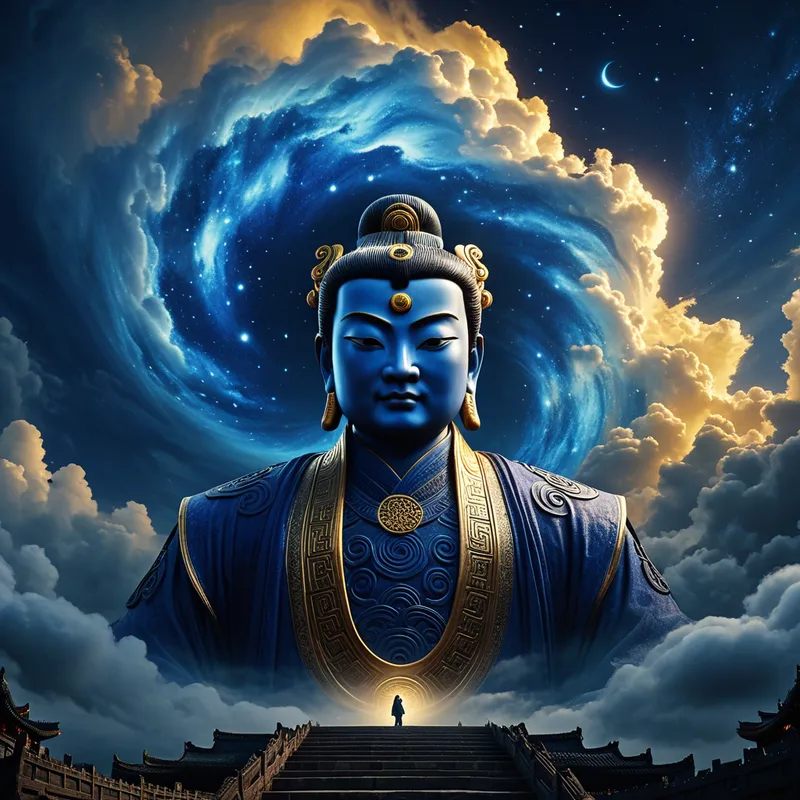
Tian Myth Meaning & Symbolism
The story of Tian, the all-encompassing Heaven, which is not a place but a principle of cosmic order, moral mandate, and the ultimate source of legitimacy.
The Tale of Tian
In the beginning, before the first dynasty carved its name in bronze, there was only the great, silent breath. Not a void, but a presence—vast, patient, and awake. This was Tian. It did not speak in words, but in seasons. It did not command with thunder, but with the turning of the stars and the flooding of the great rivers. It was the vault above and the pattern within, the source of all life and the judge of all action.
The people of the yellow earth looked up. They felt the heat of the sun, Taiyang, Tian’s bright eye. They trembled at the roar of the storm, Tian’s displeasure. They rejoiced in the gentle rain, Tian’s blessing. They knew, in their bones, that their lives were threads in a tapestry woven by a hand they could not see. The king, the Tianzi, was their bridge. He alone ascended the earthen altar, the Yuanqiu, at the winter solstice. Smearing his hands with the blood of a flawless bull, burning offerings of silk and jade, he stood between the dusty world of men and the luminous order of the sky. His plea was not for favor, but for alignment. “Let the ways of Earth mirror the ways of Heaven,” he would whisper into the rising smoke.
But Tian is no indulgent grandfather. Its mandate, the Tianming, is given, but it can be taken away. The rivers know this. When a ruler grows deaf to the people’s cries, when corruption festers like mildew in the granaries, when the rituals become empty gestures, the sky grows heavy. The sun hides. The rivers burst their banks, swallowing fields. The earth itself quakes. These are not random calamities, but Tian’s stern brushstrokes, painting its verdict across the land. The mandate grows thin, brittle. The dynasty’s virtue, its De, leaks away like water from a cracked jar.
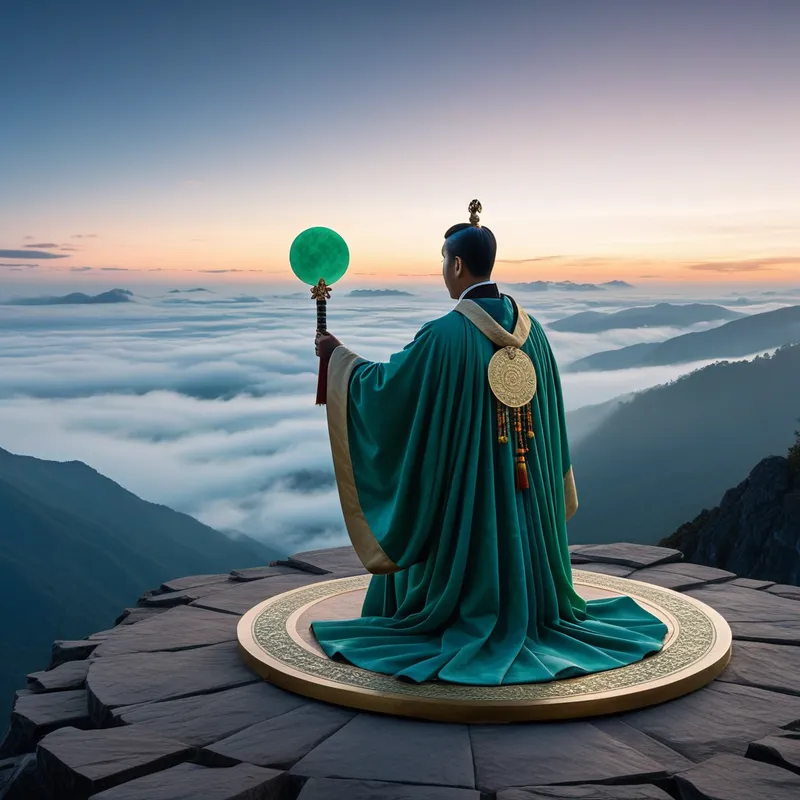
Then comes the one who listens. Not to the flattery of court, but to the sighing of the wind in the bamboo, to the weary songs of the farmers. He gathers the disaffected, the righteous, the hungry. He does not claim the throne by birthright, but by a deeper calling—a resonance with that great, silent breath above. In the clash of arms, it is not merely strength that decides, but this invisible alignment. The old dynasty falls, not just to armies, but to its own hollow core. The new ruler ascends the altar, his heart trembling not with pride, but with the terrifying weight of the covenant. He offers the jade Bi to the sky. And if his heart is true, the clouds part. The people feel it—a shift in the very air, a rightness, as if a dislocated bone has been snapped back into place. Order is restored. Tian has spoken, not with a voice, but through the rise and fall of empires.
Cultural Origins & Context
The concept of Tian is not a single story with a beginning and end, but the foundational bedrock of Chinese spiritual and political cosmology. Its origins are as old as the Shang Dynasty (c. 1600–1046 BCE), where it was referred to as Shangdi, a supreme deity who controlled victory, harvest, and the weather. With the succeeding Zhou Dynasty (1046–256 BCE), Shangdi was increasingly syncretized with the more impersonal, principled concept of Tian to justify their overthrow of the Shang. This was the formal birth of the Mandate of Heaven (Tianming) as a political theology.
The myth was passed down not by bards in taverns, but by historians, philosophers, and court ritualists. It was inscribed on oracle bones, cast into bronze vessels, and debated in the texts of Confucius, Mencius, and Mozi. Its primary societal function was immense: it provided the cosmic justification for political authority and the moral framework for its exercise. It made the ruler accountable not just to his subjects, but to the very cosmos. It was the ultimate check on power, a divine warning that tyranny and misrule would call down cosmic retribution. This idea became the engine of Chinese historiography, where the rise and fall of dynasties were narrated as a celestial moral drama.
Symbolic Architecture
Psychologically, Tian represents the ultimate principle of Order—not a rigid, imposed law, but the innate, harmonious pattern of a functioning cosmos and, by extension, a functioning psyche. It is the archetypal Ruler in its most transcendent form.
Tian is the psyche’s own demand for inner integrity. It is the silent, knowing part of us that judges our actions not by worldly success, but by their alignment with our deepest nature.
The Tianzi, the emperor, symbolizes the conscious ego. His role is to mediate between the inner divine order (Tian) and the outer, manifest world of instincts, desires, and relationships (the people, the earth). The sacred rituals are the ego’s necessary disciplines—prayer, meditation, introspection—to maintain this connection. The Tianming is the legitimacy of the ego’s rule. When the ego becomes identified with its own power (the corrupt emperor), grows selfish, and ignores the needs of the whole psyche (the suffering people), it loses its mandate. The ensuing chaos—floods, rebellions, depression, anxiety—is Tian’s feedback, the Self’s corrective action to dismantle a dysfunctional conscious attitude.

The Dreamer’s Resonance
When the myth of Tian stirs in the modern unconscious, it rarely appears as a king or a sky god. Its presence is felt in the atmosphere of the dream. One may dream of being in a towering, impersonal institution—a government building, a corporate headquarters, a vast library—that feels both awe-inspiring and oppressively authoritative. The dreamer is often seeking approval, a signature, or a verdict from a faceless committee or a distant, unseen CEO. This is the dream-ego seeking its Tianming, validation from the inner authority.
Alternatively, the dream may feature natural disasters striking a once-orderly life: a house flooded by rising water, a garden ravaged by a sudden storm. Somaticly, this can correlate with feelings of being “out of alignment,” of a deep, internal wrongness that manifests as physical tension, digestive issues, or a pervasive sense of anxiety. The psyche is signaling that the current “dynasty” of one’s lifestyle, beliefs, or choices has lost its virtue, its De. The old order must fall for a new, more authentic one to be born.

Alchemical Translation
The individuation process modeled by Tian is the alchemy of earning inner sovereignty. It begins with the realization that we are all, psychologically, the Tianzi. We bear the responsibility of ruling the inner kingdom of our psyche. The first, often arrogant, stage is claiming the throne without the mandate—identifying solely with the ego’s desires and constructing a life based on external validation, power, or control. This is the corrupt dynasty.
The inevitable crisis—the “loss of the mandate”—is a profound psychological breakdown. The floods of emotion, the earthquakes of shattered identity, the droughts of meaning. This suffering is not punishment, but the severe grace of Tian, the Self, dismantling a false structure.
The alchemical fire is not for destruction, but for revelation. It burns away the dross of the personal will to reveal the golden pattern of the impersonal, cosmic will within.
The work of transmutation is the ritual. It is the conscious, daily practice of “ascending the altar”: sincere self-reflection, ethical action towards oneself and others (De), and humility before the mysteries of one’s own soul. One does not command Tian; one aligns with it. The new “mandate” is felt as a quiet, unshakable authority that comes from within, a sense of purpose that is in harmony with one’s fundamental nature. One rules not by force, but by rightness. The inner kingdom finds peace, not because every conflict is resolved, but because every part is heard, and the ruler governs in accordance with the great, silent breath of the whole.
Associated Symbols
Explore related symbols from the CaleaDream lexicon: