Three Fates Myth Meaning & Symbolism
Three primordial sisters spin, measure, and cut the thread of every mortal life, embodying the inescapable architecture of destiny.
The Tale of Three Fates
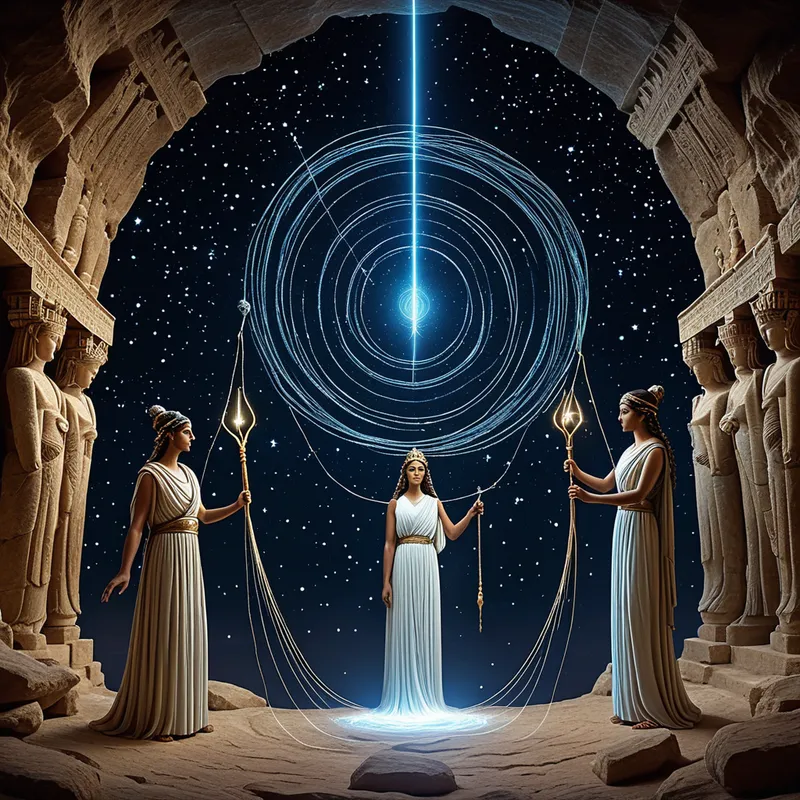
Before the gods of Olympus drew breath, in the deep marrow of [the world](/myths/the-world “Myth from Tarot culture.”/) where time itself is woven, they were already at work. No grand palace houses them, but a cave, or perhaps the space beneath the roots of the great world-tree, a place of whispering shadows and the hum of something primordial. The air is thick with the scent of wool, oil, and cold stone.
Here, in the absolute quiet, sits Clotho. Her fingers, nimble and sure, draw the raw, unformed stuff of existence from a distaff of mist and possibility. With a turn of her spindle, a single, luminous thread is born. It is not yet a life, but it is its potential—a line of light humming with all that could be. The first cry, the first breath, the first step are all held in that initial twist of fiber.
The thread passes, still humming, to the hands of Lachesis. She is the measurer, the apportioner. Her eyes, deep as wells, see not just the thread’s length, but its texture—its joys, its sorrows, its triumphs, and its burdens. She takes the rod, marked not with inches but with the turning of seasons, the phases of [the moon](/myths/the-moon “Myth from Tarot culture.”/), the beat of a heart. She lays the thread against it, determining its span. Her touch is not cruel, but it is final. She sings in a low voice, and her song is the destiny she weaves into the strand: this much love, this much loss, this much glory, this much toil.
Finally, the measured thread, now heavy with a full story, reaches Atropos. She is the smallest, yet her presence is the most immense. She does not smile. In her lap rests the dread shears, their blades honed on the whetstone of eternity. She waits. She watches the thread, seeing the pulse of life within it grow faint, seeing the story Lachesis sang reach its final note. There is no hesitation, no malice, only the pure, terrible necessity of the end. When the moment arrives—a moment known only to her—her hand moves. A single, crisp snip echoes in the silent chamber. The light in the thread winks out. The hum ceases. The story is complete.
And in the world above, a mortal draws a last, shuddering breath, and knows no more. The sisters do not pause. Clotho’s spindle has already turned again, drawing forth a new thread from the endless wool. The great loom of existence never stops.
Cultural Origins & Context
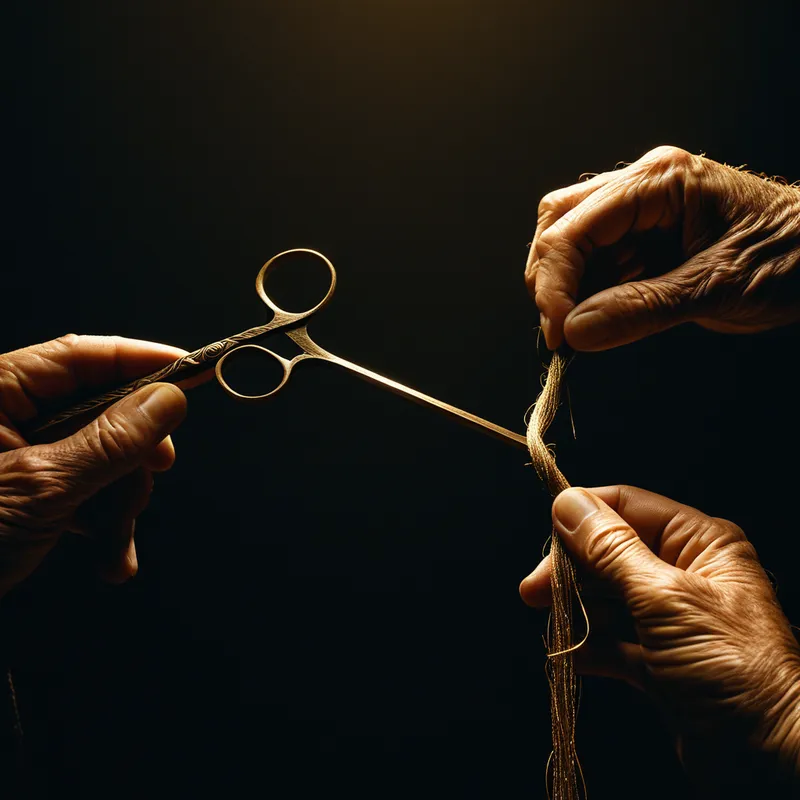
[The Moirai](/myths/the-moirai “Myth from Greek culture.”/), or Fates, were not mere Olympian deities but something far more ancient and fundamental. They predated Zeus himself, and even he was said to fear them, bound as he was to their decrees. This places them among the primordial forces of the cosmos, akin to Gaia (Earth) or Nyx (Night). Their myth was not a story told for entertainment around a fire, but a foundational truth recited in hymns, woven into the epic poetry of [Homer](/myths/homer “Myth from Greek culture.”/) and Hesiod, and invoked in solemn rituals.
Their societal function was profound: they were the ultimate explanation for the limits of human life and the seeming randomness of fortune and misfortune. Why did the hero die young? Why did the tyrant prosper? [The Fates](/myths/the-fates “Myth from Greek culture.”/) provided a cold but coherent answer: it was allotted. This belief created a cultural container for tragedy and fortune alike, moving suffering from the realm of meaningless chaos to the realm of a fixed, if inscrutable, cosmic order. They were the answer to the “why” that gods and men could not otherwise answer.
Symbolic Architecture
[The Three Fates](/myths/the-three-fates “Myth from Greek culture.”/) represent the tripartite [structure](/symbols/structure “Symbol: Structure in dreams often symbolizes stability, organization, and the framework of one’s life, reflecting how one perceives their environment and personal life.”/) of time and [consciousness](/symbols/consciousness “Symbol: Consciousness represents the state of awareness and perception, encompassing thoughts, feelings, and experiences.”/) itself: beginning, middle, and end. They are not [death](/symbols/death “Symbol: Symbolizes transformation, endings, and new beginnings; often associated with fear of the unknown.”/), but the process that contains death. Clotho is pure potential, the spark of [life](/symbols/life “Symbol: The symbol of ‘Life’ represents a journey of growth, interconnectedness, and existential meaning, encompassing both the joys and challenges that define human experience.”/), the [moment](/symbols/moment “Symbol: The symbol of a ‘moment’ embodies the significance of transient experiences that encapsulate emotional depth or pivotal transformations in life.”/) of [conception](/symbols/conception “Symbol: The beginning of new life, ideas, or projects; a moment of profound creation and potential.”/) and [birth](/symbols/birth “Symbol: Birth symbolizes new beginnings, transformation, and the potential for growth and development.”/). She is the creative [impulse](/symbols/impulse “Symbol: A sudden, powerful urge or drive that arises without conscious deliberation, often linked to primal instincts or emotional surges.”/), the initial “yes” of existence.
Lachesis is the lived life, the narrative arc. She symbolizes the substance of destiny—not a predetermined script, but the set of conditions, talents, challenges, and relationships that form the unique pattern of a life. She is the embodiment of moira, one’s portion or lot.
Atropos is the necessary limit, the closure without which a [story](/symbols/story “Symbol: The symbol of ‘Story’ represents the narrative woven through our lives, embodying experiences, lessons, and emotions that shape our identities.”/) has no meaning. She is the [acceptance](/symbols/acceptance “Symbol: The experience of being welcomed, approved, or integrated into a group or situation, often involving validation of one’s identity or actions.”/) of finitude, the cut that defines the shape of the [tapestry](/symbols/tapestry “Symbol: The tapestry represents interconnected stories, creativity, and the weaving of personal and collective experiences into a cohesive narrative.”/) by ending the thread. Psychologically, they represent [the ego](/myths/the-ego “Myth from Jungian culture.”/)‘s [journey](/symbols/journey “Symbol: A journey in dreams typically signifies adventure, growth, or a significant life transition.”/): its [emergence](/symbols/emergence “Symbol: A process of coming into being, rising from obscurity, or breaking through a barrier, often representing birth, transformation, or revelation.”/) from the unconscious (Clotho), its development and confrontation with life’s conditions (Lachesis), and its ultimate [dissolution](/symbols/dissolution “Symbol: The process of breaking down, dispersing, or losing form, often representing transformation, release, or the end of a state of being.”/) or [integration](/symbols/integration “Symbol: The process of unifying disparate parts of the self or experience into a cohesive whole, often representing psychological wholeness or resolution of internal conflict.”/) (Atropos).
Together, they form the complete [archetype](/symbols/archetype “Symbol: A universal, primordial pattern or prototype in the collective unconscious that shapes human experience, behavior, and creative expression.”/) of Moira—the [idea](/symbols/idea “Symbol: An ‘Idea’ represents a spark of creativity, innovation, or realization, often emerging as a solution to a problem or a new outlook on life.”/) that our lives are both our own making and subject to a larger [pattern](/symbols/pattern “Symbol: A ‘Pattern’ in dreams often signifies the underlying structure of experiences and thoughts, representing both order and the repetitiveness of life’s situations.”/) we cannot fully see or control.
The Dreamer’s Resonance
To dream of the Fates is to dream of the deep structures of the [psyche](/myths/psyche “Myth from Greek culture.”/) confronting the realities of time, choice, and limitation. Dreaming of Clotho often accompanies new beginnings—a pregnancy, a career shift, a creative project. One might dream of spinning, weaving, or finding a single, significant thread. It signals the somatic awakening of potential, a quickening.
A dream featuring Lachesis is a dream of measurement and assessment. The dreamer may be measuring a room, reading a map with a fading path, or hearing a distant, guiding song. This often surfaces during mid-life transitions, asking the dreamer to confront the question: “What is the substance of my life so far? What have I allotted to myself?”
Dreams of Atropos are the most potent and often frightening. They involve sharp cuts, sudden endings, broken connections, or a silent, implacable figure. This does not necessarily presage physical death, but the death of an ego-state, a relationship, a long-held identity. The psyche is performing its own necessary severance, making space for a new thread to be spun. The somatic feeling is often one of profound release after a period of tension.
Alchemical Translation
The individuation process, the journey toward psychic wholeness, is mirrored perfectly in the myth of the [Moirai](/myths/moirai “Myth from Greek culture.”/). The modern individual must become, in turn, all [three sisters](/myths/three-sisters “Myth from Native American culture.”/).
First, we must become Clotho. We must take the raw, chaotic material of our unconscious—our instincts, our wounds, our unlived potentials—and spin it into a conscious thread. This is the work of active imagination, creativity, and giving form to the formless self.
Then, we must become Lachesis. We must measure our own thread. This is the difficult, conscious work of taking responsibility for our destiny. It means looking honestly at the length and texture of our life: acknowledging our talents and our flaws, our choices and their consequences. We allot meaning to our experiences. We sing our own destiny into being through conscious reflection and choice.
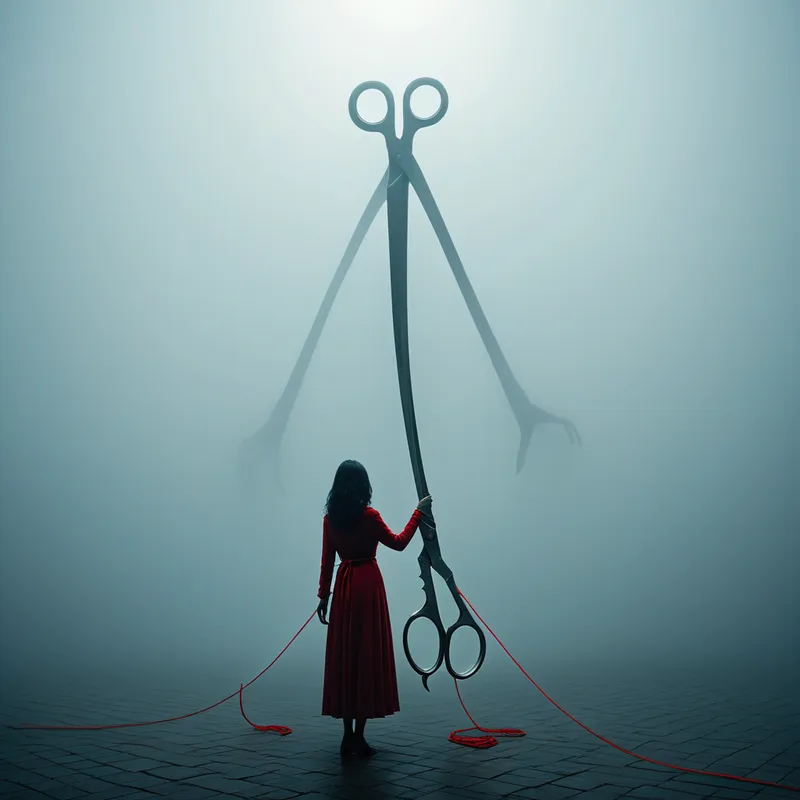
Finally, and most crucially, we must integrate Atropos. This is the alchemical mortificatio, the necessary death. To become whole, parts of the ego must be sacrificed—outdated self-images, compulsive behaviors, toxic narratives. We must learn to wield the shears ourselves, to consciously cut away what no longer serves the integrity of our life’s tapestry. This is not self-destruction, but the ultimate act of self-definition. It is the acceptance of our mortality and our limits, which in turn gives profound value and shape to the time we have.
In the end, the myth teaches that to live fully is not to escape fate, but to engage with its threefold process with consciousness and courage. We are the wool, the spinner, the measure, and the shear. Our destiny is the tapestry we help to weave, right up to the final, defining cut.
Associated Symbols
Explore related symbols from the CaleaDream lexicon: