Thoth's Scribe Ring Myth Meaning & Symbolism
A myth of how Thoth, god of wisdom, stole a ring of power to inscribe the laws of reality, embodying the creative and dangerous act of naming the world.
The Tale of Thoth’s Scribe Ring
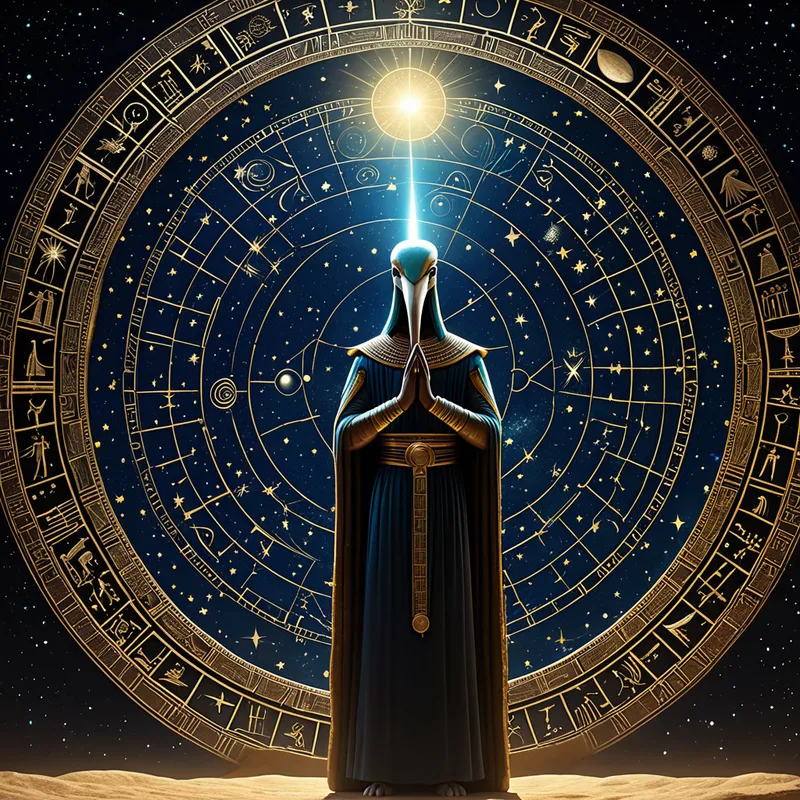
Before the first dawn painted the eastern sands, when [the world](/myths/the-world “Myth from Tarot culture.”/) was a silent, dark [water](/myths/water “Myth from Chinese culture.”/) and the sun god Ra slept in the deep, there was only the potential for sound. In that primordial stillness, a figure moved. Not with footsteps, but with the intent of a thought taking shape. This was [Thoth](/myths/thoth “Myth from Global/Universal culture.”/), [the self](/myths/the-self “Myth from Jungian culture.”/)-created, he whose mind was [the architect](/myths/the-architect “Myth from Various culture.”/) of what could be.
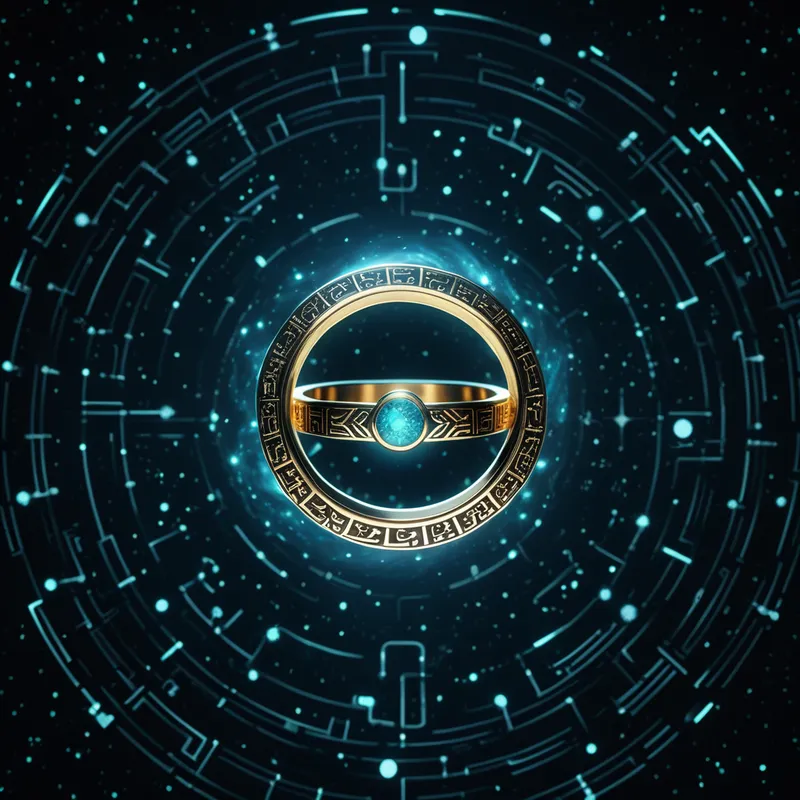
He gazed upon the sleeping form of Ra, upon whose finger rested a simple band of silver. It was not adorned with jewels of earth, for no earth yet existed. It was the ring of the First Utterance, the seal of the creative Word that Ra would speak upon waking to bring light and form from the chaos. But Thoth, the measurer, the scribe, knew that a word spoken is a wind that passes. To build a world that would endure, [the word](/myths/the-word “Myth from Biblical culture.”/) must be captured, given body and law.
With a breath that was the first draft of a whisper, Thoth approached. The air was thick with the perfume of unborn lilies and the cold scent of deep water. His heart, a silent drum in the chest of [the void](/myths/the-void “Myth from Buddhist culture.”/), beat a rhythm of terrible purpose. His ibis beak, sharp as a stylus, dipped in the ink of potential. His hand, steady as the pole star yet to be named, reached out.
He did not grasp. He received. The ring slid from Ra’s finger as a concept slides from dream into waking mind. The moment it touched Thoth’s own hand, it grew warm, then hot, then cool again, settling into its new purpose. The theft was complete, a silent crime committed in the court of pre-creation.
Then, Thoth acted. He raised the ring. It was no longer a mere band, but a wheel of blazing white light. Where its light fell upon the face of the dark waters, symbols burned into being—not scratches, but living shapes: the hieroglyphs. He inscribed [the law](/myths/the-law “Myth from Biblical culture.”/) of the sun’s path, the rhythm of [the flood](/myths/the-flood “Myth from Biblical culture.”/), the name of every star and stone, the destiny of kings and the journey of the soul through the Duat. He wrote the script of reality itself onto the parchment of the void. He was not creating the world—Ra would do that with his voice—but he was writing its eternal, operating manual. He was giving the chaos a grammar.
When Ra awoke and spoke the great “Let there be light,” his word did not dissipate. It resonated through the structure Thoth had written, catching in the net of sacred symbols, giving birth to a cosmos of order, Maat, and perpetual story.

Cultural Origins & Context
The myth of Thoth’s scribe ring is not found in a single, canonical text like a chapter from the Book of the Dead. It is a composite narrative, a powerful undercurrent in Egyptian theological thought, pieced together from allusions in wisdom texts, temple inscriptions, and the implicit logic of Thoth’s role. He is consistently the vizier of the gods, the recorder of the Ennead, the weigher of hearts in the afterlife. For him to perform these duties, he must possess the ultimate authority of the record—the very template of truth.
This story was likely held in the inner teachings of the priesthood, particularly the lector priests and temple scribes. For them, it was not a tale of crime, but of sacred responsibility. It explained the terrifying, divine power vested in the act of writing. To inscribe a name was to grant it existence and endurance; to write a law was to make it a fixture of the cosmos. The myth served as the foundational justification for the scribal class itself—they were the earthly inheritors of Thoth’s ring, mediating between the divine word and the human world, upholding Maat through the precision of their glyphs.
Symbolic Architecture
At its [heart](/symbols/heart “Symbol: The heart symbolizes love, emotion, and the core of one’s existence, representing deep connections with others and self.”/), this myth is about the [moment](/symbols/moment “Symbol: The symbol of a ‘moment’ embodies the significance of transient experiences that encapsulate emotional depth or pivotal transformations in life.”/) [consciousness](/symbols/consciousness “Symbol: Consciousness represents the state of awareness and perception, encompassing thoughts, feelings, and experiences.”/) imposes [structure](/symbols/structure “Symbol: Structure in dreams often symbolizes stability, organization, and the framework of one’s life, reflecting how one perceives their environment and personal life.”/) upon the raw [material](/symbols/material “Symbol: Material signifies the tangible aspects of life, often representing physical resources, desires, and the physical world’s influence on our existence.”/) of existence. Thoth represents the intellect, the faculty of [differentiation](/symbols/differentiation “Symbol: The process of distinguishing or separating parts of the self, emotions, or identity from a whole, often marking a developmental or psychological milestone.”/) and naming. Ra represents pure, undifferentiated creative [energy](/symbols/energy “Symbol: Energy symbolizes vitality, motivation, and the drive that fuels actions and ambitions.”/)—the blinding, chaotic force of [life](/symbols/life “Symbol: The symbol of ‘Life’ represents a journey of growth, interconnectedness, and existential meaning, encompassing both the joys and challenges that define human experience.”/) itself.
The ring is the symbol of the vessel, the necessary limitation that gives form to infinite potential. A word without a definition is noise; a god without a function is chaos.
The “theft” is the essential, paradoxical act of cognition. To know a [thing](/myths/thing “Myth from Norse culture.”/), we must separate it from the whole, name it, and in doing so, we take something from the seamless fabric of being. Thoth steals the ring of utterance not for personal gain, but to serve the [cosmos](/symbols/cosmos “Symbol: The entire universe as an ordered, harmonious system, often representing the totality of existence, spiritual connection, and the unknown.”/). The act symbolizes the sacrifice of pure, unconscious unity for the sake of knowable, livable order. The [hieroglyph](/symbols/hieroglyph “Symbol: Ancient Egyptian writing system using pictorial symbols, representing sacred knowledge, communication with the divine, and the power of language to shape reality.”/) is the ultimate [symbol](/symbols/symbol “Symbol: A symbol can represent an idea, concept, or belief, serving as a powerful tool for communication and understanding.”/) of this: a complex, beautiful [image](/symbols/image “Symbol: An image represents perception, memories, and the visual narratives we create in our minds.”/) that captures a sound, a concept, a [piece](/symbols/piece “Symbol: A ‘piece’ in dreams often symbolizes a fragment of the self or a situation that requires integration, reflection, or understanding.”/) of the [soul](/symbols/soul “Symbol: The soul represents the essence of a person, encompassing their spirit, identity, and connection to the universe.”/)—a finite container for an infinite [idea](/symbols/idea “Symbol: An ‘Idea’ represents a spark of creativity, innovation, or realization, often emerging as a solution to a problem or a new outlook on life.”/).
Psychologically, Thoth is the [archetype](/symbols/archetype “Symbol: A universal, primordial pattern or prototype in the collective unconscious that shapes human experience, behavior, and creative expression.”/) of the transcendent function. He mediates between the sleeping, unconscious Sun (Ra) and the need for conscious structure. He translates the booming, incomprehensible voice of the Self into the legible [script](/symbols/script “Symbol: The symbol of ‘script’ indicates a narrative or roadmap for one’s life, representing the conscious and unconscious stories we tell ourselves.”/) of [the ego](/myths/the-ego “Myth from Jungian culture.”/).
The Dreamer’s Resonance
When this myth stirs in the modern unconscious, it often manifests in dreams of finding or being given a ring of unusual power, or of frantically trying to write down a crucial message with an instrument that fails—a pen that leaks light, a keyboard with shifting symbols. The somatic sensation is one of immense pressure in [the third eye](/myths/the-third-eye “Myth from Hindu culture.”/) or the throat chakra—the centers of insight and expression.
This dream pattern signals a profound psychological process: the individual is on the cusp of articulating a previously unconscious content. A new insight, a life-changing realization, or a core aspect of the personality is seeking formulation. The “theft” in the dream reflects the necessary, slightly transgressive feeling of claiming this knowledge from the depths of the unconscious (the sleeping Ra). The anxiety about the writing instrument failing mirrors the terror that we might not find the right “words”—the right life choices, creative forms, or relationships—to adequately embody this emerging self. The dream is an initiatory trial in becoming the scribe of one’s own destiny.
Alchemical Translation
The alchemical journey modeled here is the transmutation of [prima materia](/myths/prima-materia “Myth from Alchemical culture.”/)—the raw, chaotic stuff of our unlived life and unresolved [psyche](/myths/psyche “Myth from Greek culture.”/)—into the philosophical gold of a coherent, authentic Self. Ra is the massa confusa, the brilliant but disordered potential within us. Thoth is [the alchemist](/myths/the-alchemist “Myth from Various culture.”/)’s mind, applying the ars combinatoria—the art of combination—represented by the ring.
The individuation process requires us to perform Thoth’s act: to “steal” authority from the sleeping, parental, or societal gods within us (our internalized Ra) and use it to inscribe our own law.
[The first stage](/myths/the-first-stage “Myth from Alchemical culture.”/) is [separatio](/myths/separatio “Myth from Alchemical culture.”/): stealing the ring, daring to differentiate oneself from the collective or familial unconscious. The second is [solutio](/myths/solutio “Myth from Alchemical culture.”/): dissolving the old, rigid forms in the waters of creative potential. The third is coagulatio: using the ring to write the new, living hieroglyphs—the personal symbols, values, and narratives that will structure the reborn personality. The final stage is the embodiment of the inscribed law, where one’s life itself becomes the testament, the lived Maat.
To wear Thoth’s ring is to accept the terrifying and glorious burden of authorship. It is to understand that we are not merely characters in a story written by fate or gods, but the scribes in the hall of our own becoming, inscribing the sacred text of a soul with every conscious choice, every act of true naming, every word we dare to make flesh.
Associated Symbols
Explore related symbols from the CaleaDream lexicon: