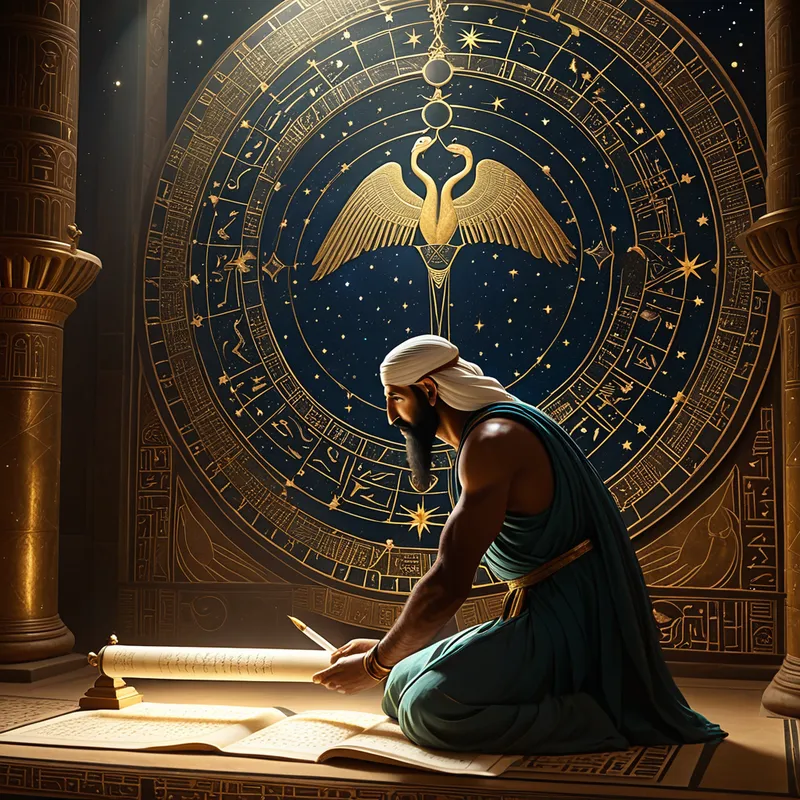
Thoth's Scribe Myth Meaning & Symbolism
A myth of divine knowledge, where the act of writing becomes a sacred burden, binding the scribe to the weight and wonder of cosmic truth.
The Tale of Thoth’s Scribe
Before [the world](/myths/the-world “Myth from Tarot culture.”/) knew its name, in the silence that cradles the first thought, there was a stirring in the Nun. From this dark, potential deep, the mind of the creator turned inward, and its first utterance was not a sound, but a shape. It was the shape of a word, and [the word](/myths/the-word “Myth from Biblical culture.”/) needed a vessel.
This is how he came to be: [Thoth](/myths/thoth “Myth from Global/Universal culture.”/), whose head is that of the probing ibis, whose beak parts the waters of the unseen to find the seed of truth. He is the measurer, the reckoner, the one who speaks the formulas that hold [the sky](/myths/the-sky “Myth from Persian culture.”/) aloft. In the hall of stars, where time is a river with many sources, [Thoth](/myths/thoth “Myth from Global/Universal culture.”/) performed his greatest magic. He took the raw substance of possibility—the clay of fate, the ink of night—and fashioned the first signs. He carved the story of the sun’s journey, the secret name of Ra, the spells to navigate the perilous beauty of the Duat. His scrolls were not of [papyrus](/myths/papyrus “Myth from Egyptian culture.”/), but of solidified light.
Yet, a divine thought is a lonely [thing](/myths/thing “Myth from Norse culture.”/). To be complete, it must be witnessed, carried, given form in a realm beyond its origin. So Thoth sought a vessel not of light, but of flesh and breath. He descended to the banks of the great river, where reeds whispered and human hands first shaped mud into brick. There, he found a man whose eyes held not the glaze of daily toil, but a quiet, reflecting pool—a man whose soul was a clean, blank sheet.
The god did not speak with a human voice. He opened his feathered arms, and from the space between his wings flowed [the river](/myths/the-river “Myth from Buddhist culture.”/) of signs. Hieroglyphs of hawk and serpent, of [water](/myths/water “Myth from Chinese culture.”/) and star, swirled in a silent, terrifying torrent. The man’s mind was flooded. He felt the weight of the sun’s barque, the cold depth of [the underworld](/myths/the-underworld “Myth from Greek culture.”/)’s lakes, the precise angle at which Maat’s feather balances a heart. It was a knowledge that burned and froze simultaneously.
Thoth placed a stylus in the man’s hand—a simple reed that now thrummed with a captive lightning. “Write,” was the unspoken command. “Make permanent what is fluid. Imprison the voice of eternity in the cage of the line. You are my scribe.”
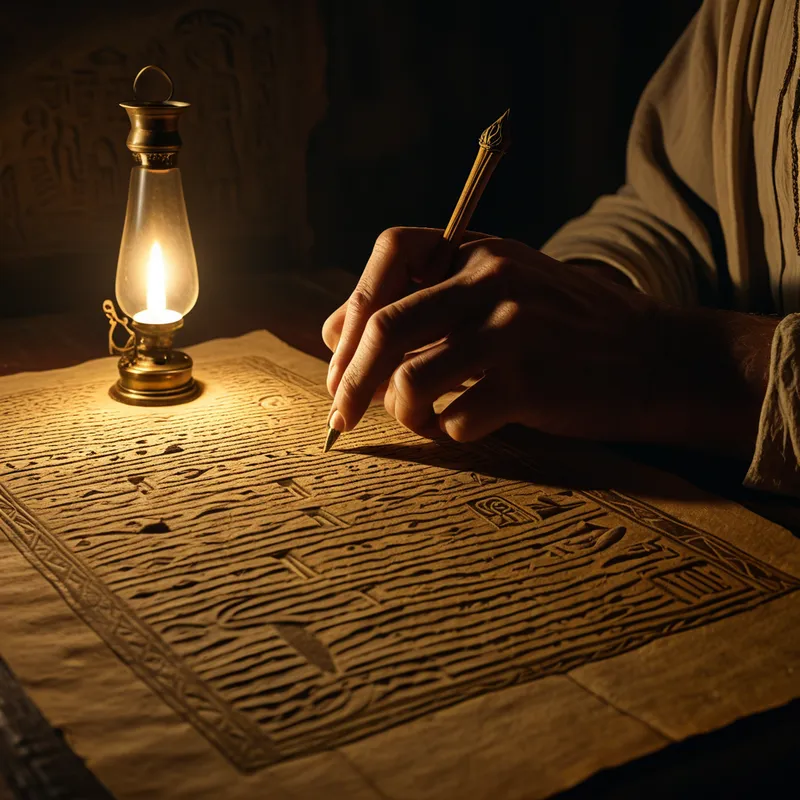
And so, the first scribe bent over a sheet of papyrus, smooth as the surface of a predawn sky. His hand moved, not by his own will, yet not without it. Each curve of a vulture glyph, each stark line of a pyramid sign, was an act of profound translation. He was not creating the knowledge; he was midwifing it from the divine realm into the world of substance. With every character inscribed, a piece of the cosmic order clicked into place, and a corresponding weight settled onto his own shoulders. He became [the anchor](/myths/the-anchor “Myth from Christian culture.”/) point for truth, the human knot that tied the rope of heaven to the post of earth. The gift was the burden, and the burden was the sacred task. He was the bridge, and the toll was his own innocence.
Cultural Origins & Context
The figure of the scribe was the axial pillar of ancient Egyptian civilization. While no single, standardized myth titled “Thoth’s Scribe” exists in one papyrus, the concept is woven into the very fabric of Egyptian thought, expressed in tomb inscriptions, [The Book of the Dead](/myths/the-book-of-the-dead “Myth from Egyptian culture.”/), and wisdom literature. Scribes were not mere clerks; they were the technocrats of the sacred, the literal holders of maat.
This “myth” was passed down not as a story told around a fire, but as a lived reality in the Per-Ankh, the “House of Life.” Here, apprentice scribes learned their craft, beginning with the sobering maxim: “Be a scribe! It saves you from toil and protects you from all work.” But this protection came with a supreme responsibility. To write the king’s decree, [the temple](/myths/the-temple “Myth from Jewish culture.”/) inventory, or a funerary spell was to participate in the same act as Thoth: ordering chaos, fixing reality through the potency of the correct word, the heka. The scribe was society’s memory and its future, ensuring the rituals that held the cosmos together were performed without error, for eternity.
Symbolic Architecture
At its [heart](/symbols/heart “Symbol: The heart symbolizes love, emotion, and the core of one’s existence, representing deep connections with others and self.”/), this myth is about the [moment](/symbols/moment “Symbol: The symbol of a ‘moment’ embodies the significance of transient experiences that encapsulate emotional depth or pivotal transformations in life.”/) [consciousness](/symbols/consciousness “Symbol: Consciousness represents the state of awareness and perception, encompassing thoughts, feelings, and experiences.”/) becomes responsible for [the Logos](/myths/the-logos “Myth from Biblical culture.”/)—the structuring principle of [reality](/symbols/reality “Symbol: Reality signifies the state of existence and perception, often reflecting one’s understanding of truth and life experiences.”/). Thoth represents the archetypal mind, the [source](/symbols/source “Symbol: The origin point of something, often representing beginnings, nourishment, or the fundamental cause behind phenomena.”/) of all patterns, laws, and symbolic forms. The scribe represents the [human](/symbols/human “Symbol: The symbol of a human represents individuality, complexity of emotions, and social relationships.”/) ego, or the individual consciousness, that is chosen to receive this overwhelming download from the [collective unconscious](/symbols/collective-unconscious “Symbol: The Collective Unconscious refers to the part of the unconscious mind shared among beings of the same species, embodying universal experiences and archetypes.”/).
The stylus is the instrument of incarnation. It translates the silent music of the spheres into the visible score that the world can play.
The act of writing is the central [symbol](/symbols/symbol “Symbol: A symbol can represent an idea, concept, or belief, serving as a powerful tool for communication and understanding.”/). It is not mere recording; it is an act of creation through limitation. The infinite divine thought must be squeezed through the finite [funnel](/symbols/funnel “Symbol: A funnel symbolizes the process of filtering or directing thoughts and emotions, allowing clarity and focus in one’s life choices.”/) of human understanding and the even more finite line of ink. This is the sacred [paradox](/symbols/paradox “Symbol: A contradictory yet true concept that challenges logic and perception, often representing unresolved tensions or profound truths.”/): to give form is to limit, and to limit is to make real. The scribe’s burden is the [weight](/symbols/weight “Symbol: Weight symbolizes burdens, responsibilities, and emotional loads one carries in life.”/) of this [responsibility](/symbols/responsibility “Symbol: Responsibility in dreams often signifies the weight of duties and the expectations placed upon the dreamer.”/)—the [anxiety](/symbols/anxiety “Symbol: Anxiety in dreams reflects internal conflicts, fears of the unknown, or stress from waking life, often demonstrating the subconscious mind’s struggle for peace.”/) that a misplaced line, a forgotten epithet, could unravel a thread of the cosmic order. He symbolizes the psychological burden of true [knowledge](/symbols/knowledge “Symbol: Knowledge symbolizes learning, understanding, and wisdom, embodying the acquisition of information and enlightenment.”/), which always separates the knower from the ignorant and charges them with a duty they cannot abandon.
The Dreamer’s Resonance
When this myth stirs in the modern [psyche](/myths/psyche “Myth from Greek culture.”/), it often manifests in dreams of overwhelming information or sacred tasks. You may dream of being handed a book with infinite pages that you must memorize, of trying to write an exam for a subject you never studied, or of being entrusted with a fragile, ancient artifact that you alone must protect.
Somatically, this can feel like a pressure in the head or chest, a literal “weight” of knowing. Psychologically, this is the process of integrating a new and potent complex—a cluster of thoughts, feelings, and memories—from the unconscious into conscious life. It is [the ego](/myths/the-ego “Myth from Jungian culture.”/) being confronted with a truth about itself or the world that is too large to ignore yet too daunting to fully hold. The dream scribe is you, facing the terrifying gift of your own depth, the unwritten book of your soul that demands to be transcribed.

Alchemical Translation
The alchemical journey modeled here is the transmutation of raw insight into disciplined wisdom. The initial stage is the inundation—the divine flood from Thoth. This is the inspirational phase, the brilliant idea, the spiritual awakening, the traumatic truth that shatters your old world. It is chaotic, glorious, and unbearable in its fullness.
The scribe’s work is the next, crucial stage: coagulation. The fixed, focused act of taking the stylus and writing. This is the labor of individuation. It is the daily practice of journaling after the breakthrough, the careful building of a philosophy after the revelation, the slow integration of a therapy session into behavioral change. It is the commitment to form.
Individuation is the scribe’s endless task: to faithfully translate the god’s dictation, knowing the translation itself becomes a new, sacred original.
The [triumph](/myths/triumph “Myth from Roman culture.”/) is not in completing the scroll—for the divine dictation is infinite—but in becoming the one who can bear the stylus. The modern individual’s “scroll” is their lived life, their art, their relationships, their contribution. The myth teaches that to receive a true calling (from [the Self](/myths/the-self “Myth from Jungian culture.”/), not the ego) is to be saddled with a beautiful burden. The alchemical gold is forged in the tension between the boundless inspiration (Thoth) and the bounded, faithful act of giving it form (the Scribe). We become whole not by staying in the ecstatic flood of the Nun, but by having the courage to sit at the desk, in the lamplight, and write our fragment of the eternal text into the story of the world.
Associated Symbols
Explore related symbols from the CaleaDream lexicon: