Thoth's Records Myth Meaning & Symbolism
The myth of the secret, divine knowledge recorded by Thoth, god of wisdom, and the eternal human quest to access its transformative power.
The Tale of Thoth’s Records
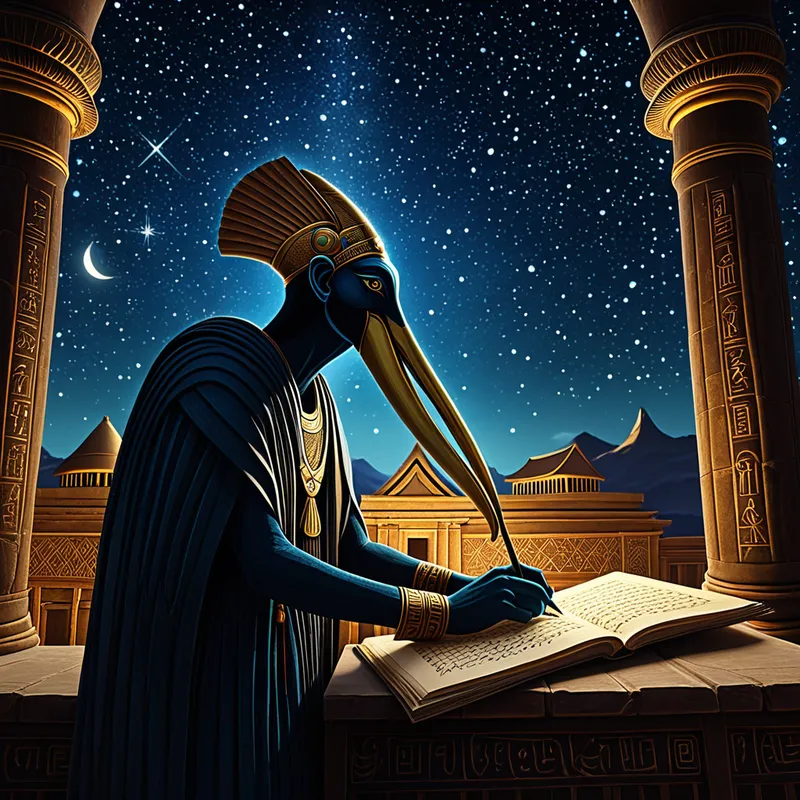
Before the first sunrise, in the silent, star-dusted womb of Nun, a thought took form. It was not a sound, but a vibration; not a word, but a pattern. And the one who gave it shape was Thoth, the ibis-headed, the measurer, the scribe of the gods.
He did not create from clay or breath, but from the substance of potential itself. In the hall of silence, before the throne of Ra, Thoth took up his palette and reed. His task was not to command armies or shape mountains, but to inscribe the bones of reality. With each stroke of his pen, a law was born. The path of the stars was charted. The rhythm of the Nile’s flood was set. The secret names of things, which hold their essence and their power, were whispered from his pen onto the pristine, endless scroll.
This was the First Recording. But Thoth’s work did not end with the scaffolding of the cosmos. He recorded the sacred rituals that keep Maat in her place, holding back the ever-gnawing jaws of Isfet. He wrote the spells that guide the soul through the terrifying beauty of the Duat, the Book of Coming Forth by Day a mere fragment of his greater archive. He recorded the histories of gods and kings, the rise and fall of dynasties not yet dreamed, and the hidden sciences—the art of healing, the movement of celestial bodies, the very language of creation.
These Records were not meant for mortal eyes. They were kept in a celestial library, a vault of light and shadow accessible only to the gods and the purified, justified dead. Yet, a whisper of them seeped into the world. It was said that a fragment, a single scroll of this divine knowledge, was hidden on earth—a treasure beyond gold, a danger greater than any serpent. To find it was to risk madness, for to gaze upon the raw architecture of reality is to see one’s own smallness etched in fire. But to understand it, even in part, was to wield a sliver of the god’s own power: to heal, to know, to bring order from chaos. The myth tells us the Records exist, complete and perfect, waiting in the silence between heartbeats, in the space behind the moon. The quest is not to possess them, but to become worthy of their glimpse.
Cultural Origins & Context
The concept of Thoth’s divine records permeates Egyptian thought, though it is less a single, standardized myth than a foundational belief woven into the fabric of their worldview. Thoth, as the divine scribe and vizier of the gods, was the ultimate source of all writing, science, law, and magic (Heka). His records were the metaphysical blueprint.
This belief was enacted and passed down primarily through the priestly and scribal classes. Scribes, in learning the hieroglyphic script—believed to be Thoth’s own invention—were participating in a sacred technology, accessing a sliver of his ordering power. In temple libraries, known as “Houses of Life,” priests preserved and studied texts on medicine, astronomy, ritual, and theology, all considered derivatives of or commentaries on Thoth’s original archives.
The societal function was one of cosmic maintenance. Knowledge was not abstract but performative. To recite a spell from a medical text or a ritual from the Pyramid Texts was to actively participate in sustaining Maat, using Thoth’s own formulas to keep chaos at bay. The myth justified the authority of written law, the efficacy of magic, and the very possibility of an afterlife, as the spells to navigate it were sourced from his divine library. It placed ultimate wisdom in a transcendent, perfect realm, making the human pursuit of knowledge a sacred, though inherently incomplete, imitation of the divine.
Symbolic Architecture
At its heart, the myth of Thoth’s Records is a profound symbol of the collective unconscious and the archetype of the Logos. Thoth represents the ordering, naming, conscious principle that structures the formless potential of the psyche (the Nun). His Records are the innate, pre-existing patterns—the archetypes themselves—that govern psychological life.
The scroll is the Self, and the hieroglyphs are the inborn language of the soul, waiting to be deciphered.
The library vault symbolizes the transcendent nature of this knowledge. It is not invented by the ego but discovered. The hidden earthly scroll represents the fragment of this wholeness that can, through great effort (the heroic journey of consciousness), be integrated into an individual life. The danger of madness signifies the ego’s potential dissolution when confronted directly by the numinous power of the unconscious without adequate preparation. Thoth, as mediator, is the archetypal psychopomp guiding between the realms of unknown potential (unconscious) and articulated reality (consciousness).
The Dreamer’s Resonance
When this myth pattern stirs in the modern dreamer, it often signals a profound encounter with the archetype of meaning. Dreams of vast, labyrinthine libraries, of finding a secret book with incomprehensible yet compelling symbols, or of being tested on ancient knowledge one never consciously learned—all are echoes of Thoth’s Records.
Somatically, this may manifest as a restless curiosity, an itch in the mind, or a deep, centering pull towards introspection. Psychologically, the dreamer is likely in a phase where the unconscious is offering up foundational patterns for examination. It is a call to “record” one’s own life—to seek the underlying laws, the hidden “true names” of one’s behaviors, relationships, and traumas. The locked books or sealed scrolls in the dream represent shadow aspects or complexes whose knowledge feels forbidden or dangerous. The act of finding, or even searching for, the right book parallels the therapeutic or introspective process of uncovering the core narrative that shapes one’s existence.

Alchemical Translation
The alchemical process modeled here is the opus of individuation, specifically the stage of illumination or sublimation. The prima materia is the chaotic, unexamined life (Isfet). Thoth’s pen is the focused attention of the conscious mind, applying the disciplina of introspection, therapy, or creative work.
The transmutation occurs when personal experience is seen not as random event, but as a unique inscription of a universal text.
The seeker (the ego) must descend into the personal “Duat” of the unconscious—facing fears, acknowledging shadows—not to steal knowledge, but to earn the right to read it. The “fragment” integrated is the realization of one’s own myth, the personal legend that makes sense of suffering and joy. This is not about omniscience, but about achieving a state of inner order (Maat) where one’s actions align with deep, self-knowledge. The modern individual performs this alchemy by journaling (the scribe’s act), by seeking therapy (deciphering the text), by creating art (writing a new page), or by simply committing to a path of authentic self-discovery. The goal is not to possess the entire library, but to faithfully inscribe one’s own scroll within it, adding a unique verse to Thoth’s eternal record.
Associated Symbols
Explore related symbols from the CaleaDream lexicon: