Thoth's Library Myth Meaning & Symbolism
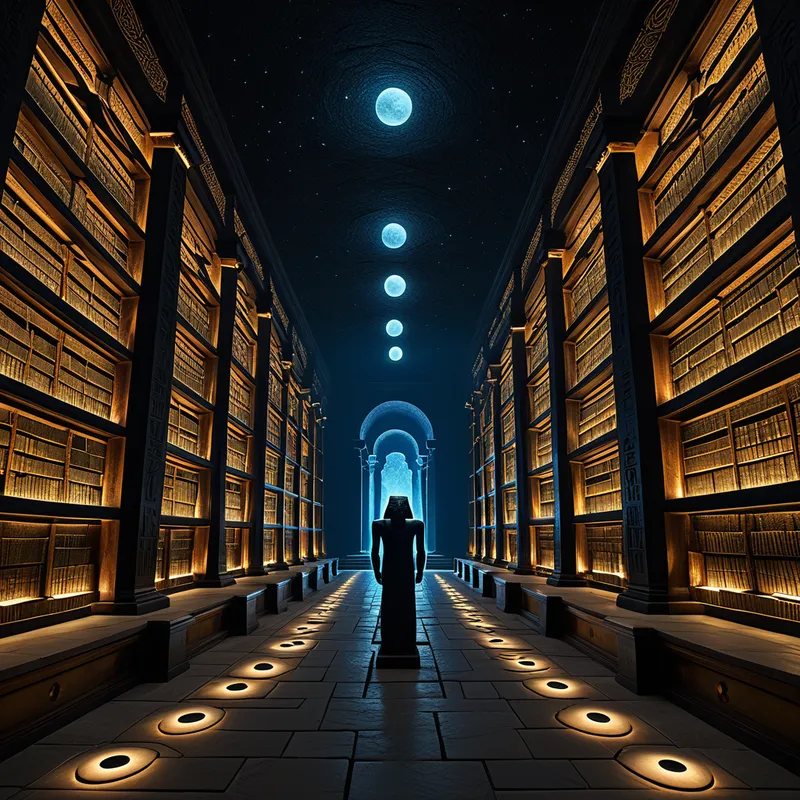
A myth of the god Thoth, who inscribed all divine knowledge onto tablets, then hid them to protect humanity from a power they were not yet ready to wield.
The Tale of Thoth’s Library
Before the first pyramid cast its shadow, before the first pharaoh drew breath, in the silent, star-dusted time when the gods walked the black soil of Kemet, there was a knowing. It was a deep, humming knowledge that pulsed in the heart of the cosmos, a pattern too vast for mortal minds to hold. And the one who held the pattern was Thoth.
He was the measurer, the scribe, the quiet architect of reality’s unseen scaffolding. While Ra sailed his barque of fire and Osiris ruled the silent lands, Thoth worked in the liminal space between light and dark, word and silence. He saw the totality of what was, is, and could be—the secret names of all things, the mathematics of creation, the spells that bind life to flesh and soul to star. This knowledge was a living, breathing entity, and it yearned for a vessel.
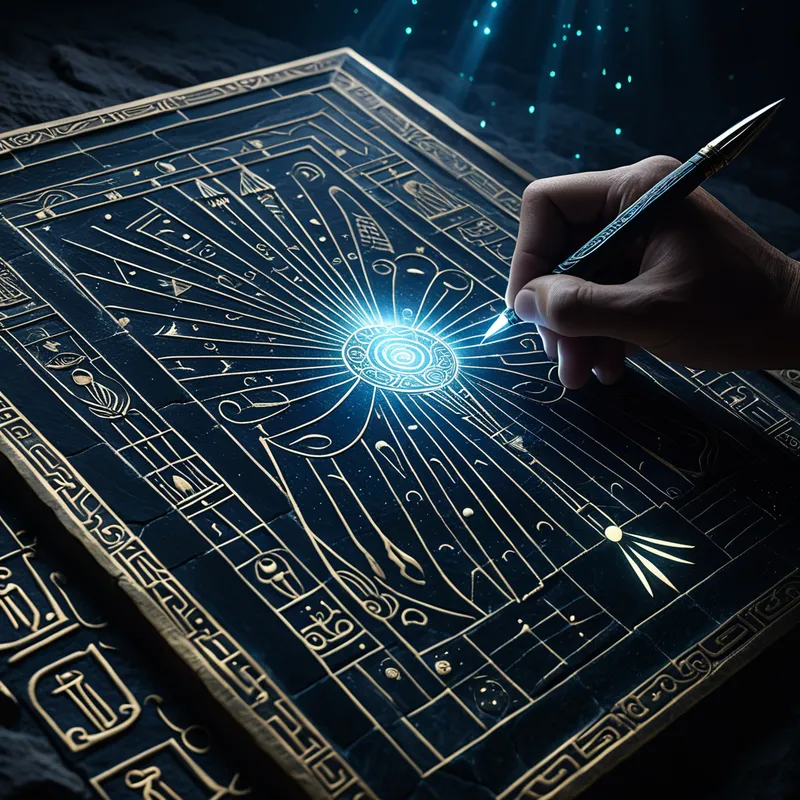
So, in a chamber carved from the bedrock of the world, where the air was cool and smelled of ink and ozone, Thoth began to write. He did not use papyrus, for such a medium would crumble to dust. Instead, he took tablets of a stone that drank the light of the moon. With a stylus forged from a beam of the imperishable stars, he began to inscribe. Each glyph he carved was not a mere letter, but a living seed of understanding. He wrote of the paths of the heavens and the currents of the Nun. He recorded the true names of the gods, the hidden anatomy of the soul—the Ka, the Ba, the Shut—and the rituals to navigate the perilous beauty of the Duat.
The library grew. Tablet upon tablet, shelf upon shelf, a labyrinth of solidified wisdom. It contained the cure for every illness, the blueprint for every just society, the answer to every question a heart could ask. It was a perfect, terrible mirror of the universe.
And here, the conflict was born not in battle, but in contemplation. Thoth, the wise, looked upon his perfect work and felt a cold dread. He saw that this knowledge was a double-edged khopesh. In wise hands, it could elevate humanity to god-like harmony. In foolish or arrogant hands, it could unravel the very fabric of Ma’at—the cosmic order. It could make tyrants immortal, turn love into a calculable formula, reduce the sacred mystery of life to a mere equation. The gift would become a curse.
So, Thoth made a choice that was both an act of profound love and devastating sacrifice. He would not bestow the library. He would hide it. With a heavy heart, he gathered the tablets, each one humming with potential. Some tales say he sealed them in a crypt deep beneath the desert sands, guarded by serpents of living shadow and riddles that spoke in dreams. Others whisper he scattered them, burying single tablets at the world’s secret nodes of power, or even cast them into the stars, so that fragments of truth might fall as inspiration, not as dogma. He hid the complete, overwhelming truth to protect the incomplete, growing soul of humanity. The library was not lost. It was sequestered, waiting for the day when humanity would not just seek knowledge, but would be worthy of the wisdom it demanded.
Cultural Origins & Context
The story of Thoth’s hidden knowledge is not a single, codified myth from a papyrus scroll, but rather a powerful thematic current running through Egyptian religious and magical thought. It is inferred from Thoth’s overarching role as the divine scribe and vizier of the gods, the inventor of writing (hieroglyphs), and the keeper of all sacred texts. In the Book of the Dead, it is Thoth who records the verdict of the weighing of the heart ceremony. He is the ultimate librarian of the soul’s journey.
This “myth of the library” was likely passed down through the priestly and scribal classes, those initiates who spent their lives in the per-ankh (House of Life), studying and copying sacred texts. For them, the pursuit of knowledge was a direct imitation of Thoth. The story functioned as a sacred caution: true wisdom is not merely information acquisition; it is a gradual initiation requiring moral preparation. It explained why the deepest mysteries (arcana) were reserved for the highest initiates, and why some spells were considered too dangerous to write down. The library was both an ideal and a warning, reinforcing that access to power is contingent upon the maturity to wield it justly.
Symbolic Architecture
At its core, the myth of Thoth’s Library is a profound parable about the relationship between consciousness and the unconscious, between the ego and the totality of the psyche, which Carl Jung called the Self.
The Library itself symbolizes the collective unconscious—the vast, timeless repository of all human potential, knowledge, and archetypal patterns. It is complete, eternal, and impersonal. The tablets are the archetypal forms and primordial ideas themselves. Thoth, as the scribe, represents the ordering, conscious principle that attempts to catalog and give form to this chaos of potential. He is the archetype of the psychopomp and the Sage.
The greatest wisdom is knowing what knowledge to withhold from a consciousness not yet tempered to hold its fire.
Thoth’s dilemma is the central crisis of integration. To bring the full, raw power of the unconscious directly into the fledgling ego-consciousness would be catastrophic—a psychic inflation or psychosis. The “hiding” of the library is not an act of divine cruelty, but of necessary psychic self-regulation. It represents the natural protective barrier between the conscious mind and the overwhelming depths of the unconscious. Truth is not denied; it is mediated, doled out in digestible fragments—dreams, intuitions, synchronicities, and the slow, painful insights of analysis—which Jung called the transcendent function.

The Dreamer’s Resonance
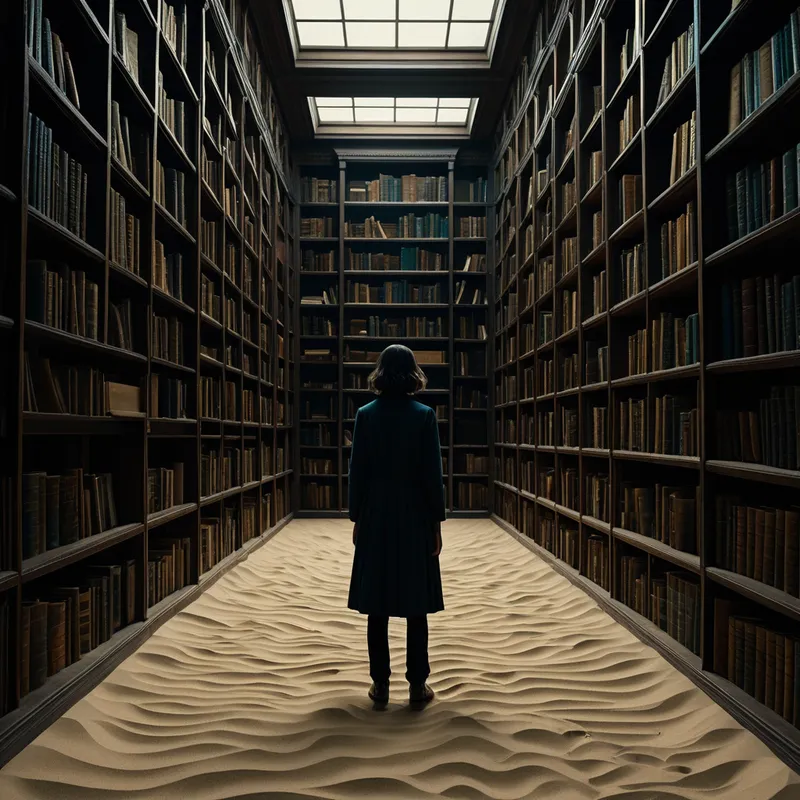
When this myth stirs in the modern psyche, it often manifests in dreams of vast, labyrinthine archives, locked rooms containing a “secret that will explain everything,” or finding a book with impossible, glowing text. The dreamer may feel a frantic urgency to decode the information before it vanishes, or a paralyzing awe before its magnitude.
Somatically, this can feel like a pressure in the chest or a buzzing in the head—the psyche’s signal that it is nearing a threshold of understanding. Psychologically, this dream pattern signifies a confrontation with a core complex or a buried layer of the personal unconscious that is ready to be made conscious. The “library” is the psyche itself offering up its records. The anxiety in the dream mirrors Thoth’s caution: the dreamer is on the verge of knowledge for which they may not yet be fully prepared—perhaps the recognition of a shadow aspect, a traumatic memory, or a destined life path that demands great responsibility. The dream is both an invitation and a test.
Alchemical Translation
The myth models the individuation process perfectly. The individual begins with a yearning for wholeness, for the “secret knowledge” that will fix their life (seeking the Library). The first stage is often a Promethean inflation—the ego believes it can seize this knowledge directly, through force of will or intellect.
The crisis comes with the realization of Thoth’s dilemma: one cannot take wisdom; one must become a vessel capable of containing it. The “hiding” of the library translates to the necessary period of frustration, shadow-work, and ego-humbling that precedes any real transformation. The seeker must turn from seeking the external library to excavating the internal one.
The alchemical vessel is not found; it is forged in the willingness to be shattered and remade by the truth it seeks to hold.
This is the nigredo—the dark night of the soul where old certainties crumble. Only through this dissolution does the ego become porous enough to receive wisdom in fragments, not in totality. Each integrated insight—each “recovered tablet”—is a piece of the lapis philosophorum, the philosopher’s stone of the Self. The final goal is not to possess the entire library, but to become, like Thoth, its wise and compassionate custodian—a conscious participant in the ongoing revelation of one’s own being, understanding that the deepest truths are not owned, but served.
Associated Symbols
Explore related symbols from the CaleaDream lexicon: