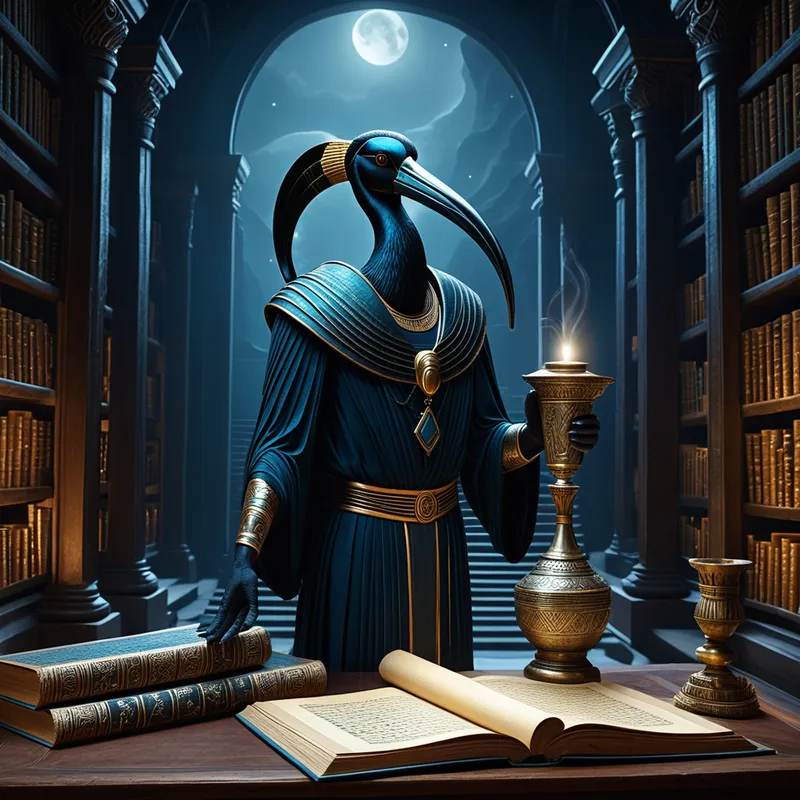
Thoth's Inkpot Myth Meaning & Symbolism
The ibis-headed god Thoth steals the sacred inkpot of Ra, using its power to invent writing and forever alter the balance between gods and humanity.
The Tale of Thoth’s Inkpot
In the time before time was measured, when the sun-god Ra sailed his barque of fire through the black waters of Nun, a silence deeper than sleep lay upon [the world](/myths/the-world “Myth from Tarot culture.”/). It was the silence of things unspoken, of thoughts unborn, of deeds forgotten as soon as they were done. Memory was a fleeting ghost, and wisdom the province of gods alone.
Among the divine company, one listened to this silence not with peace, but with a profound discontent. This was [Thoth](/myths/thoth “Myth from Global/Universal culture.”/), the measurer, the counter of stars and hearts. With the keen eye of the ibis and the patient mind of the baboon, he watched the cosmos unfold. He saw Ra’s majestic law, Maat, holding back chaos. Yet he also saw a terrible flaw: the ephemeral nature of all things. A king’s decree would fade on [the wind](/myths/the-wind “Myth from Various culture.”/). A lover’s oath would dissolve with the morning mist. The great deeds of heroes and the precise rituals of priests were destined to become whispers, then nothing.
His discontent crystallized into a dangerous, luminous idea—a rebellion not of violence, but of permanence.
He turned his gaze to [the solar barque](/myths/the-solar-barque “Myth from Egyptian culture.”/), to the innermost sanctum where Ra rested. There, beside the god’s own scrying pool, sat an object of unimaginable power: Ra’s Inkpot. It was not a scribe’s tool, but the wellspring of divine utterance. From it, Ra had spoken the names of all things at the dawn of creation, giving them form and life. Its ink was the essence of potential, a liquid that held both memory and command.
Under the cloak of Iah, [the moon](/myths/the-moon “Myth from Tarot culture.”/)’s darkest phase, Thoth moved. He was a shadow among the pillars of heaven, his heart a drumbeat against the cosmic quiet. He entered the barque, a place vibrating with raw creative power. The air tasted of ozone and myrrh. Before him, the inkpot glowed with a soft, internal light, like captured moonlight on black [water](/myths/water “Myth from Chinese culture.”/).
His hand did not tremble as he took it. [The vessel](/myths/the-vessel “Myth from Alchemical culture.”/) was cool, heavier than a mountain, lighter than a thought. In that moment of theft, the universe shuddered. A fissure opened in the perfect order of Maat. He had not stolen gold or a weapon; he had stolen the very means to alter reality through recorded word.
With his prize, Thoth descended to the reedy banks of the Nile. There, under the now-watchful eye of the moon, he performed the first magic of its kind. Dipping a reed stylus into the sacred ink, he did not write a law or a spell. He made a mark. A simple, curved line—the sign for “mouth,” ro. And as he did, the concept of “speech” was pulled from [the river](/myths/the-river “Myth from Buddhist culture.”/) of time and fixed upon the [papyrus](/myths/papyrus “Myth from Egyptian culture.”/). It would not fade. He wrote the glyph for “star,” and its light was captured. He wrote the name of a [pharaoh](/myths/pharaoh “Myth from Egyptian culture.”/) not yet born, and a thread of destiny was spun.
The silence of the world was broken forever. But as the first words dried, Thoth felt a cold weight settle in his own soul. He had given a gift of immortality to creation, but he had paid for it with a piece of the divine harmony. He had introduced the permanent record, and with it, the possibility of the permanent lie, the immutable error, the burden of a past that could never be erased.
Cultural Origins & Context
The myth of Thoth’s theft, while not a single canonical text like the Book of the Dead, is woven into the fabric of Egyptian theological and philosophical thought. It is a “secret” myth, alluded to in temple inscriptions and wisdom literature, understood by the priestly scribal class who saw themselves as Thoth’s mortal heirs. As the patron of scribes, Thoth’s origin story for writing carried profound cultural weight.
This narrative functioned on multiple levels. Societally, it sanctified the act of writing and the scribal profession, elevating it from a craft to a participation in divine, if ambivalent, power. It explained the dual nature of writing: a godly tool for preserving Maat (in laws, rituals, and histories) and a potentially dangerous technology. The myth served as a cautionary tale within the priesthood about the responsibility that comes with knowledge. To write was to wield a sliver of Ra’s creative power, and thus required absolute devotion to truth.
Symbolic Architecture
At its core, the myth is an [allegory](/symbols/allegory “Symbol: A narrative device where characters, events, or settings represent abstract ideas or moral qualities, conveying deeper meanings through symbolic storytelling.”/) for the [birth](/symbols/birth “Symbol: Birth symbolizes new beginnings, transformation, and the potential for growth and development.”/) of [consciousness](/symbols/consciousness “Symbol: Consciousness represents the state of awareness and perception, encompassing thoughts, feelings, and experiences.”/) itself—the [moment](/symbols/moment “Symbol: The symbol of a ‘moment’ embodies the significance of transient experiences that encapsulate emotional depth or pivotal transformations in life.”/) the pre-linguistic, experiential world is translated into the symbolic [realm](/symbols/realm “Symbol: The symbol of ‘Realm’ often signifies the boundaries of one’s consciousness, experiences, or emotional states, suggesting aspects of reality that are either explored or ignored.”/) of [language](/symbols/language “Symbol: Language symbolizes communication, understanding, and the complexities of expressing thoughts and emotions.”/).
The inkpot is the unformed potential of the unconscious; the written word is the conscious ego structuring that chaos into intelligible form.
Thoth represents the archetypal [Logos](/myths/logos “Myth from Christian culture.”/). His theft is the necessary, Promethean act of [differentiation](/symbols/differentiation “Symbol: The process of distinguishing or separating parts of the self, emotions, or identity from a whole, often marking a developmental or psychological milestone.”/). He separates a portion of the undifferentiated, omnipotent creative [source](/symbols/source “Symbol: The origin point of something, often representing beginnings, nourishment, or the fundamental cause behind phenomena.”/) (Ra) to create a new order—the order of language, [history](/symbols/history “Symbol: History in dreams often represents the dreamer’s past experiences, lessons learned, or unresolved issues that continue to influence their present.”/), and [linear](/symbols/linear “Symbol: Represents order, predictability, and a direct, step-by-step progression. It symbolizes a clear path from cause to effect.”/) thought. The [moon](/symbols/moon “Symbol: The Moon symbolizes intuition, emotional depth, and the cyclical nature of life, often reflecting the inner self and subconscious desires.”/), his celestial domain, symbolizes this reflective, mediating function. Just as the moon reflects the sun’s light, writing reflects and captures the light of direct experience.
The conflict is not between good and evil, but between two divine principles: Ra’s perfect, self-contained creative [authority](/symbols/authority “Symbol: A symbol representing power structures, rules, and control, often reflecting one’s relationship with societal or personal governance.”/) and Thoth’s drive to externalize, systematize, and memorialize that creation. The “sin” is one of [fragmentation](/symbols/fragmentation “Symbol: The experience of breaking apart, losing cohesion, or being separated into pieces. Often represents disintegration of self, relationships, or reality.”/) for the sake of progress. The ink, as the essence of potential, symbolizes the primal substance of thought before it is shaped into specific ideas. By stealing it, Thoth makes the inner world outer, the fluid permanent, the spoken eternal.
The Dreamer’s Resonance
When this myth stirs in the modern [psyche](/myths/psyche “Myth from Greek culture.”/), it often manifests in dreams of discovery and profound anxiety. A dreamer may find a mysterious, potent vial of ink or a pen that writes with a light of its own. They may dream of secretly taking a book from a forbidden library or recording a truth that must not be spoken.
Somatically, this can feel like a thrilling activation in the chest and mind, followed by a chilling dread—the body living out the myth’s dual gift. Psychologically, it signals a critical threshold in the dreamer’s individuation process. The “theft” represents [the ego](/myths/the-ego “Myth from Jungian culture.”/)’s courageous (or arrogant) act of claiming a piece of the unconscious’s boundless power—a new talent, a repressed memory, a traumatic truth, or a creative inspiration—and attempting to “write it down” into the structure of their conscious life. The accompanying guilt or fear is the psyche’s innate recognition that this act forever changes the balance between the conscious and unconscious realms. Once a truth is known and named, it cannot be unknown; it must be integrated, with all its consequences.

Alchemical Translation
The journey of Thoth models the alchemical opus of psychic transmutation for the modern individual. It begins in the [nigredo](/myths/nigredo “Myth from Alchemical culture.”/), the black silence of unconscious identification. The seeker, like Thoth, feels a divine discontent with this state, sensing a potential within the primal “ink” of their own unformed self.
The theft is the [separatio](/myths/separatio “Myth from Alchemical culture.”/) and [solutio](/myths/solutio “Myth from Alchemical culture.”/)—the daring act of introspection and analysis that extracts a piece of the inner gold ([the Self](/myths/the-self “Myth from Jungian culture.”/)) from the grip of the old, solar authority (the parental complexes, the societal [persona](/myths/persona “Myth from Greek culture.”/), the dominant conscious attitude). This is the birth of self-awareness, painful and guilt-laden, for it feels like a betrayal of the established order.
The act of writing with the stolen ink is the coagulatio: giving solid, enduring form to the extracted insight. This is the journal entry, the artistic creation, the life decision, the therapeutic breakthrough.
Finally, Thoth’s enduring role as mediator and scribe represents the ongoing stage of coniunctio—not a final bliss, but a lifelong duty. The individual who has “stolen the inkpot” must now live as the responsible scribe of their own soul. They must continually mediate between the raw, creative, often chaotic power of their inner Ra (the unconscious drives and genius) and the need for outer order and expression. They bear the weight of their own history, written indelibly in their psyche, and the sacred task of writing their future with integrity. The myth concludes not with a punishment, but with a permanent new responsibility: to use the gift of consciousness wisely, to record the truth of one’s being, and to forever navigate the luminous shadow cast by the act of knowing itself.
Associated Symbols
Explore related symbols from the CaleaDream lexicon: