Thoth's Hall of Records Myth Meaning & Symbolism
A myth of the god Thoth's hidden archive containing all knowledge, representing the quest for the profound wisdom buried within the self.
The Tale of Thoth’s Hall of Records
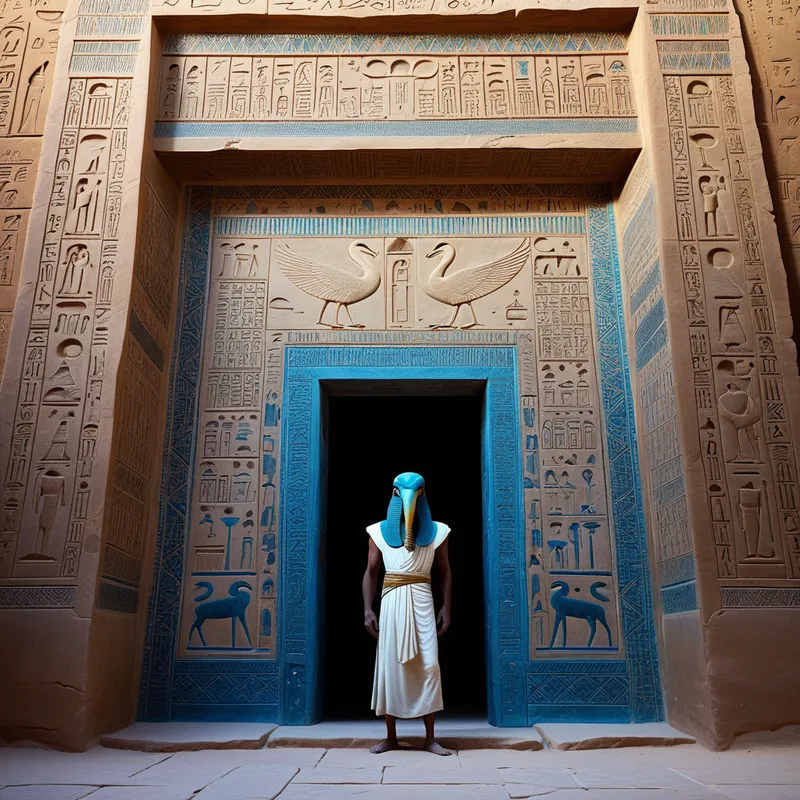
In the time before time, when [the world](/myths/the-world “Myth from Tarot culture.”/) was a thought in the mind of Atum, the silence was not empty. It was a pregnant silence, heavy with all that was, is, and ever could be. And in that silence, a sound began—not a voice, but the scratch of a stylus upon the fabric of reality itself. This was the work of [Thoth](/myths/thoth “Myth from Global/Universal culture.”/), the Measurer, the Counter of the Stars, the Lord of Divine Words.
He did not build his hall from stone or reed, but from the very substance of Maat. Its foundations were sunk deep into the black, fertile silt of the First Time, and its pillars rose to touch the belly of [the sky](/myths/the-sky “Myth from Persian culture.”/)-goddess Nut. Its location was a secret whispered only to [the wind](/myths/the-wind “Myth from Various culture.”/) and [the river](/myths/the-river “Myth from Buddhist culture.”/)’s current—some said beneath the paws of the Great [Sphinx](/myths/sphinx “Myth from Greek culture.”/), others claimed it was an island in the midst of the Celestial Nile, a place that existed just beyond the corner of the eye.
Within, there was no fire, yet a cool, silver light emanated from the walls themselves, which were not walls but living surfaces inscribed with every word ever spoken, every deed ever done, every dream ever dreamt. The air hummed with the potential of unspoken truths. Here, Thoth, with the wise head of the ibis and the steady heart of a scribe, walked the endless corridors. With his palette and reed, he did not merely record; he enacted. To inscribe a law was to give it power. To write a name was to grant it life. To chart a star’s path was to set its course.
The conflict here was not of clashing armies, but of the immense, terrifying weight of totality. To know all is to bear the burden of all. The rising action was the slow, meticulous accumulation—the turning of every leaf in [the Book of Life](/myths/the-book-of-life “Myth from Christian culture.”/), the weighing of every heart against the feather of Maat, the mapping of every secret name of every god and demon. The hall grew, a living organism of knowledge, its archives stretching into dimensions unseen.
The resolution was not an end, but a sealing. The hall was completed, a perfect, contained universe of information. Thoth closed its great, unseen doors. He did not lock them with a key of iron, but with a riddle of the spirit. The hall did not vanish; it receded. It became latent, immanent, waiting. It became the promise that beneath the world of appearances—beneath the sun-baked clay, the flowing Nile, the daily toil—lay the perfect, silent record of all that truly is. It was hidden so that it might be sought, sealed so that its discovery would be the ultimate awakening.
Cultural Origins & Context
The concept of Thoth’s hidden archive is not found in a single, canonical text like a Book of the Dead spell. Instead, it is a myth that coalesces from the entire Egyptian worldview. Thoth, as the divine scribe and vizier of the gods, was the patron of all written knowledge. The famed House of Life attached to major temples was its earthly echo—a scriptorium, library, and school where magic, medicine, astronomy, and ritual were studied and preserved.
The myth of the Hall functions on two levels. For the priesthood and literate elite, it was a theological metaphor for the divine, pre-existing blueprint of creation that Thoth helped enact. It legitimized their role as custodians of sacred knowledge. For the broader culture, it was a powerful folk belief, a “myth of the margin,” suggesting that ultimate truth was not entirely inaccessible. It was here, buried in the very land of Kemet. This idea gave mystical significance to the landscape itself—[the desert](/myths/the-desert “Myth from Biblical culture.”/), the river, [the pyramids](/myths/the-pyramids “Myth from Egyptian culture.”/)—transforming Egypt into a vast temple hiding a secret scripture.
It was passed down not as a formal narrative, but as an implication, a rumor of grandeur whispered in temple courtyards and etched in the symbolic language of art and architecture. Its societal function was to anchor Egyptian civilization in a framework of eternal, recorded order. It answered the human dread of oblivion by asserting that every life, every deed, was eternally noted in the divine register.
Symbolic Architecture
The Hall is the ultimate [symbol](/symbols/symbol “Symbol: A symbol can represent an idea, concept, or belief, serving as a powerful tool for communication and understanding.”/) of the Self—the complete, hidden totality of the individual [psyche](/myths/psyche “Myth from Greek culture.”/). Thoth represents the organizing, conscious principle of [Logos](/myths/logos “Myth from Christian culture.”/) ([word](/symbols/word “Symbol: Words in dreams often represent communication, expression, and the power of language in shaping our realities.”/), reason) that attempts to catalogue and understand this vast interiority.
The Hall of Records is not a library to be visited, but a psyche to be inhabited. Its corridors are the neural pathways of memory and potential; its scrolls are the encoded traumas and triumphs of a lifetime.
The hidden [location](/symbols/location “Symbol: The symbol of ‘Location’ signifies a sense of place, context, and the environment in which experiences unfold.”/) signifies that this core Self is not accessible to the everyday ego. It lies in the “subterranean” [realm](/symbols/realm “Symbol: The symbol of ‘Realm’ often signifies the boundaries of one’s consciousness, experiences, or emotional states, suggesting aspects of reality that are either explored or ignored.”/) of the unconscious, guarded by the [Sphinx](/symbols/sphinx “Symbol: The Sphinx is a mythical creature that embodies the convergence of strength and intelligence, often associated with mystery, protection, and the challenge of riddles.”/)-like riddles of our own defenses. The act of Thoth inscribing is crucial. It moves beyond passive recording to active creation. This symbolizes how our conscious engagement with our inner world—naming our feelings, articulating our experiences—actually shapes and gives [reality](/symbols/reality “Symbol: Reality signifies the state of existence and perception, often reflecting one’s understanding of truth and life experiences.”/) to our psychic [structure](/symbols/structure “Symbol: Structure in dreams often symbolizes stability, organization, and the framework of one’s life, reflecting how one perceives their environment and personal life.”/). The “sealing” of the hall represents the necessary hiddenness of the core Self. If it were readily apparent, [the ego](/myths/the-ego “Myth from Jungian culture.”/) would appropriate it, distort it. Its [mystery](/symbols/mystery “Symbol: An enigmatic, unresolved element that invites curiosity and exploration, often representing the unknown or hidden aspects of existence.”/) demands a [quest](/symbols/quest “Symbol: A quest symbolizes a journey or search for purpose, fulfillment, or knowledge, often representing life’s challenges and adventures.”/).
The Dreamer’s Resonance
When this myth pattern activates in the modern psyche, it often manifests in dreams of vast, labyrinthine interiors: endless libraries, government archives, data centers, or catacombs. The dreamer may feel a pressing urgency to find a specific book, file, or room, often coupled with anxiety about lost time or locked doors.
Somatically, this can correlate with a feeling of pressure in the head or chest—the “weight of knowledge” or unprocessed memory. Psychologically, this dream signals a profound turning point where the unconscious is preparing to yield a major piece of self-knowledge. The dreamer is undergoing a process of recollection in the Platonic sense: gathering the scattered fragments of their identity. The frustration of the search mirrors the resistance of the ego, which fears what it might find in those sealed records—perhaps a forgotten trauma, a denied talent, or a shocking truth about one’s authentic nature.
Alchemical Translation
The individuation process modeled by this myth is the opus of reclaiming one’s own story from the realm of fate and installing it in the realm of meaning. We are all born into a pre-existing “Hall”—the genetic, familial, cultural, and karmic records that precede us. The initial stage is unconscious inscription: life happens to us, writing its data upon our souls.
The alchemical work is to become Thoth within your own hall: to take up the stylus of consciousness and transcribe the raw data of experience into the sacred text of your own myth.
The first transmutation is from passive victim of history to active scribe of your narrative. This involves the difficult, Thoth-like task of honest self-reflection and journaling—“inscribing” the truth. The second transmutation is the “discovery” of the hidden hall itself, which is the shocking realization that you are the archive. You are not just reading the records; you are the medium upon which they are written. The final gold is the integration of this knowledge. It is not about possessing all information, but achieving the serene, detached wisdom of Thoth—the ability to hold the totality of your being, light and shadow, in conscious awareness, and to from that place, write your next chapter with deliberate, sacred intent. The quest ends not with leaving the hall, but with realizing you never left it; you have finally come home to the entirety of who you are.
Associated Symbols
Explore related symbols from the CaleaDream lexicon: