Thoth's Emerald Tablet Myth Meaning & Symbolism
The myth of Thoth inscribing cosmic laws onto an emerald tablet, a foundational act of divine wisdom that structures reality and the soul.
The Tale of Thoth’s Emerald Tablet
In the time before time, when the primordial waters of Nun were still and dark, a thought stirred. It was not a sound, but a vibration—the first word, unspoken. From this vibration, the sun-god [Khepri](/myths/khepri “Myth from Egyptian culture.”/) pushed forth the mound of creation. Light spilled across the waters, and with it came the need for law, for measure, for the very structure that would hold this brilliant, chaotic potential.
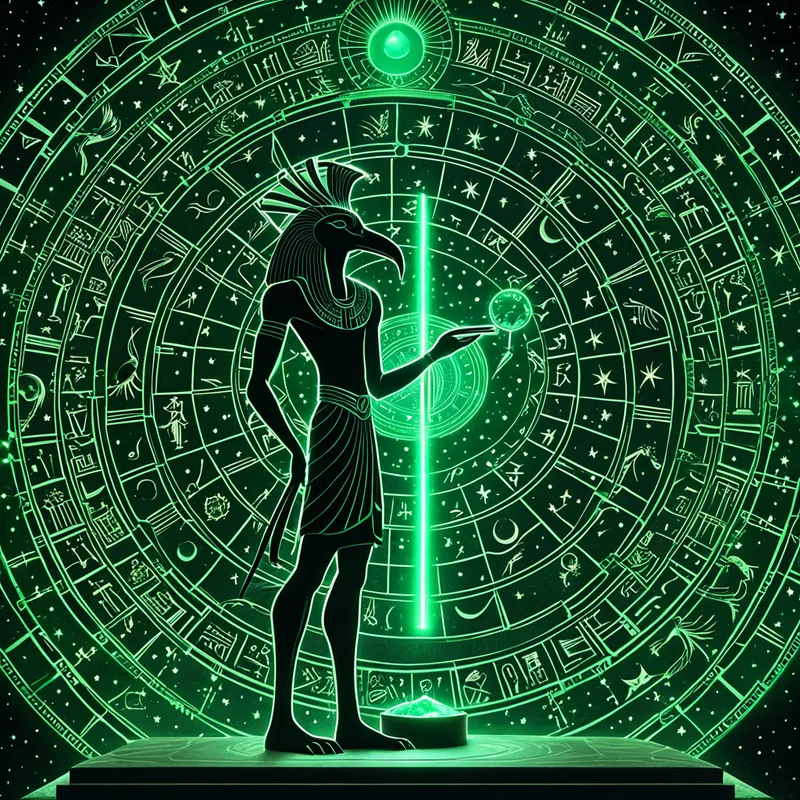
And so, from the light itself, stepped [Thoth](/myths/thoth “Myth from Global/Universal culture.”/). His form was that of a man with the serene head of an ibis, a creature that probes the mud for hidden treasures. In his hand was not a weapon, but a reed stylus. His eyes held the cool, measured light of [the moon](/myths/the-moon “Myth from Tarot culture.”/), the counterbalance to the sun’s fierce fire. He was the heart’s beat to the sun’s blaze, the scribe to the creator’s word.
The newly born world was a symphony of raw elements—earth, air, fire, [water](/myths/water “Myth from Chinese culture.”/)—dancing without rhythm, singing without scale. The gods themselves, mighty and radiant, moved with power but without a shared tongue, without a common principle. A great silence of misunderstanding lay beneath the cacophony of creation. Conflict simmered in the spaces between stars.
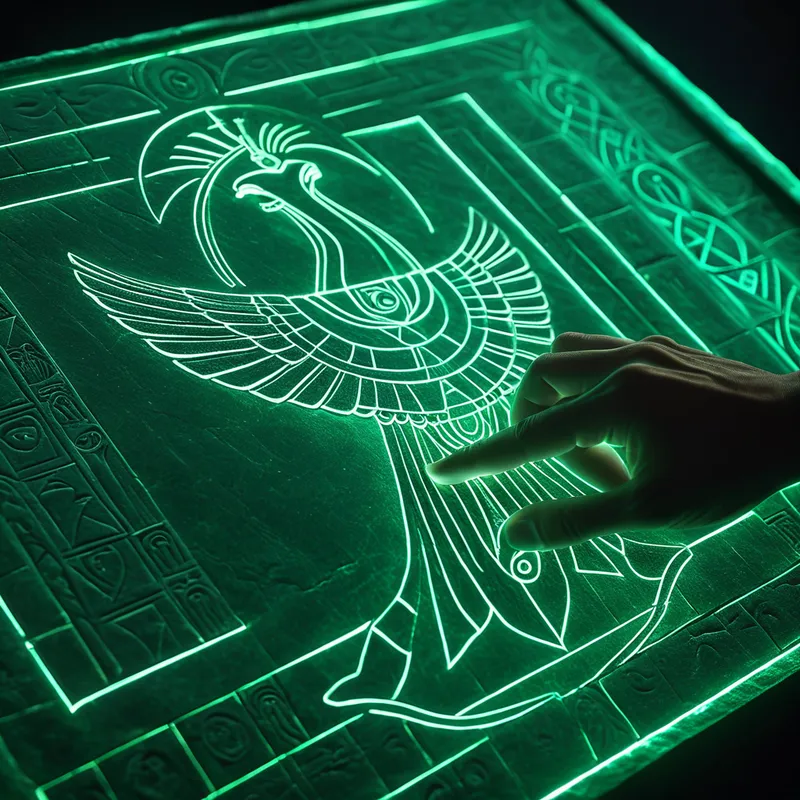
Thoth stood upon the first mound, the silence of his purpose deeper than the silence of [the void](/myths/the-void “Myth from Buddhist culture.”/). He raised his hand, and from the heart of [the earth](/myths/the-earth “Myth from Hindu culture.”/)’s green fire, he called forth a substance not of stone, not of metal, but of crystallized truth. It grew before him: a vast tablet of flawless emerald, its surface a still, deep pool of green light. It pulsed with a latent potential, waiting for the first mark.
Then, Thoth began to write. His stylus, dipped in the ink of his own divine consciousness, touched [the emerald](/myths/the-emerald “Myth from Medieval European culture.”/) surface. Where it passed, it did not scratch, but awakened. Lines of shimmering gold and silver light bloomed into being—not mere pictures, but living symbols. He inscribed [the law](/myths/the-law “Myth from Biblical culture.”/) of correspondence: “As above, so below.” He etched the principles of vibration, of polarity, of rhythm. He wrote the mathematics of the stars’ dance, the grammar of magic, the very rules of cause and consequence that would weave the tapestry of Maat from chaos.
With each glyph, the universe sighed into alignment. The warring elements found their places. The sun learned its path across [the sky](/myths/the-sky “Myth from Persian culture.”/); the moon its phases. The gods understood their roles and their relationships. [The Emerald Tablet](/myths/the-emerald-tablet “Myth from Hermetic culture.”/) became the keystone in the arch of reality, the immutable script upon which all of existence—from the flight of a god to the growth of a reed by the Nile—would be written. Thoth, the weaver of words, had given the cosmos its language. The conflict of unformed potential was resolved not by force, but by knowing. The story was now bound, and within its laws, all other stories could begin.
Cultural Origins & Context
The legend of the Emerald Tablet is a fascinating palimpsest of history. While its most famous textual incarnation is the [Tabula Smaragdina](/myths/tabula-smaragdina “Myth from Alchemical/Hermetic culture.”/), a short, cryptic alchemical treatise attributed to [Hermes Trismegistus](/myths/hermes-trismegistus “Myth from Greek culture.”/) (the Greco-Egyptian fusion of Thoth and [Hermes](/myths/hermes “Myth from Global/Universal culture.”/)) and dating from the early Islamic period, its mythological roots drink deeply from the Nile. In authentic Egyptian theology, Thoth was the divine scribe, the vizier of the gods, and the inventor of hieroglyphs—the “words of the gods.” His primary mythic function was to record and mediate, most famously during [the weighing of the heart](/myths/the-weighing-of-the-heart “Myth from Egyptian culture.”/) in the Hall of Maati.
The concept of a foundational, divine text structuring reality aligns perfectly with the Egyptian worldview. The universe was sustained by Maat, and Thoth, as “Lord of Ma’at,” was her scribe and accountant. This myth likely existed not as a single canonical story, but as a pervasive theological understanding passed down in temple mysteries by the lector priests. Its societal function was profound: it legitimized the immense cultural power of writing and knowledge (hieroglyphs were literally divine), it explained the origin of cosmic order, and it positioned Egypt, with its scribal class and precise calendars, as a living embodiment of that order on earth.
Symbolic Architecture
The myth is a masterclass in symbolic thought. Thoth himself represents the archetypal principle of conscious intelligence—the faculty that observes, names, and structures raw experience. He is not the [creator](/symbols/creator “Symbol: A figure representing ultimate origin, divine power, or profound authorship. Often embodies the source of existence, innovation, or personal destiny.”/) of the substance (the emerald), but the one who gives it form and meaning.
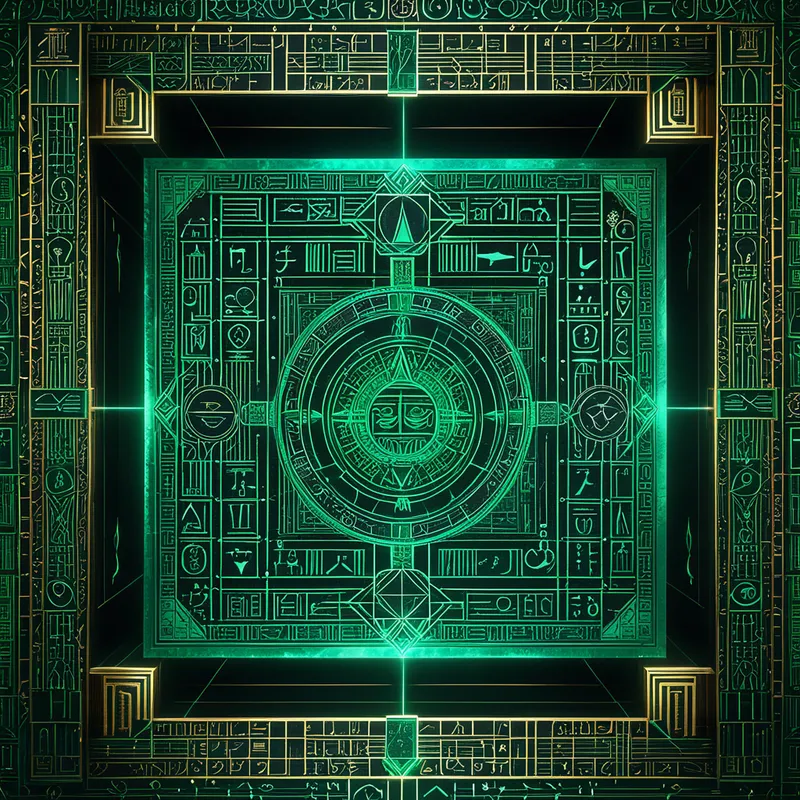
The Emerald [Tablet](/symbols/tablet “Symbol: A tablet symbolizes personal connectivity, information access, and the blending of work and play in the digital age.”/) is the ultimate [symbol](/symbols/symbol “Symbol: A symbol can represent an idea, concept, or belief, serving as a powerful tool for communication and understanding.”/) of the archetypal [pattern](/symbols/pattern “Symbol: A ‘Pattern’ in dreams often signifies the underlying structure of experiences and thoughts, representing both order and the repetitiveness of life’s situations.”/). It is not a book of facts, but a [matrix](/symbols/matrix “Symbol: A dream symbol representing the fundamental structure of reality, consciousness, or the self. It often signifies feelings of being trapped, controlled, or questioning the nature of existence.”/) of principles. Its emerald substance symbolizes the green, growing, living essence of [truth](/symbols/truth “Symbol: Truth represents authenticity, honesty, and the quest for knowledge beyond mere appearances.”/)—not dead dogma, but an organic, crystalline [structure](/symbols/structure “Symbol: Structure in dreams often symbolizes stability, organization, and the framework of one’s life, reflecting how one perceives their environment and personal life.”/) of [reality](/symbols/reality “Symbol: Reality signifies the state of existence and perception, often reflecting one’s understanding of truth and life experiences.”/).
The Tablet is not a description of the world; it is the genetic code from which the world grows.
The act of inscribing is the act of [consciousness](/symbols/consciousness “Symbol: Consciousness represents the state of awareness and perception, encompassing thoughts, feelings, and experiences.”/) itself imposing order on the [chaos](/symbols/chaos “Symbol: In Arts & Music, chaos represents raw creative potential, uncontrolled expression, and the breakdown of order to forge new artistic forms.”/) of the unconscious (the primordial Nun). The conflict resolved is the fundamental [human](/symbols/human “Symbol: The symbol of a human represents individuality, complexity of emotions, and social relationships.”/) [terror](/symbols/terror “Symbol: An overwhelming, primal fear that paralyzes and signals extreme threat, often linked to survival instincts or deep psychological trauma.”/) of the meaningless and the random. The myth assures us that reality, at its core, is intelligible—it can be read, if one knows the [language](/symbols/language “Symbol: Language symbolizes communication, understanding, and the complexities of expressing thoughts and emotions.”/).
The Dreamer’s Resonance
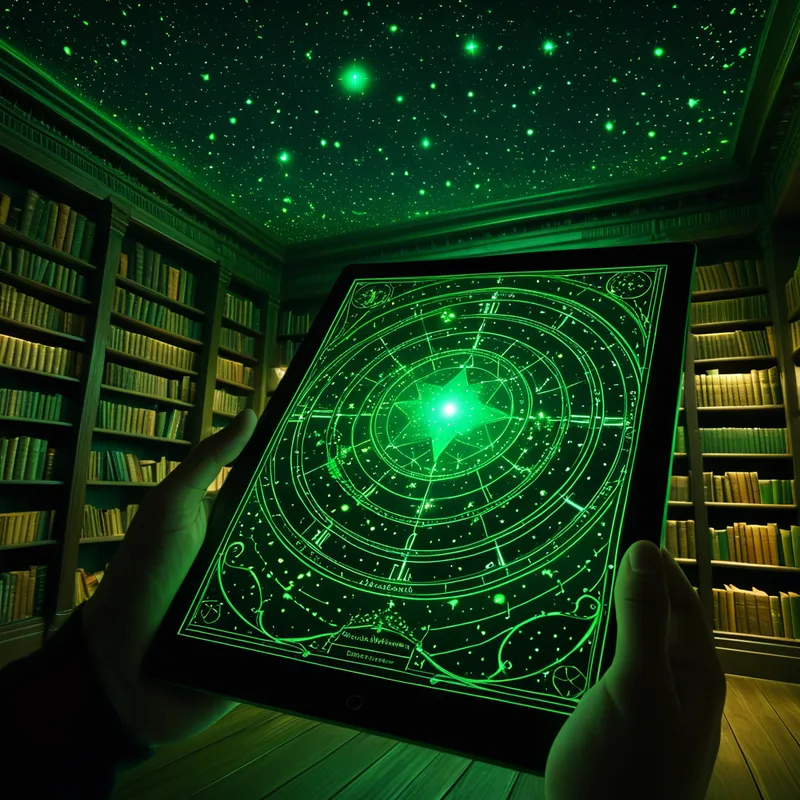
When this myth stirs in the modern [psyche](/myths/psyche “Myth from Greek culture.”/), it often manifests in dreams of finding a lost book, an encoded message, or a mysterious, glowing object (often green or crystalline). The dreamer may be in a labyrinthine library or a chaotic landscape that suddenly reveals a hidden order.
Somatically, this can correlate with a feeling of “clicking into place,” a release of tension from trying to force understanding. Psychologically, it signals a process of psychic integration. The dreamer is moving from a state of inner chaos—conflicting emotions, disjointed life narratives, a sense of being buffeted by fate—toward a state where they can discern the underlying patterns in their own life. It is [the Self](/myths/the-self “Myth from Jungian culture.”/) beginning to scribe its own “tablet,” to find the personal laws of their own nature. The anxiety in the dream is the fear of the unformed self; the awe is the dawning recognition of an inner, guiding intelligence.
Alchemical Translation
In the alchemy of individuation, Thoth’s myth models the crucial stage of conjunction and the creation of the philosophical stone. The “above” is the realm of archetypal patterns, ideals, and spirit. The “below” is the realm of bodily experience, emotion, and matter. The modern individual often feels torn between these two.
The alchemical work is to become Thoth. One must take the raw, green, chaotic “matter” of one’s lived experience—the passions, the failures, the joys, the traumas (the emerald)—and, through the reflective, lunar light of conscious attention (Thoth’s mind), inscribe it with meaning. This is not an intellectual exercise, but a profound transmutation. We write our own narrative onto the substance of our soul.
Individuation is the process of discovering you are both the tablet and the scribe.
The “Emerald Tablet” we seek is the discovered coherence of our own life. It is the understanding that our deepest patterns, our recurring themes, our core wounds and talents, are not random flaws but the unique hieroglyphs of our personal myth. To decipher them is to stop being a victim of chaos and to become a conscious participant in your own creation. The myth of Thoth tells us that the wisdom to do this is not granted from outside; it is the innate, structuring intelligence of the psyche itself, waiting to pick up the stylus and begin.
Associated Symbols
Explore related symbols from the CaleaDream lexicon: