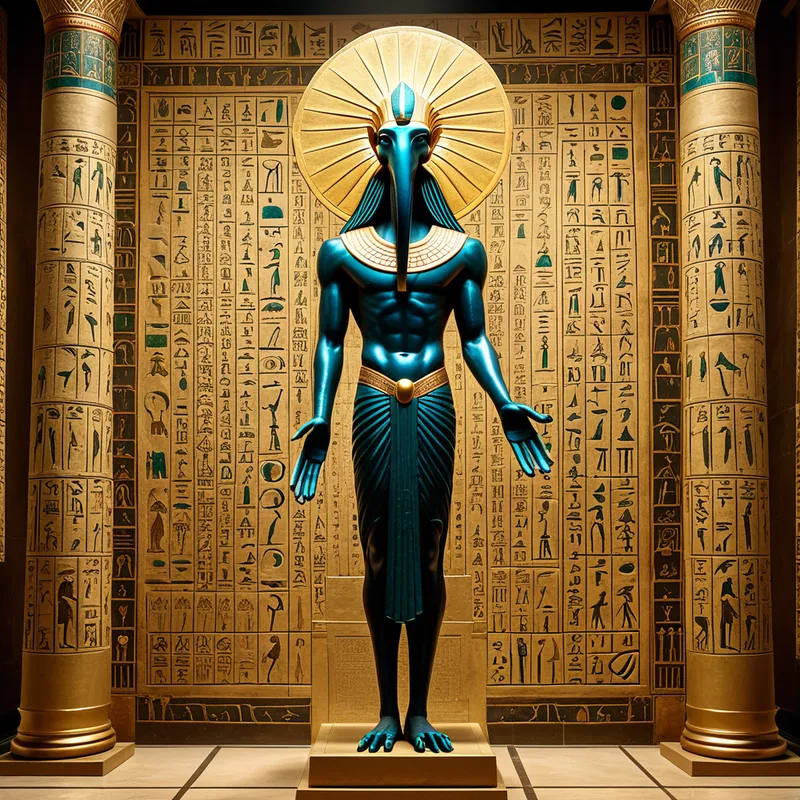
Thoth's Divine Words Myth Meaning & Symbolism
The god Thoth creates words of power to heal the goddess Isis, a sacred act that births magic and reveals language's divine, double-edged nature.
The Tale of Thoth’s Divine Words
In the time before time was measured, when the sun was young and the black silt of the Nun still clung to the roots of being, there existed a silence. It was not a peaceful quiet, but a pregnant, potent stillness waiting for a sound to give it shape. In this stillness moved [Thoth](/myths/thoth “Myth from Global/Universal culture.”/), the measurer, the counter of stars and heartbeats. His mind was the loom upon which the pattern of the cosmos was first woven.
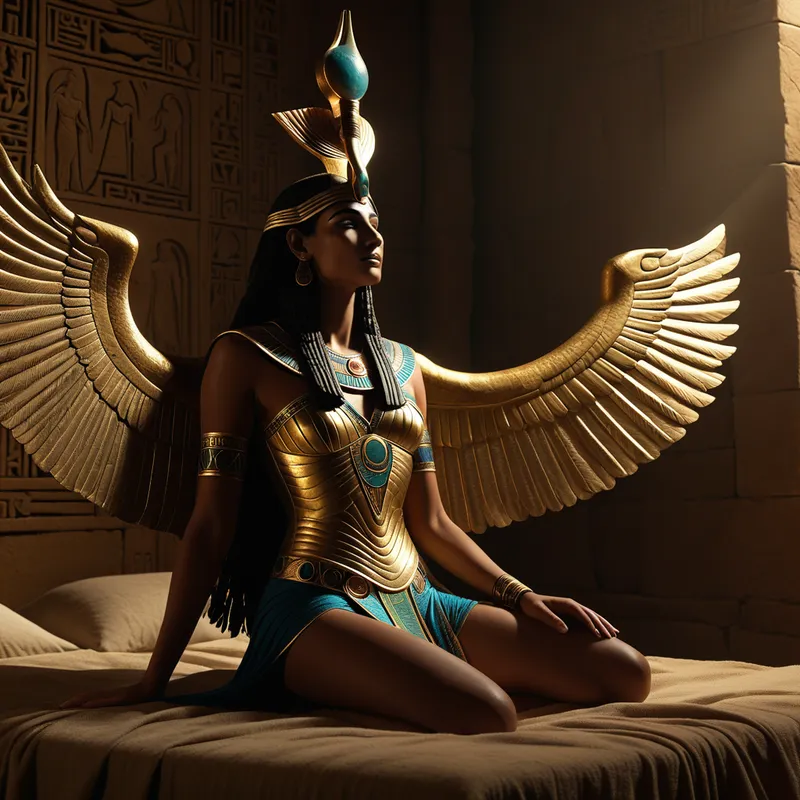
But the pattern was threatened. A great shadow had fallen upon the divine house. Isis, the great magician, she of the throne, lay stricken. A venom, subtle and cruel, coiled within her, a poison not of the body alone but of the spirit. The gods wept celestial tears that became morning dew, but they could not heal her. [Horus](/myths/horus “Myth from Egyptian culture.”/), her son, raged with a falcon’s fury, but his wrath was impotent against this creeping decay. The very order of Maat seemed to tremble.
Thoth observed this not with panic, but with the deep, calm focus of the ibis probing the waters. He withdrew to the silent places between moments, to the hall of his own divine intellect. There, he did not seek a herb or a potion. He sought the source. He listened past the lamentations, past the rustle of the [papyrus](/myths/papyrus “Myth from Egyptian culture.”/) of fate, to the foundational hum of reality itself. And from that hum, he began to speak.
He did not speak prayers or pleas. He spoke things into being. He shaped breath and intention into sounds that had never before vibrated in the air—primordial, precise, and potent. These were not mere words; they were the true names of healing, the architectural blueprints of wholeness pulled from [the void](/myths/the-void “Myth from Buddhist culture.”/). Each syllable was a key, each utterance a act of creation. He gathered them, these luminous, humming things—the Divine Words.
He carried them to Isis’s side. The air in the chamber grew thick, charged, as if before a storm. Thoth bent his ibis-head close. He did not chant loudly; he whispered, he intoned, he placed the words upon her, one by one, like applying living bandages made of sound and light. The words sank into her fevered skin, seeking the discordant poison. They did not fight it; they re-spoke it. They redefined its essence from “venom” to “lesson,” from “death” to “transformation.” [The shadow](/myths/the-shadow “Myth from Jungian culture.”/) within her uncoiled, not as a vanquished foe, but as a dark ink that was absorbed into the greater story of her being.
Isis opened her eyes. The light returned, but it was a new light, tempered by the shadow it had contained. She was healed, but more than that, she was initiated. Thoth had not just cured a goddess; he had unveiled the very mechanism of creation and un-creation. He had handed the keys of reality to consciousness itself. And in that moment, magic—Heka—was born not as a trick, but as the sacred responsibility of [the word](/myths/the-word “Myth from Biblical culture.”/).
Cultural Origins & Context
This myth, part of the larger corpus surrounding Thoth and Isis, is primarily known from later magical and religious texts, such as the Metternich Stela and various Book of the Dead spells. It was not a popular tale told in [the market](/myths/the-market “Myth from Various culture.”/) square, but a sacred narrative preserved and transmitted by the priesthood, particularly the lector priests (kheri-heb) who were the masters of ritual utterance.
Its function was deeply pragmatic within a magical worldview. It served as a divine precedent and authorization for the entire Egyptian practice of healing and protective magic. Every spell a priest uttered, every curative incantation, was seen as a direct descendant of Thoth’s primordial act. The myth established that language was not a passive tool for description, but an active, cosmic force. Writing these words down—inscribing them on amulets, stelae, or tomb walls—was to make them permanently active, a frozen moment of divine speech holding back chaos. The story was a reminder that the power of the scribe and [the magician](/myths/the-magician “Myth from Tarot culture.”/) was a fragment of the power that structured the universe.
Symbolic Architecture
At its core, this myth is about the genesis of [consciousness](/symbols/consciousness “Symbol: Consciousness represents the state of awareness and perception, encompassing thoughts, feelings, and experiences.”/) and its primary tool: symbolic [language](/symbols/language “Symbol: Language symbolizes communication, understanding, and the complexities of expressing thoughts and emotions.”/). Thoth represents the archetypal principle of [the Logos](/myths/the-logos “Myth from Biblical culture.”/)—the ordering, differentiating mind that brings form out of [chaos](/symbols/chaos “Symbol: In Arts & Music, chaos represents raw creative potential, uncontrolled expression, and the breakdown of order to forge new artistic forms.”/). Isis represents the embodied, suffering [aspect](/symbols/aspect “Symbol: A distinct feature, quality, or perspective of something, often representing a partial view of a larger whole.”/) of existence that requires the intervention of meaning to be made whole.
The Divine Word is the bridge between the unmanifest potential of the psyche and the tangible reality of experience.
The poison is not merely physical illness; it symbolizes undifferentiated suffering, meaningless pain, the raw, chaotic stuff of [life](/symbols/life “Symbol: The symbol of ‘Life’ represents a journey of growth, interconnectedness, and existential meaning, encompassing both the joys and challenges that define human experience.”/) that threatens to overwhelm the individual. Thoth’s act of creating new words is critical. He does not use old formulas. He engages in an act of pure psychic creativity, crafting the precise symbolic “container” needed to hold and transform a specific psychic [toxin](/symbols/toxin “Symbol: A substance that causes harm or death to living organisms, often representing internal or external poisons affecting the body, mind, or spirit.”/). This is the essence of true magic and deep [psychology](/symbols/psychology “Symbol: Psychology in dreams often represents the exploration of the self, the subconscious mind, and emotional conflicts.”/): not applying generic solutions, but finding the unique, living [symbol](/symbols/symbol “Symbol: A symbol can represent an idea, concept, or belief, serving as a powerful tool for communication and understanding.”/) that can re-contextualize a wound into a [source](/symbols/source “Symbol: The origin point of something, often representing beginnings, nourishment, or the fundamental cause behind phenomena.”/) of [strength](/symbols/strength “Symbol: ‘Strength’ symbolizes resilience, courage, and the ability to overcome challenges.”/).
The double-edged [nature](/symbols/nature “Symbol: Nature symbolizes growth, connectivity, and the primal forces of existence.”/) of this power is implicit. If words can heal, they can also harm; if they can create, they can deceive. Thoth, as the balanced sage, wields this power with [responsibility](/symbols/responsibility “Symbol: Responsibility in dreams often signifies the weight of duties and the expectations placed upon the dreamer.”/). The myth warns that to speak is to wield a god-like force, for good or ill.
The Dreamer’s Resonance
When this myth pattern stirs in the modern dreamer, it often manifests as dreams of discovering lost or forbidden knowledge, of speaking words that make objects glow or change, or of trying to heal someone (or oneself) with a specific, hard-to-remember phrase. The somatic sensation is often one of a buzzing in the throat or a pressure in [the third eye](/myths/the-third-eye “Myth from Hindu culture.”/).
Psychologically, this indicates a process where the dreamer is confronting a “poison”—a deep-seated emotional wound, a toxic belief, or a pattern of suffering that feels inarticulate and thus untreatable. The [psyche](/myths/psyche “Myth from Greek culture.”/) is attempting its own Thoth-like maneuver: it is struggling to find the right words. This is the process of moving pain from the nonverbal, somatic realm of pure affect into the symbolic realm where it can be understood, articulated, and ultimately transformed. The dream is a workshop where the unconscious is forging the precise “divine words”—the insights, the acknowledgments, the truthful declarations—needed to initiate healing.
Alchemical Translation
The alchemical journey modeled here is the transmutation of the [prima materia](/myths/prima-materia “Myth from Alchemical culture.”/) of suffering into the gold of wisdom. The “poison” of Isis is the leaden, heavy burden we all carry—our core wounds, our shames, our inherited traumas. The crude, unconscious suffering is the base matter.
Thoth’s retreat to his hall is the essential stage of introversion and reflection. The modern individual must withdraw from the drama of the pain and enter the silent, observant space of the inner sage. From this place, one does not react, but creates meaning.
The act of healing is an act of poetic re-creation, where we author a new narrative for our oldest wounds.
The “Divine Words” are the authentic insights and personal symbols that arise from this deep introspection. They are not clichés or borrowed affirmations, but the unique, living truths that name our experience accurately for the first time. Speaking them, writing them, or even fully thinking them is the operation of magic. It applies the transformative symbol (the word) to the chaotic substance (the pain), initiating a change in its very nature.
The healed Isis, then, is the integrated Self. She does not return to a state of naive innocence, but to a wholeness that now consciously contains the knowledge of the poison and the power of the word that overcame it. She becomes, like Thoth, a keeper of Heka. The individual who completes this process gains not freedom from suffering, but sovereignty over its meaning. They become the magician of their own life, understanding that their inner speech—the words they use to describe their world and themselves—is the most potent spell they will ever cast.
Associated Symbols
Explore related symbols from the CaleaDream lexicon: