Thoth's Divine Plans Myth Meaning & Symbolism
The myth of Thoth creating the divine plans for the cosmos, a sacred act of measurement, speech, and writing that established Ma'at and ordered reality.
The Tale of Thoth’s Divine Plans
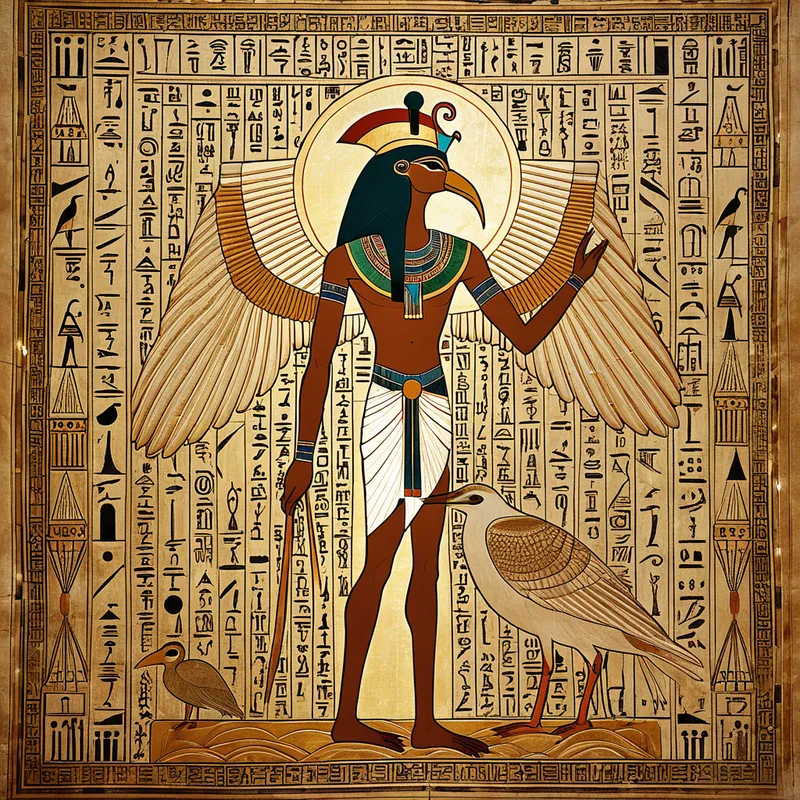
Before the first sunrise, when the world was a dark, silent potential within the Nun, a mind began to stir. Not in the heart of a mountain or the belly of a beast, but in the space between thoughts. This was Thoth, the self-created, he whose beak parts the waters of ignorance, he whose voice is the measure of all things.
He stood—or rather, his essence coalesced—in a hall that was not a hall, a space defined only by the necessity of its purpose. Before him lay the unformed clay of existence. The stars were not yet fixed in their courses; the rivers had not learned their paths to the sea; the hearts of gods and humans alike were empty vessels, waiting for a beat. Ma’at was a feather, weightless, waiting for the scale.
And Thoth began to speak.
His words were not mere sound. They were architecture. Each syllable, each consonant shaped from the breath of the heka within him, became a line of light. He spoke of foundations, and the bedrock of the earth groaned into being. He spoke of cycles, and the sun, Ra, understood his journey from east to west and through the perilous Duat. He spoke of justice, and the feather of Ma’at gained its impossible, perfect weight.
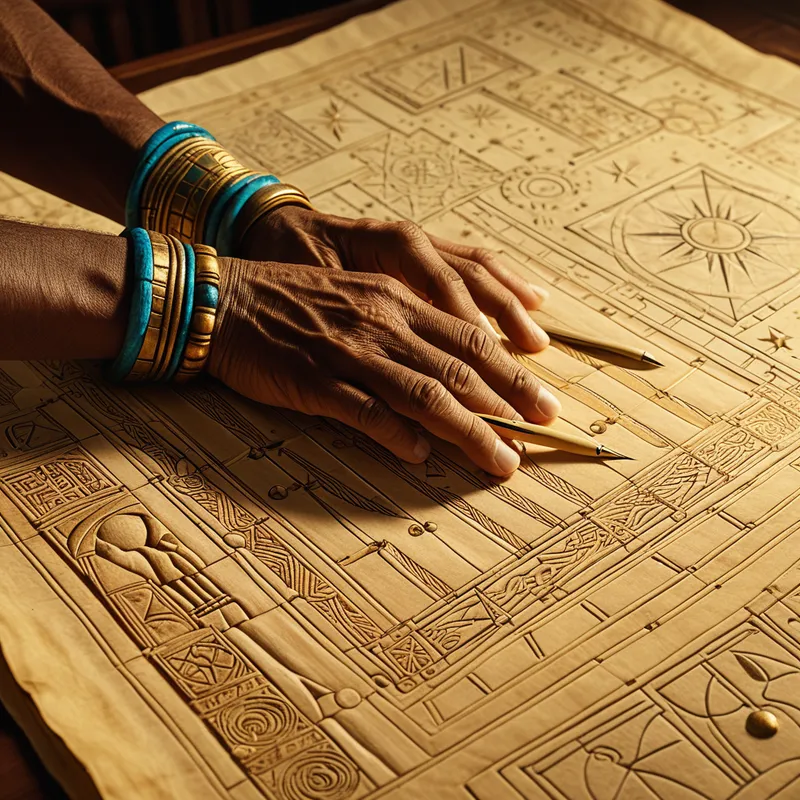
But speech, for all its power, is ephemeral. It fades into the echo of memory. Thoth knew that to bind creation, to give it a law that would outlast the whims of chaos, he must make the word permanent. From his own essence, he drew forth a reed pen and a scroll of celestial papyrus. This was the greater work: the transcription of the spoken divine command into the Divine Plans.
With meticulous care, his ibis-head bent in concentration, he began to write. He did not merely describe the world; he drafted its blueprint. He charted the precise angles of the pyramids before a single stone was quarried. He inscribed the rituals that would sustain the gods before the first priest was born. He mapped the constellations and the flow of the Nile’s inundation. Every temple, every festival, every moral law—its essence was first captured here, in the precise, magical script of his making. The conflict was not against a monster, but against the ever-present pull of the Nun, the formless chaos that sought to blur his lines and smudge his ink. His rising action was the steady, relentless act of inscription, a cosmic labor against entropy itself.
The resolution was not a battle cry, but the silent, final stroke of the pen. He laid down his instrument. Before him, the scrolls glowed with an inner light, a complete and perfect system. These were the Divine Plans—the permanent, sacred template upon which all of reality would be built and maintained. He presented them to Khnum, to Ra, to the company of the gods. And with their acceptance, the universe clicked into place, ordered, measured, and forever bound by the sacred law of the written word.
Cultural Origins & Context
The concept of Thoth’s Divine Plans is woven deeply into the fabric of Egyptian theological and statecraft. It is less a single, standardized “myth” told around a fire and more a foundational theological principle expressed in temple texts, Coffin Texts, and the architectural philosophy of the civilization itself. The primary tellers of this “story” were the priests and scribes, the literate elite who served as intermediaries between the human and divine realms.
Its societal function was paramount. It provided the divine justification for the Pharaonic state and its most ambitious projects. The Pharaoh was not just building a tomb or a temple; he was enacting a pre-ordained, divine blueprint, literally bringing heaven to earth. The meticulous measurements of a pyramid, the aligned processional avenues of a temple complex—these were not feats of engineering alone, but acts of religious devotion, a physical realization of Thoth’s scrolls. The myth established writing (Medu Netjer, “the gods’ words”) not as a human invention, but as a divine technology, the very mechanism by which Ma’at was instituted and sustained. To be a scribe was to participate in this ongoing act of cosmic maintenance.
Symbolic Architecture
At its core, the myth is a profound allegory for the emergence of consciousness from the unconscious. The Nun represents the undifferentiated, potential-filled, but chaotic state of the primal psyche. Thoth, the self-created god of the mind, symbolizes the awakening of the conscious intellect and the faculty of discrimination.
The act of speaking the world into being is the birth of Logos—the differentiating power of language that names, separates, and defines. It is how the ego begins to carve a stable identity out of the inner chaos.
The critical turn, however, is the shift from speech to writing. Speech is fluid, emotional, and personal. Writing is fixed, structural, and transpersonal. This symbolizes the move from fleeting insight or emotion to enduring structure, memory, and law. The Divine Plans are the archetypal patterns of the psyche—the innate, ordering principles (Jung’s archetypes) that govern human experience: the pattern of the Hero, the Lover, the Sage, the cycle of death and rebirth. Thoth drafting these plans represents the moment these universal patterns are crystallized from the formless potential of the collective unconscious. The pen and scroll are thus symbols of conscious formulation, the act of giving intangible inner realities a tangible, communicable form.
The Dreamer’s Resonance
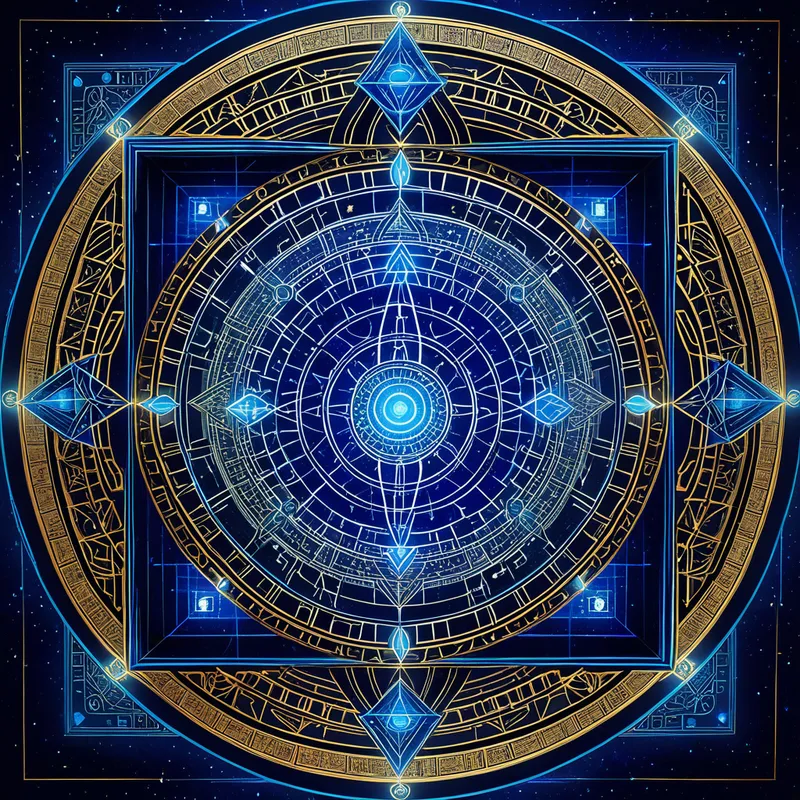
When this myth stirs in the modern unconscious, it often manifests in dreams of discovery, architecture, or sacred responsibility. A dreamer might find a hidden room in their house containing ancient scrolls or complex blueprints they feel compelled to understand. They may dream of meticulously measuring a vast, empty space, or of being in a library where they must transcribe a vital text before time runs out.
Somnatically, this can correlate with a feeling of pressure in the forehead or a focused, buzzing clarity—a literal “coming to mind.” Psychologically, this dream pattern signifies a critical phase of inner ordering. The dreamer is likely grappling with a period of internal chaos, confusion, or a life transition that has dissolved old structures. The psyche is now laboring, like Thoth, to draft new “divine plans”—to establish a new internal order, a new ethical framework, or a creative project that requires meticulous, conscious formulation. The anxiety in the dream (the smudging ink, the fading words) mirrors the fear that this new, fragile structure of the self might not hold against the lingering chaos of doubt or old habits.
Alchemical Translation
The alchemical process mirrored here is the transition from the nigredo (the blackening, chaotic Nun) to the albedo (the whitening, the purified scroll). Thoth’s labor is the work of separatio and coagulatio—separating the essential from the chaotic and then coagulating it into a fixed, enduring form.
For the individual on the path of individuation, this myth models the necessity of moving from inspired but formless intuition to disciplined, embodied creation. Many people have flashes of insight, moments of profound self-understanding, or grand ideas (Thoth’s spoken word). But these often evaporate, leaving little lasting change. The “Divine Plans” stage is the hard, unglamorous work of journaling, of therapy, of building a consistent meditation practice, of drafting the business plan, of writing the first draft of the book, of actually building the life the insight promised.
To inscribe your own divine plans is to take raw, chaotic experience and suffering and, through conscious reflection and effort, transmute it into personal wisdom, art, or a life of integrity. It is to become the scribe of your own soul, drafting the sacred laws by which you will henceforth live.
The triumph is not in having a beautiful idea, but in the patient, precise hand that commits it to the scroll, making it real for yourself and, ultimately, as a contribution to the world’s order. You enact your portion of Ma’at. In doing so, you cease to be a passive creature of chaos and become, in your own measured way, a co-creator with the divine mind.
Associated Symbols
Explore related symbols from the CaleaDream lexicon: