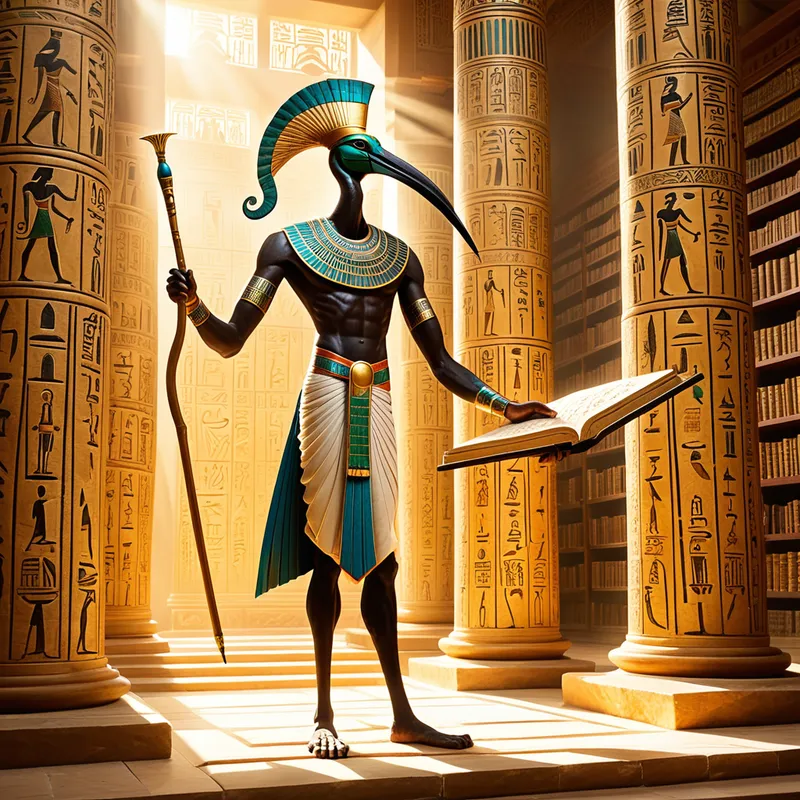
Thoth- god of writ Myth Meaning & Symbolism
The story of the god who gave humanity the sacred tools of writing and calculation, weaving order from chaos and creating the architecture of the mind.
The Tale of Thoth- god of writ
Before the world knew its name, there was only the dark, churning waters of Nun. From its depths, the sun-god Ra spoke the first word, and light was born. But light alone is a silent witness. Order emerged, but it was a mute order, a beautiful but wordless dream. The gods ruled, the Nile flowed, and the stars wheeled in perfect, silent arcs. Yet something was missing. The heart of Maat beat, but had no voice. Memory was a fleeting ghost, and wisdom died with the one who held it.
In the hallowed silence between the setting and the rising of the sun, a figure took shape. He was Thoth, self-created, born of the need to speak the order of the cosmos. His form was that of the ibis, a patient bird that probes the muddy depths, and of the baboon, who greets the dawn with chattering cries. He did not command armies or shape mountains. His domain was the space between thought and thing, the silent gap where meaning is born and lost.
He watched as Ra’s brilliant barque sailed the day sky and the treacherous night waters. He saw how the stories of gods and kings, the measures of the flood, the paths of the planets, all risked being swallowed by the same forgetful waters from which they came. A great melancholy settled over creation—a world destined to amnesia.
So Thoth retreated to the banks of the celestial Nile, under the canopy of eternal night. He listened to the music of the spheres, not as harmony, but as separate, chaotic notes. He observed the baboon’s shrewdness and the ibis’s precise strike. And in the deep well of his own being, he began to fashion. Not a weapon, not a crown. A tool. From the reed of the riverbank and the minerals of the earth, he crafted the palette and the stylus. Then, he performed the ultimate magic. He gave the silent concepts of the world—the sun, the throne, the hawk, the water, the heart—a visible body. He captured the sound of a lark’s cry, the concept of justice, the action of walking, in elegant, miniature pictures. He invented Medu Netjer, the divine words.
He presented his creation to Ra. The sun-god, in his majesty, understood its power instantly. This was not merely record-keeping. This was a net to catch time itself. This was a way to make thought eternal, to command at a distance, to heal with a name, to send the soul on its correct journey. With a stroke of the stylus, chaos was given a boundary; the ephemeral was granted a permanent home. Thoth did not just give writing. He gave the very architecture of civilization, the loom on which the tapestry of reality could be woven and remembered.
Cultural Origins & Context
The myth of Thoth is woven into the very fabric of ancient Egyptian civilization, a culture obsessed with eternity and the defeat of entropy. His worship centered at Khmun (Hermopolis Magna), the city of the eight primordial gods. As the vizier and scribe of the gods, Thoth was not a distant deity but the active principle of divine administration. His myth was not a single, canonical story recited by bards, but a theological truth embedded in rituals, temple inscriptions, and most importantly, in the practice of writing itself.
Every scribe who dipped his reed in ink was performing a sacred act, channeling Thoth. His myth was passed down through the rigorous training of the scribal class, a literate priesthood who saw themselves as “followers of Thoth.” In the Book of the Dead, it is Thoth who records the outcome of the weighing of the heart ceremony, the ultimate act of judicial writing that determines eternity. His myth functioned as the foundational justification for Egypt’s bureaucratic, monumental, and magical worldview. Writing was the technology of the soul, and Thoth was its divine patron, ensuring that the order of Maat was not just enacted but inscribed into the universe.
Symbolic Architecture
Thoth represents the archetypal moment when consciousness turns back upon itself to create a tool for self-reflection. He is the god of the meta—the principle that observes, measures, and records the system from a position just outside of it.
He is the architect of the internal space where experience ceases to be a flood and becomes a map.
The ibis head symbolizes the probing intellect, the ability to sift the fertile mud of the unconscious (Nun) for nuggets of truth. The baboon form represents the raw, chattering energy of thought before it is organized, and its association with the dawn sun highlights Thoth’s role in bringing the light of consciousness to the dark, formless contents of the mind. The scribal palette and stylus are not mere stationery; they are alchemical instruments for transmuting fleeting subjective experience into objective, communicable form. The act of writing, in this myth, is synonymous with the act of creation and the establishment of cosmic law. Thoth mediates between Ra (active, creative spirit) and Maat (passive, structural order), providing the syntax that allows spirit to articulate its order.
The Dreamer’s Resonance
To dream of Thoth, or of his symbols—an ibis, a baboon, a stylus writing on its own, or incomprehensible yet beautiful glyphs—signals a profound psychological process underway. It is the psyche’s announcement that it is ready to “write its own text.”
Somatically, one might feel a tension in the throat (the urge to speak a deep truth) or in the hand (the urge to create or record). Psychologically, this dream pattern emerges during periods of overwhelming complexity or emotional chaos. The unconscious is presenting the archetype of the scribe, the inner administrator who can bring order to the inner world. It is a call to step back from the raw experience of life—the churning waters of grief, confusion, or inspiration—and to begin the patient work of naming, cataloging, and understanding. The dream may point to a forgotten talent, an unexpressed idea, or a life situation that desperately requires clarity and deliberate articulation. It is the mind preparing to become the author of its own narrative.

Alchemical Translation
The alchemical journey modeled by Thoth is the process of conscious formulation, a core stage in Jungian individuation. We all begin in our personal Nun—a state of undifferentiated psychic chaos, driven by instincts and flooded with emotions. The “rising sun” of ego-consciousness brings light, but often only illuminates the chaos.
The Thoth within is the function that refuses to let experience simply happen and pass away. It insists on the sacred act of notation.
The “alchemical translation” begins with the retreat—the conscious decision to withdraw from identification with the chaos (the baboon’s chatter) to a place of observation. This is the crafting of the inner palette: developing the capacity for introspection and reflection. The next stage is the invention of one’s own “sacred script.” This is not literal writing, but the development of a personal symbolic language—through therapy, art, journaling, or meditation—that can accurately capture the nuances of one’s inner life.
The triumph is not control, but articulation. By giving form to the formless—naming a wound, mapping a pattern, writing a personal myth—one performs Thoth’s magic. The chaotic elements of the psyche are integrated not by force, but by being seen and recorded into the ongoing story of the self. The heart is weighed, not by an external god, but by the inner scribe who truthfully records its contents. In this act, the individual moves from being a passive character in a fateful story to becoming the active scribe and archivist of their own soul, weaving personal chaos into a legible, meaningful text. This is the ultimate wisdom-gift of Thoth: the sovereignty that comes from self-knowledge inscribed.
Associated Symbols
Explore related symbols from the CaleaDream lexicon: