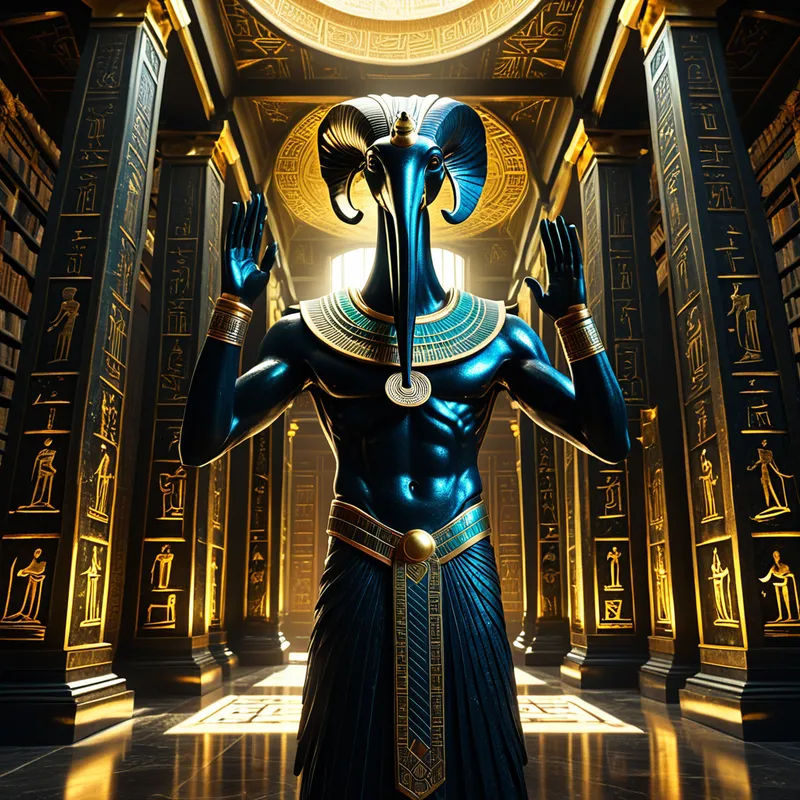
Thoth as Alchemist Myth Meaning & Symbolism
Thoth, the ibis-headed scribe of the gods, masters the alchemy of language and time, transmuting the ephemeral into the eternal through the sacred word.
The Tale of Thoth as Alchemist
Before the sun first carved its path across [the sky](/myths/the-sky “Myth from Persian culture.”/), in the silent, amniotic dark of the Nun, a thought stirred. It was not a sound, but a shape; not a word, but a weight. This was the first substance, [the prima materia](/myths/the-prima-materia “Myth from Alchemical culture.”/) of all that would be. And from this dark potential emerged the one who would name it: [Thoth](/myths/thoth “Myth from Global/Universal culture.”/), the ibis-headed, the measurer, the scribe of the gods.
His realm was not the blazing fury of the sun-barque, nor the fertile mud of [the river](/myths/the-river “Myth from Buddhist culture.”/)’s gift. His temple was the space between heartbeats, the silent expanse between stars. He walked the banks of a celestial Nile, its waters not of H2O, but of time itself, flowing and cyclical. He saw [the world](/myths/the-world “Myth from Tarot culture.”/) as it was: glorious, but fleeting. Ra’s sun would set. [Osiris](/myths/osiris “Myth from Global/Universal culture.”/) would reign in the dusky Duat. Mortals built monuments of stone that sand would claim. All was subject to the great, grinding mill of entropy.
This was the conflict that burned in Thoth’s heart of silver: the tragedy of the ephemeral. Knowledge was born in a [flash of insight](/myths/flash-of-insight “Myth from Alchemical culture.”/), only to be forgotten. Love was a fire that cooled to ash. A dynasty rose in granite, only to become a name whispered by [the wind](/myths/the-wind “Myth from Various culture.”/). The universe was a story written in [water](/myths/water “Myth from Chinese culture.”/).
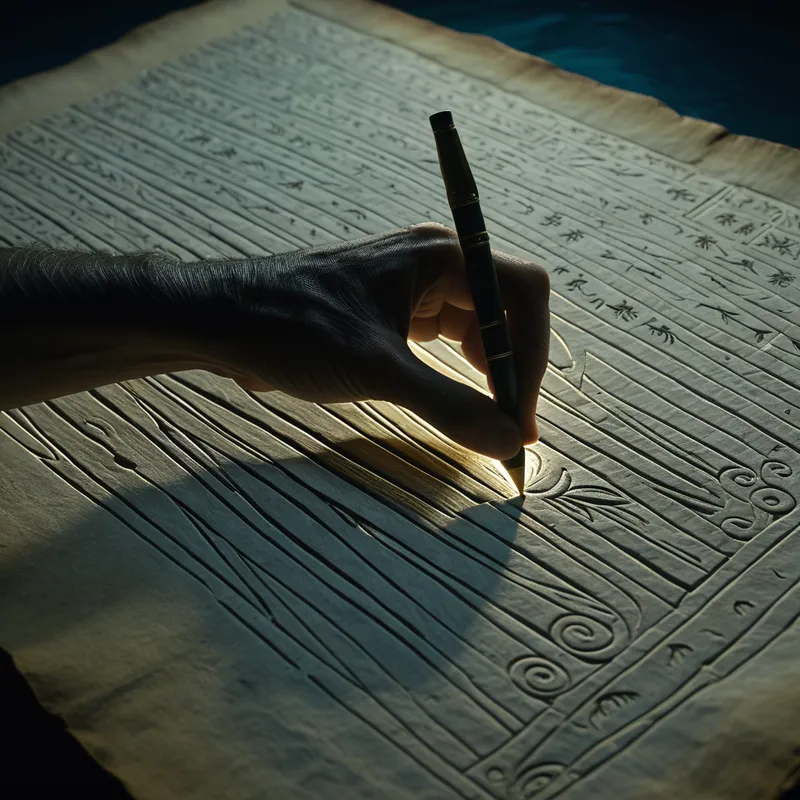
So began his great work, his alchemy. He did not seek the philosopher’s stone to turn lead to gold, but to turn moment into monument, breath into being, sound into soul. His athanor was the vault of the night sky; his crucible, the human mind. His tools were the stylus and the scroll, [the word](/myths/the-word “Myth from Biblical culture.”/) and the number. He bent over the flowing waters of time, not to drink, but to inscribe. With a stylus forged from a beam of [the moon](/myths/the-moon “Myth from Tarot culture.”/), he began to write.
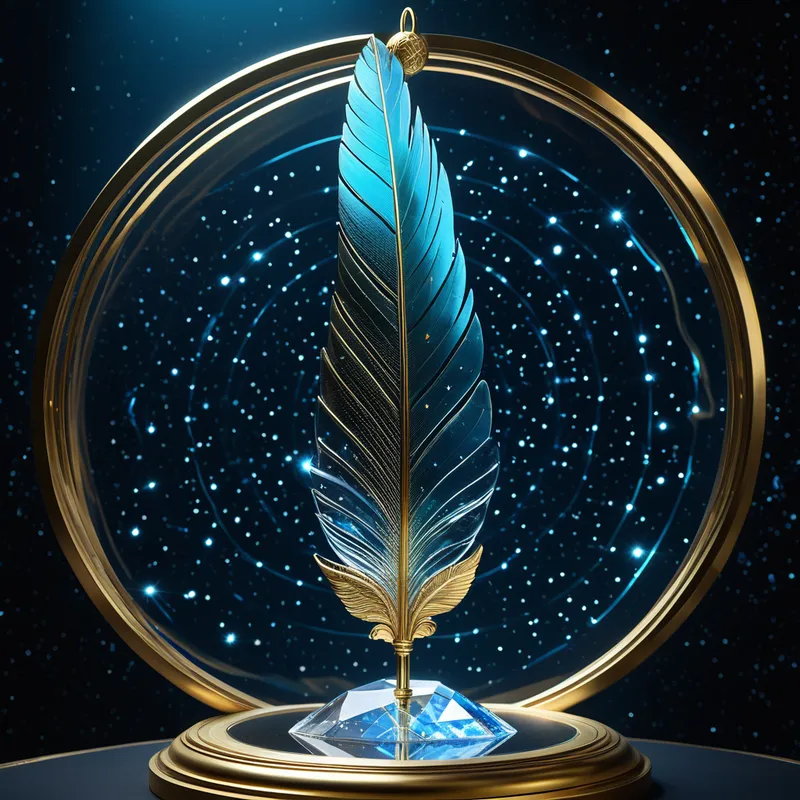
He wrote [the true name](/myths/the-true-name “Myth from Various culture.”/) of Ra, and the sun’s journey was secured. He wrote the spells of protection, and they became walls around [the solar barque](/myths/the-solar-barque “Myth from Egyptian culture.”/). He recorded the weight of a heart against the Feather of Ma’at, and thus defined the fate of souls. He did not just describe reality; he prescribed it. The word, in his script, was not a symbol for a [thing](/myths/thing “Myth from Norse culture.”/); it was [the thing](/myths/the-thing “Myth from Norse culture.”/)’s very skeleton, its spiritual DNA. To speak a [thing](/myths/thing “Myth from Norse culture.”/) with the correct formula, with the proper heka—the magic of utterance—was to summon its essence from the Nun and bind it into lasting form.
The resolution was not a single event, but an eternal process. Thoth became the divine alchemist who transmuted the chaos of potential into the cosmos of order, the fleeting into the permanent. He gave the gods their liturgy, the pharaohs their divine decree, and the dead their passport to eternity. In the silent scriptorium of the cosmos, the scratching of his stylus was the sound of creation being saved from oblivion.
Cultural Origins & Context
The figure of Thoth as the master of transformative knowledge is woven into the very fabric of Egyptian civilization, from the Old Kingdom onward. He was Khmunu’s patron, the lord of Hermopolis Magna, where the Ogdoad—the eight primordial chaos gods—were said to have begun creation. This association with the first moments of order emerging from chaos cemented his role as [the architect](/myths/the-architect “Myth from Various culture.”/) of reality through language and measure.
His myth was not contained in a single, canonical epic like the Epic of [Gilgamesh](/myths/gilgamesh “Myth from Mesopotamian culture.”/). Instead, it was disseminated through temple liturgies, wisdom texts (the “Instructions”), medical and magical papyri, and most profoundly, the Book of the Dead. Priests of Thoth were the scholars, doctors, and magicians—the intellectuals who operated the levers of cosmic and state machinery. The myth of Thoth as Alchemist functioned as the sacred justification for the entire Egyptian project of civilization: to create order (ma’at) from chaos (isfet), to build monuments that defied time, and to secure an eternal afterlife through the correct, Thoth-given rituals and words.
Symbolic Architecture
Thoth represents the archetypal principle of [consciousness](/symbols/consciousness “Symbol: Consciousness represents the state of awareness and perception, encompassing thoughts, feelings, and experiences.”/) itself—the faculty that observes, names, structures, and thereby transforms raw experience into meaningful [reality](/symbols/reality “Symbol: Reality signifies the state of existence and perception, often reflecting one’s understanding of truth and life experiences.”/). His [alchemy](/symbols/alchemy “Symbol: A transformative process of purification and creation, often symbolizing personal or spiritual evolution through difficult stages.”/) is the magic of cognition.
The unspoken is chaos; the word is cosmos. Thoth’s alchemy is the moment a feeling is named, a pattern recognized, a story told—thereby rescuing it from the void of the forgotten.
His ibis head symbolizes the probing mind, beak-like, sifting through the [muddy waters](/symbols/muddy-waters “Symbol: Muddy waters symbolize confusion, moral ambiguity, and the challenges of navigating through life’s complexities and vices.”/) of the unconscious (Nun) to find the nourishing seeds of [truth](/symbols/truth “Symbol: Truth represents authenticity, honesty, and the quest for knowledge beyond mere appearances.”/). The baboon form, often associated with him, represents the [dawn](/symbols/dawn “Symbol: The first light of day, symbolizing new beginnings, hope, and the transition from darkness to illumination.”/)—the [moment](/symbols/moment “Symbol: The symbol of a ‘moment’ embodies the significance of transient experiences that encapsulate emotional depth or pivotal transformations in life.”/) of first [illumination](/symbols/illumination “Symbol: A sudden clarity or revelation, often representing spiritual awakening, intellectual breakthrough, or the dispelling of ignorance.”/), when [night](/symbols/night “Symbol: Night often symbolizes the unconscious, mystery, and the unknown, representing the realm of dreams and intuition.”/)’s mysteries are clarified by the rising sun of [awareness](/symbols/awareness “Symbol: Conscious perception of self, surroundings, or internal states. Often signifies awakening, insight, or heightened sensitivity.”/). The [moon](/symbols/moon “Symbol: The Moon symbolizes intuition, emotional depth, and the cyclical nature of life, often reflecting the inner self and subconscious desires.”/), his celestial [body](/symbols/body “Symbol: The body in dreams often symbolizes the dreamer’s self-identity, personal health, and the relationship they have with their physical existence.”/), reflects the light of the sun (Ra, the ultimate [source](/symbols/source “Symbol: The origin point of something, often representing beginnings, nourishment, or the fundamental cause behind phenomena.”/)), just as the conscious mind reflects and gives form to the brilliant, but often blinding, insights of the deeper Self.
His central [artifact](/symbols/artifact “Symbol: An object from the past carrying historical, cultural, or personal significance, often representing legacy, memory, or hidden knowledge.”/), the scribal palette, is the alchemical [vessel](/symbols/vessel “Symbol: A container or structure that holds, transports, or protects something essential, representing the self, emotions, or life journey.”/). The black and red inks are not mere pigments; they are the substances of [differentiation](/symbols/differentiation “Symbol: The process of distinguishing or separating parts of the self, emotions, or identity from a whole, often marking a developmental or psychological milestone.”/). Black represents the fertile, potential-laden darkness, while red signifies [action](/symbols/action “Symbol: Action in dreams represents the drive for agency, motivation, and the ability to take control of situations in waking life.”/), [life](/symbols/life “Symbol: The symbol of ‘Life’ represents a journey of growth, interconnectedness, and existential meaning, encompassing both the joys and challenges that define human experience.”/), and [danger](/symbols/danger “Symbol: The symbol of ‘Danger’ often indicates a sense of threat or instability, calling for caution and awareness.”/). To write is to mix these primordial opposites on the [page](/symbols/page “Symbol: A page often represents knowledge, learning, and the unfolding of a narrative in one’s life.”/) of reality, creating the “third thing”—the lasting record, the fixed truth.
The Dreamer’s Resonance
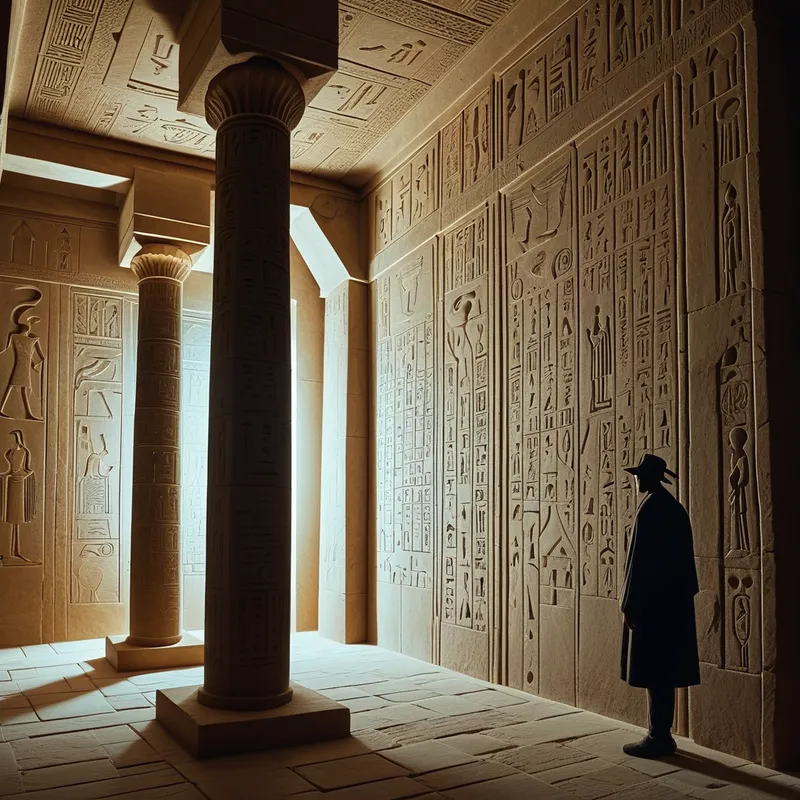
When this myth stirs in the modern [psyche](/myths/psyche “Myth from Greek culture.”/), it often manifests in dreams of libraries, forgotten languages, or urgent, unreadable messages. One might dream of trying to write with water, the letters dissolving—a somatic expression of the fear that one’s insights or experiences are slipping away, unintegrated. Alternatively, a dream of discovering a secret book whose symbols shift and glow speaks to the emergence of a new, personal “script” or framework for understanding one’s life.
The psychological process at work is the struggle to consciously assimilate and structure powerful unconscious content. The dream-ego is in the role of Thoth’s apprentice, faced with the raw, chaotic “waters” of a new emotion, a trauma, or a creative impulse. The dream is the [temenos](/myths/temenos “Myth from Greek culture.”/), the sacred workshop, where the psyche attempts its own alchemy: to find the right “word”—the correct interpretation, the healing narrative, the creative form—that will stabilize the ephemeral psychic energy into a lasting part of the personality structure.
Alchemical Translation
For the individual on the path of individuation, Thoth’s myth models the quintessential inner work of psychic transmutation. The [prima materia](/myths/prima-materia “Myth from Alchemical culture.”/) is the leaden weight of our undigested life—the repetitive patterns, the complexes, [the shadow](/myths/the-shadow “Myth from Jungian culture.”/) material that feels chaotic and burdensome.
The alchemical operation is not about eliminating the base material, but about reading it, understanding its hidden language, and transcribing it into the story of the Self.
The “[Nigredo](/myths/nigredo “Myth from Alchemical culture.”/),” the initial blackening, is the descent into this chaos, the honest confrontation with what has been left unspoken and unformed within us. Thoth, as the guiding archetype of the transcendent function, provides the tools: mindful observation (the ibis), patient waiting for insight (the moon), and the courageous act of formulation (the stylus).
The “Albedo,” the whitening, is the moment of clarity, when we find the precise inner word, image, or symbol that captures the essence of our struggle. This is the creation of our personal Book of the Dead—not for literal afterlife, but for the death of old, unconscious ways of being. By writing our own narrative, by naming our demons and our divinities, we perform Thoth’s alchemy. We transmute the lead of suffering into the gold of wisdom, the ephemeral wound into an eternal, integrated part of our myth. We become, like Thoth, the scribe of our own soul, ensuring that nothing of true value is lost to the river of time.
Associated Symbols
Explore related symbols from the CaleaDream lexicon: