Third Eye Myth Meaning & Symbolism
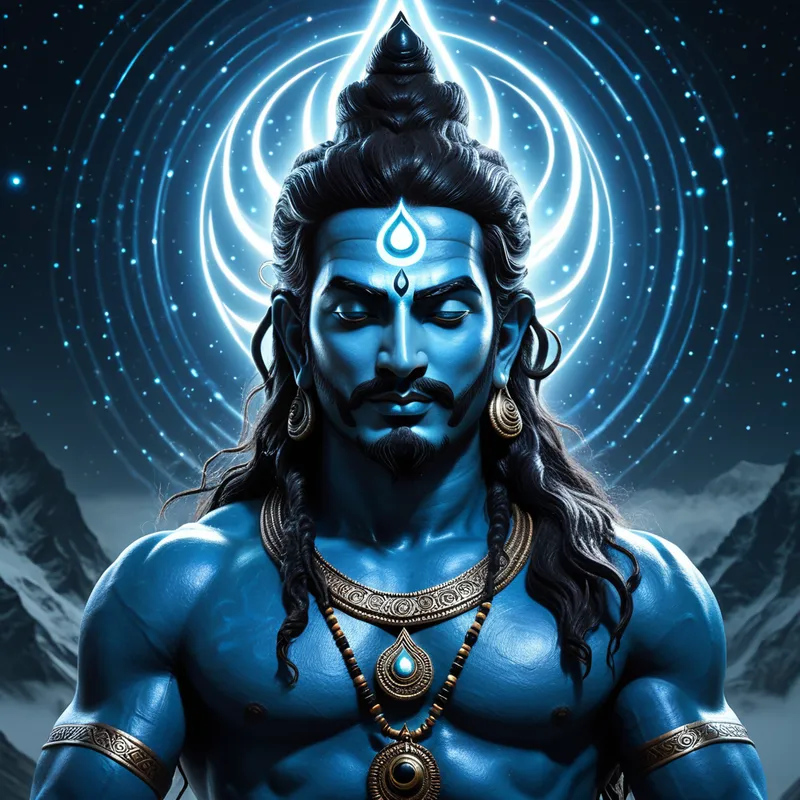
When desire threatens cosmic order, Shiva opens his Third Eye, incinerating illusion and revealing the searing light of pure, unadorned consciousness.
The Tale of the Third Eye
Listen. Before time was counted, in the high, silent fastness where snow meets sky, he sat. Shiva, the great ascetic, was deep in samadhi. His body was still as mountain stone, smeared with the ash of forgotten universes. His matted locks were the nesting place of galaxies, and the crescent moon, a cool companion, rested upon them. In this absolute stillness, the cosmos found its axis. The dance of creation and preservation whirled on, but here, in the heart of stillness, was the potential for all endings and all new beginnings.
But a tremor ran through the orders of the world. A demon, Taraka, had won a boon of invincibility—he could be slain only by a son of Shiva. And Shiva had no son. He had only his eternal meditation, his perfect, world-renouncing solitude. The gods trembled. The balance of dharma tilted towards chaos. Their solution was born of desperate cunning: Shiva must be stirred from his trance. He must look upon Shakti, the daughter of the mountain king, who loved him with a fierce, unwavering tapas of her own. He must feel desire.
They summoned Kama. The air grew heavy with the scent of mango blossoms and the distant sound of bees. Kama, handsome and fearless, crept towards the immutable one. Vasanta, the spring, went before him, weaving a carpet of sudden, impossible flowers across the eternal ice. Kama drew his bow, its string a line of hummingbirds, its arrow tipped with the essence of longing. He took aim at the heart of the unmoving god.
He loosed the arrow.
It flew, a whisper of disturbance through the pristine silence. It struck.
Shiva’s eyes did not open. But a frown, subtle as a seismic shift, passed over his features. The meditation was pierced. The infinite focus, disturbed. And in that moment of rupture, a new sense awakened. Upon his broad forehead, where the in-breath and the out-breath meet in perfect equilibrium, a fissure appeared. It was not an eye of flesh, but a vortex, a sun-birth. It was the Ajna Chakra made manifest—the Third Eye.
It opened.
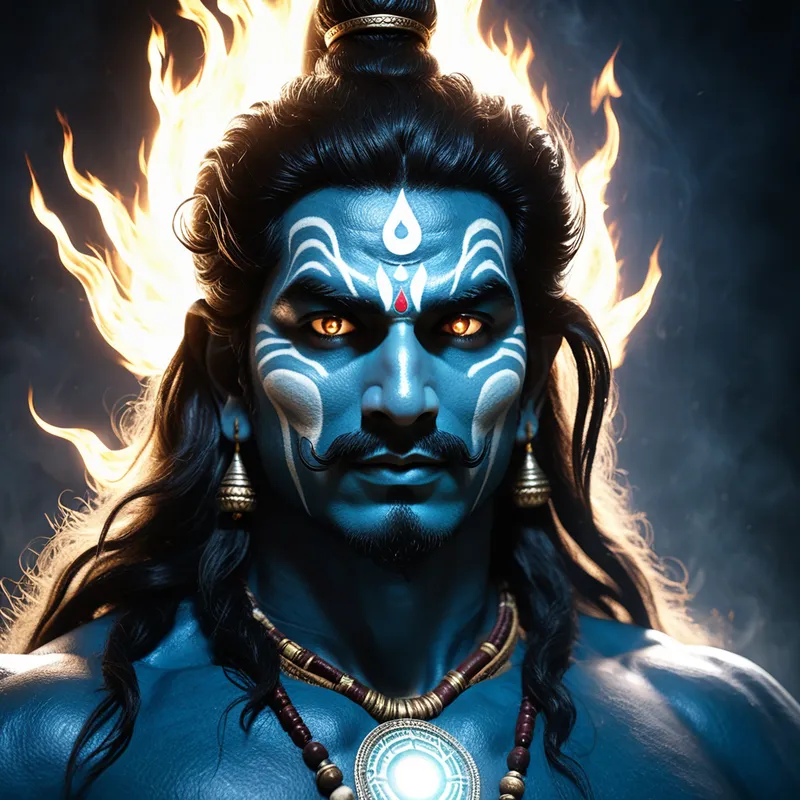
There was no pupil, only a column of pure, white, annihilating light. It was consciousness itself, furious in its purity, intolerant of any veil. The beam found Kama. There was no battle, no struggle. The god of form, of attachment, of sweet delirium, was instantly incinerated. He became ananga, the bodiless one. The scents of spring turned to acrid ozone. The imagined flowers turned to ash. The silence returned, deeper now, charged with the aftermath of an absolute negation.
Shiva’s physical eyes then opened, gazing upon the world now clear of that particular illusion. The cosmic order was preserved, for the path was now clear for a union not of mere desire, but of conscious, willing partnership with Shakti. The demon’s fate was sealed in that act of searing clarity. The Third Eye had spoken its first, fiery word: Neti, neti—not this, not this.
Cultural Origins & Context
This myth is woven into the vast tapestry of Puranic literature, particularly the Shiva Purana and the Kumarasambhava of Kalidasa. It was not merely a story for entertainment, but a cosmological instruction manual. Told by sages (rishis) in forest hermitages and later elaborated upon by temple storytellers, it served a critical societal function: it illustrated the supreme value of self-mastery (dama) and transcendent consciousness (jnana) over the chaotic pull of the senses (indriyas).
In a culture that deeply respected both the ascetic path of renunciation (sannyasa) and the householder’s path of duty (grihastha), this myth established a hierarchy of truths. It acknowledged the power of Kama—desire is a cosmic force—but positioned it as a secondary, often blinding, energy compared to the supreme reality of pure consciousness represented by Shiva. The myth validated the meditative practices of yogis seeking to awaken this very ajna chakra, while also warning of the raw, destructive power of unintegrated spiritual force. It was a narrative anchor for complex philosophical concepts about perception, reality (maya), and the ultimate goal of liberation (moksha).
Symbolic Architecture
The Third Eye is the ultimate symbol of perception beyond duality. The two physical eyes see the world of opposites: light and dark, good and evil, pleasure and pain. They are bound to maya, the glorious and terrifying illusion of separation. The Third Eye sees the unity beneath.
The Third Eye does not see objects; it sees the substance from which objects are momentarily formed.
Kama represents the entire psychic complex of attachment, personal longing, and distracting emotion. He is not “evil,” but he is the great seducer away from the absolute. Shiva’s incineration of Kama is not an act of petty wrath, but the necessary dissolution of the personal ego’s claims on the boundless Self. It is the psyche’s own immune response against a parasitic identification.
The ash that smears Shiva’s body is the residue of all such burned-away illusions. The opening of the Eye is not a gentle awakening but a violent rupture—a psychic catastrophe that is simultaneously a revelation. It symbolizes the moment when accumulated insight (viveka) reaches a critical mass and shatters the conventional mind, allowing a new, terrifying, and liberating faculty of knowing to emerge.
The Dreamer’s Resonance
When this myth stirs in the modern dreamer, it often manifests as dreams of sudden, overwhelming light—a lamp switched on in a dark room, headlights blinding the dream-ego, or a laser beam cutting through confusion. There may be dreams of burning specific objects, people, or even parts of one’s own dream body. The somatic experience is one of intense heat in the forehead or a pressure between the brows, mirroring the traditional location of the ajna chakra.
Psychologically, this dream pattern signals a profound interior process: the conscious mind is being forced to incinerate a long-held, self-serving illusion. It is the psyche’s autonomous move to destroy a “Kama” within—perhaps a cherished fantasy, a toxic attachment, or a deeply ingrained self-deception that has blocked a more authentic life. The dreamer may awake feeling scorched, empty, but strangely clear. The beloved or desired object in the dream (the Kama-figure) is not necessarily lost, but is being transformed from an object of blind craving into something that can be related to with conscious choice.

Alchemical Translation
The alchemical journey modeled here is the transmutation of scattered, desire-driven awareness into focused, penetrating insight. The prima materia is the distracted mind, buzzing with the “arrows of Kama”—every craving, opinion, and emotional reaction. The first stage is nigredo, the deep meditation or introspective work (Shiva’s tapas) that feels like a death to the world.
The opening of the Eye is the albedo and rubedo combined—a searing whitening and reddening. It is the moment of individuation where the ego, identified with its desires, is sacrificed to the greater reality of the Self.
The ultimate goal is not to become a destroyer, but to integrate the Eye’s vision so fully that one can engage the world without being consumed by it.
For the modern individual, this translates to cultivating the discipline to pause—to enter one’s own meditative stillness amidst life’s chaos. The “Third Eye” action is the conscious choice to see the compulsive desire for what it is, and to let it be burned away by the simple, fierce light of honest attention. The demon “Taraka” that can only be slain by this process is any life-stagnating pattern born of ignorance. The union with “Shakti” that follows is the sacred marriage of this clear consciousness with one’s vital, creative energy in the world, now directed wisely and powerfully. We are invited not to literally grow an eye, but to allow our perception to be born anew from the ashes of what we were once certain we needed to see.
Associated Symbols
Explore related symbols from the CaleaDream lexicon: