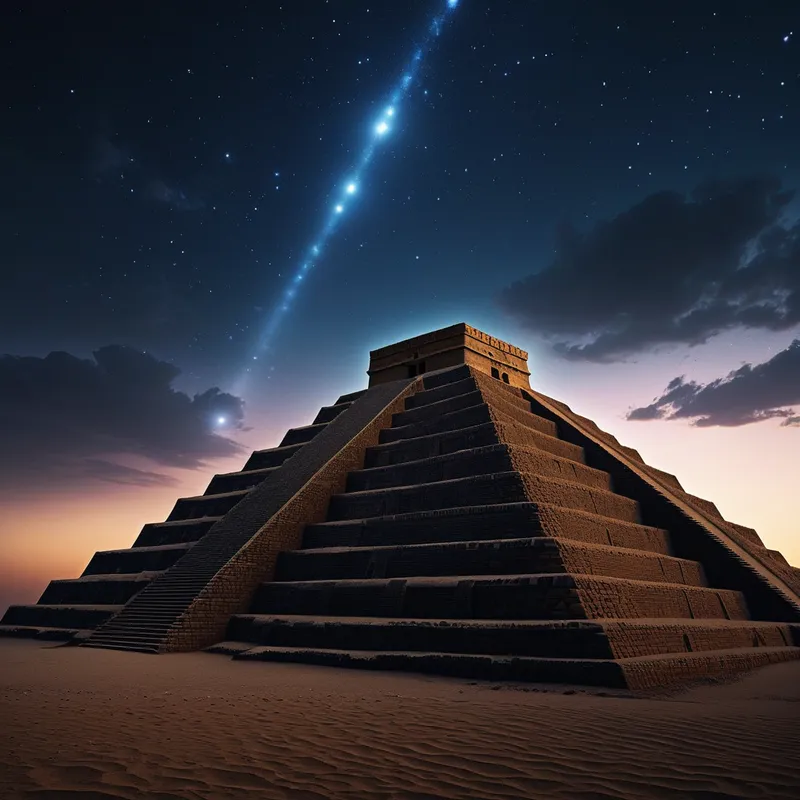
The Ziggurat Myth Meaning & Symbolism
A sacred mountain of brick and ambition, built to bridge the mortal world with the divine, only to scatter humanity into a chorus of confusion.
The Tale of The Ziggurat
Hear now, of the time when [the world](/myths/the-world “Myth from Tarot culture.”/) was young, and the memory of the great deluge was a fresh scar upon the land of Shinar. The people, once scattered by the wrath of the gods, had gathered again. Their hearts, beating as one, conceived a thought both magnificent and terrifying: “Let us build a city, and a tower whose top may reach unto heaven; and let us make us a name, lest we be scattered abroad upon the face of the whole earth.”
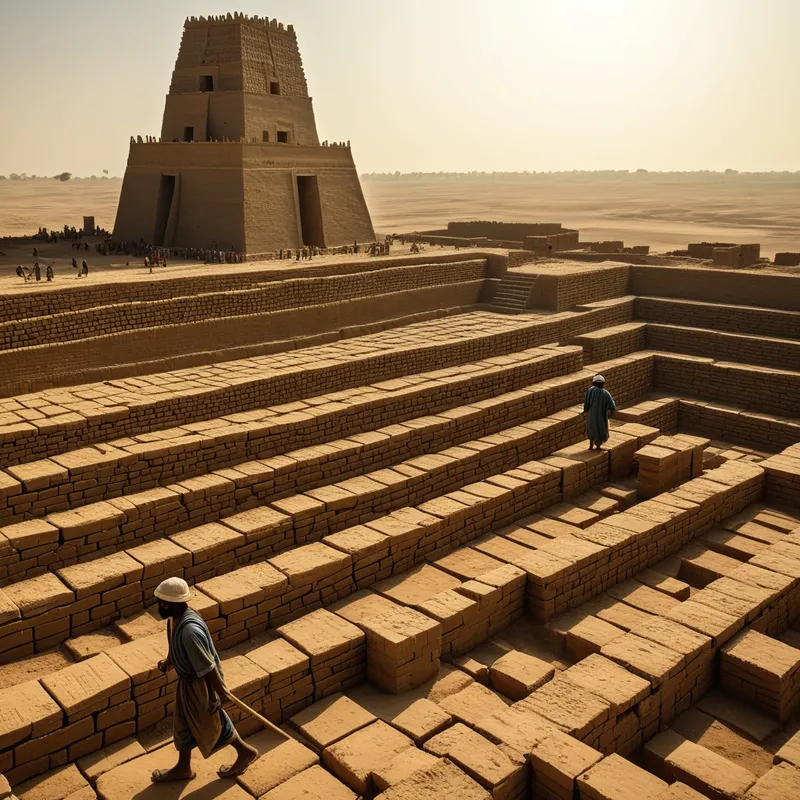
And so they did. In the plain, they baked bricks until the kilns glowed like fallen suns, and they used bitumen for mortar, black and strong as the bonds of kinship. The sound was a symphony of ambition—the slap of wet clay, the groan of ropes, the chants of laborers moving in rhythm under the watchful eye of [Marduk](/myths/marduk “Myth from Mesopotamian culture.”/). Stone by stone, course by course, the [ziggurat](/myths/ziggurat “Myth from Mesopotamian culture.”/) rose. It was not merely a building; it was a ladder of human will, a mountain crafted from [the earth](/myths/the-earth “Myth from Hindu culture.”/) itself, aiming to pierce the vault of the firmament where Anu resided.
The air grew thin at [the summit](/myths/the-summit “Myth from Taoist culture.”/). The workers, their skin coated in fine dust, could almost feel the brush of the lower heavens. They believed they were weaving the threads of earth and sky into a single tapestry, creating a permanent road for the gods to descend and for their own prayers to ascend, unmediated and pure. They were making a name, a singular identity for all humanity, united in one tongue and one purpose.
But the gods looked down from their celestial abodes. They saw the peak of [the tower](/myths/the-tower “Myth from Tarot culture.”/) inching closer, a spear of baked earth aimed at the heart of the divine realm. A council was called. “Behold, the people are one, and they have all one language,” they said, their voices like distant thunder. “And this they begin to do: and now nothing will be restrained from them, which they have imagined to do.”
Then came the decree, not of fire or flood, but of a subtler, more profound unraveling. Ea, the cunning one, acted. He did not topple the bricks. He touched the source of their unity—their speech. A great wind of confusion swept through the construction yards, the temples, the homes. A man asking for a brick found his words becoming strange, guttural sounds to his brother. Commands dissolved into babble. The shared dream, once clear as cuneiform on a tablet, shattered into a thousand meaningless fragments.
Where there was one tongue, now there were seventy. Where there was one purpose, now there were seventy scattered, competing fears. The work halted. The great tower, unfinished, stood as a monument to a lost unity. The people, unable to understand one another, looked upon their neighbors with suspicion and fear. They gathered in linguistic tribes and were scattered from Babel across the face of the world, taking with them the fragments of their grand ambition, leaving the ziggurat silent and abandoned, a stairway to nowhere.
Cultural Origins & Context
This tale, known to us from the Enuma Elish and later Hebrew texts, is not a story told for mere entertainment around a fire. It is an etiological myth, born from the very landscape of Mesopotamia. The people of the Tigris-Euphrates valley lived on a flat alluvial plain. The mountain, as a symbol of stability, permanence, and proximity to the gods, was absent. So they built their own—the ziggurat. These were not just temples but the literal axis mundi, the axis mundi, for cities like Ur, Uruk, and Babylon.
The myth of the ziggurat’s ambition—often called [the Tower of Babel](/myths/the-tower-of-babel “Myth from Global/Universal culture.”/) narrative—functioned as a profound cultural mirror. It explained the bewildering diversity of human languages and tribes. More importantly, it served as a divine sanction for the social and political order. The king, as the intermediary between gods and men, was the only one who could properly ascend the ziggurat’s heights during sacred rituals. The myth warned against collective human ambition unchecked by divine authority and priestly hierarchy. It was a story told by the scribes and priests to reinforce the idea that direct access to the divine is not humanity’s prerogative; it is a mediated privilege, granted through the correct channels of ritual and royal power.
Symbolic Architecture
The [ziggurat](/symbols/ziggurat “Symbol: A ziggurat symbolizes a connection between humanity and the divine, representing a structured path to spiritual elevation and cultural legacy.”/) is more than a failed [skyscraper](/symbols/skyscraper “Symbol: Skyscrapers often symbolize ambition, success, and the pursuit of dreams, representing both personal and societal aspirations.”/). It is a perfect symbolic [architecture](/symbols/architecture “Symbol: Architecture in dreams often signifies structure, stability, and the framing of personal identity or life’s journey.”/) of the [human](/symbols/human “Symbol: The symbol of a human represents individuality, complexity of emotions, and social relationships.”/) [psyche](/myths/psyche “Myth from Greek culture.”/). Its stepped levels represent the arduous [ascent](/symbols/ascent “Symbol: Symbolizes upward movement, progress, spiritual elevation, or striving toward higher goals, often representing personal growth or transcendence.”/) from the mundane world of matter (the base) to the [realm](/symbols/realm “Symbol: The symbol of ‘Realm’ often signifies the boundaries of one’s consciousness, experiences, or emotional states, suggesting aspects of reality that are either explored or ignored.”/) of [spirit](/symbols/spirit “Symbol: Spirit symbolizes the essence of life, vitality, and the spiritual journey of the individual.”/) and [consciousness](/symbols/consciousness “Symbol: Consciousness represents the state of awareness and perception, encompassing thoughts, feelings, and experiences.”/) (the apex). Each terrace is a stage of understanding, a [layer](/symbols/layer “Symbol: Layers often symbolize complexity, depth, and protection in dreams, representing the various aspects of the self or situations.”/) of [the self](/myths/the-self “Myth from Jungian culture.”/) to be integrated.
The true summit is not in overpowering the heavens, but in discovering that the heavens are a mirror of the depths within.
The single, unified [language](/symbols/language “Symbol: Language symbolizes communication, understanding, and the complexities of expressing thoughts and emotions.”/) represents [the ego](/myths/the-ego “Myth from Jungian culture.”/)’s initial, monolithic consciousness—a state of naive identification where the individual is perfectly merged with the tribe, the culture, the single goal. There is no internal conflict because there is no internal “other.” The “name” they seek to make is a solidified, collective ego, desperate for immortality and recognition.
The “[confusion](/symbols/confusion “Symbol: A state of mental uncertainty or disorientation, often reflecting internal conflict, lack of clarity, or overwhelming choices in waking life.”/) of tongues” sent by the gods is not a [punishment](/symbols/punishment “Symbol: A dream symbol representing consequences for actions, often tied to guilt, societal rules, or internal moral conflicts.”/), but the necessary [birth](/symbols/birth “Symbol: Birth symbolizes new beginnings, transformation, and the potential for growth and development.”/) of the unconscious. It is the [eruption](/symbols/eruption “Symbol: A sudden, violent release of pent-up energy or emotion from beneath the surface, often representing transformation or crisis.”/) of complexity, of [shadow](/symbols/shadow “Symbol: The ‘shadow’ embodies the unconscious, repressed aspects of the self and often represents fears or hidden emotions.”/), of all the repressed and differing parts of the self that the singular, ambitious ego tried to ignore. The scattering is the [fragmentation](/symbols/fragmentation “Symbol: The experience of breaking apart, losing cohesion, or being separated into pieces. Often represents disintegration of self, relationships, or reality.”/) of the psyche into complexes—the inner voices that argue in different languages, the drives that pull in opposing directions. The unfinished [tower](/symbols/tower “Symbol: The tower symbolizes protection, aspirations, and isolation, representing both stability and the longing for higher achievement.”/) then becomes the Self in its potential, unrealized state. The [journey](/symbols/journey “Symbol: A journey in dreams typically signifies adventure, growth, or a significant life transition.”/) is no longer a straight vertical climb, but a painful, circuitous gathering of these scattered psychic fragments.
The Dreamer’s Resonance
When the ziggurat appears in a modern dream, it is a signal from the depths. You are likely in a phase of ambitious striving, building a career, a relationship, or an identity with single-minded focus. The dream asks: What are you trying to forcibly unite? What aspect of your inner world are you attempting to storm and conquer?
Dreaming of climbing the ziggurat speaks to a sincere, often arduous, process of spiritual or psychological ascent. You are working through layers of yourself. But if the stairs crumble, or you find yourself lost on endless terraces, the unconscious is warning of spiritual bypassing—using transcendence to avoid the messy, human work of integration.
Dreaming of the construction site, with its chaos and babble, directly mirrors the experience of a psyche in the throes of reorganization. The different “languages” are your conflicting values, roles, and desires. The somatic feeling is often one of frustration, anxiety, or profound loneliness—the sense that even the parts of yourself cannot understand each other. This is not a dysfunction, but the necessary deconstruction of an old, rigid ego-structure before a more authentic Self can be assembled.
Alchemical Translation
The alchemical process mirrored here is the [solutio](/myths/solutio “Myth from Alchemical culture.”/) followed by the long work of coagulatio. The initial, unified ego (the single language) must be dissolved (the confusion). This is a crisis, a dark night where all former certainties and identities lose their meaning. We are scattered into our component complexes.
The individuation journey is not about rebuilding the same monolithic tower with a different name. It is about learning to listen to the cacophony. [The alchemist](/myths/the-alchemist “Myth from Various culture.”/) must become a linguist of the soul, patiently learning the seventy tongues within—the language of the inner child, the critic, the rebel, the sage. Each must be given a voice, heard, and acknowledged.
The goal is not a new, higher singularity, but a sacred assembly—a parliament of the self where all voices are heard, yet a central, reconciling consciousness presides.
The completed “ziggurat” of the individuated Self is not a tower that reaches an external heaven. It is an internal structure of profound depth and height, where the summit and the foundation are in constant communication. The “gods” are no longer external forces to be stormed, but archetypal powers integrated into the personality. The myth teaches that wholeness is found not in conquering the divine, but in realizing that the journey to the summit is, simultaneously, a descent into the very core of one’s own being, where all languages finally, quietly, make sense.
Associated Symbols
Explore related symbols from the CaleaDream lexicon: