The Writing on the Wall Myth Meaning & Symbolism
A king's sacrilegious feast is interrupted by a disembodied hand, writing a cryptic judgment on the palace wall that seals his empire's fate.
The Tale of The Writing on the Wall
Let the noise of the world fade. Let us travel to a city of baked brick and blue-glazed tile, where the Euphrates flows slow and heavy as molten bronze. Babylon, the glory of kingdoms, the beauty of the Chaldeans’ pride. Its walls are broad enough for chariots to turn upon; its hanging gardens whisper secrets to the desert wind. And in its heart, in the palace that scrapes the belly of the sky, a feast is laid.
King Belshazzar commands it. A thousand of his lords are gathered—satrap, general, and courtier—their robes a riot of purple and crimson. The air is thick with the scent of roasting meats, spiced wine, and the oil of a hundred lamps. Music thrums, a relentless pulse of lyre and pipe and drum, meant to drown out the silence of the encircling night. But this is no ordinary celebration. A cold defiance fuels its fire. For outside the walls, a host encamps: the Medes and the Persians, led by Darius. The siege is a tightening fist.
And Belshazzar, in his pride, makes a decree. His voice cuts through the revelry. “Bring the vessels.” Not just any vessels, but the sacred gold and silver goblets looted decades prior from the Temple in Jerusalem. They are brought, these hallowed things, and the king, his princes, his wives, his concubines, drink from them. They drink to gods of gold and silver, of bronze, iron, wood, and stone—deaf and dumb idols. They profane the holy with their lips, using the sacred to toast their own fleeting power. It is an act of supreme hubris, a deliberate spitting in the eye of the Unseen.
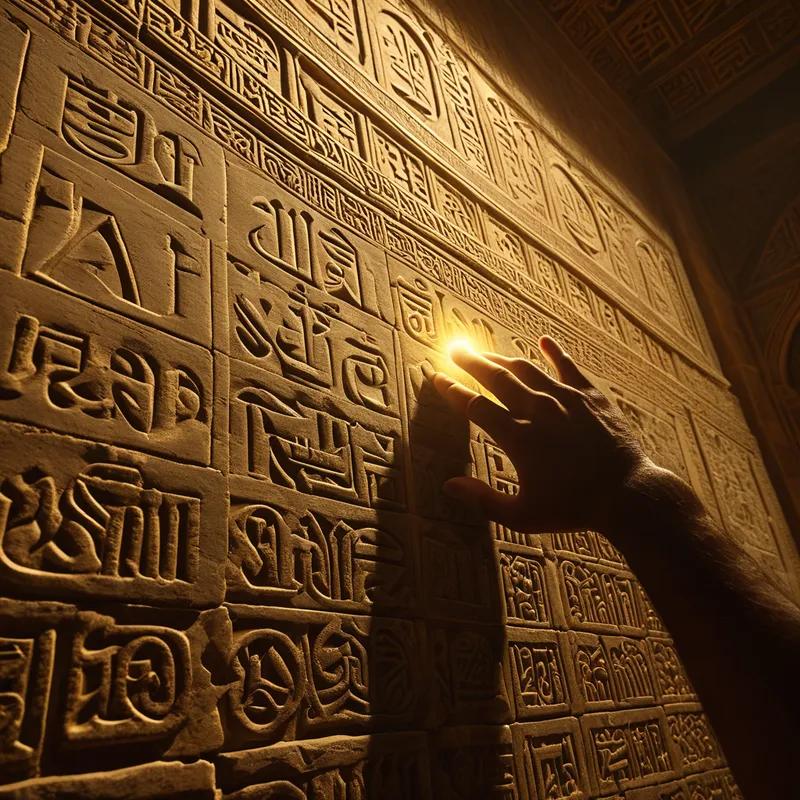
Then, in the midst of the cacophony, a change sweeps the hall. The music dies in the throats of the players. The laughter curdles. All eyes are drawn, as if by a physical force, to the blank plaster of the wall, illuminated by the lampstand’s glow. And there it appears: the fingers of a human hand. No arm, no body, just the fingers, writing silently upon the wall. They trace words in the plaster, letters of fire that burn without consuming.
The king watches. The blood drains from his face; his limbs tremble until his knees knock together. The festive heat vanishes, replaced by a tomb’s chill. His majesty unravels into raw, animal fear. He cries out for his wise men—the enchanters, the Chaldeans, the astrologers. “Whoever reads this writing and shows me its interpretation,” he gasps, “shall be clothed in purple, have a chain of gold around his neck, and shall be the third ruler in the kingdom!” But the wise men are useless. They stare at the words—MENE, TEKEL, PARSIN—and see only mystery. They cannot read the writing or make known its interpretation. The king’s terror deepens; the feast hall has become a court of dread.
Then the queen mother enters, her bearing calm amidst the panic. She speaks of a man in the kingdom, a captive from Judah, in whom is the spirit of the holy gods. A man of illumination and insight. “Let Daniel be called,” she says. And Daniel is brought before the shaking king. He refuses the rewards. He recounts the story of Belshazzar’s father, Nebuchadnezzar, and his humbling by the Most High. “But you, Belshazzar,” Daniel’s voice rings clear, “have not humbled your heart, though you knew all this. You have exalted yourself against the Lord of heaven.”
Then he turns to the writing. “This is the interpretation: MENE: God has numbered the days of your kingdom and brought it to an end. TEKEL: You have been weighed on the scales and found wanting. PERES: Your kingdom is divided and given to the Medes and Persians.”
That very night, as the words still glowed in the memory of the plaster, Darius the Mede entered the city. Belshazzar, the Chaldean king, was slain. The empire passed to another. The writing was not a warning; it was a verdict, already executed. The hand had merely inscribed the decree of a reality that had already come to pass.
Cultural Origins & Context
This story is preserved in the fifth chapter of the Book of Daniel. While set during the Babylonian exile (6th century BCE), most scholars place its composition later, during the Maccabean period (2nd century BCE), a time of intense cultural and religious crisis for the Jewish people. The tale functioned as powerful resistance literature. For a community under the heel of a foreign empire (first Greek, then Roman), the story of Belshazzar’s fall was a potent myth of hope and divine justice. It asserted that no earthly power, no matter how glorious or blasphemous, operates outside a higher moral order. Its telling was an act of psychological defiance, a reminder that the profanation of the sacred (like the Temple vessels) would not go unanswered by history itself. It was passed down not as a dry chronicle, but as a prophetic drama, a sermon in narrative form, meant to fortify identity and faith in the face of overwhelming oppression.
Symbolic Architecture
The myth’s power lies in its stark, almost surgical symbolism. The feast represents the inflated, performative ego—Belshazzar’s attempt to use spectacle, noise, and sacrilege to ward off the reality of his own vulnerability and the enemy at the gate. The sacred vessels are symbols of the numinous, the transcendent, which the ego attempts to co-opt for its own aggrandizement, draining them of their true meaning.
The writing appears not in the sky for all to see, but on the interior wall of the palace. Revelation strikes at the heart of the fortress the ego has built for itself.
The disembodied hand is the intrusion of the Self—the total, organizing principle of the psyche—into the narrow kingdom of the conscious ego. It is impersonal, undeniable, and writes in the language of the soul. Daniel, the interpreter, embodies the archetype of the sage or prophet—the psychic function capable of translating the symbolic language of the unconscious into conscious understanding. The three words are a profound tripartite judgment: Numbered speaks to the limits of temporal power; Weighed is an ethical and existential audit; Divided signifies the inevitable disintegration that follows when the psyche is cut off from its sacred center.
The Dreamer’s Resonance
When this myth patterns a modern dream, the dreamer is often in a state of profound psychological reckoning. The “feast” may manifest as a dream of a chaotic party, a stressful work event, or a scenario of hollow success. The “sacred vessels” could be represented by misused personal talents, neglected values, or a relationship treated with disrespect. The somatic feeling is often one of latent anxiety beneath a facade of control—the “knees knocking” sensation.
The climactic moment is the appearance of the “writing.” In dreams, this may be a mysterious text on a phone screen that can’t be read, graffiti on a familiar wall that shifts meaning, or a crucial document whose words blur. The terror is not of a monster, but of a message—a verdict from a deeper part of the self that the conscious ego has been avoiding. The dreamer is at the threshold where a long-ignored inner truth can no longer be suppressed. It is the psyche’s final notice before a necessary collapse of an outdated way of being.

Alchemical Translation
The alchemical process modeled here is the nigredo—the blackening, the putrefaction, the necessary death of the old king (the dominant conscious attitude). Belshazzar’s ego, identified entirely with the power and glory of the temporal kingdom (Babylon), must be dissolved for something new to emerge. The feast is the last, frantic inflation before the fall.
The hand does not write a suggestion; it inscribes a fact. The alchemical revelation is that the transformation is not something you choose to begin, but something you discover has already begun within you.
The individual’s “Daniel moment” is the courageous act of turning toward the frightening script and seeking its meaning. This is the beginning of interpretatio, the crucial work of making the unconscious conscious. To be “weighed and found wanting” is not a condemnation to worthlessness, but a call to integrate the missing parts—often humility, reverence, or connection to the transpersonal. The kingdom that is “divided and given to the Medes and Persians” symbolizes the end of a monolithic, autocratic ego-structure. In its place, a more complex, differentiated psyche can form, one that acknowledges other “rulers” or internal authorities (the Medes and Persians as other aspects of the Self). The myth, in its brutal elegance, assures us that this death is not chaos, but a divinely-ordered end—the prelude to a new, and perhaps more authentic, reign.
Associated Symbols
Explore related symbols from the CaleaDream lexicon: