The World Tree Yggdrasil from Myth Meaning & Symbolism
An immense ash tree connects all worlds, from the gods' realm to the underworld, embodying cosmic order, sacrifice, and the cycle of destruction and renewal.
The Tale of The World Tree Yggdrasil
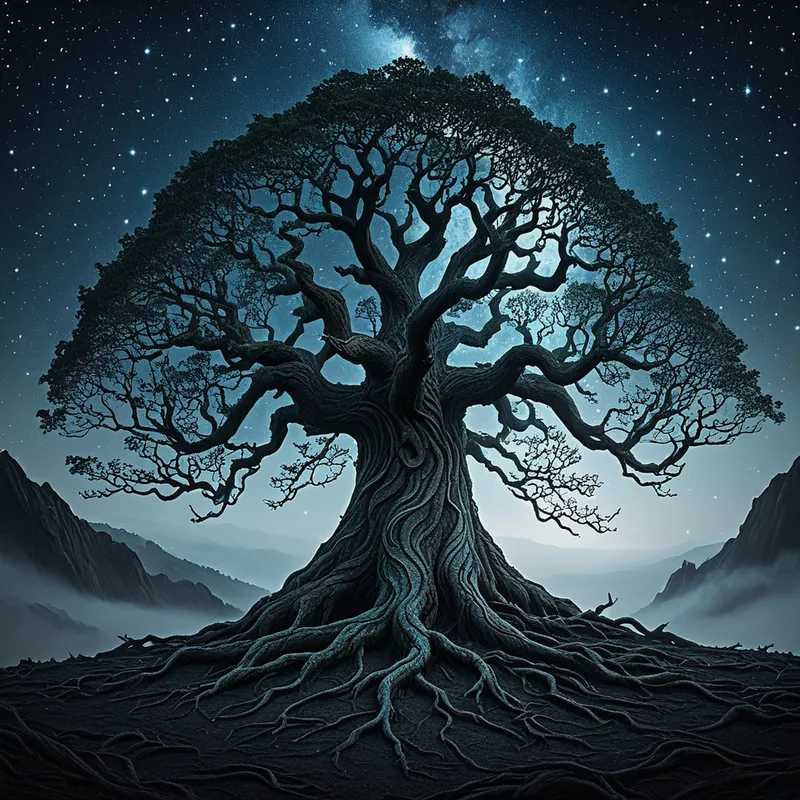
Listen, and hear the whisper in the wind through the leaves. It speaks of an age before ages, of a foundation that is not stone but sap and spirit. There stands Yggdrasil, the Ash, immense and terrible in its majesty. Its branches, heavier than mountains, scrape the cold stars. Its three great roots drink from wells of fate, memory, and primal mist.
High in its crown sits Asgard, golden and proud. An eagle, keen-eyed and knowing, perches here, and between its eyes sits a hawk. In the middle branches, the world of mortals, Midgard, is encircled by the vast, endless body of the world-serpent, Jormungandr. A squirrel, Ratatoskr, carries insults and gossip, a ceaseless chatter, from the eagle above to the serpent below. And below, in the dark and dripping places where the roots clutch the earth, lies the well of Nidhogg. Here, the great dragon-chewer of corpses gnaws relentlessly at the root, while serpents writhe in the murky waters, their venom dripping down to poison the tree.
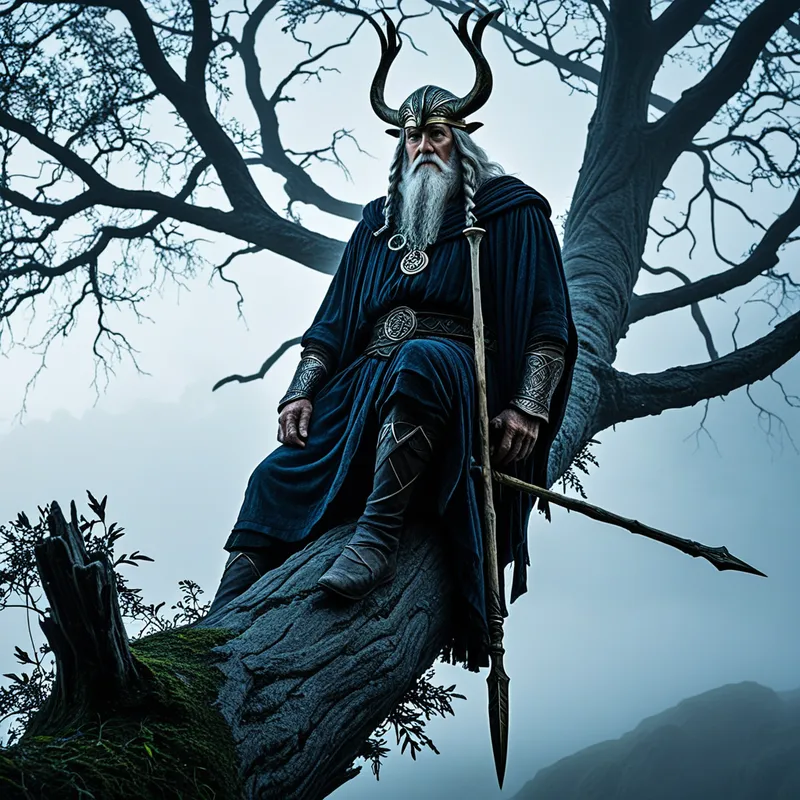
But the heart of the tale is a hanging. The All-Father, Odin, driven by a hunger for the wisdom that stitches destiny together, came to the tree. He took his own spear, Gungnir, and wounded himself, offering himself to himself. For nine nights, a sacred and terrible number, he hung from the bough of Yggdrasil, a sacrifice suspended between heaven and the abyss. The winds of the worlds howled around him. He stared into the well of Urd, where the Norns weave the threads of life for gods and men alike. He peered past the veil of being, into the source. As he hung, at the brink of death, the runes—the secret, shaping letters of power—cried out to him. He seized them, and with a great gasp, he fell from the tree, forever changed, forever knowing.
And the tree endures. The stag Eikthyrnir eats from its leaves, and dew falls from its antlers into the valleys. The goat Heidrun feeds upon it, providing mead for the heroes in Odin’s hall. Yet, always, the gnawing continues below. The tree groans, a living axis of a cosmos that is perpetually wounded and perpetually nourished, holding all things in a trembling, sacred balance until the final day.
Cultural Origins & Context
This mythos is the profound heart of the pre-Christian Norse worldview, preserved primarily in the Poetic Edda and the Prose Edda. It was not a dogmatic scripture but a living, breathing cosmology passed down by skalds (poets) and storytellers in the halls of chieftains, around hearth fires, and in the collective memory of a people intimately tied to a harsh, majestic landscape. The myth of Yggdrasil served as the ultimate map of reality. It explained the structure of the cosmos, the interconnectedness of all life (from gods to serpents), and the precarious, organic nature of order itself. It was a narrative anchor in a universe perceived as dynamic, often hostile, and fundamentally alive. The tree was not a metaphor for the world; it was the world—its suffering, its sustenance, and its skeletal frame.
Symbolic Architecture
Yggdrasil is the ultimate symbol of the axis mundi, the cosmic pillar that connects all levels of existence: the celestial (Asgard), the terrestrial (Midgard), and the chthonic (Hel, Niflheim). It represents the very architecture of the psyche, where conscious thought, lived experience, and the unconscious depths are in constant, dynamic relation.
The World Tree is the psyche in its totality: the ego perched in its branches, the shadow gnawing at its roots, and the Self, the vast, connecting trunk that holds the tension.
The creatures inhabiting it are not mere fauna but psychic forces. The eagle and hawk represent lofty consciousness and far-seeing wisdom. The serpents and Nidhogg embody the corrosive, destructive, yet necessary forces of entropy and the unconscious that challenge stability. Ratatoskr, the gossip, symbolizes the internal dialogue—often negative and fractious—that runs between our highest aspirations and our lowest instincts. Odin’s auto-sacrifice is the quintessential act of gaining profound wisdom through ego-surrender. He does not conquer the tree; he submits to it, allowing his old self to die so that a deeper, more painful, and more potent knowledge can be born.
The Dreamer’s Resonance
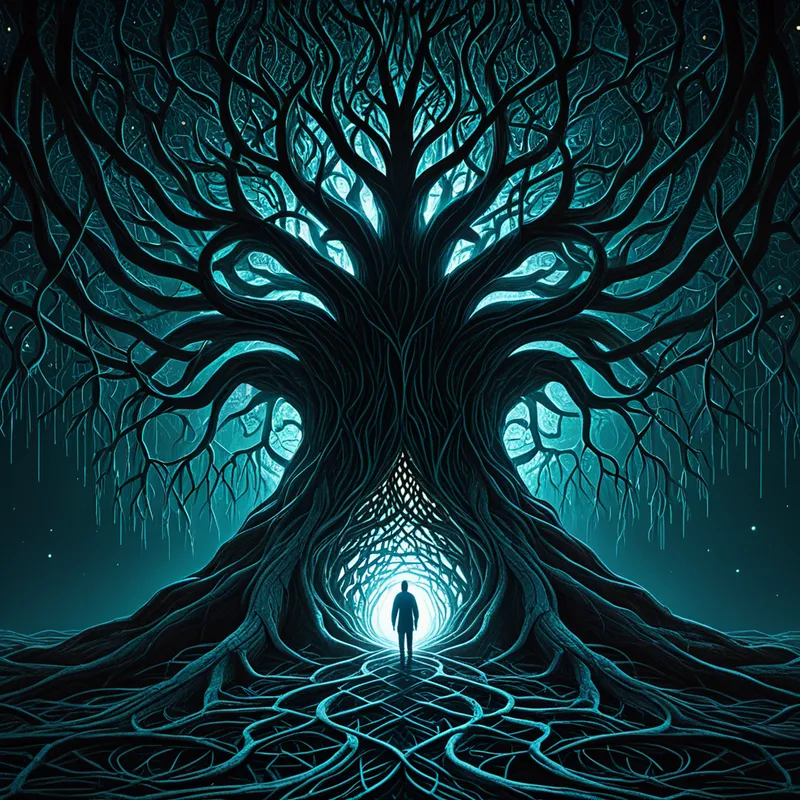
To dream of a World Tree is to encounter the dreamer’s own psychic structure at a monumental scale. One might dream of climbing an immense, endless tree toward a light, only to feel its roots trembling from some unseen disturbance below. Or perhaps of trying to heal a wound in the tree’s bark as venom drips from above. Such dreams often surface during periods of profound life transition, existential questioning, or when the individual feels both stretched too thin (across multiple worlds of obligation) and deeply rooted in a crisis.
Somatically, this can feel like a literal tension in the spine—the body’s own axis—a feeling of being pulled upward by ambition or aspiration while simultaneously being dragged down by fatigue, illness, or unresolved trauma (the gnawing). The dream is an image of the psyche’s attempt to hold these opposites, to find the trunk within oneself amidst the chaos of the chattering squirrel and the venomous drip of anxiety.
Alchemical Translation
The myth of Yggdrasil models the alchemical process of individuation not as a linear ascent to enlightenment, but as the painful, necessary maintenance of a living system. The modern individual’s journey toward wholeness is not about escaping the gnawing serpent or silencing the gossip, but about recognizing them as intrinsic parts of the whole self. The “work” is to become the tree itself—to be the vessel that contains the conflict.
Individuation is the courage to be the wounded, nourishing, groaning axis of your own universe, holding the tension between creation and decay without splintering.
Odin’s ordeal is the template: one must willingly hang in the uncertainty, suspended in a crisis of meaning (the “dark night of the soul”), to gain the runes—the authentic, personal symbols of power and understanding. This is the psychic transmutation: from identifying with the god in his hall (the ego in its castle) to identifying with the tree that supports the hall (the Self). It is to realize that wisdom (Odroerir) is not taken, but received through sacrificial engagement with the depths of one’s own experience. The goal is not a sterile peace, but a vibrant, resilient, and conscious endurance—to stand, like Yggdrasil, as the connecting point where all worlds meet and are sustained, even in their strife, until a new cycle begins.
Associated Symbols
Explore related symbols from the CaleaDream lexicon: