The World of Forms Myth Meaning & Symbolism
A philosophical allegory of a perfect, eternal realm of pure Ideas, casting our world as a shadowy reflection, guiding the soul's ascent to true knowledge.
The Tale of The World of Forms
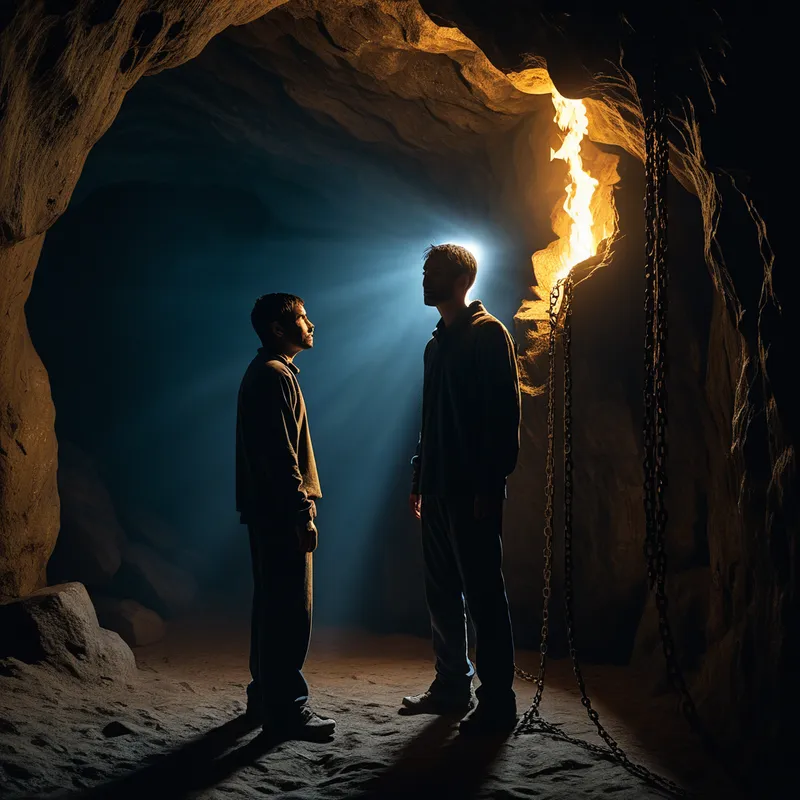
Imagine a cave, deep and damp, where the air is thick with the smell of earth and cold stone. From childhood, its inhabitants have been prisoners here, necks and legs fettered so they cannot turn their heads. All they have ever seen of the world is the cave wall before them. Behind and above them burns a fire, and between the fire and the prisoners runs a low wall, like the screen at a puppet show. Along this wall, other people carry all sorts of vessels, statues, and figures of animals and men. The fire casts the shadows of these objects onto the wall the prisoners face. The echoes of the carriers’ voices bounce off the wall, seeming to come from the shadows themselves. For the prisoners, this play of shadows is reality. They name the shadows, debate their sequences, and take pride in discerning which will pass next.
Now, picture one prisoner being freed. His chains are struck off, and he is compelled to stand up, to turn his neck, to walk and to look towards the light. The fire’s blaze pains his eyes. The moving figures seem less real than the shadows he knew. He is dragged, struggling and distressed, up the steep, rough ascent out of the cave and into the sunlight. The light of the sun blinds him utterly at first. He can see nothing. Slowly, his eyes adjust. He sees shadows first, then reflections in water, then the things themselves—the trees, the flowers, the animals under the true sun. He looks up at the night sky, seeing the moon and stars, and finally, though with difficulty, the sun itself, not as an image in water, but in its own place, and as it truly is. He understands it as the source of the seasons and the years, the guardian of all in the visible world, and in a way, the cause of all they had seen in the cave.
His heart fills with pity for his old companions. He descends back into the cave’s darkness. His eyes, now accustomed to the sun, are blind in the gloom. The prisoners, seeing his stumbling and hearing his strange tales of a world above, laugh at him. They say his journey ruined his sight. They resolve that if anyone tried to free them and lead them up, they would seize him and kill him.
Cultural Origins & Context
This is not a myth of gods and heroes, but of the mind and the soul. It originates not from an oral bardic tradition, but from the written dialogues of the philosopher Plato, specifically in his work The Republic (circa 375 BCE). In the context of Athenian society, it was a radical thought-experiment shared among an educated elite in the Academy. Its function was didactic and polemical. Plato used it to illustrate his core metaphysical doctrine: that the tangible, changing world we perceive through our senses is a flawed copy of a higher, intelligible realm of eternal, unchanging, perfect Forms or Ideas.
The myth was passed down through philosophical schools, from the Platonists to the Neoplatonists, and later into Christian, Islamic, and Renaissance thought. Its societal function was to establish a hierarchy of reality and knowledge, privileging the intellectual pursuit of truth (philosophy) over the mere observation of appearances (doxa, or opinion). It served as a foundational narrative for the idea that the philosopher, like the freed prisoner, has a duty to seek truth and, however difficult, to return to guide society, even at great personal risk.
Symbolic Architecture
The Cave Allegory is a masterful map of the human psyche and its potential journey from ignorance to enlightenment. Every element is a profound symbol.
The Cave represents the phenomenal world of sensory experience and conventional opinion—the persona and the collective unconscious of a society, which accepts shadows as reality. The Shadows are the illusions, projections, and half-truths we mistake for substance: social status, material possessions, popular opinion. The Chains are the internal and external constraints of habit, fear, upbringing, and uncritical acceptance.
The journey from the cave is not a change of location, but a revolution of the soul.
The Ascent is the painful process of education (periagoge) and philosophical inquiry. The Sun symbolizes the ultimate Form of the Good—the illuminating principle of all truth, beauty, and reality. It is the Self in its fullest, most integrated Jungian sense. The Return is the most psychologically crucial and often neglected part. It represents the integration of higher knowledge back into life, the burden of consciousness, and the often-traumatic attempt to communicate transformed understanding to an uncomprehending world.
The Dreamer’s Resonance
When this mythic pattern stirs in the modern unconscious, it often manifests in dreams of profound disorientation and reorientation. One might dream of being trapped in a basement, a subway tunnel, or a windowless office—a confined space where a flickering screen (a TV, a phone) provides the only narrative. The turning point is a discovered door, a crack of light, or a sudden compulsion to climb a hidden staircase.
The somatic experience is key: the strain in the neck from looking in a new direction, the physical pain of emerging into bright light, the feeling of weightlessness or vertigo upon seeing a vast, unfamiliar landscape. Psychologically, this dream sequence signals a nascent stage of introversion and disillusionment. The dreamer’s psyche is initiating a break from identification with collective values (the shadow-play) and beginning the difficult work of discerning what is authentically true for the Self. A dream of returning to the dark place, now blind and mocked, often follows a real-life attempt to share an insight that was rejected, reflecting the loneliness of the individuation path.

Alchemical Translation
The alchemical process mirrored here is the opus magnum—the great work of transforming leaden, unconscious existence into golden consciousness. The cave is the prima materia, the chaotic, dark starting point of the soul. The fire in the cave is the initial, ego-driven spark of curiosity or suffering that begins the work.
The ascent is the stage of separatio and sublimatio. The soul separates itself from the amalgam of projected realities (the shadows) and is sublimated—purified and elevated—through the fire of disciplined thought and emotional suffering (the blinding light). The vision of the true sun is the coniunctio, the mystical union with the lapis philosophorum, here understood as the direct apprehension of the Form of the Good, or Self-realization.
The true alchemy occurs not in seeing the sun, but in carrying its light back into the cave of the world.
The return is the critical stage of coagulatio—making the spirit solid. It is the embodiment of wisdom. The enlightened one must “coagulate” their sublime, airy understanding into the earth of practical life, relationships, and service. This is the ultimate transmutation: not an escape from the world, but the redemption of the world by infusing it with conscious meaning. The struggle, the potential for rejection, and the perseverance in the dark with remembered light—this is the model for the modern individual’s psychic transmutation, where enlightenment is meaningless unless it grounds itself in the shadowy, imperfect, and very real human community.
Associated Symbols
Explore related symbols from the CaleaDream lexicon: