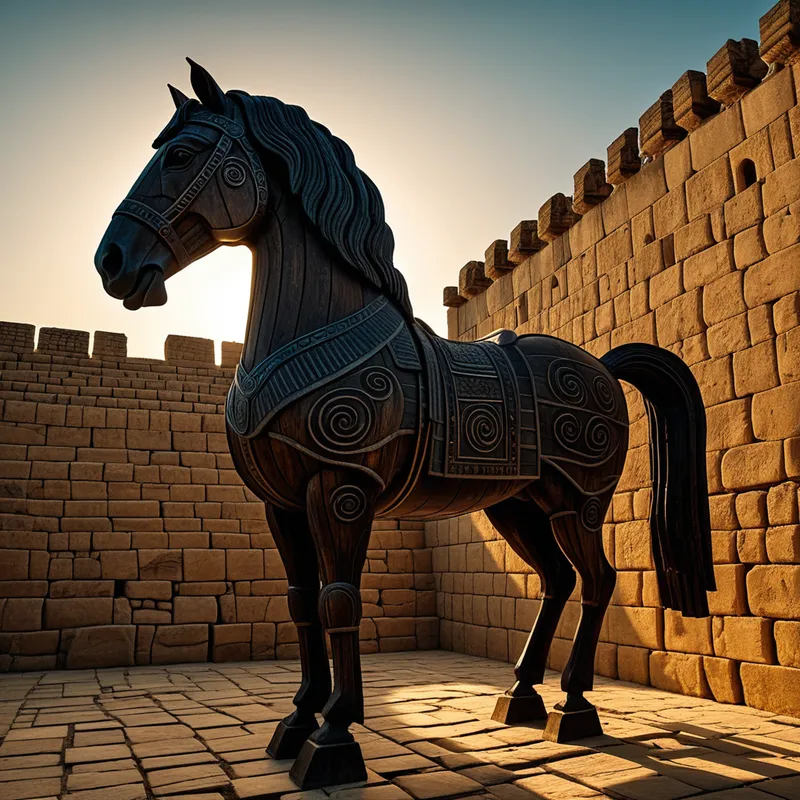
The Wooden Horse of Troy Myth Meaning & Symbolism
A cunning gift concealing warriors, the wooden horse breached Troy's impenetrable walls, ending a decade-long war through subterfuge and hidden force.
The Tale of The Wooden Horse of Troy
The salt air of the Aegean was thick with the ghosts of ten years. Ten years of bronze clashing on the plains before the high walls of Ilium, ten years of heroes fallen to the dust, their names whispered by [the wind](/myths/the-wind “Myth from Various culture.”/) that now carried only an eerie silence. The great Greek host, that sprawling beast of men and ships that had roared for a decade, was gone. Vanished. In its place, on the shore where the Myrmidon tents once stood, they left only the scars of their fires and a single, monstrous creation.
It was a horse. But no horse that ever drew breath. Fashioned from the dark pine of Mount Ida, it stood taller than the city gates, a colossus of polished wood and cunning joints. Its neck was arched in a frozen challenge, its eyes seemed to hold the deep, empty knowledge of [the sea](/myths/the-sea “Myth from Greek culture.”/). To the Trojans peering from the Scaean Gates, it was an object of awe and profound confusion, a riddle carved in timber left upon their doorstep.
A lone figure was found hiding in the dunes, a Greek named Sinon. Dragged before King Priam, he spun a tale of divine wrath and desperate escape. The horse, he wept, was an offering to Athena, built to appease her for the theft of her sacred image, the [Palladium](/myths/palladium “Myth from Greek culture.”/), from her Trojan temple. It was made so immense, he said, precisely so the Trojans could not take it within their walls, for if they did, Athena’s favor would pass to them, making Troy invincible.
The people were divided. The priest [Laocoön](/myths/laocon “Myth from Greek culture.”/) cried out in terrible warning, “I fear the Greeks, even when they bring gifts!” He hurled his spear into the horse’s flank, and the hollow womb echoed like a tomb. But the gods, it seemed, had chosen their side. From the calm sea, two serpents emerged, coiling around [Laocoön](/myths/laocon “Myth from Greek culture.”/) and his sons, crushing the life from them in a spectacle of divine punishment. The message was clear: the priest had blasphemed against a sacred offering.
Conviction turned to fervor. The Trojans breached their own famed wall, tearing down a section of stone to drag the giant gift into the heart of their city. They wreathed its neck with flowers, poured libations at its feet, and celebrated what they believed was their salvation and the end of the war. The night deepened, heavy with wine and relief.
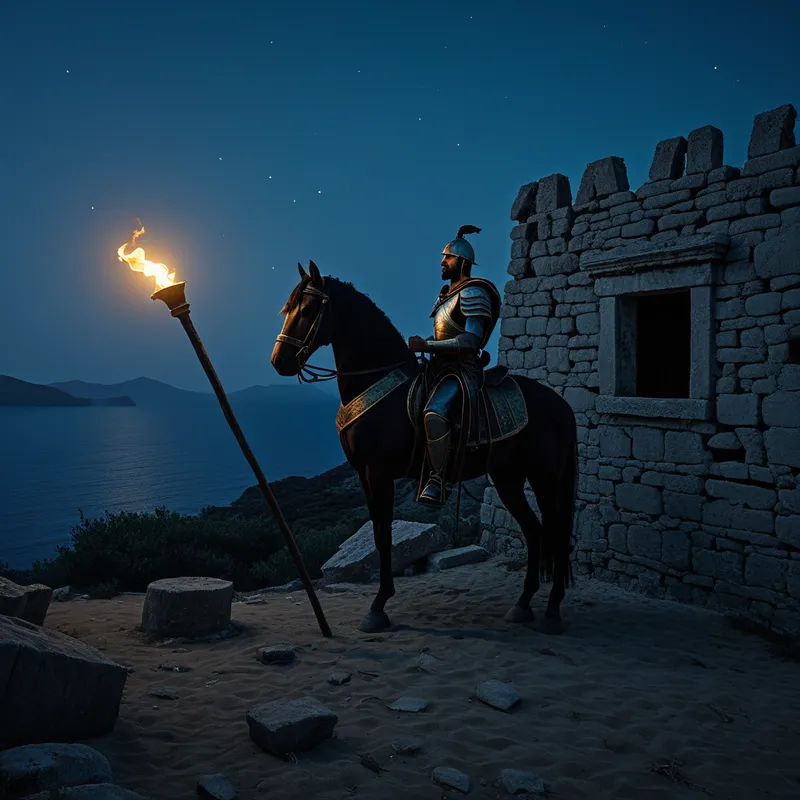
And in that darkness, within the horse’s silent belly, a different heart began to beat. The chosen warriors of Greece, led by the cunning [Odysseus](/myths/odysseus “Myth from Greek culture.”/) and the fierce Achilles’ son, Neoptolemus, listened to the revelry fade into drunken slumber. A signal flame was lit on the shore, calling the fleet back from its hiding place behind Tenedos. A hatch opened in the horse’s side. One by one, shadows dropped onto the sacred soil of Troy, their swords unsheathed. They flung open the gates they had spent a decade trying to break, and the returned Greek army poured in like a black tide. The fire that night was not of celebration, but of annihilation. The great city, which had withstood a decade of open assault, fell in a single night to [the thing](/myths/the-thing “Myth from Norse culture.”/) it had willingly pulled inside itself.
Cultural Origins & Context
This master-narrative of deception and downfall is the climactic pivot of the Epic Cycle. While [Homer](/myths/homer “Myth from Greek culture.”/)’s Iliad ends before the horse’s construction, the story was central to the broader oral tradition. It was [the bard](/myths/the-bard “Myth from Celtic culture.”/)’s ultimate lesson in [metis](/myths/metis “Myth from Greek culture.”/)—cunning intelligence—and ate—the ruinous folly that follows hubris. Passed down by rhapsodes for centuries before being crystallized in works like Virgil’s Aeneid, the myth served a crucial societal function. For the Greeks, it validated the [triumph](/myths/triumph “Myth from Roman culture.”/) of intellect ([metis](/myths/metis “Myth from Greek culture.”/)) over sheer force (bie), embodied by Odysseus over Ajax. For audiences, it was a profound cautionary tale about the permeability of boundaries, the danger of gifts from enemies, and the catastrophic cost of misreading signs. The horse was the ultimate plot device, a narrative engine that explained the inexplicable: how a city famed for its impregnability could be so utterly destroyed.
Symbolic Architecture
The Wooden Horse is perhaps mythology’s most potent [symbol](/symbols/symbol “Symbol: A symbol can represent an idea, concept, or belief, serving as a powerful tool for communication and understanding.”/) of the [shadow](/symbols/shadow “Symbol: The ‘shadow’ embodies the unconscious, repressed aspects of the self and often represents fears or hidden emotions.”/) made manifest. It represents the [idea](/symbols/idea “Symbol: An ‘Idea’ represents a spark of creativity, innovation, or realization, often emerging as a solution to a problem or a new outlook on life.”/) that the most devastating forces are not those that assault us from without, but those we internalize, those we welcome across our own thresholds believing them to be blessings.
The fortress falls not by the battering ram, but by the invited guest who carries the siege within.
The horse itself is a masterful symbol of paradoxical duality. Externally, it is a [votive offering](/symbols/votive-offering “Symbol: A Votive Offering represents a dedication made to a deity, often symbolizing gratitude or a request for favor, showcasing the human desire to connect with the divine.”/), a sacred object of appeasement and potential power. Internally, it is a [weapon](/symbols/weapon “Symbol: A weapon in dreams often symbolizes power, aggression, and the need for protection or defense.”/), a [vessel](/symbols/vessel “Symbol: A container or structure that holds, transports, or protects something essential, representing the self, emotions, or life journey.”/) of destruction. This mirrors the psychological [truth](/symbols/truth “Symbol: Truth represents authenticity, honesty, and the quest for knowledge beyond mere appearances.”/) of complex traits: what appears as a weakness or a gift can [harbor](/symbols/harbor “Symbol: A harbor symbolizes safety, rest, and the arrival at a destination, representing a place of shelter and emotional refuge.”/) its opposite. The Trojans’ fatal [error](/symbols/error “Symbol: A dream symbol representing internal conflict, perceived failure, or a mismatch between expectations and reality.”/) was a failure of interpretation—they saw only the surface symbol (the offering to Athena) and not its latent, destructive content. The horse is the unconscious content of the conflict, the repressed [strategy](/symbols/strategy “Symbol: A plan of action designed to achieve a long-term or overall aim, often involving competition, resource management, and foresight.”/) that could not be born in ten years of conscious, frontal warfare. It is the rejected, cunning thought that finally wins the day.
Furthermore, the horse is a [womb](/symbols/womb “Symbol: A symbol of origin, potential, and profound transformation, representing the beginning of life’s journey and the unconscious source of creation.”/) and a tomb. It gestates the warriors who will bring [death](/symbols/death “Symbol: Symbolizes transformation, endings, and new beginnings; often associated with fear of the unknown.”/), making it a symbol of treacherous creation. Its hollow [interior](/symbols/interior “Symbol: The interior symbolizes one’s inner self, thoughts, and emotions, often reflecting personal growth, vulnerabilities, and secrets.”/) speaks to the deceptiveness of appearances, a core [theme](/symbols/theme “Symbol: Themes in dreams often represent the overarching ideas or emotions the dreamer is grappling with.”/) in a world where gods walk among men in disguise. The act of breaching their own [wall](/symbols/wall “Symbol: Walls in dreams often symbolize boundaries, protection, or obstacles in one’s life, reflecting the dreamer’s feelings of confinement or security.”/) to admit it is the ultimate act of self-sabotage, a literalization of the psychological process where [the ego](/myths/the-ego “Myth from Jungian culture.”/), in a [moment](/symbols/moment “Symbol: The symbol of a ‘moment’ embodies the significance of transient experiences that encapsulate emotional depth or pivotal transformations in life.”/) of grandiosity or [relief](/symbols/relief “Symbol: Relief signifies release from tension or discomfort, often representing emotional healing and liberation from burdens.”/), lets down its defenses and is overrun by unconscious complexes.
The Dreamer’s Resonance
When this mythic pattern stirs in the modern dreamscape, it often signals a profound encounter with the [psyche](/myths/psyche “Myth from Greek culture.”/)’s own “Trojan Horse.” The dreamer may find themselves in a secure, familiar place—a childhood home, a modern fortress of an office—into which they have willingly brought an object, a person, or an idea that feels like a gift, a solution, or a hard-won prize.
The somatic feeling is one of creeping unease after the act of acceptance. The initial relief or triumph gives way to a silent, hollow dread. The dream’s “city” feels infected from within. This mirrors a psychological process where an individual has internalized a belief, a relationship dynamic, or a self-image that initially seemed salvific but is now revealing its destructive payload. It is the moment one realizes a cherished ambition is eating them alive, or that a comforting narrative about themselves is a prison. The dream is the psyche’s Laocoön, screaming a warning that the conscious mind has rationalized away. The ensuing “fall of the city” in the dream—chaos, invasion, fire—often correlates with the collapse of a long-held conscious attitude or life structure, initiated not by external catastrophe but by this welcomed, hidden factor.
Alchemical Translation
In the alchemical journey of individuation, the myth of the Wooden Horse models the critical, dangerous stage of [nigredo](/myths/nigredo “Myth from Alchemical culture.”/)—the blackening, the confrontation with [the shadow](/myths/the-shadow “Myth from Jungian culture.”/)—and its necessary, if devastating, role in transformation. The ten-year stalemate represents the ego’s protracted, exhausting battle with a complex or a life problem using known, “heroic” methods. It is a war of attrition that leads nowhere.
The horse is the symbol of the unexpected solution, which arises not from the ego’s repertoire but from the unconscious. It is the cunning, often morally ambiguous insight (Odysseus’s metis) that breaks the deadlock.
The psyche’s liberation often arrives disguised as its own potential ruin.
The task for the modern individual is not to avoid the “horse,” for that is to remain in perpetual, sterile siege. The task is to develop the capacity for discernment that the Trojans lacked. This is the coniunctio oppositorum—[the conjunction](/myths/the-conjunction “Myth from Alchemical culture.”/) of opposites—in its most treacherous form. One must learn to “inspect the hollow flank,” to listen to the inner Laocoön (the voice of instinctual suspicion) without being paralyzed by it, and to understand that any great gift from the unconscious carries with it a destructive potential. Integrating this “horse” means consciously unpacking its contents—facing the shadow warriors within—rather than leaving them to operate autonomously in the dark. [The fall of Troy](/myths/the-fall-of-troy “Myth from Greek culture.”/) is the necessary death of an old, rigidified psychic structure (the impregnable ego-city) so that a new consciousness, like Aeneas carrying his father from the flames, can be founded on its ashes. The victory is not for the Greeks or the Trojans, but for the process of transformation itself, which requires the death of the old king and the burning of the familiar walls to make way for what is new.
Associated Symbols
Explore related symbols from the CaleaDream lexicon: