
The Witch's Poppet Myth Meaning & Symbolism
A tale of a stolen soul-fragment bound into a doll, and the perilous journey to reclaim it from the witch who holds it captive.
The Tale of The Witch’s Poppet
Listen, and hear a tale not of heroes and dragons, but of a quieter, deeper theft. It begins not with a bang, but with a whisper—the whisper of a name given in a moment of despair, or a lock of hair left carelessly on a pillow, or a fingernail clipping swept into the wrong corner. These are the doors left ajar.
In a village much like any other, there lived a person—perhaps a farmer, a weaver, a youth full of longing. Life wore upon them. A grief too heavy to carry, a betrayal that festered, a loneliness that hollowed the bones. In that moment of profound fracture, when the soul feels thin and [the world](/myths/the-world “Myth from Tarot culture.”/) feels hostile, the connection was made. Not by grand ceremony, but by that subtle, unconscious offering of a piece of [the self](/myths/the-self “Myth from Jungian culture.”/). The witch, who dwells at the edge of the known world where the trees grow thick, felt the vibration of that loss. She collected the fragment—the psychic detritus of a breaking heart.
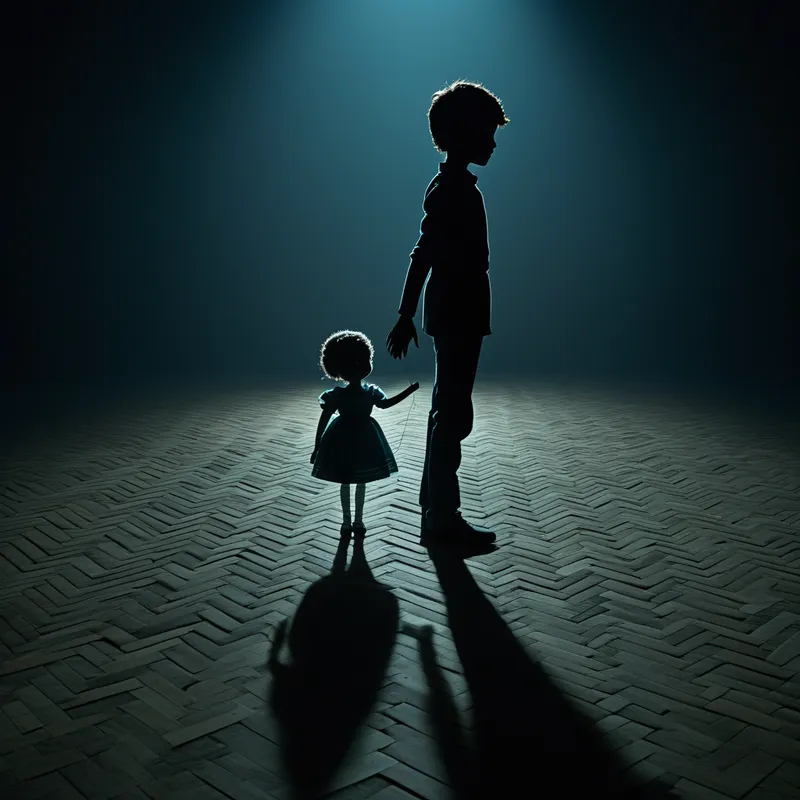
In her cottage that smelled of dried herbs and cold earth, she did not cackle. She worked with a focused sorrow. From clay, or wax, or rough-hewn cloth, she fashioned a form. Into its chest, she placed the gathered fragment—the name, the hair, the sorrow itself. She bound it with threads the color of dusk and dawn. And as she sewed the final stitch, a tiny, captive light flickered within the doll’s chest. It was not the whole person, but a vital piece: their capacity for joy, their will, their voice. The poppet was born, and the person in the village felt a corresponding dimming. They went through the motions of life, but the flavor was gone. They were a tenant in their own flesh, haunted by the ghost of their own feeling.
The witch did not torment the poppet. She often placed it on a shelf, or in a niche, and simply… kept it. She would look upon it not with malice, but with a strange, melancholic possession. The stolen light warmed her lonely house. The myth does not say she was evil; she was hungry, and the world had made her so. She fed on the attention, the unbroken psychic tether to another living soul.
But a soul cannot abide such division forever. A deep, instinctual knowing began to stir in the person back in the village—a pull toward the woods, a dream of a glowing doll, a sense of a path that must be walked. This is the call. Without sword or shield, armed only with the terrifying memory of their own wholeness, they entered the forest. The journey was inward as much as outward, a navigation through thickets of forgotten memories and swamps of old shame, following the faint, aching tug of the thread that still connected them to their captive piece.
The confrontation at the cottage was never a battle. It was a reckoning. The witch would meet them at the door, the poppet held close. The person, standing in their own emptiness, had to speak not demands, but truth. They had to name their own despair that had created the opening. They had to see the witch not as a monster, but as [the mirror](/myths/the-mirror “Myth from Various culture.”/) of their own inner poverty and hunger. Sometimes, the myth says, the witch wept, for she too was a prisoner of this arrangement. The resolution was an exchange, not a theft. The person offered something real—a genuine tear, a true forgiveness, a shared meal—in return for the fragment. The witch, her hunger acknowledged, would slowly unwind the threads. The light would drift from the doll’s chest and back into the person’s, and the poppet would become inert cloth and straw once more. The person returned to the village, not to a fanfare, but to a life that now held its full resonance again. The cottage at the edge of the woods fell silent, waiting, perhaps, for another whisper on [the wind](/myths/the-wind “Myth from Various culture.”/).

Cultural Origins & Context
The motif of the witch’s poppet is not the property of a single culture, but a widespread folkloric archetype found across European, African, and Appalachian traditions, often surviving in hushed warnings and “old wives’ tales.” It was transmitted orally, typically by elders and storytellers within close-knit communities, serving as both entertainment and profound social-psychological instruction. Its primary function was cautionary, but not in a simplistic “beware of witches” sense. It taught about psychic hygiene, personal responsibility, and the fragility of the soul’s integrity.
The story codified the understanding that elements of the self—emotion, vitality, autonomy—could be lost or given away not through overt attack, but through carelessness, prolonged misery, or unresolved trauma. The witch figure often represented the marginalized “other”—the solitary, knowledgeable woman who existed outside the village’s social contract. The myth thus also explored the community’s shadow: its fears of the unknown and its unconscious creation of the very “monsters” it shunned. The poppet ritual mirrored real folk practices of sympathetic magic, grounding the tale in a tangible, believable logic for its original audiences. It was a story that explained a specific kind of spiritual malaise and provided a mythical roadmap for its cure.
Symbolic Architecture
At its core, the myth is a profound map of [shadow](/symbols/shadow “Symbol: The ‘shadow’ embodies the unconscious, repressed aspects of the self and often represents fears or hidden emotions.”/) [projection](/symbols/projection “Symbol: The unconscious act of attributing one’s own internal qualities, emotions, or shadow aspects onto external entities, people, or situations.”/) and psychic dismemberment. The poppet is not an external object, but an internal complex—a bundle of thoughts, feelings, and energies that has split off from the conscious [personality](/symbols/personality “Symbol: Personality in dreams often symbolizes the traits and characteristics of the dreamer, reflecting how they perceive themselves and how they believe they are perceived by others.”/).
The Witch’s Poppet is the embodied symbol of that part of the soul we mortgage to our suffering, believing we can no longer afford to feel it.
The [witch](/symbols/witch “Symbol: The image of a witch embodies the archetype of the outlawed or misunderstood, often associated with feminine power, magic, and the unknown.”/) symbolizes the autonomous, personified complex itself. She is not merely an external [antagonist](/symbols/antagonist “Symbol: A character or force that opposes the protagonist, creating conflict and driving narrative tension in artistic works.”/), but the psychic agency that holds the lost fragment. She is the depressive complex that feeds on our [sadness](/symbols/sadness “Symbol: A deep emotional state of sorrow, grief, or melancholy often signaling loss, unmet needs, or existential reflection.”/), the [anxiety](/symbols/anxiety “Symbol: Anxiety in dreams reflects internal conflicts, fears of the unknown, or stress from waking life, often demonstrating the subconscious mind’s struggle for peace.”/) complex that consumes our [peace](/symbols/peace “Symbol: Peace represents a state of tranquility and harmony, both internally and externally, often reflecting a desire for resolution and serenity in one’s life.”/), the inner critic that hoards our self-worth. She dwells “at the edge of the woods”—[the border](/symbols/the-border “Symbol: A liminal space representing boundaries between identities, territories, or states of being, often symbolizing transition, conflict, or separation.”/) between conscious and unconscious. The stolen fragment is always a [life](/symbols/life “Symbol: The symbol of ‘Life’ represents a journey of growth, interconnectedness, and existential meaning, encompassing both the joys and challenges that define human experience.”/)-giving quality: joy, will, voice, or love. It is what goes missing in states of depression, codependency, or creative blockage. The [journey](/symbols/journey “Symbol: A journey in dreams typically signifies adventure, growth, or a significant life transition.”/) through the [forest](/symbols/forest “Symbol: The forest symbolizes a complex domain of the unconscious mind, representing both mystery and potential for personal growth.”/) is the necessary descent into the unconscious, the willingness to face the disowned parts of oneself. The final confrontation and exchange is the act of conscious recognition and re-ownership. One cannot violently slay the [witch](/symbols/witch “Symbol: The image of a witch embodies the archetype of the outlawed or misunderstood, often associated with feminine power, magic, and the unknown.”/) (repress the complex), for she holds the [treasure](/symbols/treasure “Symbol: A hidden or valuable object representing spiritual wealth, inner potential, or divine reward.”/). One must integrate her.

The Dreamer’s Resonance
When this myth stirs in the modern dreamscape, it signals a profound process of soul-reclamation. To dream of a doll or figurine that seems to hold a part of you, or to dream of a powerful, ambiguous figure (often female) who has something you need, is to dream the Witch’s Poppet.
The somatic experience is one of haunting emptiness coupled with a specific pull—a sense that your vitality is located elsewhere. You may feel chronically tired, disassociated, or “going through the motions.” Psychologically, you are navigating the realization that an aspect of your identity or power has been ceded to an unconscious complex. This could manifest as feeling enslaved by a job, a relationship pattern, an addiction, or a narrative about yourself (“I am not creative,” “I am unlovable”). The witch in the dream is the embodiment of that enslaving pattern. The dream is the [psyche](/myths/psyche “Myth from Greek culture.”/)’s dramatization of the need to undertake the journey, to track that lost energy to its source in the inner wilderness, and to negotiate for its return.
Alchemical Translation
The alchemical [prima materia](/myths/prima-materia “Myth from Alchemical culture.”/) of this myth is the state of psychic fragmentation—the [nigredo](/myths/nigredo “Myth from Alchemical culture.”/) or blackening of despair that precedes the work. The process of individuation it models is one of recollection (literally, re-gathering).
The ultimate transmutation is not creating gold from lead, but wholeness from abandonment. It is the re-fusion of the ego with its exiled vitality.
[The first stage](/myths/the-first-stage “Myth from Alchemical culture.”/) is Calcination: the burning away of the illusion that the emptiness is caused solely by external circumstances. This is the painful acknowledgment that one has participated in the loss. The Separation is the journey itself—distinguishing the self from the complex (the witch), seeing the pattern clearly. The key operation is Conjunction, which occurs in the cottage confrontation. This is not a merger through force, but through conscious negotiation. [The ego](/myths/the-ego “Myth from Jungian culture.”/) must offer its honest awareness (the “true tear”) to the complex. It must see the witch’s hunger as its own. This honest engagement is the solvent that dissolves the binding threads.
Finally, the Coagulation is the return of the fragment. The reclaimed quality—will, joy, voice—is now integrated, no longer a naive possession but a hard-won faculty. The individual returns to life not as the innocent who lost the fragment, but as the seasoned traveler who has reclaimed it from the depths. The inert poppet left behind signifies that the complex, once integrated, loses its autonomous, haunting power. It becomes simple memory, raw material for the next cycle of the work. The myth thus offers a timeless recipe: to become whole, one must be willing to visit the very place where one was broken, and treat with the keeper of the pieces.
Associated Symbols
Explore related symbols from the CaleaDream lexicon: