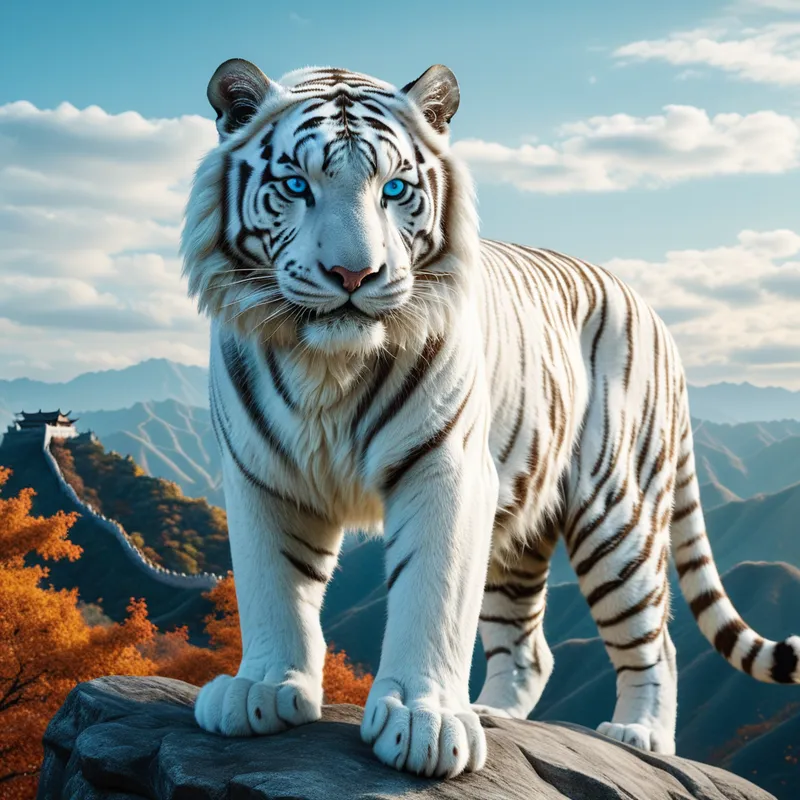
The White Tiger Myth Meaning & Symbolism
The celestial guardian of the West, a mythic beast embodying autumn, metal, and righteous force, who defends the cosmic order from chaos.
The Tale of The White Tiger
Hear now of the West, the quarter of gathering shadows and the falling leaf. In the time when [the world](/myths/the-world “Myth from Tarot culture.”/) was young and the patterns of heaven were still being woven into the fabric of earth, a great unrest stirred beyond the sunset. This was the realm of Metal, of descending energy, of things completing their cycle. But from the deep valleys where light died, a formless chaos, a qi of pure dissolution, began to rise. It threatened to unravel the autumn harvest, to turn righteous grief into despair, and to let the forces of unchecked decay consume [the world](/myths/the-world “Myth from Tarot culture.”/).
The Celestial Emperor gazed westward, and with a breath that carried the scent of chrysanthemums and frost, he summoned forth a guardian. Not from clay or star-stuff, but from the very principle of righteous force itself. From the collective breath of all fallen warriors who died with honor, from the unyielding strength of the mountain range, and from the cold, clarifying light of the full moon, a form coalesced.
It was the Bai Hu. It stood larger than any earthly beast, its fur not merely white, but the white of bleached bone, of first snow on a high peak, of the finest jade. Its stripes were not black, but deep blue like cracks in glacier ice. When it opened its eyes, they were pools of captured winter sky, seeing not just forms, but the moral weight of actions. Its roar was not a sound of mindless fury, but the thunder of a falling avalanche—a declaration of inevitable, structured power.
The Bai Hu did not hunt the chaos like a wolf hunts a rabbit. It presenced itself. It paced the western borders, and where its paws touched [the earth](/myths/the-earth “Myth from Hindu culture.”/), wild energies settled. Rampant decay became the fertile compost for new cycles. Lawless spirits found themselves facing an immovable will, a mirror that reflected only their own formlessness. The Tiger became the boundary itself. Its very existence was a statement: here, chaos ends and order begins. Here, the letting-go of autumn is sacred, not destructive. It was the emperor’s general, the executor of celestial law, the unwavering force that made the peaceful harvest possible.
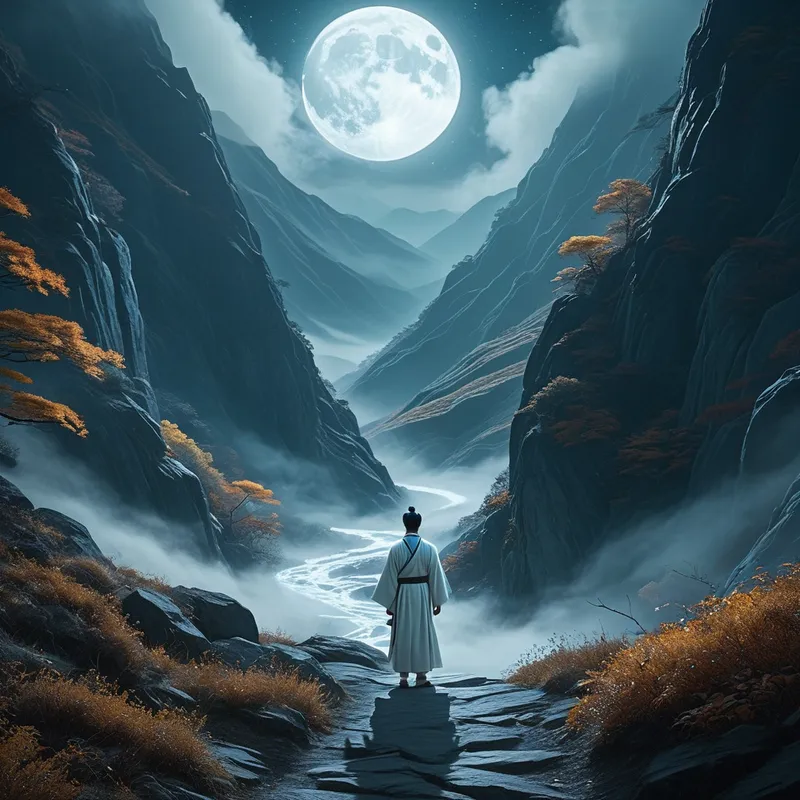
Cultural Origins & Context
The [White Tiger](/myths/white-tiger “Myth from Chinese culture.”/) is not a myth from a single story, but a cosmological pillar. Its origins are woven into the ancient Chinese systems of [Yin-Yang](/myths/yin-yang “Myth from Taoist culture.”/) and the Wuxing. As one of the Si Xiang or Four Celestial Guardians, the Bai Hu’s domain is the West, the season of Autumn, the element of Metal, and the color white.
This mythic complex was articulated by court astronomers, Taoist philosophers, and folk practitioners. It served a profound societal function: to map the human and natural world onto a coherent, sacred cosmology. The White Tiger provided a symbolic anchor for the potentially frightening aspects of life—war, [justice](/myths/justice “Myth from Tarot culture.”/), death, and decline. By giving these forces a divine, noble form, culture could engage with them ritually and respectfully. It was invoked for protection in battle, for righteous judgment in courts, and to ensure that the necessary endings of life proceeded in harmony with [the Tao](/myths/the-tao “Myth from Taoist culture.”/), not in rebellion against it.
Symbolic Architecture
Psychologically, the White [Tiger](/symbols/tiger “Symbol: The tiger symbolizes power, courage, and primal instincts, often representing untamed energy and aggression.”/) represents the archetypal principle of necessary force. It is not aggression for its own sake, but the structured, precise [application](/symbols/application “Symbol: An application symbolizes engagement, integration of knowledge, or the pursuit of goals, often representing self-improvement and personal development.”/) of power to maintain integrity, enforce boundaries, and execute inevitable endings.
The Tiger does not question the autumn; it is the autumn. It is the psychic faculty that allows us to cut away what is rotten, to defend the sanctity of our inner space, and to face the shadow with unwavering clarity.
Its element, [Metal](/symbols/metal “Symbol: Metal in dreams often signifies strength, transformation, and the qualities of resilience or coldness.”/), symbolizes both the sword and [the mirror](/myths/the-mirror “Myth from Various culture.”/). The sword cuts, divides, and values (as metal is [currency](/symbols/currency “Symbol: Currency represents value exchange, personal worth, and societal power dynamics. It symbolizes resources, control, and the abstract systems governing human interaction.”/)). [The mirror](/myths/the-mirror “Myth from Various culture.”/) reflects without [distortion](/symbols/distortion “Symbol: The alteration of form, sound, or perception from its original state, often creating unsettling or creative effects.”/). Thus, the White Tiger [energy](/symbols/energy “Symbol: Energy symbolizes vitality, motivation, and the drive that fuels actions and ambitions.”/) is about discernment and execution. It is the courage to make final decisions, to say “no,” to end toxic cycles, and to uphold a personal code of honor against internal or external [chaos](/symbols/chaos “Symbol: In Arts & Music, chaos represents raw creative potential, uncontrolled expression, and the breakdown of order to forge new artistic forms.”/). It is the psychological “immune [system](/symbols/system “Symbol: A system represents structure, organization, and interrelated components functioning together, often reflecting personal or social order.”/)” that identifies and eliminates psychic threats to the wholeness of [the Self](/myths/the-self “Myth from Jungian culture.”/).
The Dreamer’s Resonance
When the White Tiger pads into modern dreams, it often signals a profound encounter with the [psyche](/myths/psyche “Myth from Greek culture.”/)’s own boundary-keeping and truth-telling functions. The dreamer may be in a life situation requiring fierce protection, a decisive ending, or a confrontation with a personal “chaos” they have been avoiding.
Somatically, this might manifest as a feeling of solidity in the spine, a clenched jaw during the dream, or upon waking, a surprising sense of resolve where there was previously anxiety. The Tiger does not arrive to soothe; it arrives to fortify. Dreaming of being chased by a white tiger may indicate running from one’s own necessary power or a looming, righteous consequence. Dreaming of riding or standing beside the tiger suggests an alignment with this archetypal energy—the dreamer is integrating their capacity for righteous force and self-defense.

Alchemical Translation
The individuation process, the journey toward psychic wholeness, requires not just nurturing the gentle and creative aspects, but also integrating the ruler and the warrior. The White Tiger models this alchemical translation: how to transmute raw, defensive aggression into disciplined, self-owned power.
The first step is Recognition of the Frontier. One must identify where in one’s life chaos reigns—be it a draining relationship, a diffuse sense of self, or an unexpressed truth. This is the “western border” of the personal psyche.
The second is Summoning the Guardian. This is the conscious invocation of courage and clarity. It is the internal declaration: “This far, and no further.” It often feels cold, metallic, and severe, unlike the warm, expansive energy of the heart.
The alchemy occurs when the personal will surrenders to the archetypal function. One does not become violently angry; one channels the Tiger’s impeccable timing and precision. The cut is clean, the boundary is set, not from hatred, but from a higher law of self-preservation.
Finally, there is Embodiment of Autumn. The Tiger teaches that endings are a natural, sacred phase. Letting go, grieving, and cutting away are not failures but acts of alignment with the cosmic cycle. The integrated individual learns to wield this “autumnal” power with respect, using it to harvest the lessons of completed experiences and to clear the ground for what must come next. In doing so, they become the guardian of their own inner kingdom, capable of both profound compassion and unassailable strength.
Associated Symbols
Explore related symbols from the CaleaDream lexicon: