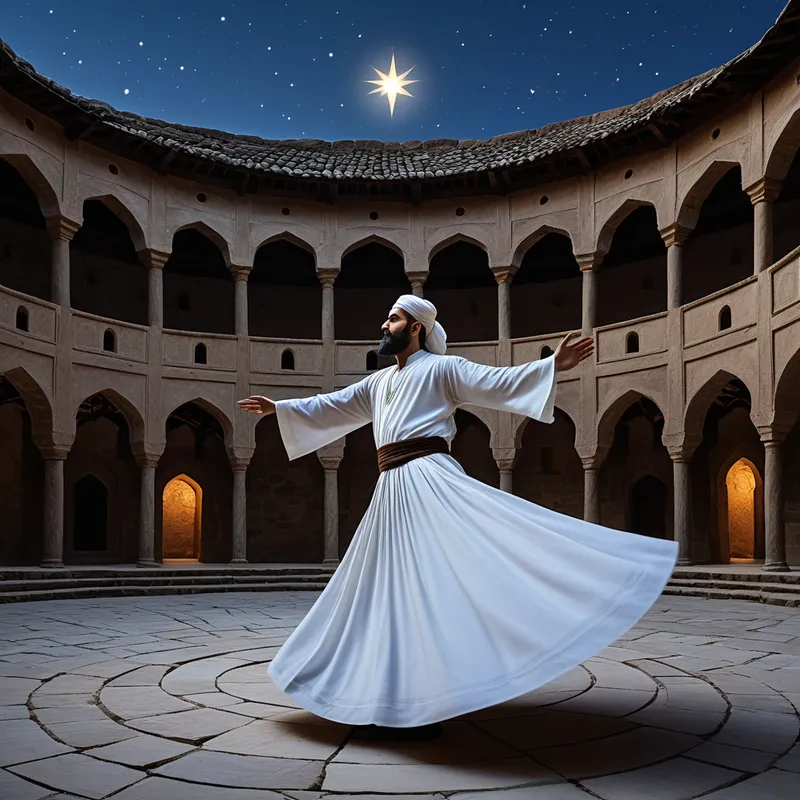
The Whirling Dervish Myth Meaning & Symbolism
A mystic, through ecstatic whirling, dissolves his ego to become a conduit for divine love, embodying the soul's journey from separation to union.
The Tale of The Whirling Dervish
Listen. There is a silence so deep it becomes a sound—a hum at the root of [the world](/myths/the-world “Myth from Tarot culture.”/). In a land of dust and longing, where the sun bleaches bones and prayers alike, there lived a man whose soul was a clenched fist. He was a seeker, but his seeking was a frantic digging in dry earth. He scoured scriptures, mastered ascetic rigors, and debated scholars until his mind was a [labyrinth](/myths/labyrinth “Myth from Various culture.”/) with no center. Yet the peace he hunted remained a phantom, a shimmer on [the horizon](/myths/the-horizon “Myth from Various culture.”/) that vanished as he approached.
One evening, despair heavy as a millstone upon his chest, he wandered beyond the city walls into [the desert](/myths/the-desert “Myth from Biblical culture.”/)’s embrace. [The sky](/myths/the-sky “Myth from Persian culture.”/) deepened from blue to violet, and the first stars, cold and distant, pricked the heavens. Overwhelmed, he fell to his knees, his prayers not words but a raw, wordless cry from [the pit](/myths/the-pit “Myth from Christian culture.”/) of his being: “I am lost. Show me [the way](/myths/the-way “Myth from Taoist culture.”/), or let the sands take me.”
[The wind](/myths/the-wind “Myth from Various culture.”/) died. The desert held its breath. And then, he heard it—not with his ears, but in the marrow of his bones. It was the sound of the spheres turning, a cosmic music both terrifying and sweet. He looked up and saw the stars not as fixed points, but as brilliant dancers in a slow, majestic wheel. The very Earth beneath him seemed to pivot on a silent axis.
A compulsion seized him. He rose. He removed his cloak, the symbol of his worldly station. He stood barefoot on the cooling sand, one foot anchoring him to the heart of the world. He raised his right palm to the sky, a vessel to receive. He pointed his left palm to [the earth](/myths/the-earth “Myth from Hindu culture.”/), a channel to pour forth.
And then, he began to turn.
At first, it was clumsy, a stagger. The world blurred—rock, sky, star became a streaked painting. Dizziness threatened to pull him down. But he did not fight it. He surrendered to the spin, letting his clenched soul be flung outward by the centrifugal force of his own surrender. His long skirt billowed, catching the starlight, becoming a perfect, white circle.
The frantic seeker was gone. In his place was a pivot, a still point in the turning world. [The music of the spheres](/myths/the-music-of-the-spheres “Myth from Greek culture.”/) was now the rhythm of his own heart. He whirled not to reach the divine, but because he had become the space where the divine turned. He was no longer a man praying to God; he was the prayer itself—a living, spinning invocation. The dance was his death and his birth, his question and its eternal, silent answer. When dawn finally touched the horizon with rose-gold fingers, he slowed, coming to rest not as a man exhausted, but as one who has finally come home. He stood in the center of a perfect circle traced in the sand by his own feet, and in his eyes was the quiet reflection of the infinite.

Cultural Origins & Context
This is not a myth of a single hero from a forgotten age, but the living, breathing heart of the Sufi path, crystallized in the 13th century by the poet and mystic Jalaluddin Rumi. The practice, known as Sema, is the ritual enactment of this story. It is passed down not merely through words, but through the body—from teacher (Murshid) to disciple (Murid) in the sacred space of the Semahane.
Its societal function was and remains profoundly counter-cultural. In a world obsessed with acquisition and identity, the Whirling Dervish models radical surrender and ego-dissolution. The Mevlevi Order formalized this into a precise spiritual technology: the camel-hair hat (sikke) is [the ego](/myths/the-ego “Myth from Jungian culture.”/)’s tombstone; the white skirt (tennure) is its shroud. The ceremony is a public enactment of the soul’s return to its source, a reminder that society’s ultimate health depends on individuals who remember how to turn towards the Real.
Symbolic Architecture
The myth is a perfect map of the [soul](/symbols/soul “Symbol: The soul represents the essence of a person, encompassing their spirit, identity, and connection to the universe.”/)’s cosmology. The whirling is not mere [movement](/symbols/movement “Symbol: Movement symbolizes change, progress, and the dynamics of personal growth, reflecting an individual’s desire or need to transform their circumstances.”/); it is the visible form of an invisible [reality](/symbols/reality “Symbol: Reality signifies the state of existence and perception, often reflecting one’s understanding of truth and life experiences.”/).
The right hand receives from heaven, the left hand bestows upon the earth. The human being is not a terminal, but a transformer.
The [axis](/symbols/axis “Symbol: A central line or principle around which things revolve, representing stability, orientation, and the fundamental structure of reality or consciousness.”/) foot is the unwavering [connection](/symbols/connection “Symbol: Connection symbolizes relationships, communication, and bonds among individuals.”/) to [truth](/symbols/truth “Symbol: Truth represents authenticity, honesty, and the quest for knowledge beyond mere appearances.”/), the immutable self that does not spin. The spinning foot is the active engagement with the manifest world. Together, they embody the [paradox](/symbols/paradox “Symbol: A contradictory yet true concept that challenges logic and perception, often representing unresolved tensions or profound truths.”/) of being in the world but not of it. The whirling [skirt](/symbols/skirt “Symbol: Skirts can symbolize femininity, identity, and societal roles regarding gender expression.”/) becomes the circle of existence, the planets orbiting the sun, the electron around the [nucleus](/symbols/nucleus “Symbol: The core or central part of something, often representing the essence of self, foundational identity, or the source of emotional energy.”/)—a visual hymn to the fundamental [pattern](/symbols/pattern “Symbol: A ‘Pattern’ in dreams often signifies the underlying structure of experiences and thoughts, representing both order and the repetitiveness of life’s situations.”/) of creation: a still center around which all [activity](/symbols/activity “Symbol: Activity in dreams often represents the dynamic aspects of life and can indicate movement, progress, and engagement with personal or societal responsibilities.”/) revolves.
The central psychological figure is the nafs. The [seeker](/symbols/seeker “Symbol: A person actively searching for meaning, truth, or a higher purpose, often representing the dreamer’s own quest for identity or fulfillment.”/)’s initial desperation is the nafs at its most tortured, seeking fulfillment in objects and achievements. The ecstatic surrender in the [whirl](/symbols/whirl “Symbol: A rapid, circular motion representing transition, chaos, or being swept up in forces beyond one’s control.”/) is the alchemical [death](/symbols/death “Symbol: Symbolizes transformation, endings, and new beginnings; often associated with fear of the unknown.”/) of the nafs, allowing the [birth](/symbols/birth “Symbol: Birth symbolizes new beginnings, transformation, and the potential for growth and development.”/) of the qalb—the [heart](/symbols/heart “Symbol: The heart symbolizes love, emotion, and the core of one’s existence, representing deep connections with others and self.”/) that perceives directly. The Dervish becomes a al-Insān al-Kāmil, a [conduit](/symbols/conduit “Symbol: A passage or channel that transfers energy, information, or substance from one place to another, often hidden or structural.”/) where divine attributes flow unimpeded.
The Dreamer’s Resonance
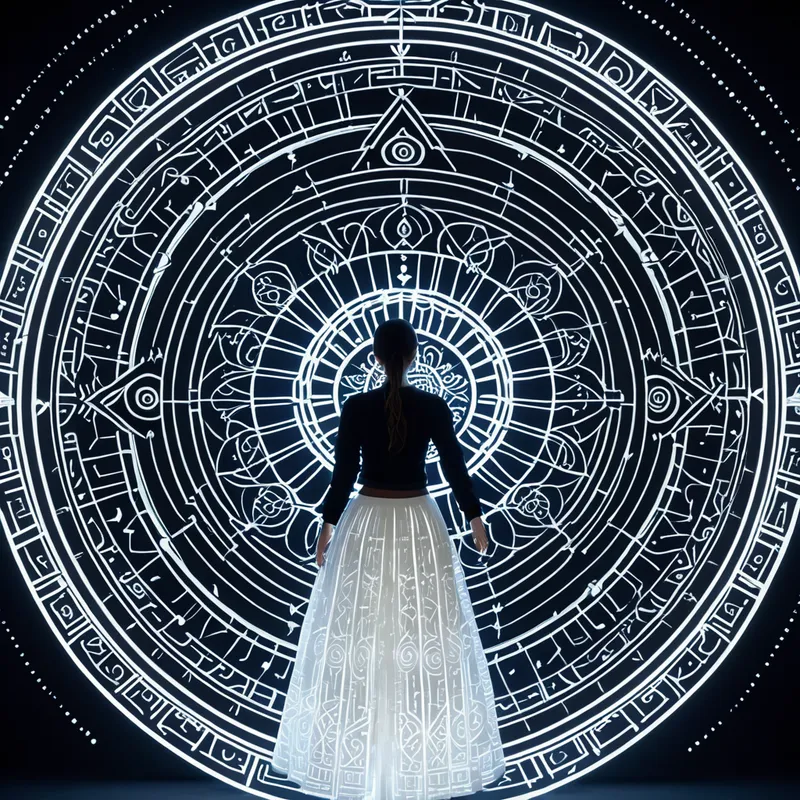
When this myth stirs in the modern dreamer, it often manifests not as a literal whirling, but as its somatic and emotional correlates. You may dream of vertigo—sudden, overwhelming spins where the world loses its orientation. This is the [psyche](/myths/psyche “Myth from Greek culture.”/) signaling an impending, necessary dissolution of a rigid ego-structure. You may dream of being a fulcrum, a still point in a chaotic storm, or conversely, of being helplessly caught in a vortex.
These dreams point to a critical psychological process: the confrontation between the centrifugal forces of life’s demands and the need for a centripetal, integrating center. The dizziness is the fear of letting go of a familiar, albeit painful, identity. The dream-whirl is the unconscious insisting on a motion too vast for the waking ego to comprehend—a motion towards wholeness that must first feel like disintegration.
Alchemical Translation
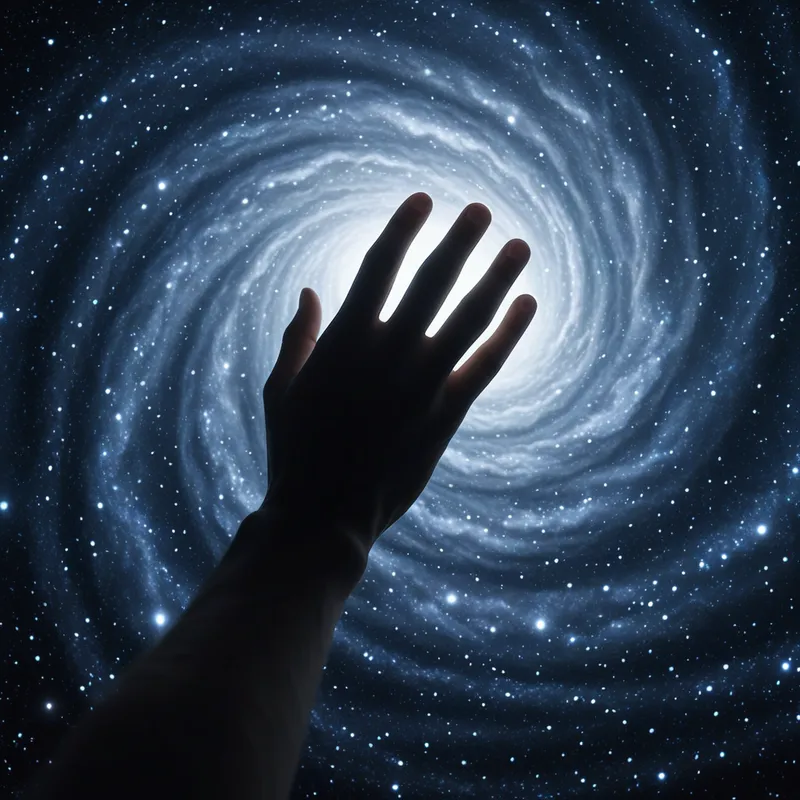
For the modern individual, the myth of the Whirling Dervish is a manual for individuation. Our secular lives are often a frantic, linear striving—a horizontal dash towards goals. The myth calls for a vertical, circular revolution.
The alchemy occurs not in the seeking, but in the becoming of the circle. The goal is to become the vessel, not to fill it.
The first turn is the recognition of the ego’s prison: our curated identities, our lists of achievements and failures. The surrender to the spin is the courageous act of therapy, shadow-work, or any deep introspection—allowing buried grief, rage, and joy to surface and be flung to the periphery. The ecstatic axis is the discovery of [the Self](/myths/the-self “Myth from Jungian culture.”/) (with a capital S), the immutable core that observes the drama of the personality without being consumed by it.
In this alchemy, our daily actions become the turning. We plant one foot in our core values (our axis) and allow the other to engage with the world from that centered place. We become transformers: receiving the raw data of experience (the right hand), processing it through the heart’s intelligence (the still center), and offering back a response infused with meaning and compassion (the left hand). We learn that true power is not in stubborn resistance, but in conscious, graceful revolution around what is eternally true. We become, in our own humble way, a whirling dervish—a silent, spinning prayer in the midst of the world’s noise.
Associated Symbols
Explore related symbols from the CaleaDream lexicon: