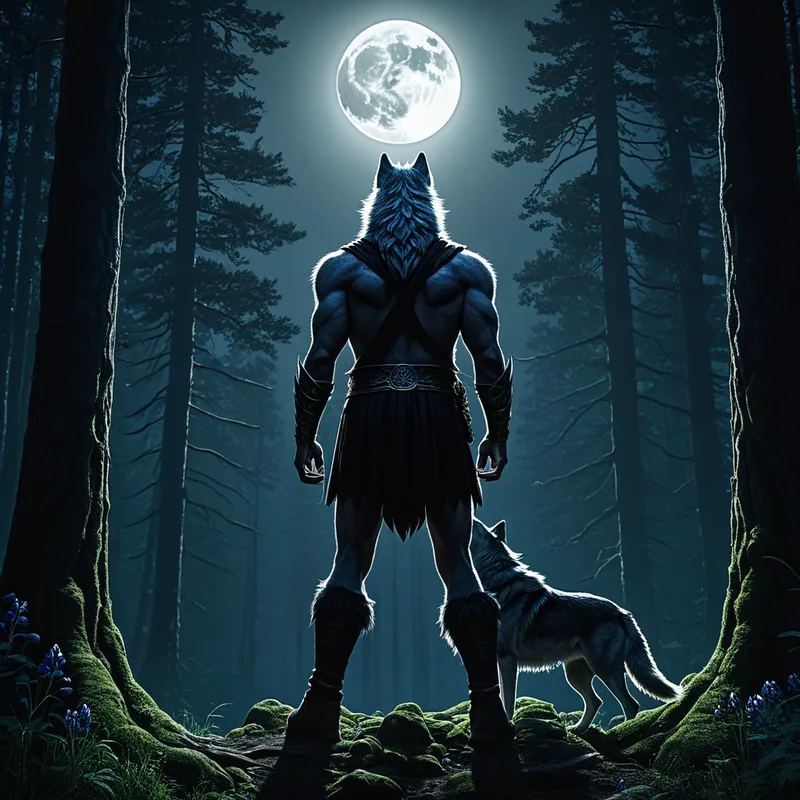
The Werewolf Myth Meaning & Symbolism
A shapeshifter's curse reveals the eternal human struggle between civilized restraint and the untamed, instinctual wilderness of the soul.
The Tale of The Werewolf
Listen, and hear the tale that is told when the fire burns low and [the wind](/myths/the-wind “Myth from Various culture.”/) howls from the black woods. It is not a story of one land, but of all lands where [the moon](/myths/the-moon “Myth from Tarot culture.”/) holds sway over the hearts of men.
There was a man—a good man, by the measure of the village. He was strong, a provider, a keeper of [the hearth](/myths/the-hearth “Myth from Norse culture.”/). His name is lost, for in the end, he became something else. He lived on the border, his farm the last outpost of plowed field before the ancient, whispering trees began. He knew the woods, their paths and their dangers, but he did not fear them. Not then.
It began with a feeling, a restlessness that came with the waxing moon. A prickling beneath his skin, as if his very blood were remembering a different course. He would wake from dreams of running on four legs, of tasting the hot copper of a fresh kill, his senses flooded with the scent of pine and loam and distant deer. He dismissed them. A man’s mind plays tricks in the lonely dark.
Then came the night of the full moon. A silver coin hung in [the sky](/myths/the-sky “Myth from Persian culture.”/), so bright it cast sharp, black shadows. The feeling was no longer a whisper but a roar. His bones ached with a deep, grinding pain. His teeth felt too large for his mouth. The civilized world—the smell of bread, the sound of his wife’s voice, the feel of wool—became a distant, irritating dream. The call of the wild was a siren song in his marrow.
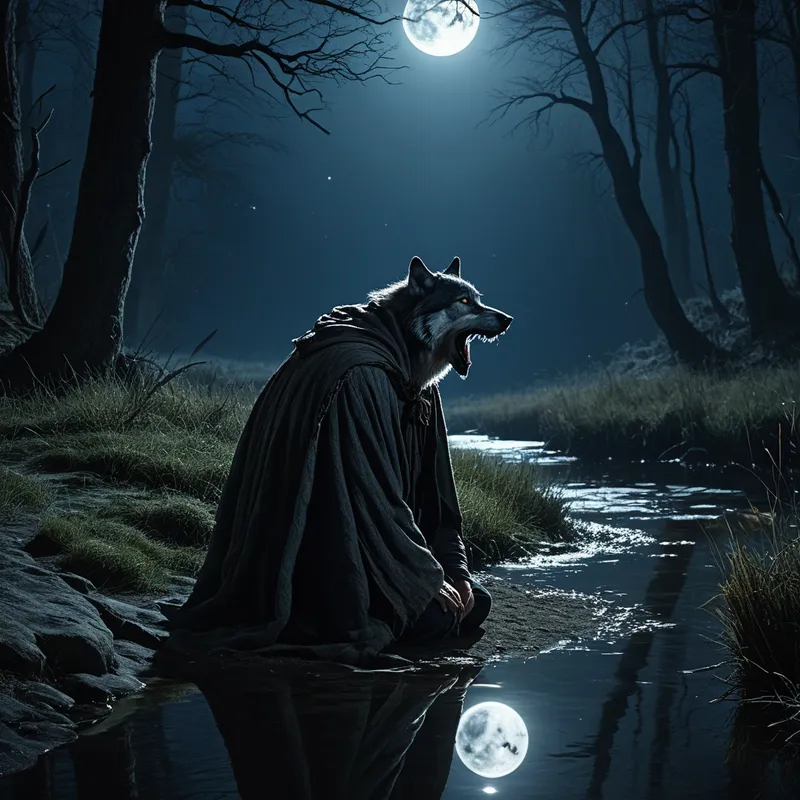
He fled his home, not as a man, but as a creature driven. He tore at his clothes as he ran into the forest. The transformation was not clean, not a magic of words, but a violent, sweating, screaming rebirth. His spine curved, his jaw lengthened into a muzzle, coarse fur erupted from his pores. His hands, which had held a plow, became paws tipped with claws that dug into the soft earth. His mind, the seat of reason and prayer, was submerged beneath a tide of pure instinct: hunt, run, live.
That night, the wolf ran. It was him, and it was not him. It was a primal self, unleashed and glorious in its freedom. It brought down a stag, and the feast was the most profound satisfaction he had ever known. But with the first grey light of dawn, the glory curdled into horror. He awoke naked, shivering in the leaf litter, the taste of blood in his human mouth, the memory of the kill vivid in his mind. He was a man again, but a man who knew the beast within.
And so the cycle was forged: the man by day, haunted and weary; the wolf by night, unleashed and ravenous. The border between his two selves, like the border of his farm, became a place of terrible conflict. He was a stranger to his own life, a ghost in his home, a demon in the woods. The curse was not merely the change, but the knowing. The eternal exile in the no-man’s-land between natures.
Cultural Origins & Context
The [werewolf](/myths/werewolf “Myth from European culture.”/) is a myth without a single birthplace. It is a pan-European phantom, appearing in the lore of the Germanic tribes, the Norse, the Slavs, the Celts, and the peoples of the Baltic and Balkan regions. Its name derives from the Old English wer (man) and wulf (wolf). This was not a singular story told by bards, but a pervasive folk belief, a dark whisper explaining the violence that could erupt from within a community or the unseen dangers of [the wilderness](/myths/the-wilderness “Myth from Biblical culture.”/).
It was passed down in winter tales, in warnings to children to come home before dark, and in the fearful accusations hurled at outsiders or those who lived on the literal and social margins. In some traditions, like those recorded in medieval Iceland, the transformation was a voluntary act of donning a vargúlfr (wolf-skin). In others, it was a curse inflicted by gods or witches, or the fate of those born under an ill omen. Its societal function was multifaceted: it was a cautionary tale about losing control, a [projection](/myths/projection “Myth from Alchemical culture.”/) of societal fears onto the “beast within” [the stranger](/myths/the-stranger “Myth from Biblical culture.”/), and a folk explanation for serial violence, lycanthropy (the clinical delusion of being a wolf), and the very real threat of wolf packs.
Symbolic Architecture
At its core, the [werewolf](/symbols/werewolf “Symbol: The werewolf symbolizes the duality of human nature, representing both civilization and primal instinct.”/) is the ultimate [symbol](/symbols/symbol “Symbol: A symbol can represent an idea, concept, or belief, serving as a powerful tool for communication and understanding.”/) of repressed instinct breaking its chains. The civilized, daylight self—the [farmer](/symbols/farmer “Symbol: Farmers symbolize hard work, nurturing, and the cultivation of not just crops, but also personal growth and community.”/), the [father](/symbols/father “Symbol: The father figure in dreams often symbolizes authority, protection, guidance, and the quest for approval or validation.”/), the citizen—is a thin veneer over the raw, primal self that evolution has not erased. The full [moon](/symbols/moon “Symbol: The Moon symbolizes intuition, emotional depth, and the cyclical nature of life, often reflecting the inner self and subconscious desires.”/) represents the cyclical, tidal pull of the unconscious, that which is luminous but cold, revealing but distorting.
The werewolf is not an animal, but the animal in the man, made flesh. It is the shadow given teeth and claws.
The transformation is not a mere physical change but a psychic one. Reason, [language](/symbols/language “Symbol: Language symbolizes communication, understanding, and the complexities of expressing thoughts and emotions.”/), and morality are subsumed by [sensation](/symbols/sensation “Symbol: Sensation in dreams often represents the emotional and physical feelings experienced in waking life, highlighting one’s intuition or awareness.”/), [impulse](/symbols/impulse “Symbol: A sudden, powerful urge or drive that arises without conscious deliberation, often linked to primal instincts or emotional surges.”/), and [appetite](/symbols/appetite “Symbol: Represents desire, need, and consumption in physical, emotional, or spiritual realms. Often signals unmet needs or excessive cravings.”/). The [wolf](/symbols/wolf “Symbol: Wolves in dreams symbolize instinct, intelligence, freedom, and a deep connection to the wilderness and primal instincts.”/)-self is amoral, not immoral; it operates on the [logic](/symbols/logic “Symbol: The principle of reasoning and rational thought, often representing order, structure, and intellectual clarity in dreams.”/) of survival and satiation. This is the terrifying allure of the myth: the fantasy of utter liberation from society’s constraints, paired with the inevitable [horror](/symbols/horror “Symbol: Horror in dreams often symbolizes deep-seated fears, anxieties, and unresolved conflicts that the dreamer faces in waking life.”/) of its consequences. The werewolf is the [shadow](/symbols/shadow “Symbol: The ‘shadow’ embodies the unconscious, repressed aspects of the self and often represents fears or hidden emotions.”/) incarnate, not as a vague dark figure, but as a specific, feral counterpart to the [persona](/symbols/persona “Symbol: The social mask or outward identity one presents to the world, often concealing the true self.”/). The [curse](/symbols/curse “Symbol: A supernatural invocation of harm or misfortune, often representing deep-seated fears, guilt, or perceived external malevolence.”/) is the acute [awareness](/symbols/awareness “Symbol: Conscious perception of self, surroundings, or internal states. Often signifies awakening, insight, or heightened sensitivity.”/) of this duality, the schism in the [soul](/symbols/soul “Symbol: The soul represents the essence of a person, encompassing their spirit, identity, and connection to the universe.”/).
The Dreamer’s Resonance
When the werewolf pattern emerges in modern dreams, it rarely appears as a Hollywood monster. It manifests as a profound somatic and psychological process of integration crisis. The dreamer may feel a terrifying, involuntary change coming over them—their body morphing, their voice becoming a growl, their hands becoming paws. This often occurs in settings of high stress or repressed anger, where the “civilized” [persona](/myths/persona “Myth from Greek culture.”/) is under strain.
Somatically, it can relate to feeling out of control of one’s own body or impulses—a rage that “comes out of nowhere,” a sexual urge that feels alien and powerful, or a deep, instinctual grief that howls for expression. Psychologically, it signifies a confrontation with the raw, unadapted parts of [the self](/myths/the-self “Myth from Jungian culture.”/) that [the ego](/myths/the-ego “Myth from Jungian culture.”/) has tried to disown. The dream is the [psyche](/myths/psyche “Myth from Greek culture.”/)‘s dramatic enactment of a truth: “You are not only what you present to [the world](/myths/the-world “Myth from Tarot culture.”/). There is a wildness in you that demands acknowledgment.” The terror in the dream is [the ego](/myths/the-ego “Myth from Jungian culture.”/)‘s terror of being dissolved by this powerful, ancient energy.
Alchemical Translation
The werewolf’s journey is a brutal, involuntary map of the alchemical [nigredo](/myths/nigredo “Myth from Alchemical culture.”/). It is the necessary, dark night of the soul where one’s composed identity is shattered by the emergence of [the shadow](/myths/the-shadow “Myth from Jungian culture.”/). The “curse” is, from the perspective of individuation, the call to initiation. One cannot become whole by only embracing the light, rational self. The wolf must be met, not slain.
The goal is not to destroy the wolf, but to cease being its helpless victim. To learn its language and, in doing so, reclaim its power.
The alchemical work is in the dawn after the transformation. The modern individual’s task is to consciously integrate that feral energy. This means creating a vessel—through therapy, art, ritual, or embodied practice—to hold the instincts without being consumed by them. It is the translation of blind rage into assertive boundaries, of untamed hunger into passionate creativity, of pack instinct into deep community. The silver bullet of old lore is not a weapon for killing, but a symbol of the reflective, lunar consciousness itself. To “see” the beast in the silver mirror of self-awareness is to begin the transmutation. The integrated self is not the man or the wolf, but the one who can walk the border between both worlds, conscious of each nature, master of neither, but enriched by both. The curse becomes a difficult gift, the mark of a soul that has dared to know its full, terrifying, and vital spectrum.
Associated Symbols
Explore related symbols from the CaleaDream lexicon: