The Well of Wisdom Myth Meaning & Symbolism
A sacred well of knowledge, guarded by a fierce goddess, can only be accessed by a hero willing to sacrifice his eye for ultimate wisdom.
The Tale of The Well of Wisdom
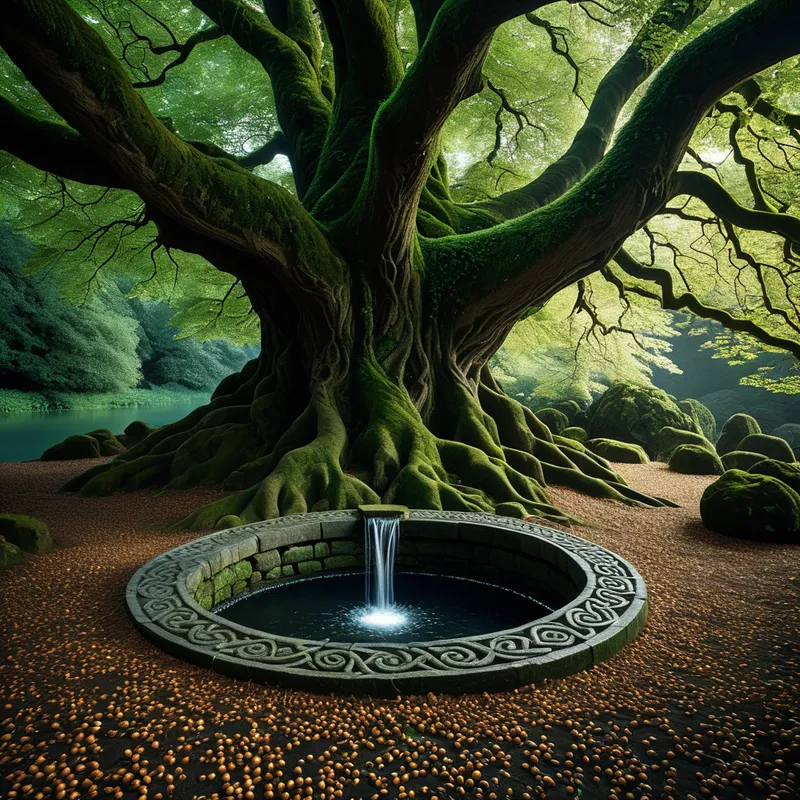
Listen, and let the mists of [the Otherworld](/myths/the-otherworld “Myth from Celtic culture.”/) part. In a time before time, when the land was young and the gods walked as giants among the hills, there existed a place of such power that even the Tuatha Dé Danann spoke of it in whispers. It was not a fortress or a throne, but a well.
Deep in the heart of the land, at the very source of the [River Boyne](/myths/river-boyne “Myth from Celtic culture.”/), lay Segais. Its waters were not of this earth, but of pure knowing. They were dark, still, and fathomless. Above it grew nine sacred hazel trees of crimson nut, trees of poetry and inspiration. In their season, the hazelnuts, heavy with all the knowledge of the arts and sciences, would fall into the waters with a soft plip. The nuts would be consumed by the [Salmon of Wisdom](/myths/salmon-of-wisdom “Myth from Celtic culture.”/), who swam in those silent depths, its speckled skin becoming a living map of the cosmos.
But such a font was not unguarded. Its keeper was Boann, she of the white cows. Yet, the true sentinel was a figure of immense and terrifying sovereignty: the goddess the Mórrígan, or in some tellings, her sister, the hag-goddess Nemain. She was the well’s fierce protector, its lid and its lock. To approach without reverence was to invite a fate worse than death.
Into this charged sanctum came a seeker. Not a young, untested warrior, but a king, a druid, a giant of thought: Fionn mac Cumhaill. He had heard the whispers of the salmon, had felt the ache for the knowledge that pulsed from the land itself. He came not with an army, but alone, his soul a vessel empty and ready.
The air by the well was thick, humming with latent power. The hazel leaves did not rustle; they hung still, as if listening. Before the dark [water](/myths/water “Myth from Chinese culture.”/), the guardian presence manifested—not as a monster to slay, but as an immutable law, a cosmic gatekeeper. The voice that spoke was not loud, but it vibrated in his very bones. The price for a drink from these waters is fixed. It is non-negotiable. To see with the All-Seeing, you must surrender the seeing of the One.
The conflict was not of sword and shield, but of [psyche](/myths/psyche “Myth from Greek culture.”/) and spirit. To gain everything, he must give up a part of his very self, his physical sight, his way of navigating [the world](/myths/the-world “Myth from Tarot culture.”/) of form. The rising action was the silent, agonizing deliberation within Fionn’s heart. He looked into the well. In its black mirror, he saw not his own face, but the swirling of stars, the patterns of [ogham](/myths/ogham “Myth from Celtic culture.”/) in the bark of the trees, the sorrows and joys of ages past. He saw knowledge, pure and undiluted.
With a resolve that echoed through the silent grove, he made his choice. There was no fanfare, only the terrible, intimate sound of sacrifice. He offered up his right eye, placing it upon the stone lip of the well. As it touched the cold rock, a shudder went through [the earth](/myths/the-earth “Myth from Hindu culture.”/). The guardian’s presence shifted from forbidding to acknowledging. The well’s waters, which had been still as death, began to gently swirl.
Leaning forward, his face a mask of pain and ecstatic anticipation, Fionn cupped his hands into the now-stirring waters. He brought them to his lips and drank. And in that draught, he did not taste water. He tasted the bitterness of the hazelnut’s shell, the sweetness of its kernel, the salt of [the sea](/myths/the-sea “Myth from Greek culture.”/), and the silence between stars. The knowledge of the world flooded into him—not as facts, but as being. He became the history of the land, the structure of a poem, the path of a salmon upstream. He gained the gift of imbas forosnai, the wisdom that lights up what is dark. He rose, no longer just Fionn the man, but Fionn the Seer, his one remaining eye now looking upon two worlds at once.
Cultural Origins & Context
The myth of the [Well of Wisdom](/myths/well-of-wisdom “Myth from Celtic culture.”/) is a cornerstone of the Irish mythological cycle, primarily preserved in medieval manuscripts like the Lebor Gabála Érenn (The Book of Invasions) and the Metrical Dindshenchas (Lore of Places). It is crucial to remember that “Celtic” is a broad linguistic and cultural umbrella; this myth is specifically Irish, filtered through the pens of Christian monks who recorded the native oral traditions. The story was not a mere folktale but a dindshenchas, explaining the origin and sacred nature of a specific location—the source of [the River](/myths/the-river “Myth from Buddhist culture.”/) Boyne.
Its societal function was multifaceted. For the learned class, the filid (poets) and druids, it was a foundational metaphor for the source of poetic inspiration and esoteric knowledge, which was seen as a dangerous, transformative force requiring severe personal discipline and sacrifice. For the wider culture, it reinforced the idea that the land itself was alive with consciousness and that true sovereignty—whether of a king or an individual—came not from force, but from a hard-won, sacrificial connection to that hidden wisdom.
Symbolic Architecture
The Well is the [collective unconscious](/symbols/collective-unconscious “Symbol: The Collective Unconscious refers to the part of the unconscious mind shared among beings of the same species, embodying universal experiences and archetypes.”/) itself—the dark, nourishing, and perilous [source](/symbols/source “Symbol: The origin point of something, often representing beginnings, nourishment, or the fundamental cause behind phenomena.”/) of all potential [knowledge](/symbols/knowledge “Symbol: Knowledge symbolizes learning, understanding, and wisdom, embodying the acquisition of information and enlightenment.”/) and psychic [life](/symbols/life “Symbol: The symbol of ‘Life’ represents a journey of growth, interconnectedness, and existential meaning, encompassing both the joys and challenges that define human experience.”/). The [water](/symbols/water “Symbol: Water symbolizes the subconscious mind, emotions, and the flow of life, representing both cleansing and creation.”/) is the fluid, unconscious content: memories, instincts, and archetypal patterns.
The well does not grant information; it confers being. To drink is to be dissolved and reconstituted with the waters of origin flowing in your veins.
The nine hazel trees represent the ordered, structuring principles of [consciousness](/symbols/consciousness “Symbol: Consciousness represents the state of awareness and perception, encompassing thoughts, feelings, and experiences.”/) (nine being a sacred [number](/symbols/number “Symbol: Numbers in dreams often symbolize meaning, balance, and the quest for understanding in the dreamer’s life, reflecting their mental state or concerns.”/) of completion). The nuts are the concentrated kernels of [insight](/symbols/insight “Symbol: A sudden, deep understanding of a complex situation or truth, often arriving unexpectedly and illuminating hidden connections.”/)—poetic, scientific, spiritual—that must fall into the unconscious (the water) to be made digestible. The Salmon is the [archetype](/symbols/archetype “Symbol: A universal, primordial pattern or prototype in the collective unconscious that shapes human experience, behavior, and creative expression.”/) of the Self, the psychic totality that has integrated all knowledge. It is the goal of the [individuation process](/symbols/individuation-process “Symbol: The psychological journey toward self-realization and wholeness, integrating conscious and unconscious aspects of personality.”/), swimming perfected in the [depths](/symbols/depths “Symbol: Represents the subconscious, hidden emotions, or foundational aspects of the self, often linked to primal fears or profound truths.”/).
The [guardian](/symbols/guardian “Symbol: A protector figure representing safety, authority, and guidance, often embodying parental, societal, or spiritual oversight.”/) [goddess](/symbols/goddess “Symbol: The goddess symbolizes feminine power, divinity, and the nurturing aspects of life, embodying creation and wisdom.”/) (the Mórrígan/Nemain) is the terrifying [aspect](/symbols/aspect “Symbol: A distinct feature, quality, or perspective of something, often representing a partial view of a larger whole.”/) of the [anima](/symbols/anima “Symbol: The feminine archetype within the male unconscious, representing soul, creativity, and connection to the inner world.”/) or the [Shadow](/symbols/shadow “Symbol: The ‘shadow’ embodies the unconscious, repressed aspects of the self and often represents fears or hidden emotions.”/). She is the necessary [resistance](/symbols/resistance “Symbol: An object or tool representing opposition, struggle, or the act of pushing back against external forces or internal changes.”/), the embodiment of the cost. She ensures that wisdom is not stolen or taken lightly, but earned through a [transaction](/symbols/transaction “Symbol: An exchange of value, energy, or information between parties, representing balance, reciprocity, and the flow of resources in life.”/) that alters the [seeker](/symbols/seeker “Symbol: A person actively searching for meaning, truth, or a higher purpose, often representing the dreamer’s own quest for identity or fulfillment.”/) irrevocably. Fionn’s sacrifice of his eye is the ultimate [symbol](/symbols/symbol “Symbol: A symbol can represent an idea, concept, or belief, serving as a powerful tool for communication and understanding.”/) of relinquishing one’s limited, ego-bound [perspective](/symbols/perspective “Symbol: Perspective in dreams reflects one’s viewpoints, attitudes, and how one interprets experiences.”/). The physical eye sees duality (self/other); the price for non-dual, holistic [vision](/symbols/vision “Symbol: Vision reflects perception, insight, and clarity — often signifying the ability to foresee or understand deeper truths.”/) is the surrender of that very tool of [separation](/symbols/separation “Symbol: A spiritual or mythic division between realms, states of being, or consciousness, often marking a transition or loss of connection.”/).
The Dreamer’s Resonance
When this myth stirs in the modern psyche, it manifests in dreams of profound cost and transformation. A dreamer may find themselves at a pivotal source—a well, a spring, a cracked pipe in a basement gushing with dark water. There is always a choice presented, often by a formidable, silent female figure or an immutable voice. The “price” is visceral: perhaps dream-teeth falling out (a classic symbol of a price paid), or the dreamer willingly plucking out their own eye, not in horror, but in solemn offering.
Somatically, the dream may be accompanied upon waking by a feeling of hollowed-out awe in the solar plexus or a pressure in [the third eye](/myths/the-third-eye “Myth from Hindu culture.”/). Psychologically, this signals a critical juncture in the individuation process. [The ego](/myths/the-ego “Myth from Jungian culture.”/) is being asked to capitulate, to give up a cherished “way of seeing” (a rigid belief, a self-image, a long-held grievance) to access a deeper, more painful, and ultimately liberating truth. The dream is the psyche’s enactment of the sacrificial ritual, preparing the dreamer for a conscious, waking-life integration that feels like both a loss and a staggering gain.

Alchemical Translation
The myth of the Well is a perfect map of psychic alchemy. The process begins with the [nigredo](/myths/nigredo “Myth from Alchemical culture.”/): Fionn’s journey to the well, his confrontation with the dark goddess. This is the descent into the unconscious, the confrontation with [the shadow](/myths/the-shadow “Myth from Jungian culture.”/) and the anima in her most challenging form. The sacrifice is the mortificatio—the killing of the old, sight-bound ego.
The plucked eye is the prima materia, the base lead of limited perception, offered up to be transmuted.
The drinking of the waters is the albedo and citrinitas—the washing and illumination. The ego, now humbled and reduced, is dissolved in the waters of the unconscious. It does not drown; it is baptized. From this dissolution, a new compound emerges: the conscious mind now infused with, and respectful of, the unconscious source. This is the [rubedo](/myths/rubedo “Myth from Alchemical culture.”/), the creation of the philosophical gold—the integrated Self, symbolized by Fionn as the Sage.
For the modern individual, this translates to any profound, life-altering insight that comes not from study, but from surrender. It is the moment after a devastating loss that reveals a deeper strength. It is the relinquishing of a toxic identity that allows one’s true nature to surface. The myth teaches that wisdom is not accumulated; it is uncovered within, through a voluntary maiming of our defensive, know-it-all ego. We must be willing to become one-eyed kings in the world of form to become seers in the world of essence. The well is always there, at the root of our own psychic river. The guardian is our own resistance. The sacrifice is always ours to make.
Associated Symbols
Explore related symbols from the CaleaDream lexicon: