The Weaving Maid and Cowherd Myth Meaning & Symbolism
A celestial weaver and a mortal cowherd fall in love, are separated by the Milky Way, and are permitted to reunite just once a year.
The Tale of The Weaving Maid and Cowherd
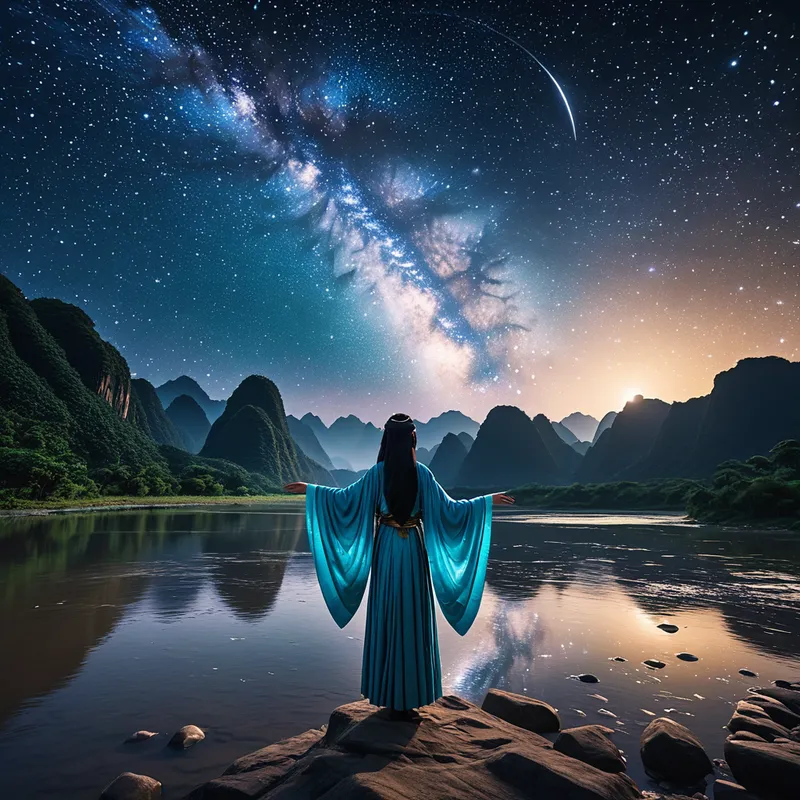
Listen, and hear the tale written in the stars themselves. In the high, silent courts of the [Jade Emperor](/myths/jade-emperor “Myth from Chinese culture.”/), there lived a daughter, the Weaving Maiden, Zhinü. Her fingers were not merely skilled; they were the conduits of cosmic order. With threads of cloud and starlight, she wove the very tapestries of the heavens—the sunset’s blush, the dawn’s first gold, the shimmering veils of [the Milky Way](/myths/the-milky-way “Myth from Greek culture.”/). Yet, for all her divine craft, her world was one of profound solitude, a gilded cage of celestial duty.
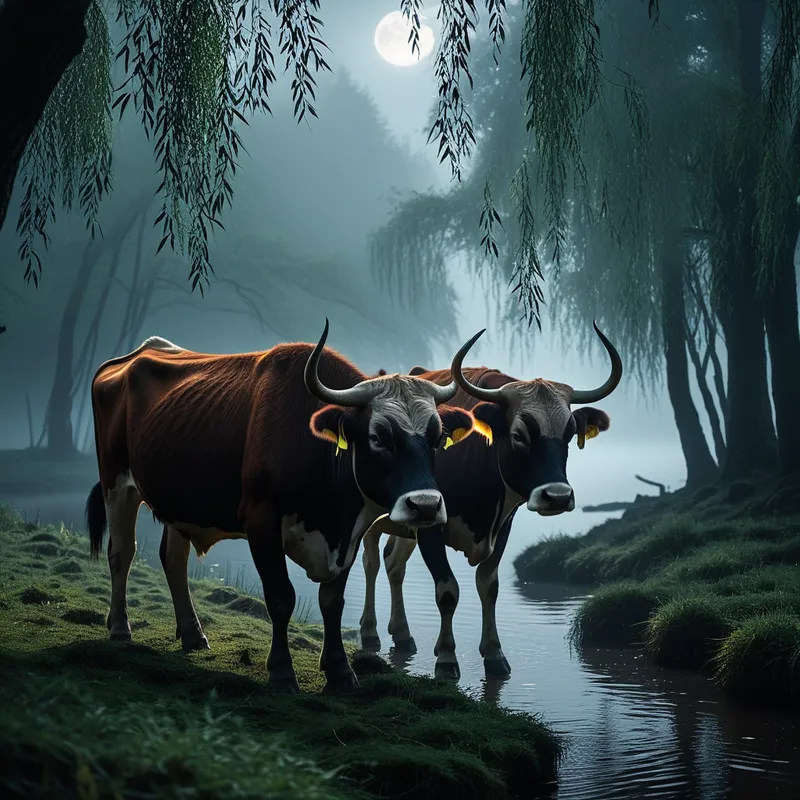
Far below, on the green, mortal earth, lived a young cowherd, Niulang. Orphaned and poor, his only kin were an old ox and a heart full of simple, honest labor. His world was the smell of damp earth, the lowing of cattle at dusk, and the vast, indifferent sky above. He knew nothing of heavenly looms, only the solid ground beneath his feet.
But the cosmos thrives on unexpected symmetries. The old ox, who was more than he seemed, spoke one evening in a voice like grinding stones. “Beyond the western forest,” it said, “by the hidden lake where the willows weep, you will find a marvel. Follow, and do not be afraid.”
Guided by the ox, Niulang pushed through the whispering bracken to the lake’s edge. There, draped upon a branch like captured rainbows, were robes of unearthly silk. And in the [water](/myths/water “Myth from Chinese culture.”/), a maiden of such beauty that the very air seemed to still. It was Zhinü, bathing with her sisters, having stolen a moment of fleeting freedom from [the sky](/myths/the-sky “Myth from Persian culture.”/)-palace. In that instant, as Niulang’s eyes met hers across the [water](/myths/water “Myth from Chinese culture.”/), a silent bolt struck both their hearts—a recognition deeper than heaven or earth.
He took her robes, not as theft, but as an act of fate. When she emerged, shivering not from cold but from the shock of the mortal world, he stood before her, holding her celestial garment. There were no grand words, only the profound silence of two solitudes meeting. She stayed. She, the weaver of skies, learned the weight of an earthenware bowl, the warmth of a hearth fire, the simple, staggering joy of shared laughter. He, the tiller of soil, beheld the universe in her eyes. They married, and for a time, heaven and earth were reconciled in their humble home. Two children were born, their laughter a new music in [the world](/myths/the-world “Myth from Tarot culture.”/).
But the cosmic order, once disrupted, trembles. The Jade Emperor and the Queen Mother of the West looked down and saw the sacred loom abandoned, the heavenly patterns growing dull. A daughter of the sky could not belong to the mud of earth. With a wrath that shook the seasons, the Queen Mother descended. She appeared not as a storm, but as an implacable law. With a hairpin snatched from her own brow, she drew a single, terrible line across the vault of heaven. Where it passed, stars boiled up into a raging, silver torrent—the Silver River, impassable and cold, forever dividing the lover from the beloved.
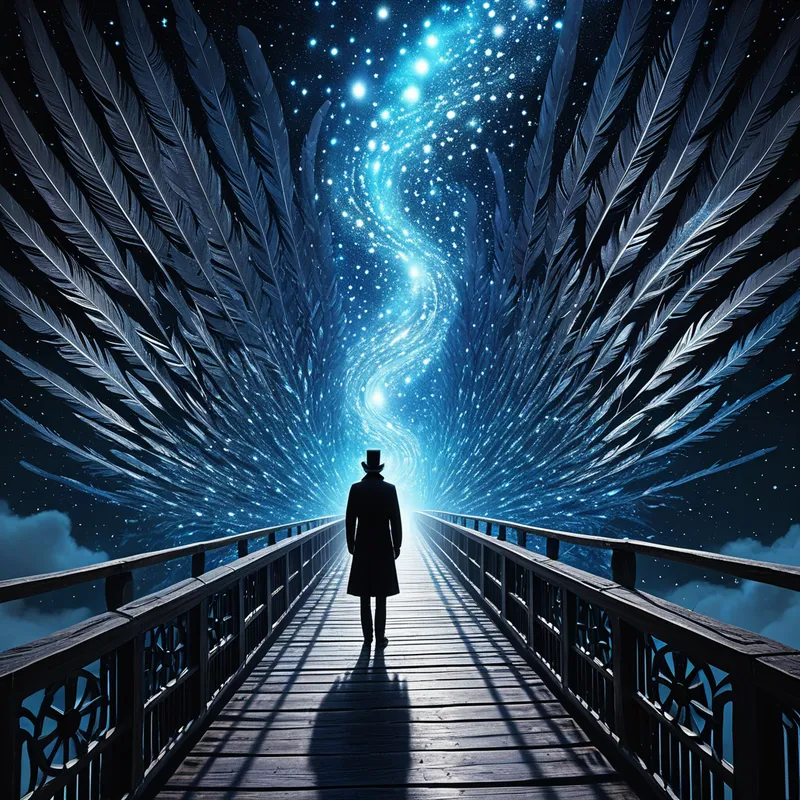
On one bank, Zhinü wept, her tears becoming new stars. On the other, Niulang stood with their children, his cry a silent rent in the fabric of the world. Their despair was so pure, so vast, that it moved the very heart of the cosmos. Magpies, those messengers between realms, heard it. And so, once each year, on the seventh day of the seventh lunar month, every magpie in the world takes wing. They fly to the Silver River, and with their own bodies, they form a living, beating bridge across the starry void. For one night, the Weaver and the Cowherd cross the bridge of wings, and heaven and earth touch once more in a silent, desperate embrace.
Cultural Origins & Context
This is not merely a story; it is an ancient rhythm in the bone-memory of a culture. Its earliest fragments appear in the Classic of Poetry over 2,500 years ago, evolving through the Han and Tang dynasties into the poignant narrative we know. It was a tale told by grandmothers on summer nights, pointing to the bright stars Vega and Altair separated by the hazy band of the Milky Way. It was enacted in rituals, most notably during the Qixi Festival, where young women would make offerings of fruit and demonstrate skills like weaving, praying for Zhinü’s blessing to find a diligent husband or master a craft.
Its societal function was multifaceted. It explained celestial phenomena, yes, but more deeply, it gave poetic form to universal human experiences: the separation of families (through marriage, war, or death), the tension between duty and desire, and the harsh realities of a social order that often divided classes and genders. It was a vessel for longing, making the vast, impersonal sky a map of intimate, human heartbreak and hope.
Symbolic Architecture
Beneath the celestial romance lies a profound symbolic [architecture](/symbols/architecture “Symbol: Architecture in dreams often signifies structure, stability, and the framing of personal identity or life’s journey.”/). Zhinü is not just a [princess](/symbols/princess “Symbol: The symbol of a princess embodies themes of power, privilege, and feminine grace, often entailing a journey of self-discovery.”/); she is the archetypal principle of Wen, the celestial order, culture, and the disciplined, conscious mind that weaves [reality](/symbols/reality “Symbol: Reality signifies the state of existence and perception, often reflecting one’s understanding of truth and life experiences.”/) into coherent patterns. Niulang represents Zhi, the raw, earthy, instinctual [life](/symbols/life “Symbol: The symbol of ‘Life’ represents a journey of growth, interconnectedness, and existential meaning, encompassing both the joys and challenges that define human experience.”/) force, the unconscious grounded in [nature](/symbols/nature “Symbol: Nature symbolizes growth, connectivity, and the primal forces of existence.”/) and the [body](/symbols/body “Symbol: The body in dreams often symbolizes the dreamer’s self-identity, personal health, and the relationship they have with their physical existence.”/).
Their union is the primordial dream of the psyche: the marriage of consciousness and the unconscious, culture and nature, spirit and matter.
The Silver [River](/symbols/river “Symbol: A river often symbolizes the flow of emotions, the passage of time, and life’s journey, reflecting transitions and movement in one’s life.”/) is the great divide that inevitably arises after this initial, blissful [conjunction](/symbols/conjunction “Symbol: In arts and music, a conjunction represents the harmonious or dissonant merging of separate elements to create a new, unified whole.”/). It is the necessary [separation](/symbols/separation “Symbol: A spiritual or mythic division between realms, states of being, or consciousness, often marking a transition or loss of connection.”/) that creates [consciousness](/symbols/consciousness “Symbol: Consciousness represents the state of awareness and perception, encompassing thoughts, feelings, and experiences.”/) itself—[the ego](/myths/the-ego “Myth from Jungian culture.”/)’s realization of its distinctness from the primal unity. The hairpin that creates it is the sharp, discriminating intellect or the rigid law of tradition that enforces this [separation](/symbols/separation “Symbol: A spiritual or mythic division between realms, states of being, or consciousness, often marking a transition or loss of connection.”/) for the sake of cosmic (or psychic) order. The [magpie bridge](/myths/magpie-bridge “Myth from Chinese culture.”/) is the miraculous, temporary [connection](/symbols/connection “Symbol: Connection symbolizes relationships, communication, and bonds among individuals.”/)—the [symbol](/symbols/symbol “Symbol: A symbol can represent an idea, concept, or belief, serving as a powerful tool for communication and understanding.”/) of [empathy](/symbols/empathy “Symbol: The capacity to understand and share the feelings of others, often manifesting as emotional resonance or intuitive connection in dreams.”/), imagination, dreams, and [synchronicity](/symbols/synchronicity “Symbol: Meaningful coincidences that suggest an underlying connection between events, often interpreted as guidance or confirmation from the universe.”/) that can, at appointed times, bridge the seemingly unbridgeable gap between our conscious lives and the deep, forgotten parts of our [soul](/symbols/soul “Symbol: The soul represents the essence of a person, encompassing their spirit, identity, and connection to the universe.”/).
The Dreamer’s Resonance
When this myth stirs in the modern dreamer, it signals a profound somatic and psychological process. To dream of a loved one across an uncrossable river, or to be separated by a vast, beautiful, yet terrifying space, is to feel the ache of the Zhinü and Niulang within.
This is the [psyche](/myths/psyche “Myth from Greek culture.”/) experiencing the pain of internal separation. It may manifest as: the feeling of being cut off from one’s creativity or passion (the abandoned loom); the longing for a lost aspect of [the self](/myths/the-self “Myth from Jungian culture.”/) or a relationship that feels fated but impossible; or the tension between one’s professional, orderly life (heaven) and one’s personal, instinctual desires (earth). The dream is the soul’s magpie, building a bridge of imagery to show you what is divided within you. The somatic resonance is often a deep, central ache—a heartache in the literal, emotional, and spiritual sense—coupled with a yearning that feels both ancient and urgent.
Alchemical Translation
The individuation process modeled here is not one of permanent, blissful union, but of learning to live with sacred separation and the grace of periodic reunion. The initial, innocent marriage is the ego’s first, naive engagement with the unconscious—a “fall” into relationship that is blissful but unsustainable, as it lacks conscious understanding.
The enforced separation by the Queen Mother of the West (who represents the necessary, if severe, aspect of the Self that enforces boundaries) is a critical stage. It is the painful but essential differentiation where one must learn to stand on one’s own bank, to tend to one’s own domain. Zhinü must return to her loom, to her conscious craft; Niulang must raise the children, tending to the earthly reality. This is the long, lonely work of developing the individual personality.
The alchemy occurs in the faithful waiting and the annual return. The bridge does not appear out of pity, but because the steadfastness of their longing compels it.
For the modern individual, the “alchemical translation” is this: We must cease craving a permanent end to our inner divisions. Instead, we must honor both banks of our own river—the disciplined weaver and the instinctual cowherd within. We commit to our daily looms and our earthly fields. And then, we cultivate the conditions for the magpie bridge. This is the dedicated practice—be it active imagination, creative work, deep relationship, or ritual—that we consciously engage in to facilitate those moments of transcendent reunion. We do not live on the bridge, but we learn to trust it will form, again and again, connecting the heavens of our potential with [the earth](/myths/the-earth “Myth from Hindu culture.”/) of our lived experience, making our wholeness not a static state, but a dynamic, celestial dance across a river of stars.
Associated Symbols
Explore related symbols from the CaleaDream lexicon: