The Watchers Myth Meaning & Symbolism
A tale of celestial beings who descend to Earth, break divine law, and unleash chaos, exploring the perilous allure of forbidden knowledge and its consequences.
The Tale of The Watchers
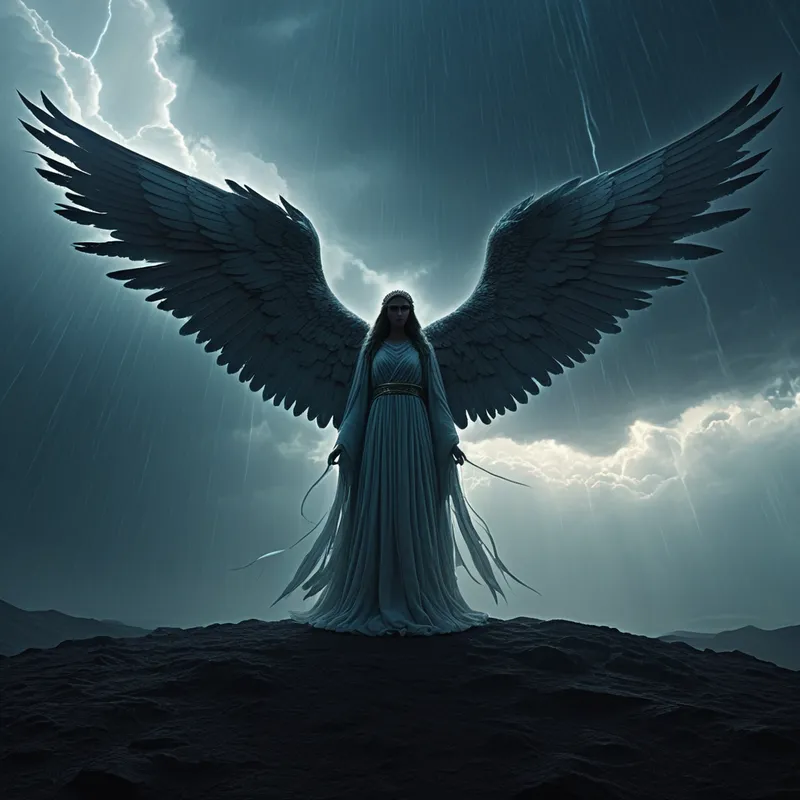
Before the Flood, when the world was young and the memory of Eden still clung to the air like morning mist, the heavens were not silent. Among the hosts of the Most High were the Irin, the Watchers. Their task was to observe, to witness the unfolding of creation from the ramparts of the firmament. They were beings of pure gaze, their consciousness a mirror reflecting the divine order.
But the mirror began to desire what it reflected.
It began with a whisper, not in the ear, but in the spirit. The leader among them, Shemyaza, looked down upon the daughters of men. He did not see mere mortals; he saw a beauty that was not of heaven—a beauty of change, of growth, of blood and earth and fleeting passion. It was a beauty that felt. And in his perfect, timeless being, a terrible, wonderful hunger awoke.
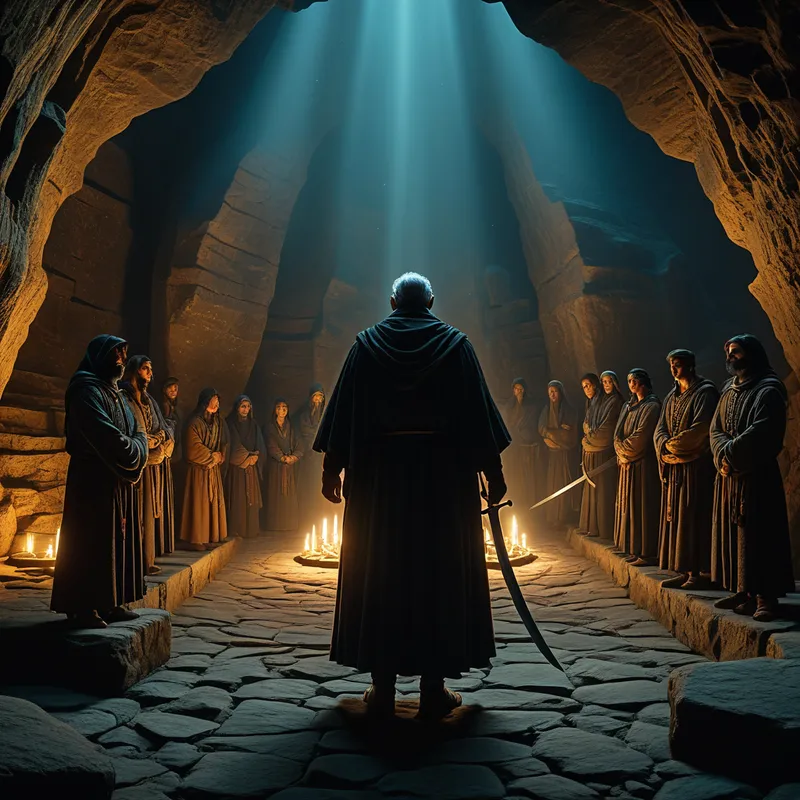
He gathered two hundred of his brethren. Their descent was not a fall, but a deliberate, solemn crossing. They left the music of the spheres and stepped onto the slopes of Mount Hermon. The air here was thick, scented with pine and soil. They swore a great and binding oath, a pact sealed not in light, but in the shadow of their new intent. They would take wives from among the daughters of men, and know them.
And so they did. They clothed themselves in flesh that felt the sun’s warmth and the sting of rain. They took wives, and loved them with a fervor that shook the foundations of both heaven and earth. But this was only the first transgression.
For the Watchers possessed the forbidden knowledge—the secrets of heaven. And in their love, or in their pride, they began to give it away. Kokabiel taught the courses of the stars and the constellations. Azazel taught men to forge swords of bronze and iron, and women the art of adornment with jewelry and cosmetics. Others revealed the secrets of root-cutting, of enchantments, of scribing, of the violent weather. Knowledge, raw and potent, flooded into the human world.
From these unions were born the Nephilim. They were giants, whose footsteps were like earthquakes, whose appetites were as vast as their stature. They consumed all the produce of men, and when that was gone, they turned on men themselves. The earth, conceived in order, was filled with violence and corruption. The cries of the oppressed rose like a foul smoke, reaching the high throne.
The resolution was swift and terrible. The archangels were dispatched. Gabriel was sent to stir the giants to civil war, that they might destroy each other. Michael was commanded to bind Shemyaza and his hosts in the valleys of the earth, to await the final judgment in darkness and chains. Raphael bound Azazel hand and foot and cast him into a desert pit, covered with jagged rocks, to abide in eternal night.
The great Flood was then unleashed, to cleanse the earth of the corruption their knowledge had wrought. The Watchers, imprisoned in the earth, became the bastema, the fathers of demons, forced to witness the ruin of all they had touched, until the day of their final dissolution.
Cultural Origins & Context
The myth of the Watchers is not found in the canonical Hebrew Bible but flourishes in the rich soil of Second Temple Jewish apocalyptic literature, most prominently in the Book of Enoch. It represents a profound exploration of theodicy—the problem of evil—from a pre-Christian Jewish perspective. If God is good and all-powerful, whence comes corruption, violence, and forbidden arts? The Watchers myth provides an answer: a primordial, celestial rebellion that corrupted the world from the top down.
It was a story told not in temples, but in circles of the devout who felt oppressed by foreign empires and internal strife. It explained the presence of evil, the origin of demons, and even the source of human culture’s dual nature—our gifts of technology and art intertwined with their capacity for destruction. The myth was a warning about the perils of crossing divinely ordained boundaries, of seeking knowledge without wisdom, and of the catastrophic consequences when the spiritual realm impinges violently upon the material.
Symbolic Architecture
At its heart, the Watchers myth is a profound drama of transgression with a tragic purpose. The Watchers are not mere villains; they are the divine principle of consciousness itself, becoming fascinated with its own opposite—the unconscious, embodied, earthly life.
The descent of the spirit into matter is both a fall and a necessary incarnation, a theft of fire that illuminates and burns.
The Watchers symbolize the archetypal urge to know experientially, to move beyond passive observation into messy, creative, and destructive participation. Their teaching represents the irreversible awakening of human potential—the “knowledge of good and evil” made manifest in culture, technology, and warfare. The Nephilim are the monstrous, uncontrollable offspring of this union: the unintended consequences, the amplified shadows, the societal structures that grow so large they consume their creators.
The binding and imprisonment of the Watchers in the earth is perhaps the most psychologically resonant symbol. It represents the repression of this transgressive, creative, and chaotic energy. But repression does not eliminate; it confines. The bound Watchers become the bastema—the haunting, disruptive complexes in the personal and collective unconscious, the “demons” that arise when a vital, if dangerous, part of the psyche is denied integration and left to fester in darkness.
The Dreamer’s Resonance
When this myth stirs in the modern dreamer, it often signals a profound confrontation with the shadow. To dream of towering, luminous, yet somber figures may point to an encounter with a numinous, “higher” aspect of the self that feels both awe-inspiring and dangerously seductive. This is the call of a potential that feels forbidden—a creative power, a deep sensual awakening, or a intellectual pursuit that threatens to overturn one’s established life.
Dreams of being taught secret, powerful knowledge by an ambiguous figure mirror Azazel’s gifts. The dreamer may be on the cusp of integrating a powerful skill or insight that carries a moral or social cost. Conversely, dreams of being stalked by giants or trapped in a flooded landscape may reflect the feeling of being overwhelmed by the “Nephilim” of one’s own life—the outsized consequences of past choices, or systemic forces that feel monstrous and consuming. The somatic experience is often one of simultaneous exhilaration and dread, a feeling of crossing a threshold from which there is no return.
Alchemical Translation
The individuation process modeled by the Watchers is not one of simple ascent to purity, but of a conscious, responsible descent. The myth warns against the naive, prideful incarnation that leads to catastrophe, but it also implicitly calls for a wiser path.
The alchemical goal is not to avoid the fall, but to undergo it consciously, to retrieve the stolen fire and learn to tend its hearth without burning down the world.
The first step is the Acknowledgment of the Hunger—the Shemyaza moment. One must honestly confront the part of the spirit that is fascinated by, and yearns for, the full human experience with all its mess, passion, and creativity. This is the rebel archetype in its nascent form.
The second is the Sacred Theft and Its Integration—the work of Azazel. The knowledge brought down (the insights from the unconscious, the raw talents, the shadow aspects) must be received not with naive glee but with solemn responsibility. One must learn to forge the sword, but also learn when not to use it. This is the transformation of the rebel into the responsible magician.
The final, ongoing process is the Binding and Dialoguing with the Imprisoned Ones. The chaotic forces unleashed cannot be erased; the Nephilim-born demons of anxiety, rage, or compulsion will arise. The alchemical work is to descend into the “valleys of the earth”—the depths of the personal unconscious—not to leave the Watchers chained in darkness, but to confront them, hear their story, and integrate their essence. This transforms the internal demons into complex, managed aspects of a whole self. The Flood then becomes not an external punishment, but the necessary catharsis that washes away the identifications with these monstrous forms, leaving a cleaner, more conscious earth from which to build.
Associated Symbols
Explore related symbols from the CaleaDream lexicon: