The Wandering Druid Myth Meaning & Symbolism
A tale of a druid cast from the sacred grove, condemned to wander, seeking not a home but the lost song of the world's soul.
The Tale of The Wandering Druid
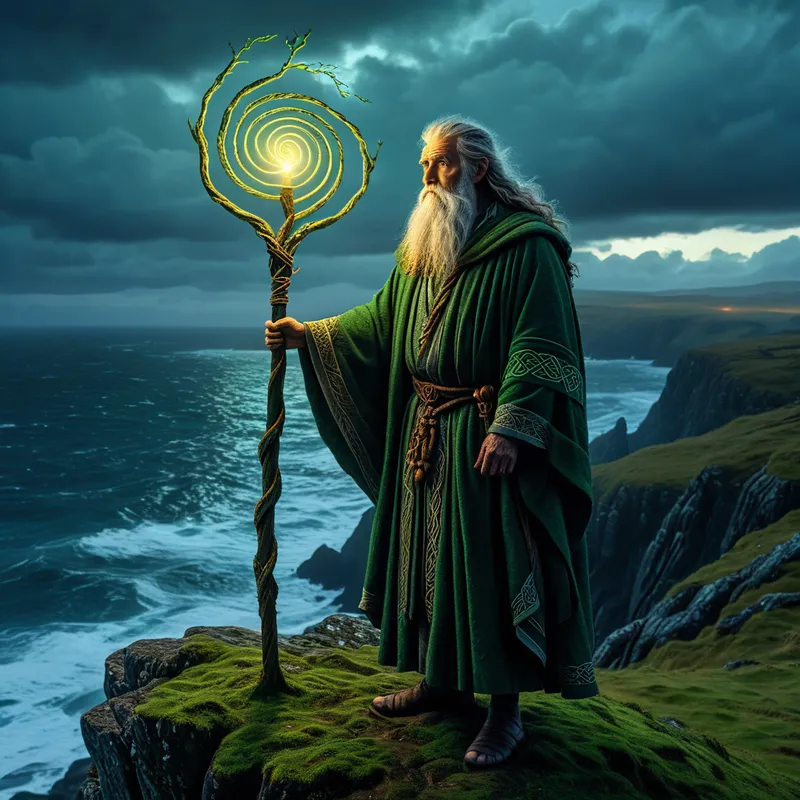
Listen. The wind in the nemeton does not always sing of peace. There was a druid, Dairgné, whose wisdom was as deep as the roots of the oldest tree. He served the tribe, read the flight of birds, and sang the sun across the sky. But his heart held a secret hunger—a longing to know the song the world sings to itself when no one is listening.
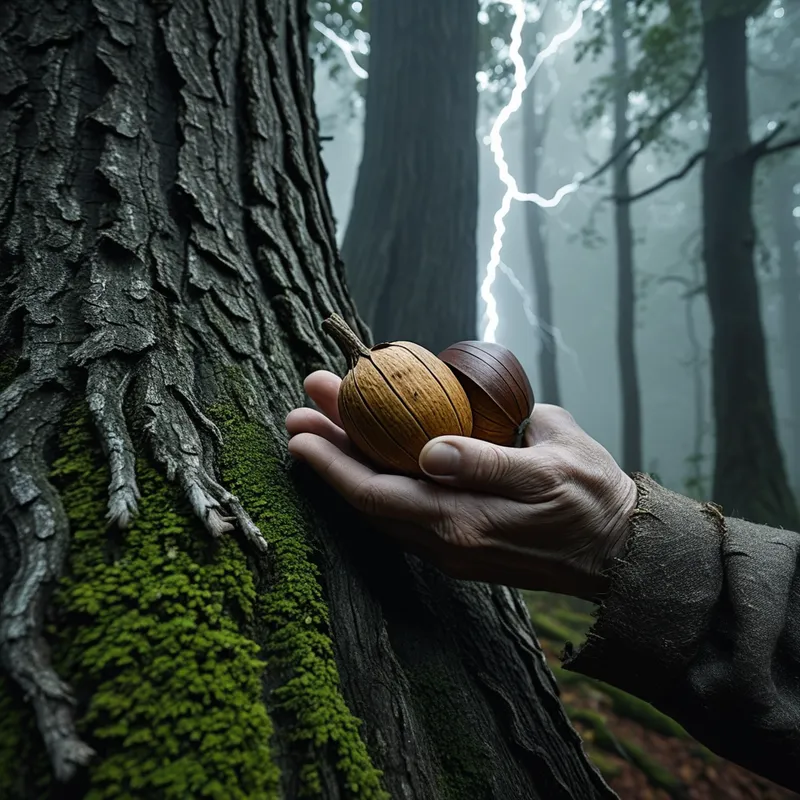
One Samhain, when the veil thinned to a spider’s thread, Dairgné dared a forbidden rite. While the tribe honored the ancestors, he went to the heart of the grove, to the Bile tree, a great oak older than memory. He pressed his brow to its bark and asked not for a vision for the people, but for the vision of the oak itself. He sought the memory of the acorn, the feeling of the rain, the whisper of the stone beneath the root. The tree, in its ancient generosity, showed him. It poured into him the raw, unfiltered song of the earth—a symphony of growth and decay, of crushing pressure and silent, patient waiting. It was a truth too vast for a human soul to hold and remain unchanged.
He emerged not as a druid of the tribe, but as a stranger. His eyes reflected forests unseen; his voice, when he tried to chant the blessings, carried the dissonant echo of tectonic plates shifting. The people grew fearful. The chieftain declared him díbergach. The high druid, with sorrow, performed the rite of severance. They broke his ritual sickle, scattered his sacred herbs to the wind, and led him to the edge of the settled lands. “You have drunk from a well not meant for mortals,” the high druid said. “The grove can no longer hold you. You are condemned to walk the paths between places, to be a guest at no hearth, until you find a way to carry the song without being consumed by it.”
And so, Dairgné began his wandering. He walked the high moors where the wind scoured the soul. He slept in the caves of forgotten beasts. He was not searching for a new home, for he knew none could hold him. He was searching for a vessel. He learned the language of wolves not by sound, but by the shape of their hunger in the night. He deciphered the maps written in lichen on north-facing stones. He carried the world’s song within him, a tempest that both sustained and isolated him. His final test came at a lonely crossroads, where a Bean Sídhe appeared, offering him a choice: a cup of forgetfulness, to return to the tribe as a simple man, or a staff of living rowan, which would forever bind him to the lonely road. He took the staff. As his hand closed around the wood, the inner tempest quieted, not gone, but finally woven into the rhythm of his steps. He became the walker between worlds, the Wandering Druid, whose wisdom was not in settlement, but in the sacred act of passage itself.
Cultural Origins & Context
The figure of the Wandering Druid is not a singular myth from a specific text, but a powerful archetype woven from the frayed edges of Celtic oral tradition and later medieval Irish literature. The druids themselves left no written records, so their lore survives in fragments: in the cryptic legal tracts of the Brehon Laws, in the tantalizing observations of Roman commentators, and most vividly, in the cycles of Irish myth written down by Christian monks. Characters like Cathbad, or the many exiled poets and seers, carry echoes of this archetype.
This myth likely functioned as a cultural container for profound existential realities. In a society deeply tied to the land and tribe, exile was a fate worse than death, a spiritual as well as a physical erasure. The Wandering Druid myth explores the inverse: what if exile is not an end, but a transformation? It gave a sacred shape to the experience of the outsider-seer, the one whose knowledge or vision sets them apart from the collective. It was a story told not to warn against seeking forbidden knowledge, but to acknowledge its terrible, beautiful cost and its necessary role in the psychic ecology of the world. The druid’s wandering mirrors the Celtic spiritual view of life as a journey (immram), where wisdom is found in motion, at the thresholds, not in permanent stasis.
Symbolic Architecture
At its core, the myth is a profound map of the individuation process, where the Self must often break its contract with the collective ego to fulfill a deeper destiny. The sacred grove represents the ordered, known world of the conscious personality and tribal identity. The Bile tree is the symbolic axis mundi, the conduit to the objective psyche, the collective unconscious.
The true sage is not made in the council circle, but on the lonely road where the soul’s hunger meets the world’s raw song.
Dairgné’s transgression is the heroic, necessary ego-inflation that precedes a fall into depth. He seeks not personal power, but unmediated experience of the Anima Mundi. The consequence—exile—symbolizes the inevitable alienation that occurs when one incorporates contents too vast for the personal self. The wandering is the long, painful process of integrating this inflation, of grinding the raw gem of numinous experience into a lens through which to see the world. The staff of rowan, a tree of protection and poetry in Celtic lore, symbolizes the achieved vessel: a structure of consciousness strong enough to channel the unconscious without being shattered by it. The druid does not return “home”; he becomes the embodiment of the threshold itself.
The Dreamer’s Resonance
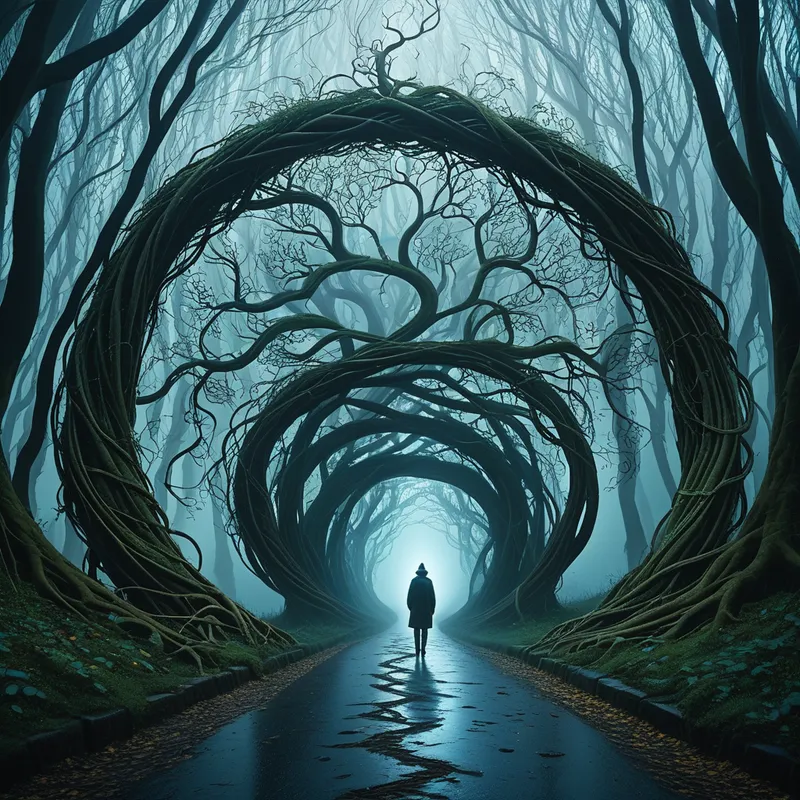
When this myth stirs in the modern dreamer, it often announces a profound interior exile. You may dream of being cast out of a familiar place (office, family home, hometown) for knowing or seeing something “too much.” You dream of endless walking through liminal landscapes—empty highways, misty bridges, corridors that change. There is a deep somatic sense of rootlessness, of carrying a secret weight.
This is the psyche signaling a critical dissolution phase. The old identity—the “tribe” of your accustomed roles, beliefs, and self-concept—can no longer contain the new psychological material seeking emergence. This material might be a burgeoning creative vision, a spiritual awakening, or the painful acknowledgment of a personal truth that society deems inconvenient. The wandering in the dream is not aimless; it is the psyche’s way of forcing a confrontation with the void, of stripping away external validation until you must learn to find sustenance from the “song” within. The loneliness is acute, but it is the fertile ground where the autonomous psyche begins to speak in its own voice.
Alchemical Translation
The alchemy here is of solutio and coagulatio—dissolution and re-coagulation. The myth models the full arc of psychic transmutation. First, the nigredo: the druid’s conscious identity is dissolved in the overwhelming waters of the unconscious (the tree’s song). This is a dark, chaotic state of inflation and alienation.
The goal is not to rebuild the old house, but to learn the sacred geometry of the road.
The wandering represents the albedo, the whitening, a purifying journey through the barren landscapes of the soul where one learns to distinguish the eternal song from the personal noise. The final choice at the crossroads is the rubedo, the reddening, the moment of conscious commitment to the transformed state. He chooses the enduring, active principle (the staff) over a return to unconsciousness (the cup of forgetfulness).
For the modern individual, this translates to the courage to endure the exile that deep authenticity demands. It is the process of giving up the comfort of belonging in a superficial sense to claim a more profound belonging to the totality of one’s experience. The Wandering Druid does not find a new static self; he becomes a process. His wisdom is his movement, his insight is his permeability to the world. His ultimate teaching is that the soul’s home is not a place on a map, but the quality of attention carried on the journey. We are all, in our deepest transformations, wanderers between who we were and who we are becoming, tasked with carrying our own fragment of the world’s song until it becomes our staff, our guide, and our true belonging.
Associated Symbols
Explore related symbols from the CaleaDream lexicon: