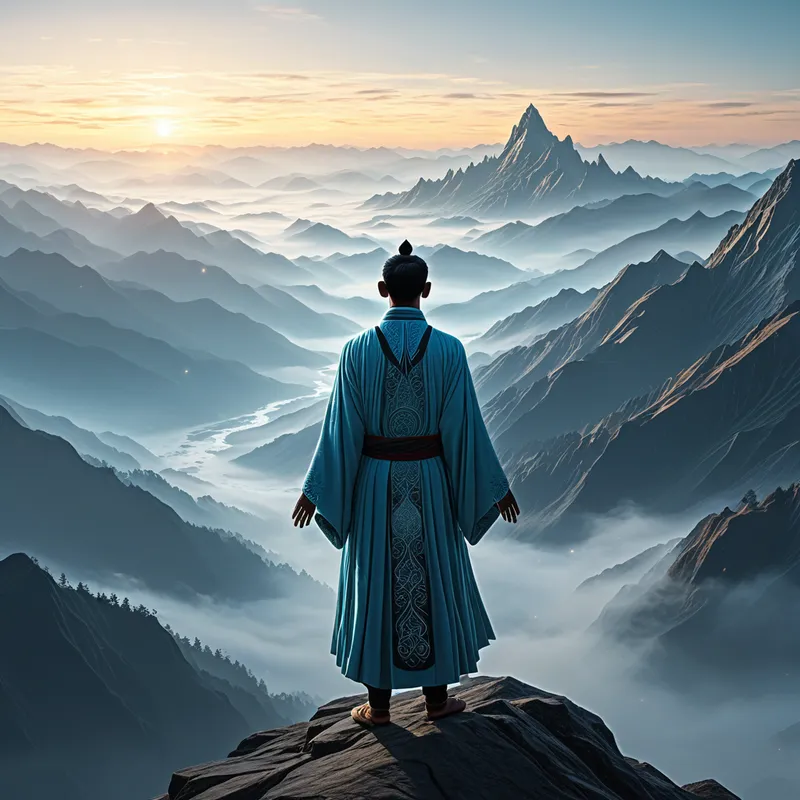
The Wanderer Myth Meaning & Symbolism
A celestial being, exiled from the eternal garden, wanders the mortal world to remember his true nature and find the pathless path back to the source.
The Tale of The Wanderer
Listen, and let the mists of time part. Before the ten thousand things had names, there was a garden at the heart of the cosmos, a place of pure, undifferentiated harmony known as Wu Ji. Here, the celestial spirits dwelled in effortless unity with the Tao. Among them was one called You Fang Zhe. He was not the greatest, nor the wisest, but his spirit held a peculiar quality—a love for the patterns of things, the dance of shadows and light within the garden’s eternal noon.
One day, as he traced the spiraling path of a falling leaf that should not have fallen, he came upon the garden’s one and only gate—a simple arch of moonstone, veiled in silence. A question, unbidden and sharp as a shard of ice, pierced his being: “What lies beyond the harmony?” In the asking, the harmony fractured. The very act of distinguishing an “inside” from an “outside” was a primal separation. The gate, which had been merely a form, became a threshold. The garden, which had been all, became a place.
A great stillness fell. The other spirits turned not in anger, but in profound, silent witnessing. No voice pronounced a judgment, for the Tao does not judge. Yet, a law as immutable as gravity took hold: to see the gate is to stand before it. To ask the question is to be compelled toward the answer. With a heart heavy with a sorrow he could not yet name, You Fang Zhe passed under the arch.
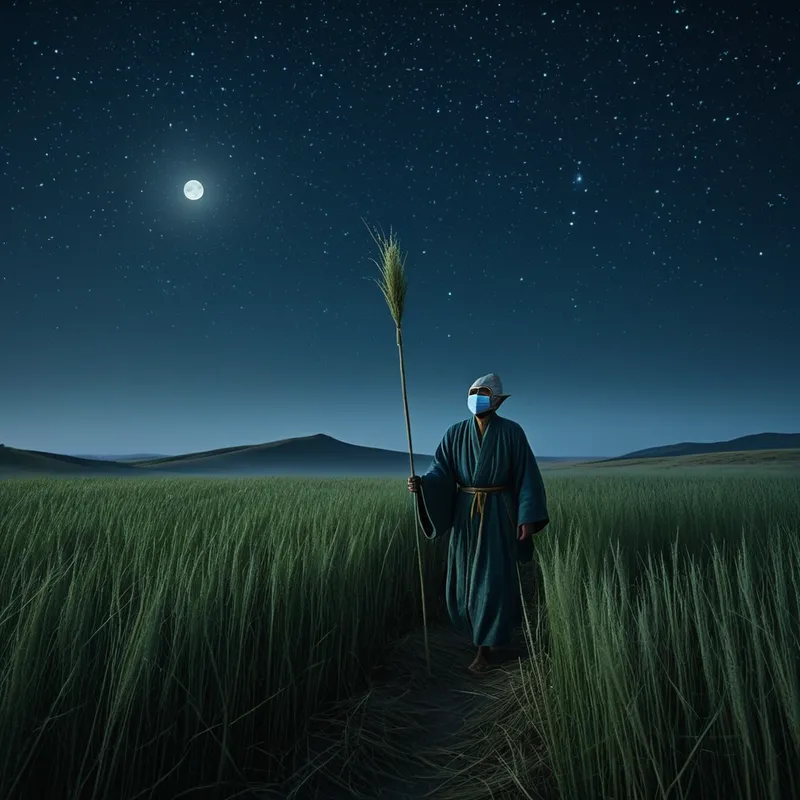
He fell not through space, but through states of being. The seamless unity of the garden gave way to the dazzling, terrifying multiplicity of the world. He landed on the banks of a rushing river, in a realm of mountains and valleys, seasons and decay. He was clothed in coarse hemp, a simple gourd and a staff of knotted wood his only possessions. His celestial memory began to cloud, like a reflection in disturbed water. He remembered the garden as a fading dream of perfect light, and the gate as a forgotten door in a childhood home.
And so, his wandering began. He walked the dusty roads between mortal kingdoms, a silent figure at the edges of feasts and wars. He climbed peaks where eagles nested, seeking a vantage point to see the garden, but found only more mountains. He sat by waterfalls, trying to hear its music in the roar, but heard only water. Decades turned, his sandals wearing thin on the unyielding earth. He was not searching, for he had forgotten what was lost. He was simply walking, a question mark moving through a world of exclamation points.
The resolution came not on a mountaintop, but in a humble valley, by a still pond at dusk. Exhausted, he knelt to drink. In the water’s perfect stillness, he saw the reflection of the evening star—and for a moment, it was not a star, but the single, unwavering light of the garden’s heart. He saw his own weathered face, and in his own eyes, he saw the same light. The gate was not behind him. The garden was not a place he had left. The question and the answer, the wanderer and the path, the exile and the home—they were all the same. He had been carrying the gate within him all along. He laughed, a sound like a dry stream finding water again. He lay down by the pond, and as he closed his eyes, the boundaries of his self dissolved into the rustling grass, the cool earth, the vast sky. He was not in the world. He was the world, wandering back to itself. The journey ended where it had always been: here.
Cultural Origins & Context
The figure of the Wanderer is not the protagonist of a single, canonical Taoist scripture like the Tao Te Ching or the Zhuangzi. Rather, he is a pervasive archetype woven through the fabric of Taoist folklore, allegorical poetry, and the oral traditions of hermits and Xian-seekers. His tale is the story of every adept who leaves the “world of dust” (the mundane social order) to take up the “cloud wandering” life.
This myth was passed down not in imperial courts, but in mountain grottos, roadside tea stalls, and the shared silence between master and disciple. It functioned as a map of the internal landscape. For a culture deeply skeptical of rigid social roles and conventional ambitions, the Wanderer modeled an alternative: a life of radical simplicity and direct engagement with the Tao through the medium of the natural world and the untethered self. He was a psychological safety valve, a cultural permission slip for the individual to step off the well-trodden path of duty and honor, and into the wilderness of their own nature.
Symbolic Architecture
The myth is a masterclass in the symbolism of non-duality. The central conflict is not between good and evil, but between the illusion of separation and the reality of unity.
The exile is not a punishment, but the necessary condition for the homecoming. One must forget the garden to truly find it in the grain of sand.
The Garden of Wu Ji represents the original, unconscious wholeness of the psyche—the state before the ego’s birth. The Gate is the moment of consciousness, the awakening of the individual mind that simultaneously creates the concepts of “self” and “other.” Exile is the inevitable human condition: the sense of alienation, longing, and incompleteness that fuels all seeking.
The Wandering itself is the hero’s journey inverted. There is no dragon to slay, no treasure to win in a distant castle. The journey is one of un-learning, of shedding the accumulated dust of identity, ambition, and knowledge. The Gourd symbolizes non-utility and natural containment (the void that holds potential). The Staff represents reliance on the Tao itself as one’s only support. The final Reflection in the Pond is the moment of gnosis: the realization that the seeker, the path, and the goal are not separate. The true home was never lost; only the awareness of being at home was forgotten.

The Dreamer’s Resonance
When this myth stirs in the modern dreamer, it often manifests as dreams of profound, melancholic travel. You are in an airport terminal where all signs are in an unknown script. You are driving on an endless highway at night. You are walking through a city that is both familiar and utterly alien. The somatic feeling is one of rootless motion, a deep, bodily sense of not-belonging.
Psychologically, this indicates a critical phase where the conscious personality feels exiled from its own depths. The ego has become overly identified with a role, a achievement, or a self-concept (the “garden” of personal history or ambition), and has now sensed its own emptiness. The wandering in the dream is the psyche’s process of de-integrating this rigid identity. It is not a crisis to be solved, but a process to be endured. The dream is the soul beginning its “cloud wandering,” dissolving the landmarks of the old self to make space for a more authentic, but as yet unknown, alignment.
Alchemical Translation
The Wanderer’s path is the alchemy of individuation through surrender, not conquest. For the modern individual, the myth models the process of psychic transmutation in three stages.
First, The Exile of the Ego: This is the often-painful awakening where one’s constructed life—career, relationships, self-image—suddenly feels like a beautifully furnished prison. This is the call to wander, often experienced as depression, ennui, or a “midlife crisis.” It is the necessary death of the persona.
Second, The Wandering of the Soul: This is the active, often confusing, phase of exploration. We may change jobs, travel, study new philosophies, or delve into therapy. We are looking for the “gate” back to meaning. Yet, like You Fang Zhe, we are looking out there. The alchemical work here is the gradual burning away of projections. We learn that no new job, partner, or belief system is the ultimate answer.
The alchemical gold is not found at the journey’s end, but is forged in the very heat of the wandering, in the friction between longing and presence.
Finally, The Return to the Source: This is the unio mystica of the process, the realization that the core of the self is not a small, separate ego, but the boundless, impersonal Tao itself. It is not an achievement, but a recognition. The conflict dissolves. One stops seeking a spiritual life and begins living from a spiritual center. The wanderer comes to rest, not by arriving somewhere new, but by discovering he was always, already home. The psyche achieves a fluid, resilient wholeness where the individual is both a distinct expression of life and a fully integrated part of the cosmic whole. The exile is over, because the wanderer has finally met himself.
Associated Symbols
Explore related symbols from the CaleaDream lexicon: