The Vitrum Philosophers Myth Meaning & Symbolism
A myth of alchemical masters who sacrificed their bodies to become living glass, holding the world's memory and offering a path to lucid consciousness.
The Tale of The Vitrum Philosophers
Listen, and hear the tale whispered on the breath of the furnace, etched in the condensation of [the alembic](/myths/the-alembic “Myth from Alchemical culture.”/).
In the First Age, when [the world](/myths/the-world “Myth from Tarot culture.”/) was a heavy, dreaming [thing](/myths/thing “Myth from Norse culture.”/) of raw potential, there walked the Philosophers. They were not kings or warriors, but quiet men and women who listened to the conversations of minerals and the dreams of fire. They sought the [Philosopher’s Stone](/myths/philosophers-stone “Myth from Alchemical culture.”/), not for gold, but for a truth so pure it would clarify all existence.
Their greatest labor was the [Magnum Opus](/myths/magnum-opus “Myth from Alchemical culture.”/), and in its final, most terrible stage—the Albedo—they faced a precipice. [The prima materia](/myths/the-prima-materia “Myth from Alchemical culture.”/) of the soul was prepared, the inner fires stoked, but to fix the fleeting spirit, to make insight permanent, required a vessel of impossible transparency and strength. Flesh was too opaque, stone too brittle.
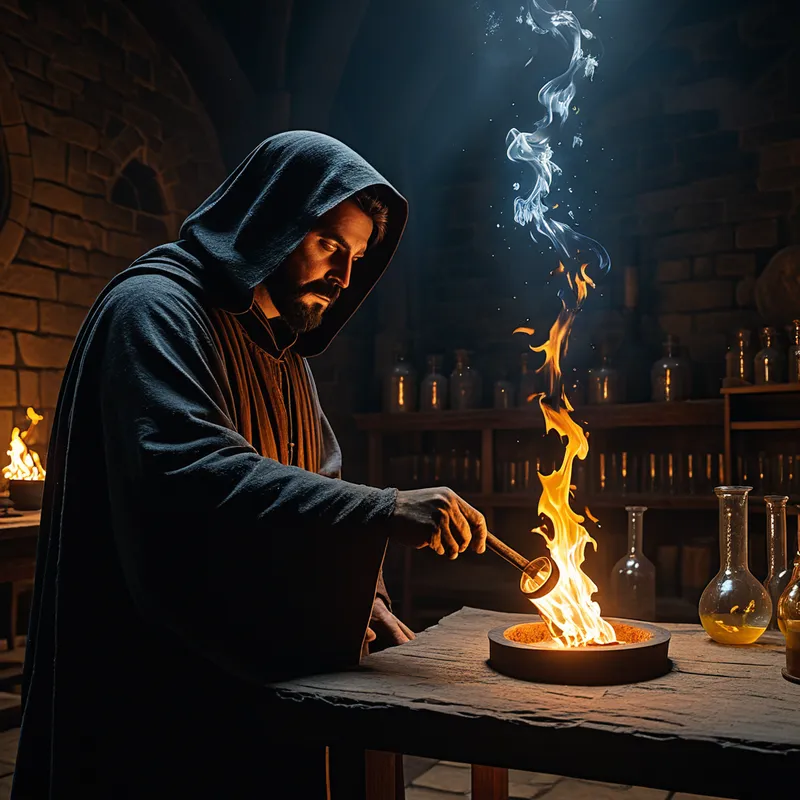
The eldest among them, a woman named Lux Prima, stood before the communal furnace, its heart a sun of liquid silica and rare salts. “The formula is complete,” she spoke, her voice steady as a plumb line. “But the final ingredient is [the vessel](/myths/the-vessel “Myth from Alchemical culture.”/) itself. [The crucible](/myths/the-crucible “Myth from Alchemical culture.”/) must become the elixir. To see the world truly, we must become a lens. To hold its memory, we must become its archive.”
A silence fell, thick as slag. To become the [Vitrum](/myths/vitrum “Myth from Alchemical culture.”/) was to forsake the soft, warm chaos of the mortal coil for the hard, clear order of crystal. It was a death of blood and breath for a life of light and record.
One by one, they consented. Not with fanfare, but with the solemnity of a vow. They approached the great crucible. There was no scream of pain, but a profound, resonant hum—the sound of matter being persuaded into a new song. Flesh, bone, and thought dissolved into the molten glass, not as destruction, but as translation. From the glowing pool, they drew themselves forth anew.
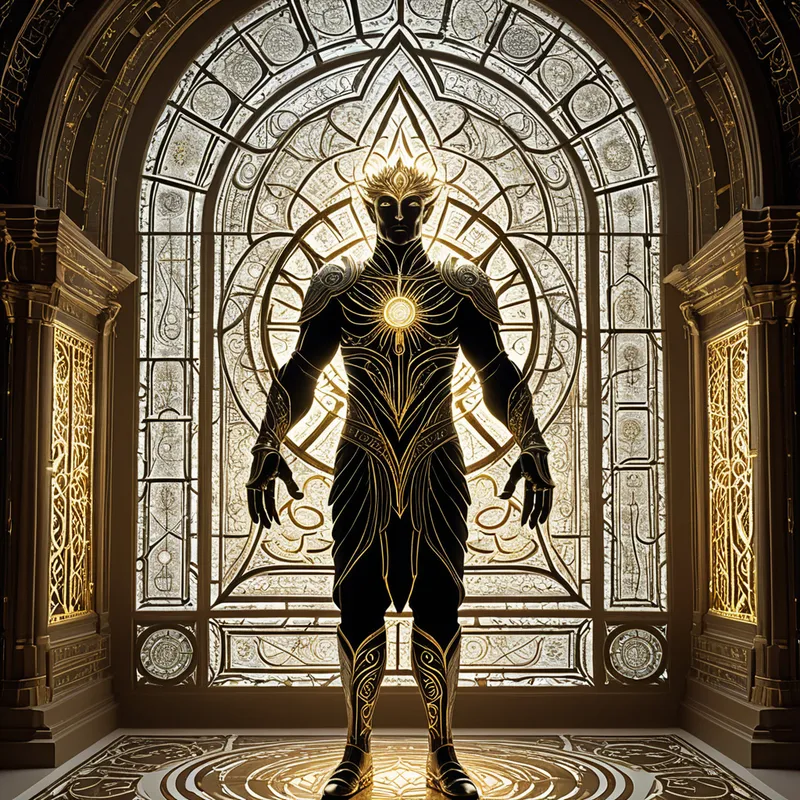
They rose as the Vitrum Philosophers. Their bodies were flawless, transparent glass, within which swirled constellations of captured experience—the silver tracks of tears, the gold filigree of joy, the leaden streaks of sorrow, all held in crystalline suspension. Their eyes were not for seeing out, but for focusing the [inner light](/myths/inner-light “Myth from Buddhist culture.”/) of understanding. They did not speak, but when sunlight or starlight passed through them, it cast upon the walls perfect, moving pictures of all they had ever learned, every truth they had distilled.
They retreated to the Turris Memoriae, a spire not of stone, but of grown crystal. There, they stand eternally in silent congress, a living library. Their greatest gift—and their eternal sorrow—is that any seeker who dares [the tower](/myths/the-tower “Myth from Tarot culture.”/)‘s heights and has the courage to gaze into a Philosopher, not at them, will see their own life reflected back with absolute, unforgiving clarity. [The Vitrum](/myths/the-vitrum “Myth from Alchemical culture.”/) offers no comfort, only truth. And in that truth, the chance to begin one’s own Great Work.
Cultural Origins & Context
The myth of the Vitrum Philosophers is [the cornerstone](/myths/the-cornerstone “Myth from Biblical culture.”/) of the esoteric “Alchemical” cultural tradition, a body of knowledge that views cosmology, psychology, and material science as a single, unified process. It originated not as a popular folktale, but as an initiatory narrative, passed orally within closed guilds and scriptoriums. It was never written in plain text, but encoded in the illustrations of Mutus Liber, hinted at in the recipes for making stained glass for cathedrals, and whispered during the final vigil of an apprentice’s journey to mastery.
Its tellers were the master alchemists themselves, who served as proto-psychologists and spiritual guides. The myth’s function was multifaceted: it was a warning about the ultimate cost of enlightenment (the loss of mundane humanity), a map of the final stage of spiritual transformation, and a societal anchor for the value of preserved knowledge. The Philosophers became the culture’s ultimate archetype of the objective, non-attached witness—the ideal toward which all scholarly and introspective endeavor was directed.
Symbolic Architecture
The myth is a profound symbolic [blueprint](/symbols/blueprint “Symbol: A blueprint represents the foundational plan or design for something, often symbolizing potential, structure, and the mapping of one’s inner self or future.”/) for the transformation of [consciousness](/symbols/consciousness “Symbol: Consciousness represents the state of awareness and perception, encompassing thoughts, feelings, and experiences.”/). The Philosophers represent [the ego](/myths/the-ego “Myth from Jungian culture.”/)‘s ultimate sacrifice on the [path](/symbols/path “Symbol: The ‘path’ symbolizes a journey, choices, and the direction one’s life is taking, often representing individual growth and exploration.”/) to a transpersonal state of [awareness](/symbols/awareness “Symbol: Conscious perception of self, surroundings, or internal states. Often signifies awakening, insight, or heightened sensitivity.”/).
The self must become a vessel so transparent that it ceases to be a thing seen and becomes the medium through which all things are seen.
The [Athanor](/symbols/athanor “Symbol: An alchemical furnace representing spiritual transformation, purification, and the sustained process of creating the Philosopher’s Stone.”/) is the [crucible](/symbols/crucible “Symbol: A vessel for intense transformation through heat and pressure, symbolizing spiritual purification, testing, and alchemical change.”/) of intense psychological ordeal—the “dark [night](/symbols/night “Symbol: Night often symbolizes the unconscious, mystery, and the unknown, representing the realm of dreams and intuition.”/) of the [soul](/symbols/soul “Symbol: The soul represents the essence of a person, encompassing their spirit, identity, and connection to the universe.”/)” where all previous identities are dissolved. The [molten glass](/symbols/molten-glass “Symbol: Molten glass represents transformation, fluidity, and creation, highlighting the dynamic processes of change in one’s life.”/) symbolizes the fluid, undifferentiated state of the [psyche](/myths/psyche “Myth from Greek culture.”/) at the [height](/symbols/height “Symbol: Height often symbolizes ambition, perspective, and the elevation of one’s self-awareness.”/) of its potential, just before it is given a new, permanent form. The act of “becoming Vitrum” is the fixing of [insight](/symbols/insight “Symbol: A sudden, deep understanding of a complex situation or truth, often arriving unexpectedly and illuminating hidden connections.”/), the [moment](/symbols/moment “Symbol: The symbol of a ‘moment’ embodies the significance of transient experiences that encapsulate emotional depth or pivotal transformations in life.”/) a fleeting realization becomes a permanent part of one’s operating consciousness.
The [transparency](/symbols/transparency “Symbol: A state of clarity, openness, and unobstructed visibility where truth, intentions, or processes are fully revealed without deception or hidden elements.”/) of [glass](/symbols/glass “Symbol: Glass in dreams often symbolizes clarity, transparency, fragility, and the need for introspection.”/) is the [symbol](/symbols/symbol “Symbol: A symbol can represent an idea, concept, or belief, serving as a powerful tool for communication and understanding.”/) of absolute consciousness without the [shadow](/symbols/shadow “Symbol: The ‘shadow’ embodies the unconscious, repressed aspects of the self and often represents fears or hidden emotions.”/) of the unconscious—a state of complete self-awareness and [lucidity](/symbols/lucidity “Symbol: Awareness within a dream that one is dreaming, often allowing conscious control over the dream narrative and environment.”/). The metallic inclusions within their forms (silver, gold, lead) show that the transformed self does not reject [life](/symbols/life “Symbol: The symbol of ‘Life’ represents a journey of growth, interconnectedness, and existential meaning, encompassing both the joys and challenges that define human experience.”/)‘s experiences but integrates them, holding even the painful, “base” elements in a new, meaningful [structure](/symbols/structure “Symbol: Structure in dreams often symbolizes stability, organization, and the framework of one’s life, reflecting how one perceives their environment and personal life.”/). The Turris Memoriae is the [lapis](/symbols/lapis “Symbol: A deep blue stone historically revered as a celestial connection and symbol of wisdom, truth, and spiritual enlightenment.”/), the perfected Self, now a stable repository of the totality of the individual’s [journey](/symbols/journey “Symbol: A journey in dreams typically signifies adventure, growth, or a significant life transition.”/), accessible to those who seek.
The Dreamer’s Resonance
When this myth activates in the modern dreamscape, it signals a profound somatic and psychological process: the crystallization of [the Self](/myths/the-self “Myth from Jungian culture.”/). A dreamer may find themselves in a glass house, their body feeling brittle or translucent, or they may be polishing or repairing a glass object of great importance. They might dream of a library where the books are made of light passing through crystal, or feel an intense, burning clarity about a life situation.
Somatically, this can correlate with a sense of “coolness” or detachment—not emotional coldness, but the clear-headed space that follows an emotional purge. There can be a feeling of fragility, as a new, more authentic identity is still setting and is vulnerable to shock. Psychologically, the dreamer is undergoing the Athanor stage: old defenses, self-deceptions, and comfortable narratives are being melted down. The dream is the psyche’s representation of the pressure to “hold form” as a new, more conscious and truthful way of being solidifies from the chaotic fluidity of transformation.
Alchemical Translation
For the modern individual, the path of the Vitrum Philosophers models the final stage of Jungian individuation: the creation of the Self as a conscious, functioning reality. We are all engaged in [the Great Work](/myths/the-great-work “Myth from Alchemical culture.”/) of becoming who we truly are.
Individuation is not about becoming someone new, but about becoming transparent to the ancient, singular pattern you always were.
The “lead” is our unconscious, habitual life—the neuroses, complexes, and inherited scripts that cloud our perception. The long labor of therapy, introspection, and honest living is the [Nigredo](/myths/nigredo “Myth from Alchemical culture.”/) and Albedo. The moment of “becoming Vitrum” is that irreversible shift where you no longer believe a truth about yourself; you know it in your bones. Your identity reorganizes around this core knowing. You become a vessel for consciousness itself.
The sacrifice is the permanent death of the innocent, ego-driven self that needs to be liked, approved of, or seen in a certain light. In its place is a self that can witness its own processes without immediate identification—the transparent Philosopher. This is not a loss of humanity, but its refinement. The modern “Turris Memoriae” is the integrated psyche, where every memory, every trauma, every joy is now held not as a raw wound or a desperate clutch, but as data in the crystal lattice of a larger, meaningful story. To gaze into this inner Vitrum is to achieve self-reflection of unparalleled clarity, the starting point for any authentic action in the world. The myth ends not with an answer, but with the offer of a tool: perfect sight. The rest of the work is yours.
Associated Symbols
Explore related symbols from the CaleaDream lexicon: