The Vimana Myth Meaning & Symbolism
A myth of celestial chariots, divine conflict, and the soul's ascent. The Vimana is a vehicle of cosmic law, bridging heaven and earth.
The Tale of The Vimana
Hear now, a tale from the dawn of time, when the breath of creation was still warm upon [the world](/myths/the-world “Myth from Tarot culture.”/). [The sky](/myths/the-sky “Myth from Persian culture.”/) was not a ceiling, but a vast and trembling ocean of potential. And in that ocean sailed the great ships of the gods—the Vimanas.
It began not with a whisper, but with a roar. The demon Vritra, the “Encloser,” had coiled himself around the waters of life. He was drought incarnate, a serpent of stone and shadow, holding the nourishing rains captive in the hollows of the mountains. [The earth](/myths/the-earth “Myth from Hindu culture.”/) cracked and wept dust. The rivers became mere memories in the sand. Life itself held its breath, waiting for the one who dared to challenge the constrictor.
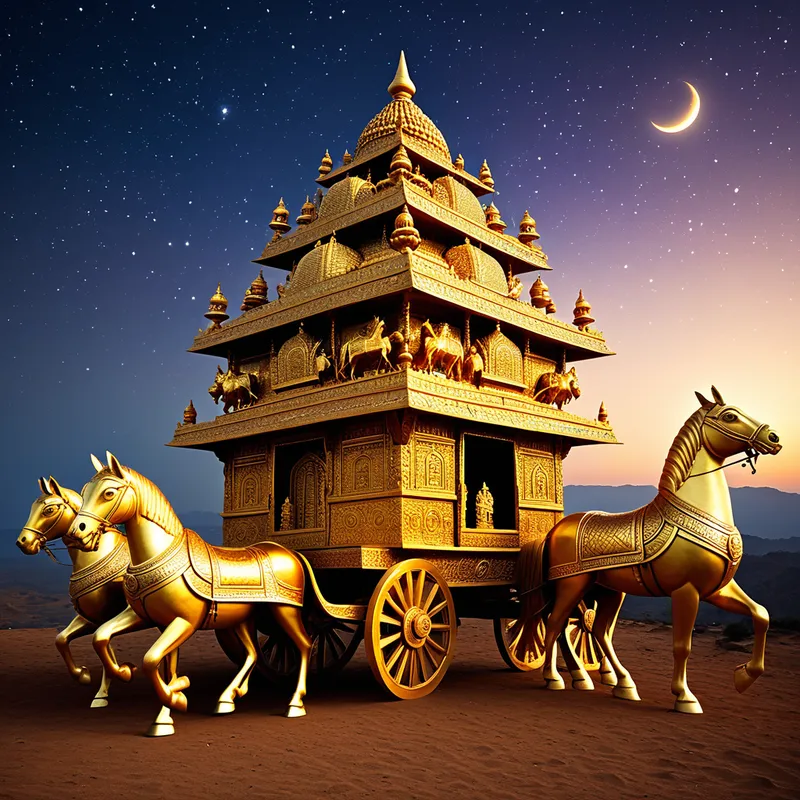
That one was [Indra](/myths/indra “Myth from Hindu culture.”/). But [Indra](/myths/indra “Myth from Hindu culture.”/) was not alone. He stood within the heart of his power, his [Vimana](/myths/vimana “Myth from Vedic culture.”/). This was no mere cart. Its wheels were forged from the resolve of the sun and the steadfastness of [the law](/myths/the-law “Myth from Biblical culture.”/), Dharma. Its canopy was the firmament itself, studded with the unwavering stars. It was drawn not by horses of flesh, but by the seven winds, the Maruts, who sang a fierce hymn of impending storm as they charged.
The ascent was a tearing of veils. The Vimana did not simply fly; it parted the realms. The familiar green of the earth fell away, replaced by the thin, cold blue of the middle atmosphere, and then the profound, star-dusted black of the highest heaven, Dyaus. From this vantage, the world was a jewel in distress, and Vritra a dark, possessive stain upon it.
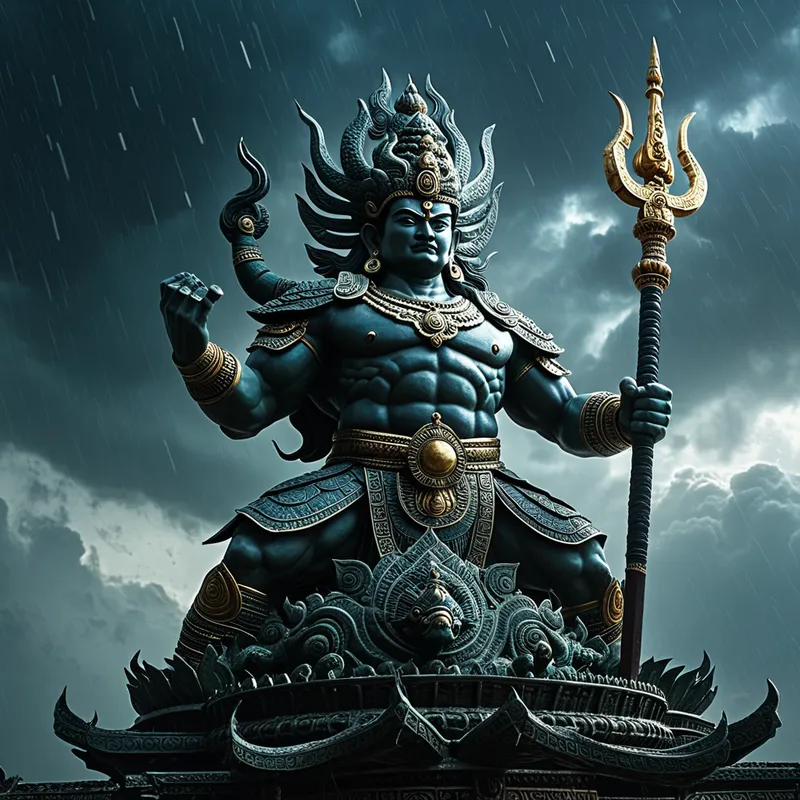
The conflict was a symphony of cosmic forces. Indra raised his weapon, the [Vajra](/myths/vajra “Myth from Hindu culture.”/), forged by the artisan god Tvastar. It gathered the light of a thousand dawns into a single point of unbearable intensity. Vritra hissed, unleashing clouds of obscurity and torrents of resistance. But the Vimana held its course, a beacon of unwavering purpose. It was the stable platform from which chaos could be met, the mobile throne of sovereignty that allowed Indra to see the whole of the battle, not just the snapping jaws before him.
With a cry that shook the pillars of the cosmos, Indra let fly the Vajra. It was not an act of blind violence, but of surgical liberation. The bolt pierced the serpent’s hold, not to destroy the waters, but to free them. And so they came—not a trickle, but a cataclysm of release. The rains fell, first in great, heavy drops that cratered the dust, then in sheets that sang upon the stones, and finally in a life-giving deluge that filled the riverbeds and soaked the parched earth to its core.
The Vimana descended through the cleansed air, its work complete. Where it passed, a rainbow arched, a bridge between the fury of the storm and the peace of the renewed earth. Indra, the king, returned not to conquest, but to a kingdom restored to its natural, flowing order. [The chariot](/myths/the-chariot “Myth from Tarot culture.”/) of the heavens was parked at [the horizon](/myths/the-horizon “Myth from Various culture.”/), its light fading into the promise of the next dawn, a silent witness that the path between the human and the divine, though fraught, was forever open.
Cultural Origins & Context
The myth of the Vimana is woven into the very fabric of the Vedas, particularly the Rigveda. These were not static texts but living, oral traditions, composed and meticulously preserved by generations of Rishis. The stories were chanted, not read; they were sonic technologies for aligning the human community with the cosmic order, Rta.
In this context, the Vimana was far more than a fantastical vehicle. It was a symbol of divine agency and royal authority. The king (Rajan) was seen as the human counterpart to Indra, and the concept of the chariot was central to Vedic life—for war, for ceremony, for traversing the vast landscapes. By projecting this essential technology into the heavens, the mythos performed a sacred function: it connected the earthly realm of action and society to the celestial realm of power and principle. To hear the tale of Indra’s Vimana was to be reminded that true leadership and heroic action require a “higher vehicle”—a perspective and a principle that transcends immediate, ground-level conflict.
Symbolic Architecture
At its core, the Vimana is the archetypal [vehicle](/symbols/vehicle “Symbol: Vehicles in dreams often symbolize the direction in life and the control one has over their journey, reflecting personal agency and decision-making.”/) of [consciousness](/symbols/consciousness “Symbol: Consciousness represents the state of awareness and perception, encompassing thoughts, feelings, and experiences.”/). It represents the structured [capacity](/symbols/capacity “Symbol: A measure of one’s potential, limits, or ability to contain, process, or achieve something, often reflecting self-assessment or external demands.”/) that allows the [psyche](/myths/psyche “Myth from Greek culture.”/) to navigate between different levels of [reality](/symbols/reality “Symbol: Reality signifies the state of existence and perception, often reflecting one’s understanding of truth and life experiences.”/).
The Vimana is not the destination, but the means of travel. It is the disciplined mind, the focused will, and the ethical framework that carries the spark of the Self from the muddled plains of instinct to the clear skies of awareness.
Indra represents the conscious ego, the [aspect](/symbols/aspect “Symbol: A distinct feature, quality, or perspective of something, often representing a partial view of a larger whole.”/) of the psyche tasked with maintaining order and executing will. His [enemy](/symbols/enemy “Symbol: An enemy in dreams often symbolizes an internal conflict, self-doubt, or an aspect of oneself that one struggles to accept.”/), Vritra, is the shadowy force of psychic stagnation—the complex, the addiction, the unresolved [trauma](/symbols/trauma “Symbol: A deeply distressing or disturbing experience that overwhelms the psyche, often manifesting in dreams as unresolved emotional wounds or psychological injury.”/) that “encloses” our vital [energy](/symbols/energy “Symbol: Energy symbolizes vitality, motivation, and the drive that fuels actions and ambitions.”/), our emotional and creative waters, holding them in a state of [drought](/symbols/drought “Symbol: Drought signifies a period of emotional scarcity, lack of resources, or feelings of deprivation leading to anxiety or intense longing.”/). The battle is not for destruction, but for release.
The Vimana, therefore, is the crucial intermediary. It symbolizes the [structure](/symbols/structure “Symbol: Structure in dreams often symbolizes stability, organization, and the framework of one’s life, reflecting how one perceives their environment and personal life.”/) necessary for successful inner conflict. Without it, Indra is just a man shaking his [fist](/symbols/fist “Symbol: A fist symbolizes strength, determination, and the assertion of power, often associated with conflict or resistance.”/) at a [dragon](/symbols/dragon “Symbol: Dragons are potent symbols of power, wisdom, and transformation, often embodying the duality of creation and destruction.”/). With it, he gains the elevated [perspective](/symbols/perspective “Symbol: Perspective in dreams reflects one’s viewpoints, attitudes, and how one interprets experiences.”/), the [stability](/symbols/stability “Symbol: A state of firmness, balance, and resistance to change, often represented by solid objects, foundations, or steady tools.”/), and the [connection](/symbols/connection “Symbol: Connection symbolizes relationships, communication, and bonds among individuals.”/) to higher powers (the Maruts, the Vajra) needed to engage the [shadow](/symbols/shadow “Symbol: The ‘shadow’ embodies the unconscious, repressed aspects of the self and often represents fears or hidden emotions.”/) effectively. It is the vehicle of transformation itself.
The Dreamer’s Resonance
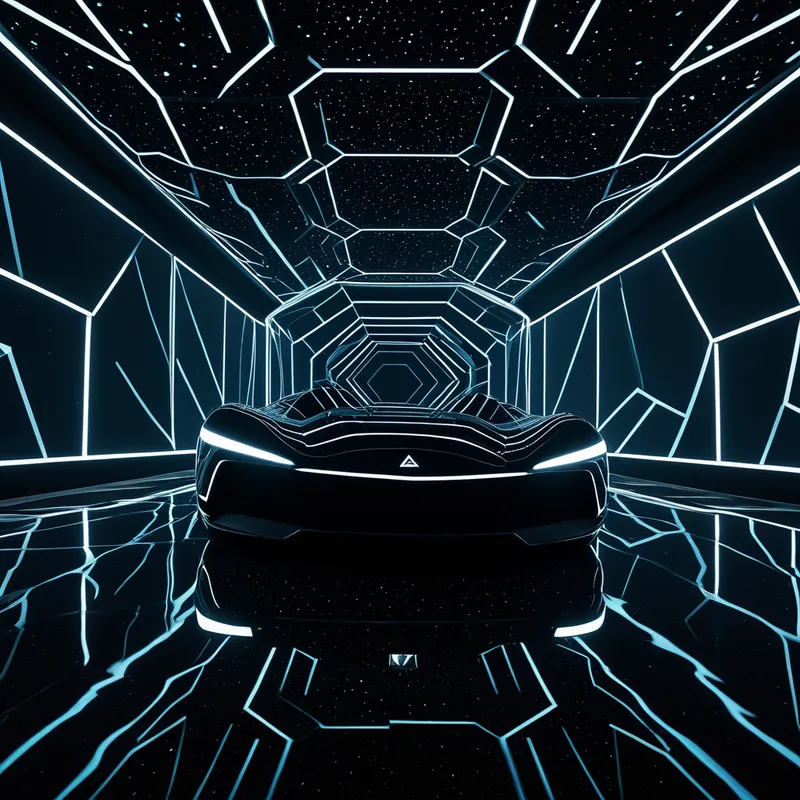
When the motif of the Vimana appears in modern dreams, it seldom manifests as a literal golden chariot. More often, it is felt as a sensation or seen as a structure. One might dream of a uniquely designed car, a silent aircraft, a geometric elevator, or even a specific room that feels like a command center. The common thread is a profound sense of agency within transition.
Somatically, the dreamer may report feelings of smooth acceleration, effortless levitation, or a quiet, humming power. Psychologically, this signals a process where [the ego](/myths/the-ego “Myth from Jungian culture.”/) is constructing or accessing a new psychic structure to deal with an entrenched “Vritra”—a long-standing depression, a creative block, or a relational pattern that feels constricting. The Vimana-dream suggests the unconscious is providing the blueprint for a “vehicle” strong enough to carry the dreamer’s consciousness into confrontation with this shadow material without being overwhelmed. It is the psyche’s innate technology for undertaking the heroic inner journey.
Alchemical Translation
The myth of the Vimana provides a precise model for the alchemical process of individuation—the forging of an integrated Self. The base material, the [prima materia](/myths/prima-materia “Myth from Alchemical culture.”/), is the drought-stricken land of the personal psyche, ruled by the oppressive, serpentine complex (Vritra).
[The first stage](/myths/the-first-stage “Myth from Alchemical culture.”/), [nigredo](/myths/nigredo “Myth from Alchemical culture.”/) (blackening), is the recognition of this drought, the feeling of being trapped and parched. Indra’s decision to fight is the beginning of albedo (whitening), the raising of consciousness. But the critical, often overlooked agent is the Vimana—the vas or vessel of the work.
Individuation is not a wild flight of fancy; it is a disciplined ascent. The Vimana is the vessel of that discipline—the therapy, the journaling, the meditation practice, the ethical commitment—that contains and directs the transformative fire.
Building and “boarding” this vehicle is the act of committing to a structure that supports transformation. The battle in the heavens is the [rubedo](/myths/rubedo “Myth from Alchemical culture.”/) (reddening), the fierce engagement and integration of [the shadow](/myths/the-shadow “Myth from Jungian culture.”/). The liberated waters are the aqua vitae, [the flood](/myths/the-flood “Myth from Biblical culture.”/) of liberated life energy, creativity, and emotion that results from the complex’s dissolution. Finally, the Vimana’s return represents the citrinitas (yellowing), the bringing of this newly integrated, golden awareness back down to earth, to inform daily life.
Thus, the Vimana myth teaches that transcendence is not an escape from the world, but a journey undertaken for its sake. We do not become gods by fleeing in a chariot; we build the chariot so that we may return as more fully human beings, capable of releasing the nourishing rains within our own souls and into the world we inhabit.
Associated Symbols
Explore related symbols from the CaleaDream lexicon: