
The Village of the Kind Folk / Hidden People Myth Meaning & Symbolism
A weary traveler discovers a hidden village of benevolent beings, but the gift of their kindness is lost when broken by the harsh light of the ordinary world.
The Tale of The Village of the Kind Folk / Hidden People
Listen, and I will tell you of a place that is, and yet is not. It exists in the fold of the hill, in the breath between twilight and dark, in the silence that follows the last bird’s call. It is the village of the Kind Folk, and to find it, one must be utterly lost.
Once, a traveler walked [the world](/myths/the-world “Myth from Tarot culture.”/). Not a hero with a shining sword, but a soul worn thin by the grinding stones of days—a woodcutter whose axe was dull, a shepherd whose flock had scattered, a scholar whose words had turned to dust. Their feet were heavy with the mud of despair, their heart a cold stone in their chest. They stumbled from the known path, through brambles that tore not at their cloak, but at their memory of home, into a forest where the trees whispered in a language just beyond understanding.
As the last light bled from [the sky](/myths/the-sky “Myth from Persian culture.”/), a mist rose, not from the ground, but from the very air, cool and silver. In its heart, a soft, golden glow pulsed like a heartbeat. Drawn by a hunger deeper than for bread, the traveler pushed forward—and passed through a veil that felt like cool [water](/myths/water “Myth from Chinese culture.”/) and [spider](/myths/spider “Myth from Native American culture.”/) silk. The world shifted. The air grew sweet with the scent of blooming night-flowers and baking honey-cakes. Before them lay a village of impossible grace: round houses with roofs of living moss, windows glowing with a light that held no flame, and streams that sang as they flowed over smooth, singing stones.
And there were the Folk. They moved with a quiet music, their forms luminous and gentle. They did not startle at [the stranger](/myths/the-stranger “Myth from Biblical culture.”/)’s presence. Instead, they smiled with eyes that held no suspicion, only a deep, abiding peace. Without a word, they took the traveler’s weary hands. They washed the dust from their feet in water that warmed the bone. They offered fruits that tasted of forgotten joy and drink that soothed the raw edges of the spirit. The traveler was given a soft bed, and for the first time in years, they slept without a dream, cradled in pure, silent kindness.
For a time—a day, a month, a season? Time had no hold here—the traveler lived in this gentle rhythm. Their calloused hands softened. The stone in their heart began to thaw. But a thorn of the old world remained lodged in their mind: This cannot be real. This is a dream from which I must wake. I must take proof.
One morning, as a kind being offered a blossom that never wilted, the traveler, gripped by a sudden, fierce longing for the harsh truth of their old life, pocketed the flower. In that instant, a chime, sad and final, echoed through the valley. The Kind Folk’s smiles did not fade, but a profound sorrow filled their eyes. The golden light began to dim. The mists swirled in, cold and thick.
“You have chosen [the anchor](/myths/the-anchor “Myth from Christian culture.”/) of doubt,” one of them whispered, their voice like wind through reeds. “And so you must be anchored to your world.”
The traveler was gently, irrevocably, guided back to [the veil](/myths/the-veil “Myth from Various culture.”/). They stepped through, and turned to look back, the stolen blossom still in their hand. But there was only the ordinary forest, the ordinary night, and in their palm, the blossom had turned to a handful of common, withered leaves.
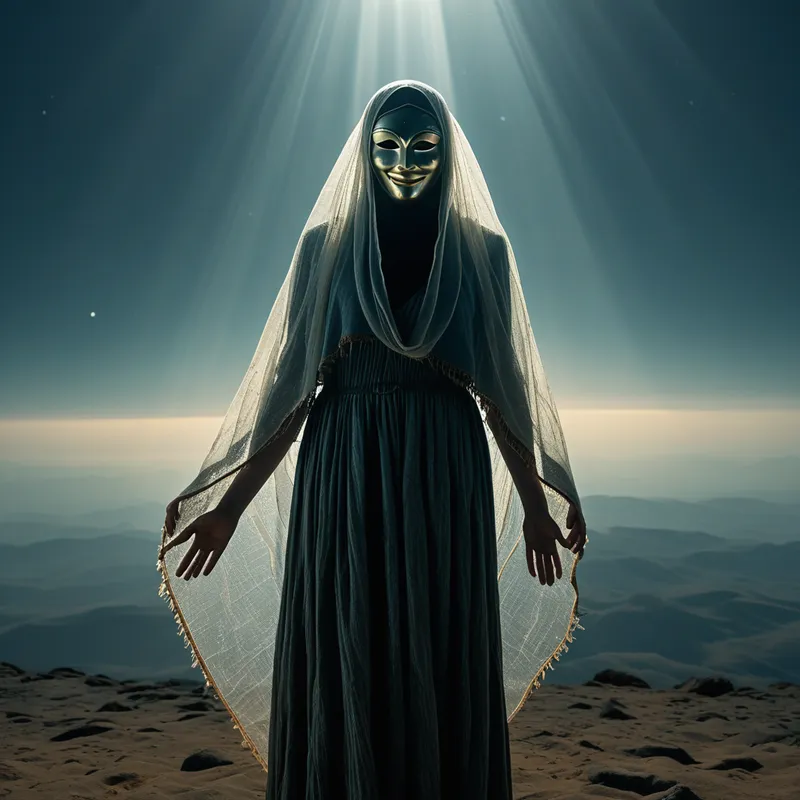
Cultural Origins & Context
This story is not born of one land, but whispers from countless corners of [the earth](/myths/the-earth “Myth from Hindu culture.”/). We hear it in the Icelandic Huldufólk, who dwell in rocks and hills, offering aid but vanishing if offended. We see it in the Filipino Diwata, benevolent guardians of forests who test human hearts. It echoes in tales of the Slavic Domovoi, who help a harmonious household but mislead a greedy one. This is a core narrative of Global Folklore, passed down not in royal courts but by hearths and in fields, by grandmothers and shepherds.
Its societal function was multifaceted. On one level, it was a cautionary tale about respect for the unknown and the dangers of greed and disbelief. It encoded an ecological ethic: there are places and beings beyond human dominion that must be approached with humility. On a deeper level, it served as a container for the profound human experience of grace—those moments of unearned kindness, profound peace, or mystical insight that arrive unbidden, and the haunting, lifelong grief of their inevitable, often self-induced, loss.
Symbolic Architecture
The myth is a perfect map of a psychological [event](/symbols/event “Symbol: An event within dreams often signifies significant life changes, transitions, or emotional milestones.”/). The weary [traveler](/symbols/traveler “Symbol: A person on a journey, representing movement, transition, and the search for new experiences or self-discovery.”/) is the conscious ego, exhausted by the burdens of [persona](/symbols/persona “Symbol: The social mask or outward identity one presents to the world, often concealing the true self.”/) and [adaptation](/symbols/adaptation “Symbol: The process of adjusting to new conditions, often involving psychological or physical change to survive or thrive.”/). The hidden [village](/symbols/village “Symbol: Symbolizes community, connection, and a reflection of one’s roots or origins.”/) represents the unconscious itself—not as a frightening [cellar](/symbols/cellar “Symbol: A cellar represents the subconscious mind, hidden emotions, and unacknowledged aspects of the self; it is a place of storage, preservation, and sometimes decay.”/) of repressed [trauma](/symbols/trauma “Symbol: A deeply distressing or disturbing experience that overwhelms the psyche, often manifesting in dreams as unresolved emotional wounds or psychological injury.”/) (the [shadow](/symbols/shadow “Symbol: The ‘shadow’ embodies the unconscious, repressed aspects of the self and often represents fears or hidden emotions.”/)), but as the positive, nurturing [aspect](/symbols/aspect “Symbol: A distinct feature, quality, or perspective of something, often representing a partial view of a larger whole.”/) of the unconscious, the [temenos](/myths/temenos “Myth from Greek culture.”/) or sacred precinct where the [psyche](/myths/psyche “Myth from Greek culture.”/) heals and integrates.
The Kind Folk are the personified, benevolent forces of the unconscious—the guiding symbols of the Self that work autonomously to guide us toward completeness.
The act of stealing the [blossom](/symbols/blossom “Symbol: A symbol of new beginnings, growth, and the unfolding of potential, often marking a transition or the start of a journey.”/) is the critical pivot. It is not simple greed, but [the ego](/myths/the-ego “Myth from Jungian culture.”/)’s insistence on possession and proof. It is the intellect’s demand to drag the numinous experience into the harsh, quantifying light of [consciousness](/symbols/consciousness “Symbol: Consciousness represents the state of awareness and perception, encompassing thoughts, feelings, and experiences.”/), thereby killing its essential [nature](/symbols/nature “Symbol: Nature symbolizes growth, connectivity, and the primal forces of existence.”/). The transformation of the [blossom](/symbols/blossom “Symbol: A symbol of new beginnings, growth, and the unfolding of potential, often marking a transition or the start of a journey.”/) into dead leaves is the inevitable result: when we try to own, define, or monetize a transcendent experience, we are left with only the dead [husk](/symbols/husk “Symbol: A hollow, discarded outer shell, often representing emptiness, potential, or transformation after the core has been removed.”/) of the [symbol](/symbols/symbol “Symbol: A symbol can represent an idea, concept, or belief, serving as a powerful tool for communication and understanding.”/), its [life](/symbols/life “Symbol: The symbol of ‘Life’ represents a journey of growth, interconnectedness, and existential meaning, encompassing both the joys and challenges that define human experience.”/) and meaning extinguished.
The Dreamer’s Resonance
When this myth pattern stirs in modern dreams, it signals a profound somatic and psychological process: a tentative, fragile contact with the healing, positive unconscious. You may dream of discovering a hidden, beautiful room in your own house, of meeting inexplicably benevolent strangers who offer solace, or of finding a pristine, secret garden.
The somatic feeling is one of deep, almost tearful relief—a warmth in the chest, a release of tension held in the shoulders and jaw. Psychologically, this occurs during periods of burnout, profound grief, or after a long period of over-adaptation to external demands. The psyche, in its infinite wisdom, is offering a taste of its own restorative medicine. The conflict in the dream—the hesitation at the door, the fear of the light, the impulse to take a “souvenir”—mirrors the dreamer’s own resistance to fully accepting this unearned grace, often due to a deep-seated belief that they are not worthy of such kindness, or that they must “figure it out” to deserve it.

Alchemical Translation
The journey of the traveler models the alchemical process of individuation, specifically the stage of albedo, or whitening, which follows [the dark night of the soul](/myths/the-dark-night-of-the-soul “Myth from Christian Mysticism culture.”/) ([nigredo](/myths/nigredo “Myth from Alchemical culture.”/)). The weariness is the nigredo—the dissolution of the old, rigid ego. The village is the albedo—the cleansing, illuminating contact with [the Self](/myths/the-self “Myth from Jungian culture.”/).
The ultimate transmutation is not in staying forever in the hidden village, but in carrying the memory of its kindness back into the world of blackness and white, without the need for a dead leaf to prove it happened.
The [triumph](/myths/triumph “Myth from Roman culture.”/) is not in possession, but in transformation. The successful initiate is not the one who remains in paradise, but the one who returns to the ordinary world forever changed by having witnessed it. The stone heart that began to thaw in the village continues to melt in the real world, not into sentimentality, but into a grounded, enduring compassion. The traveler learns that the true “proof” is not an object, but a new way of being—a quiet knowledge that alongside the world of struggle, there exists, and has always existed, a dimension of unconditional kindness. The task of psychic alchemy is to let that knowledge live within you as a quiet, guiding light, rather than as a trophy to be displayed and desecrated. You become, in your own humble way, a vessel through which a fragment of that hidden village’s kindness can, at last, seep into the visible world.
Associated Symbols
Explore related symbols from the CaleaDream lexicon: