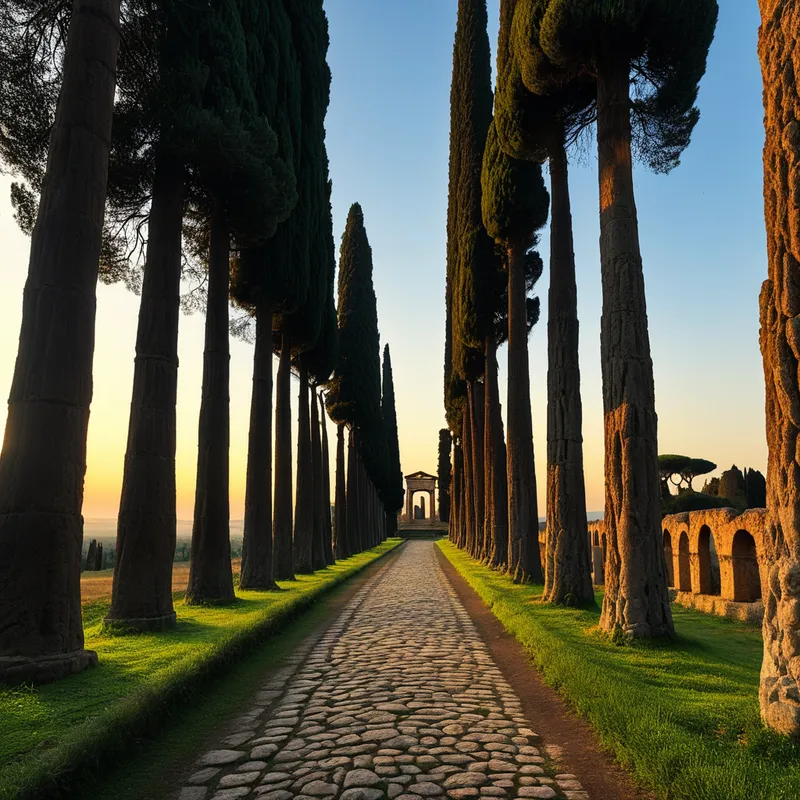
The Via Appia (Roman road of c Myth Meaning & Symbolism
A myth of the first Roman road, a sacred line of stone and will, binding the wild earth to the city's heart, forging a path for gods and legions.
The Tale of The Via Appia
Hear now of the first binding of the land, the moment the wild earth was made to answer to a human will. Before the legions, before the empire of marble, there was only the ager romanus—a realm of stubborn hills, treacherous marshes, and spirits that whispered in the reeds. The city on the seven hills was a heartbeat surrounded by chaos, its people strong but isolated, their reach ending where the mud began.
Then came Appius Claudius, a man whose inner vision was not dimmed by the outer darkness that would later claim his eyes. He stood on the Capitoline and did not see farms and forests; he saw a line. A line of intent, straight as a plumb bob dropped from the mind of Jupiter himself. He summoned the lictors, the surveyors, the masters of stone and draft oxen. “We shall draw a line,” he declared, his voice cutting the humid air. “From the Forum to the distant south. We shall speak to [the earth](/myths/the-earth “Myth from Hindu culture.”/) not with pleas, but with geometry. We shall not ask for passage—we shall declare it.”
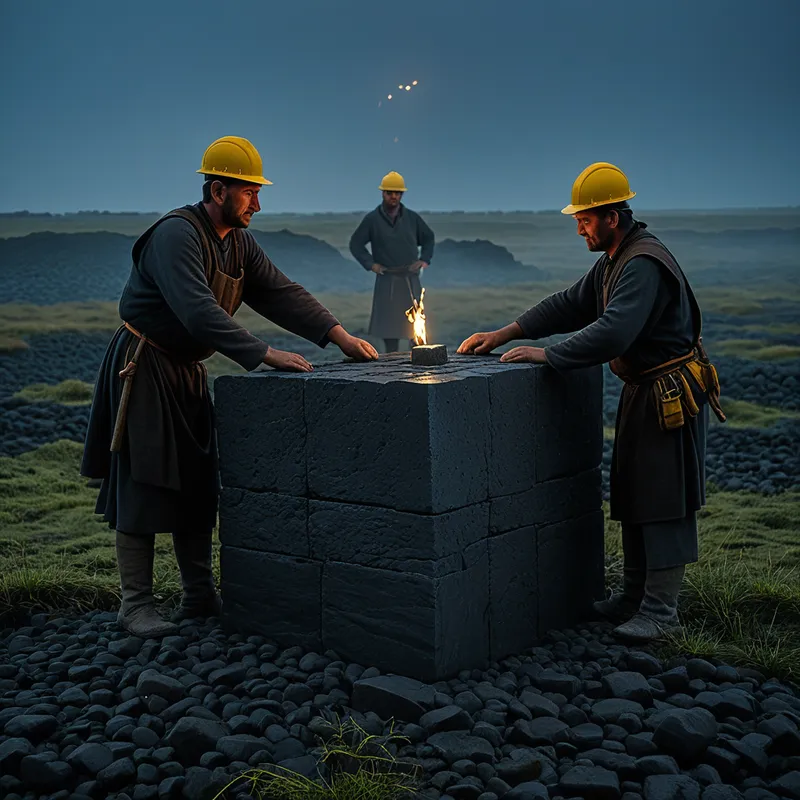
The work was a war against the primordial. Men sank into black bogs, their shouts swallowed by the fen. Spirits of the marsh, the numina of the untamed places, hissed in the night, loosening stones laid by day. The earth itself seemed to rebel, swelling with rain, shrugging off the weight of imported basalt. But Appius Claudius was unmoving. He was the fixed point, the [terminus](/myths/terminus “Myth from Roman culture.”/). He commanded that the road be built not of gravel, but of fitted stone—a surface so hard, so true, that it would echo with the tramp of centuries. They dug down to the firm clay, the pavimentum. They laid the foundation of crushed stone, the statumen. Then the layer of rubble, the rudus, bound with lime. Finally, the crowning glory: the summum dorsum, the great back of polygonal basalt blocks, fitted together so tightly a blade could not slip between them.
On the day the final stone was set, a silence fell. The road lay like a silver-gray tendon, a new muscle on the body of [the world](/myths/the-world “Myth from Tarot culture.”/). From the Porta Capena, it arrowed southeast, unwavering. And then, the first sound: the crisp, rhythmic tramp of a century of soldiers, their hobnailed caligae striking sparks from the stone. Behind them came the rumble of wagons laden with grain from Capua. The line was no longer just stone; it was will made manifest. It was [the Republic](/myths/the-republic “Myth from Platonic culture.”/)’s spine. The wild had been measured, defined, and connected. The path was now eternal—the Regina Viarum, the Queen of Roads. Her journey had just begun.
Cultural Origins & Context
The [Via Appia](/myths/via-appia “Myth from Roman culture.”/) is not a myth of gods and monsters, but a foundational myth of civilization itself, born from the historical reality of 312 BCE. Its “mythology” is the mythology of infrastructure, of the human imposition of abstract order—law, administration, military logic—onto the living, chaotic landscape. The story was passed down not by bards, but by historians like Livy and engineers like Vitruvius. Its tellers were the senators who walked its course and the legionaries who marched its length.
Its societal function was multifaceted: it was a monument to civic virtue and gravitas, a tangible symbol of Roman resolve and technical superiority. It served as a narrative of control, demonstrating that the Republic could not only conquer peoples but could also conquer geography, binding newly acquired territories directly to the heart of power. The road was a physical manifestation of the imperium of the state. It functioned as a sacred boundary, a pomerium on a colossal scale, dividing the civilized urbs from the external orbis. To travel it was to participate in the ritual of Roman identity.
Symbolic Architecture
At its core, the myth of the Via Appia is a profound [symbol](/symbols/symbol “Symbol: A symbol can represent an idea, concept, or belief, serving as a powerful tool for communication and understanding.”/) of the Ego establishing a permanent [pathway](/symbols/pathway “Symbol: A symbol of life’s journey, direction, and personal progress, representing choices, transitions, and the unfolding of one’s destiny.”/) through the unconscious. The wild, marshy [landscape](/symbols/landscape “Symbol: Landscapes in dreams are powerful symbols representing the dreamer’s emotional state, personal journey, and the broader context of life situations.”/) represents the undifferentiated, instinctual, and potentially overwhelming [psyche](/myths/psyche “Myth from Greek culture.”/) before the intervention of conscious [direction](/symbols/direction “Symbol: Direction in dreams often relates to life choices, guidance, and the path one is following, emphasizing the importance of navigation in personal journeys.”/).
The road is not a discovery of a pre-existing path, but a declaration of one. It is consciousness laying its law upon the chaos of the inner world.
The figure of Appius Claudius embodies the archetypal Ruler and the determined will of the conscious mind. His [blindness](/symbols/blindness “Symbol: Represents a lack of awareness, insight, or refusal to see truth, often tied to emotional avoidance or spiritual ignorance.”/) in later [life](/symbols/life “Symbol: The symbol of ‘Life’ represents a journey of growth, interconnectedness, and existential meaning, encompassing both the joys and challenges that define human experience.”/) only deepens the symbol: the [vision](/symbols/vision “Symbol: Vision reflects perception, insight, and clarity — often signifying the ability to foresee or understand deeper truths.”/) that creates the road is an inner vision, a vision of [connection](/symbols/connection “Symbol: Connection symbolizes relationships, communication, and bonds among individuals.”/) and order that transcends physical [sight](/symbols/sight “Symbol: Sight symbolizes perception, awareness, and insight, representing both physical and inner vision.”/). The layered [construction](/symbols/construction “Symbol: Construction symbolizes creation, building, and the process of change, often reflecting personal growth and the need to build a solid foundation.”/) of the road—pavimentum, statumen, rudus, summum dorsum—mirrors the layered [structure](/symbols/structure “Symbol: Structure in dreams often symbolizes stability, organization, and the framework of one’s life, reflecting how one perceives their environment and personal life.”/) of the psyche: the deepest instincts, the emotional [rubble](/symbols/rubble “Symbol: Represents destruction, collapse, and the aftermath of breakdown, often symbolizing emotional or structural ruin that requires clearing and rebuilding.”/), the binding agents of complex, and finally, the hard, conscious [persona](/symbols/persona “Symbol: The social mask or outward identity one presents to the world, often concealing the true self.”/) presented to the world. The road’s unswerving straightness is the symbol of directed [intention](/symbols/intention “Symbol: Intention represents the clarity of purpose and direction in one’s life and can symbolize motivation and commitment within a dream context.”/), of a [life](/symbols/life “Symbol: The symbol of ‘Life’ represents a journey of growth, interconnectedness, and existential meaning, encompassing both the joys and challenges that define human experience.”/) lived with [purpose](/symbols/purpose “Symbol: Purpose signifies direction, meaning, and intention in life, often reflecting personal ambitions and core values.”/) rather than wandering in [reaction](/symbols/reaction “Symbol: A reaction in a dream signifies the subconscious emotional responses to situations we face, often revealing our coping mechanisms and fears.”/).
The Dreamer’s Resonance
To dream of such a road—a perfectly straight, ancient, and enduring path—signals a critical phase of psychic consolidation. The dreamer is likely engaged in the somatic and psychological process of building internal structure. This is not the dream of the wandering Explorer, but of the founding Ruler.
Somatically, this may feel like a strengthening of the spine, a literal and metaphorical finding of one’s backbone. Psychologically, it is the process of defining personal boundaries, establishing routines, and creating reliable channels between different parts of [the self](/myths/the-self “Myth from Jungian culture.”/) (the “Rome” of the conscious identity and the distant, resource-rich “Capua” of the talents or instincts). The conflict in the dream may appear as obstacles to the road’s construction—the marshland threatening to swallow the works, the sense of resistance. This reflects the real resistance encountered when trying to impose new, disciplined structures on old, chaotic habits or emotional states. The [triumph](/myths/triumph “Myth from Roman culture.”/) is the completed, traversable road, symbolizing a new, reliable avenue for psychic energy and intention to flow.

Alchemical Translation
The alchemical process modeled here is Coagulatio, the transformation of the volatile and watery (the marshy unconscious) into the solid and enduring (the stone road). This is the work of psychic transmutation central to individuation: rendering the fleeting insights of the unconscious into durable structures of the personality and life.
The modern individual undertakes this “Appian Work” when they move from inspiration to institution. It is the labor of writing the book after having the idea, of building the business plan after the visionary flash, of committing to the daily practice that turns a spiritual glimpse into a lived philosophy. The “engineers” are the cognitive functions—thinking and sensation—that do the hard, unglamorous work of surveying, measuring, and laying stone. The “spirits of the marsh” are the personal and collective shadows that resist this ordering, preferring the comfortable, if dysfunctional, chaos.
Individuation is not merely exploring the wilderness of the self; it is the sacred, arduous duty of building a via sacra through it, a highway for the soul’s legions to march upon.
The ultimate goal is not to pave over the entire inner landscape, but to establish a secure, sovereign connection between the core of consciousness and the distant, vital territories of the soul. One remains aware of the wild on either side, but one is no longer its prisoner. One has built a way through. The Via Appia myth teaches that the foundation of a sovereign self is laid stone by conscious stone, through the unwavering application of will upon the raw material of one’s own nature.
Associated Symbols
Explore related symbols from the CaleaDream lexicon: