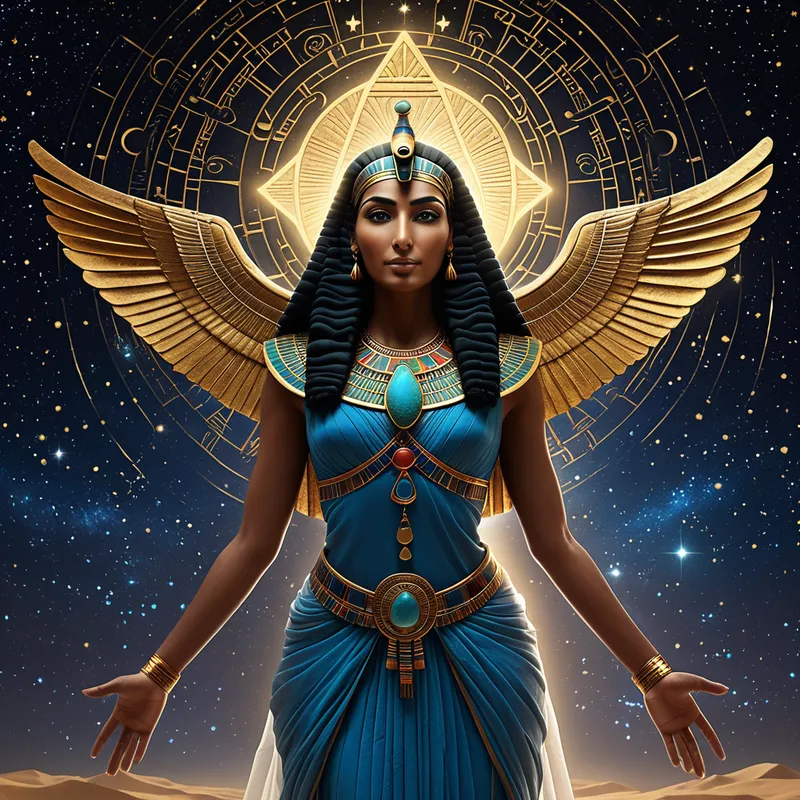
The Veil of Isis Myth Meaning & Symbolism
A myth of the goddess Isis, whose veil conceals the ultimate nature of reality, which no mortal or god may lift without consequence.
The Tale of The Veil of Isis
Hear now a truth whispered in the reeds of the Nile and carved in the stone of fallen temples. It is not a story of battle or of love, but of a silence so profound it contains all sound, and a veil so thin it hides the heart of creation.
In the time when gods walked as kings and [the sky](/myths/the-sky “Myth from Persian culture.”/) was closer to [the earth](/myths/the-earth “Myth from Hindu culture.”/), there reigned a goddess whose name was a sigh of devotion: Isis. She was the throne itself, the giver of life, the weaver of destinies. She knew [the true name](/myths/the-true-name “Myth from Various culture.”/) of Ra, and with that knowledge, she held power over the very fabric of ma’at—the cosmic order. But her greatest secret was not a name to be spoken. It was a truth to be seen, and for this seeing, she wore a veil.
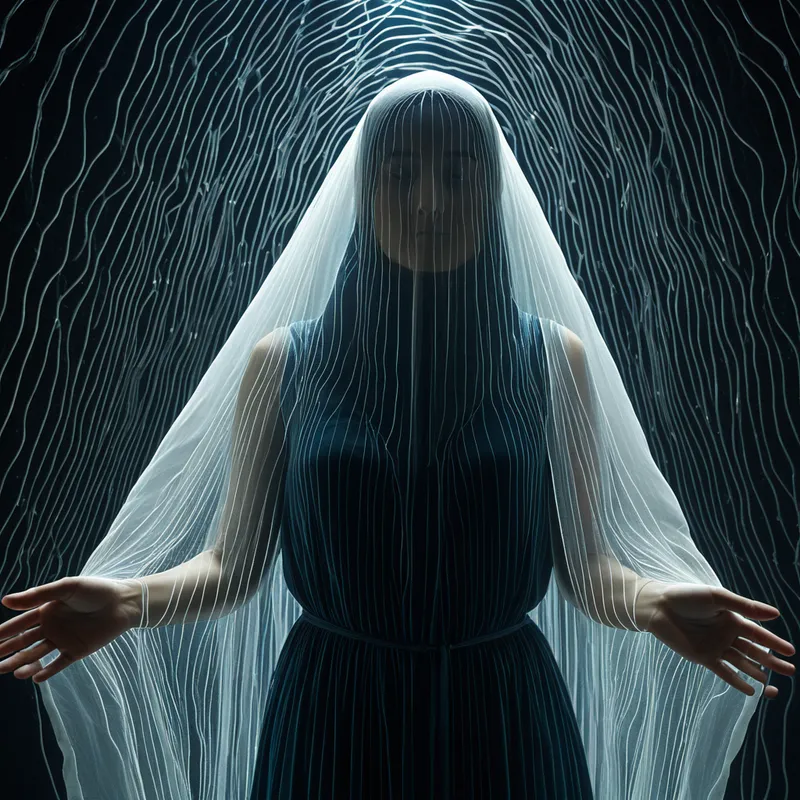
This was no ordinary cloth. Woven from the twilight between stars and the breath before dawn, it shimmered with the potential of all things unseen: the root seeking [water](/myths/water “Myth from Chinese culture.”/) in the dark earth, the thought forming in the mind of a sage, the fate not yet written in the stars. To look upon it was to gaze into a living mist where all forms danced half-born.
Many sought her in her sanctuaries. The mighty [pharaoh](/myths/pharaoh “Myth from Egyptian culture.”/) came, offering empires of gold to behold what lay behind the gossamer barrier. Isis only smiled, her eyes holding the patience of [the Sphinx](/myths/the-sphinx “Myth from Greek culture.”/). “[The veil](/myths/the-veil “Myth from Various culture.”/) is not for lifting,” her silence seemed to say. “It is for understanding.”
Then came a different seeker. Not a king, but a philosopher, a man whose hunger was not for power, but for the final answer. He had studied the geometry of the heavens and the logic of the waters. He believed that with sufficient purity of intellect, the last mystery would yield. He stood before the goddess, his soul laid bare in his beseeching gaze. “Mother of All,” he implored, “let me see the face of truth. Let me know what is.”
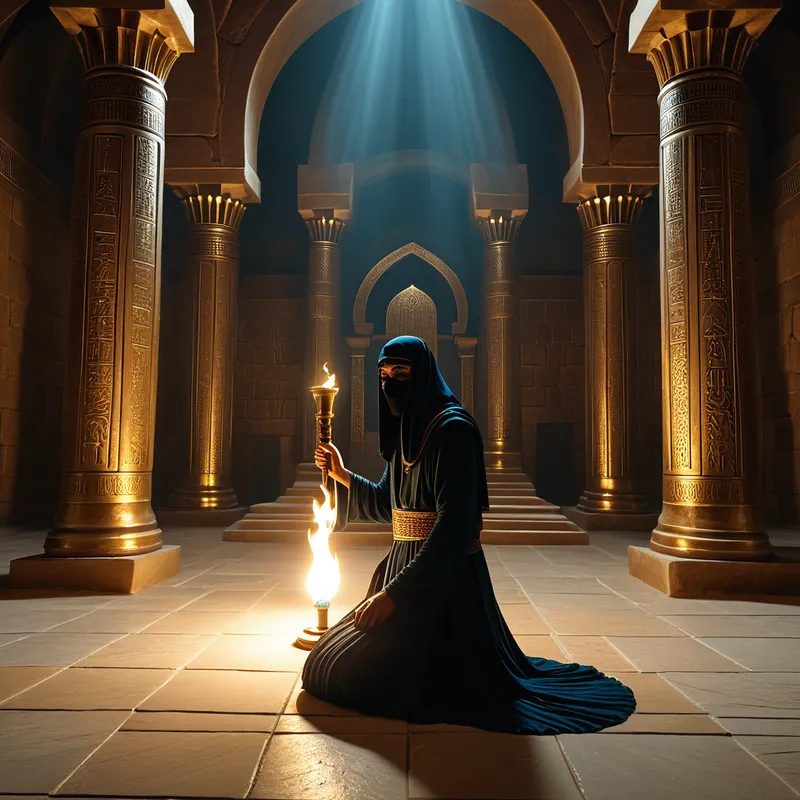
A great stillness filled [the temple](/myths/the-temple “Myth from Jewish culture.”/). The oil lamps guttered. Isis, in her infinite compassion for the hunger of a mortal soul, did not refuse him. She did not speak, but her meaning was clear: You may try.
With a hand steady from a lifetime of discipline, yet trembling with a terror he had never known, he reached. His fingers did not touch linen or silk, but the texture of a whispered secret, the coolness of deep space. He gathered the nebulous fabric. And he lifted.
There was no blinding light, no thunderous revelation. For a single, eternal instant, he saw What Is. It was not a face, but the source of all faces. Not a [thing](/myths/thing “Myth from Norse culture.”/), but the no-thing from which all things are born. It was beauty and terror, creation and dissolution, utter unity and absolute solitude, all existing simultaneously without contradiction. It was the universe knowing itself, and in that knowing, he was unmade.
He did not scream. He made no sound. He simply lowered his hand, the veil falling back into place, more mysterious than ever. He left the temple a different man. He never wrote a treatise on what he saw, for no language could hold it. He simply lived, thereafter, with a profound quiet at his center, his eyes holding the same knowing, patient silence as the goddess who had granted him the only gift she could: not the answer, but the awe.
Cultural Origins & Context
The motif of the [Veil of Isis](/myths/veil-of-isis “Myth from Egyptian culture.”/) is not a single, codified myth from one [papyrus](/myths/papyrus “Myth from Egyptian culture.”/), but a profound philosophical and mystical concept that coalesced around the figure of Isis in the late antique period. It emerges from the syncretic, mystery-rich milieu of the Greco-Roman world, where Egyptian ma’at met Greek philosophy. While the core identity of Isis as the all-encompassing mother goddess is rooted in millennia of Egyptian worship, the specific allegory of the veil was articulated by thinkers like Plutarch and later adopted by Neoplatonists and Hermeticists.
The story was transmitted not in popular folklore, but in philosophical tracts and the teachings of mystery cults. The cult of Isis, which spread throughout the Roman Empire, promised initiates personal salvation and secret knowledge (gnosis). The veil served as a central teaching metaphor within these esoteric circles. It was a narrative for the initiated, explaining the nature of the divine and the limits of human perception. Its societal function was to validate the quest for wisdom while humbling the intellect, directing the seeker toward experiential, mystical understanding rather than purely rational comprehension.
Symbolic Architecture
The [veil](/symbols/veil “Symbol: A veil typically symbolizes concealment, protection, and transformation, representing both mystery and femininity across cultures.”/) is the ultimate [symbol](/symbols/symbol “Symbol: A symbol can represent an idea, concept, or belief, serving as a powerful tool for communication and understanding.”/) of the mysterium tremendum et fascinans—the dreadful and fascinating [mystery](/symbols/mystery “Symbol: An enigmatic, unresolved element that invites curiosity and exploration, often representing the unknown or hidden aspects of existence.”/) at the [heart](/symbols/heart “Symbol: The heart symbolizes love, emotion, and the core of one’s existence, representing deep connections with others and self.”/) of existence. Isis herself represents [Nature](/symbols/nature “Symbol: Nature symbolizes growth, connectivity, and the primal forces of existence.”/) or the Supreme Divine in its manifest, knowable form: the [goddess](/symbols/goddess “Symbol: The goddess symbolizes feminine power, divinity, and the nurturing aspects of life, embodying creation and wisdom.”/) who can be prayed to, depicted, and understood through her actions of healing, magic, and sustenance. She is the phenomenal world.
The veil is the boundary between the manifest and the unmanifest, the knowable goddess and the unknowable source.
What lies behind the veil is the noumenon, [the thing](/myths/the-thing “Myth from Norse culture.”/)-in-itself, the transcendent [reality](/symbols/reality “Symbol: Reality signifies the state of existence and perception, often reflecting one’s understanding of truth and life experiences.”/) beyond all names, forms, and dualities. It is the raw, unmediated Is-ness prior to [perception](/symbols/perception “Symbol: The process of becoming aware of something through the senses. In dreams, it often represents how one interprets reality or internal states.”/). The myth asserts that this ultimate [reality](/symbols/reality “Symbol: Reality signifies the state of existence and perception, often reflecting one’s understanding of truth and life experiences.”/) cannot be grasped by the conscious, rational ego—the “[philosopher](/symbols/philosopher “Symbol: A seeker of wisdom and truth, representing deep contemplation, questioning reality, and the pursuit of fundamental knowledge about existence.”/)-[king](/symbols/king “Symbol: A symbol of ultimate authority, leadership, and societal order, often representing the dreamer’s inner power or external control figures.”/)” part of the [psyche](/myths/psyche “Myth from Greek culture.”/). To attempt to lift the veil with the tools of [the ego](/myths/the-ego “Myth from Jungian culture.”/) alone is to invite a shattering [dissolution](/symbols/dissolution “Symbol: The process of breaking down, dispersing, or losing form, often representing transformation, release, or the end of a state of being.”/), for [the ego](/myths/the-ego “Myth from Jungian culture.”/) cannot survive direct contact with the totality of the Self.
The [seeker](/symbols/seeker “Symbol: A person actively searching for meaning, truth, or a higher purpose, often representing the dreamer’s own quest for identity or fulfillment.”/)’s transformation is the key. He is not punished, but he is fundamentally altered. His failure to possess the [knowledge](/symbols/knowledge “Symbol: Knowledge symbolizes learning, understanding, and wisdom, embodying the acquisition of information and enlightenment.”/) becomes the success of being transformed by it. He integrates the experience not as data, but as a state of being—a quiet awe. This represents the shift from seeking God or [Truth](/symbols/truth “Symbol: Truth represents authenticity, honesty, and the quest for knowledge beyond mere appearances.”/) as an external object, to embodying the reverence such a [quest](/symbols/quest “Symbol: A quest symbolizes a journey or search for purpose, fulfillment, or knowledge, often representing life’s challenges and adventures.”/) implies.
The Dreamer’s Resonance
When this myth stirs in the modern unconscious, it often manifests in dreams of near-impenetrable barriers: walls of fog, doors that lead to blinding light, or trying to read a book whose text constantly shifts. The dreamer feels a compulsive need to see or know something critical, often related to a life purpose, a hidden trauma, or the answer to a profound personal question.
Somatically, the dream may be accompanied by a feeling of immense pressure in the head or chest, or a paradoxical mix of exhilarating anticipation and deep dread. Psychologically, this signals a confrontation with a core existential mystery that the conscious mind is trying to solve or control. The ego is pressing against the boundary of what it can healthily comprehend. The dream is a warning and an invitation: the frantic striving must cease. The psyche is orchestrating a necessary humiliation of the intellect to make way for a different mode of knowing—one rooted in intuition, somatic feeling, and acceptance of mystery. The dreamer isn’t dreaming of finding the answer; they are dreaming of the transformative crisis that occurs when they stop demanding one.
Alchemical Translation
In the alchemy of individuation, the myth of the Veil maps perfectly onto the perilous stage of coniunctio—[the sacred marriage](/myths/the-sacred-marriage “Myth from Various culture.”/)—and the encounter with [the Self](/myths/the-self “Myth from Jungian culture.”/). The conscious mind (the seeker) approaches the anima/animus or the archetypal image of the Self (Isis) seeking ultimate integration and wholeness.
The lifting of the veil is not an act of discovery, but an act of surrender. The psyche is not illuminated by grasping the light, but by becoming transparent to it.
The initial, ego-driven attempt to “lift the veil” and possess the Self leads to a potentially destructive inflation or a crushing sense of insignificance—the unmaking. This is a necessary death. The true alchemical work begins in the aftermath, in the “profound quiet” of the transformed seeker. Here, the ego, having been dissolved in its old form, is reconstituted in a new relationship to the unconscious. It no longer seeks to rule the inner world or wrest its secrets by force. Instead, it becomes a witness, a vessel, and a participant in a mystery it no longer needs to solve.
The veil remains, but its function changes. It is no longer a frustrating barrier, but the very medium through which the divine is perceived—the filter that makes the unbearable radiance of totality into the beautiful, complex, and knowable tapestry of a life. The individual learns to see the goddess in the veil, not behind it. The quest for final knowledge transmutes into the practice of endless reverence, and in that practice, wholeness is continually born.
Associated Symbols
Explore related symbols from the CaleaDream lexicon: