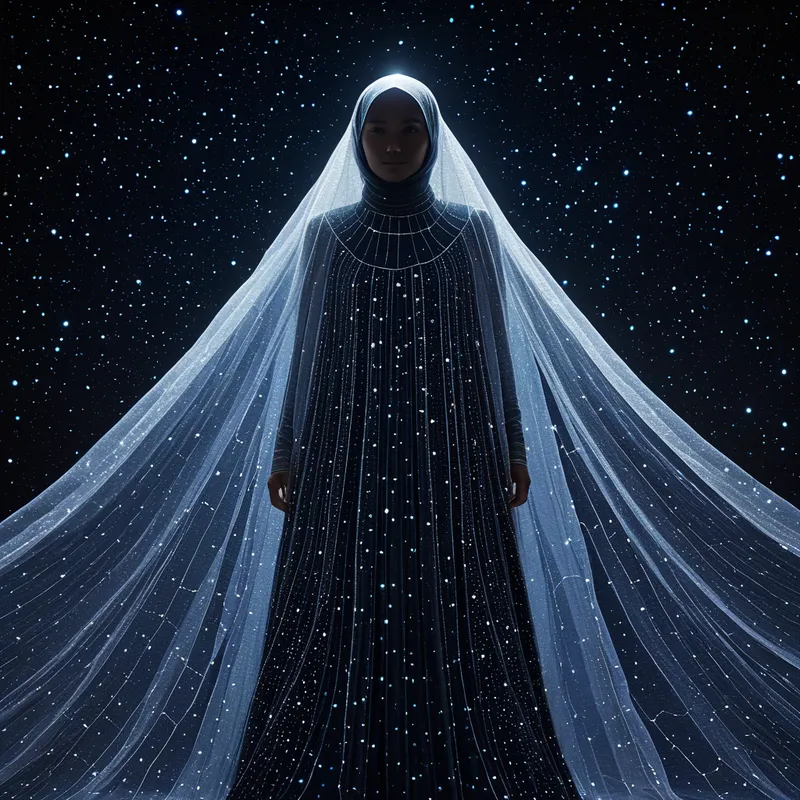
The Veil Myth Meaning & Symbolism
A timeless myth of a sacred boundary dividing reality, its transgression, and the irreversible transformation that follows the lifting of the veil.
The Tale of The Veil
In the time before time, when [the world](/myths/the-world “Myth from Tarot culture.”/) was raw song and [the sky](/myths/the-sky “Myth from Persian culture.”/) was not yet named, there existed not one world, but two. They were twin realms, born of the same breath: the Realm of Is, a place of blinding, unified light where every thought was a star and every feeling a constellation; and the Realm of Seems, a land of shadow and substance, of mountains that ached and rivers that remembered.
Between them hung The Veil. It was not woven on any loom mortal or divine. It was the sigh between creation and creator, the silence between note and echo. To gaze upon it was to see everything and nothing—a fabric of twilight, shimmering with the potential of all colors yet holding the deep grey of unformed dawn. It hummed with a low, foundational tone that vibrated in the bones of [the earth](/myths/the-earth “Myth from Hindu culture.”/) and the pulse of the first blood.
The guardians of this threshold were the Keepers of [the Threshold](/myths/the-threshold “Myth from Folklore culture.”/). They were not fierce warriors, but sorrowful poets. Their eyes held the light of Is and the dust of Seems. They did not forbid passage; they sang the cost. Their song was the myth itself, a warning woven into [the wind](/myths/the-wind “Myth from Various culture.”/): “To cross is to know, and to know is to be forever changed. The unity behind is a memory; the duality ahead, a life.”
For ages, the song was enough. The creatures of Seems lived in the rich, painful, beautiful dream of separation, sensing the light beyond as a longing in their hearts—a homesickness for a home they had never known. The beings of Is perceived the drama of form as a fascinating, distant dance.
But one day, a being from Seems—call them a seeker, a fool, a lover of truth—stood before The Veil. Not out of rebellion, but out of a love so profound it ached. They loved the world of Seems—the taste of rain, the grip of grief, the warmth of a hand—but they loved the promise of Is more. The Keeper’s song washed over them, not as a warning, but as an invitation.
With a breath that held the sum of their courage and their despair, they reached out. Their fingers did not push; they simply ceased to resist. The Veil parted not like a curtain, but like [water](/myths/water “Myth from Chinese culture.”/), like a sigh of release. For a moment that contained all moments, the seeker was not in Is or Seems, but in the impossible junction where light becomes apple, where sorrow becomes song, where the singer and the sung are one.
Then, they fell. Or perhaps, they were born. They tumbled back into Seems, but it was not the same world. The light of Is was now within them, a searing jewel in the chest, and the world of Seems was now seen through it. The mountain was no longer just rock; it was a slow, patient prayer. [The river](/myths/the-river “Myth from Buddhist culture.”/) was no longer just water; it was a story telling itself. They were whole, yet forever split; enlightened, yet forever burdened. The Veil was now behind their eyes, and the unity they sought was the lens through which they saw eternal separation. The myth ends not with an answer, but with a new kind of question, burning in the heart of the world.
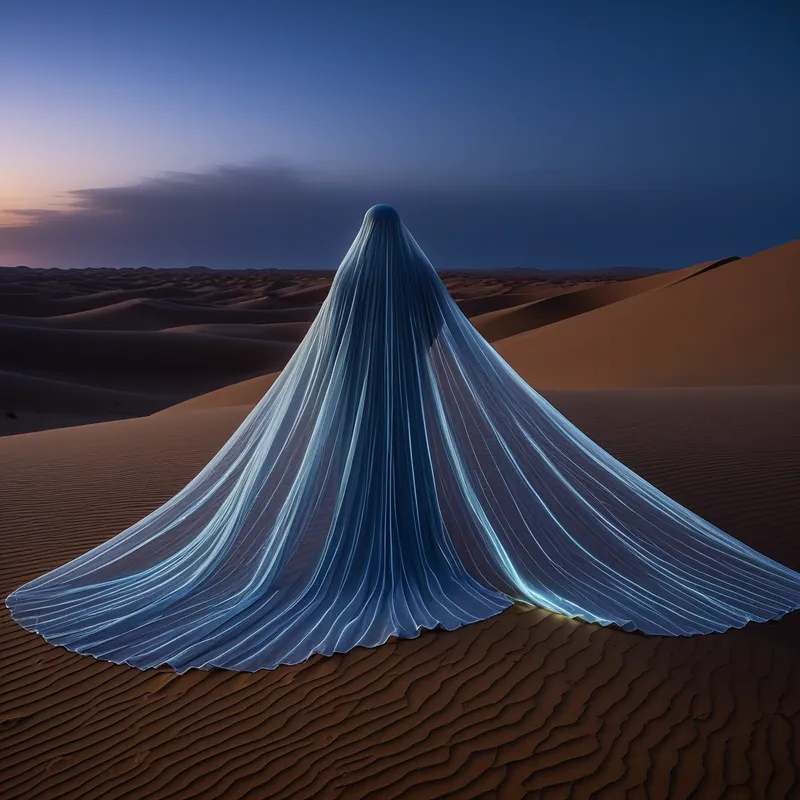
Cultural Origins & Context
The myth of The Veil is not the property of any single culture named “Various”; it is the shared inheritance of the human [psyche](/myths/psyche “Myth from Greek culture.”/), appearing in countless guises across time and geography. It is the ur-narrative of the boundary. We find it in the [Pleroma](/myths/pleroma “Myth from Gnostic culture.”/) separated from our world by the Kenoma. We hear it in the Jewish mystical concept of the Pargod before the divine throne. It is present in the Islamic tradition of the [Hijab](/myths/hijab “Myth from Islamic culture.”/), and in the Avidya that keeps us in [Samsara](/myths/samsara “Myth from Buddhist culture.”/).
This story was never confined to a single sacred text. It was told by shamans at the edge of firelight, explaining why the spirit world feels so close yet so untouchable. It was whispered in Eleusinian Mysteries, hinting at the revelation that lay beyond a ritual curtain. It was the unspoken truth behind every temple’s inner sanctum, every taboo, every societal rule separating the sacred from the profane. Its function was profound: to explain the fundamental human condition of felt separation—from the divine, from nature, from our own souls—and to map the perilous, transformative journey that seeks to bridge it.
Symbolic Architecture
The [Veil](/symbols/veil “Symbol: A veil typically symbolizes concealment, protection, and transformation, representing both mystery and femininity across cultures.”/) is the ultimate [symbol](/symbols/symbol “Symbol: A symbol can represent an idea, concept, or belief, serving as a powerful tool for communication and understanding.”/) of the conscious [boundary](/symbols/boundary “Symbol: A conceptual or physical limit defining separation, protection, or identity between entities, spaces, or states of being.”/). It represents the necessary illusion that allows for experience itself.
The Veil is not an error to be corrected, but a condition to be consciously lived. It is the surface of the mirror that allows for a reflection.
The twin realms represent the fundamental duality of existence: [spirit](/symbols/spirit “Symbol: Spirit symbolizes the essence of life, vitality, and the spiritual journey of the individual.”/) and matter, unconscious and conscious, potential and actualization. The [Realm](/symbols/realm “Symbol: The symbol of ‘Realm’ often signifies the boundaries of one’s consciousness, experiences, or emotional states, suggesting aspects of reality that are either explored or ignored.”/) of Is is the [collective unconscious](/symbols/collective-unconscious “Symbol: The Collective Unconscious refers to the part of the unconscious mind shared among beings of the same species, embodying universal experiences and archetypes.”/) in its pure, undifferentiated state. The [Realm](/symbols/realm “Symbol: The symbol of ‘Realm’ often signifies the boundaries of one’s consciousness, experiences, or emotional states, suggesting aspects of reality that are either explored or ignored.”/) of Seems is [the ego](/myths/the-ego “Myth from Jungian culture.”/)-[consciousness](/symbols/consciousness “Symbol: Consciousness represents the state of awareness and perception, encompassing thoughts, feelings, and experiences.”/), the world of individual experience.
The Keepers of the Threshold symbolize the psyche’s own protective mechanisms—the [resistance](/symbols/resistance “Symbol: An object or tool representing opposition, struggle, or the act of pushing back against external forces or internal changes.”/), the fear, the rational mind—that guard [the border](/symbols/the-border “Symbol: A liminal space representing boundaries between identities, territories, or states of being, often symbolizing transition, conflict, or separation.”/) between the known self and the vast, unknown Self. Their song is the voice of warning that arises when we approach a radical [truth](/symbols/truth “Symbol: Truth represents authenticity, honesty, and the quest for knowledge beyond mere appearances.”/) about ourselves.
The [seeker](/symbols/seeker “Symbol: A person actively searching for meaning, truth, or a higher purpose, often representing the dreamer’s own quest for identity or fulfillment.”/)’s act is the archetypal [journey](/symbols/journey “Symbol: A journey in dreams typically signifies adventure, growth, or a significant life transition.”/) of the individuation. The “falling back” transformed is not a failure, but the necessary return. One does not stay in the unconscious; one brings its light back to consciousness. The burning jewel in the [chest](/symbols/chest “Symbol: The chest symbolizes the core of one’s being, encompassing emotions, identity, and the protective barriers we create around ourselves.”/) is the integrated Self, which does not erase the duality of [life](/symbols/life “Symbol: The symbol of ‘Life’ represents a journey of growth, interconnectedness, and existential meaning, encompassing both the joys and challenges that define human experience.”/) but allows one to hold it in a state of conscious [tension](/symbols/tension “Symbol: A state of mental or emotional strain, often manifesting physically as tightness, pressure, or unease, signaling unresolved conflict or anticipation.”/).
The Dreamer’s Resonance
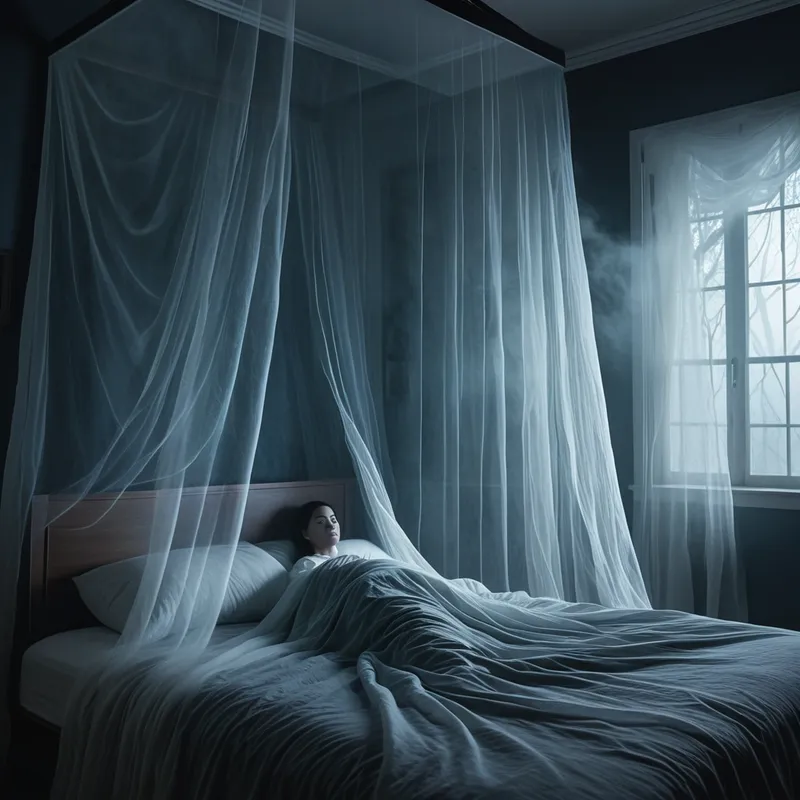
When the myth of The Veil stirs in modern dreams, it signals a profound threshold in the dreamer’s psychological life. Dreaming of a sheer curtain, a foggy barrier, a translucent wall, or standing before a mysterious doorway often marks this archetypal moment.
Somatically, the dreamer may experience this as a tightening in the chest (the jewel being formed), a feeling of profound stillness or awe, or a sense of vertigo. Psychologically, this is the process of a core complex or a deep layer of [the personal unconscious](/myths/the-personal-unconscious “Myth from Jungian Psychology culture.”/) preparing to break into awareness. The dream-Veil thins when old defenses are no longer sustainable, when a repressed truth demands acknowledgment, or when a new level of consciousness is gestating. The act of touching or passing through the dream-Veil often coincides with a waking-life insight, a breakdown of old patterns, or the sudden, irreversible understanding of a deep personal truth. The dream is the psyche’s ritual enactment of its own imminent transformation.
Alchemical Translation
The alchemical process mirrored in this myth is not the creation of gold, but the coniunctio oppositorum—[the sacred marriage](/myths/the-sacred-marriage “Myth from Various culture.”/) of opposites within the soul. The journey is [the opus](/myths/the-opus “Myth from Alchemical culture.”/) itself.
The goal is not to live in Is or in Seems, but to become the living Veil—the permeable, conscious membrane where the transcendent and the immanent meet and exchange their essence.
For the modern individual, [the first stage](/myths/the-first-stage “Myth from Alchemical culture.”/) ([nigredo](/myths/nigredo “Myth from Alchemical culture.”/)) is the burning longing, the “divine homesickness” that makes the comforts of the ordinary world (Seems) feel insufficient. The confrontation with the Keepers is the albedo, the whitening, where one must face the inner voices of fear, doubt, and rationalization that guard the status quo.
The parting of The Veil is the citrinitas, the yellowing or illumination—a fleeting, direct experience of non-dual awareness, of psychic wholeness, often experienced in moments of peak experience, profound therapy, or creative flow. The critical alchemical stage is the return, the [rubedo](/myths/rubedo “Myth from Alchemical culture.”/) or reddening. This is the “fall” back into the world, now carrying the integrated truth. The seeker must now embody the jewel. They must live the unity in the midst of duality, bring the insight of Is to the problems of Seems. This is the true transmutation: not an escape from life, but a deeper, more conscious, and more responsible participation in it. The individual becomes [the vessel](/myths/the-vessel “Myth from Alchemical culture.”/) where the myth lives, where the Veil, now internalized, becomes the very organ of perception.
Associated Symbols
Explore related symbols from the CaleaDream lexicon: