The Vas Myth Meaning & Symbolism
A myth of a sacred vessel that shatters to release a world, teaching the necessity of breaking form to free the boundless spirit within.
The Tale of The Vas
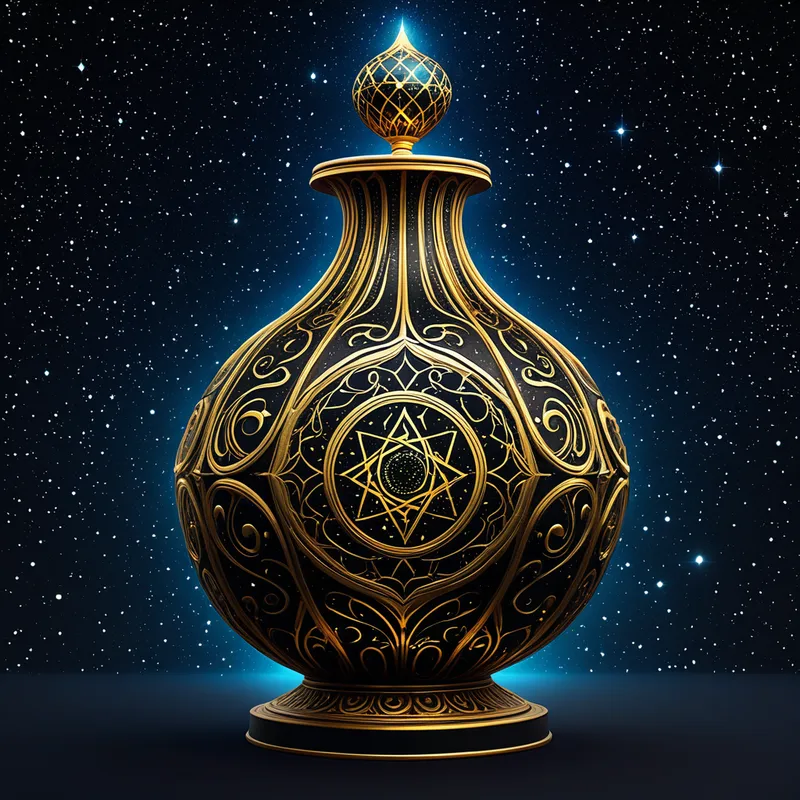
Listen. In the time before time was measured, when the substance of [the world](/myths/the-world “Myth from Tarot culture.”/) was a single, silent note held in the throat of [the void](/myths/the-void “Myth from Buddhist culture.”/), there existed The Vas. It was not made, for there was no maker. It simply was: a perfect, seamless sphere of [Prima Materia](/myths/prima-materia “Myth from Alchemical culture.”/), darker than the space between stars, yet humming with a captive light.
Within The Vas swirled the All-in-Potential—the screams of unborn suns, the whispers of forests yet to root, the salt of oceans and the memory of grief. It was a beautiful, terrible fullness. A perfect containment. The cosmos, in its infant yearning, pressed against the inner skin of [the vessel](/myths/the-vessel “Myth from Alchemical culture.”/), but the vessel did not yield. It held. This was its nature, its holy purpose: to be the boundary that defined the boundless.
But a vessel that never empties can never truly be filled anew. And within the swirling potential, a longing grew—not for more, but for less. For the touch of the void from which it had co-arisen. This longing took form as a vibration, a single dissonant frequency that resonated through the perfect sphere.
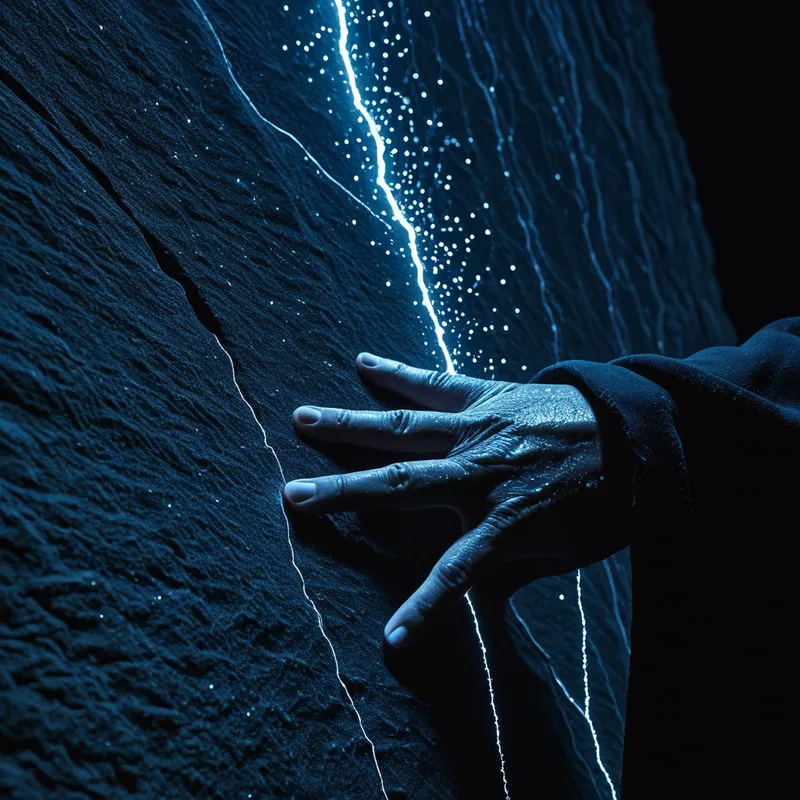
It began as a whisper-thin line, a flaw of desire upon the flawless surface. A crack. Not a rupture of violence, but a sigh of profound relief. From this fissure wept not the contents, but the context—the silent, empty ground of being that The Vas had, in its perfection, forgotten.
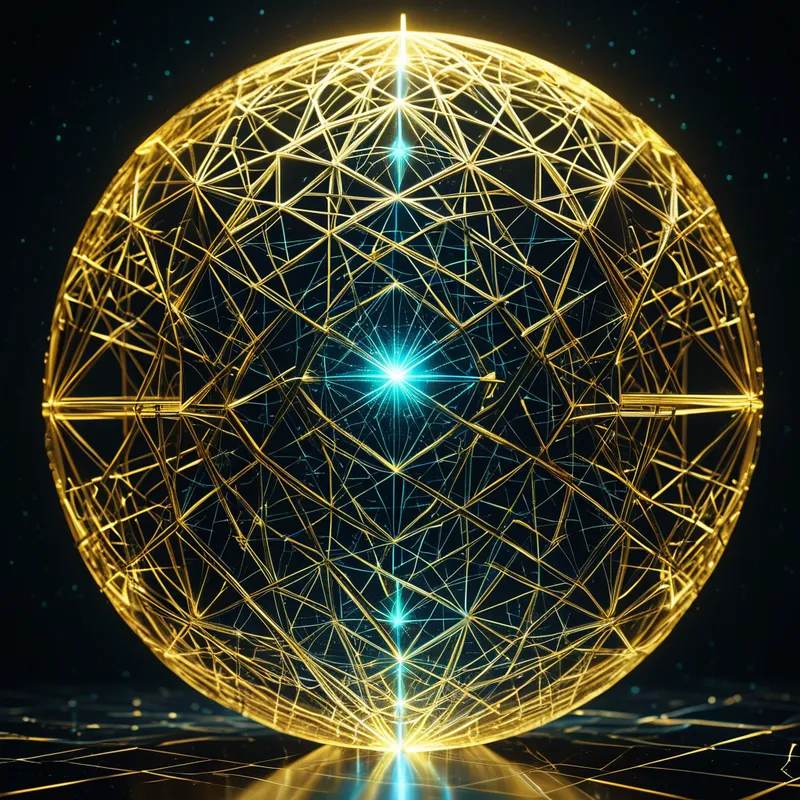
The crack propagated. It was a lightning bolt of absence, a branching tree of negation spreading across the dark surface. And as it spread, the captive light within did not explode outward in chaos. Instead, it unfolded. The potential suns found their distances and ignited. The whispers took root in the cooling matter and became green things. The salt gathered in low places and knew itself as sea.
The Vas did not vanish. Its fragments, now cooled and still humming with the memory of wholeness, became the hidden foundations of things: the bedrock beneath mountains, the crystalline lattice of gems, the silent, supportive bones within all that lives. It had performed its final and greatest act of containment by choosing to cease containing. The world was not born from its breaking, but into the space its breaking made possible.
Cultural Origins & Context
The myth of The Vas is central to the esoteric narrative tradition known as the Alchemical Recitations. Unlike state-sponsored cosmogonies, these stories were preserved in workshop-laboratories, whispered between adept and apprentice during the long vigil of a distillation or the patient grinding of ore. The teller was not a bard performing for a crowd, but a guide framing a practical operation within a cosmological drama.
Its societal function was twofold. For the culture at large, it provided a model of sacred imperfection; the world itself was founded on a necessary flaw, a “fortunate fall” from unity that allowed for diversity and life. It sanctified the broken pot, the weathered stone, the scar—seeing in them the echo of the primordial act.
For the initiate, however, the myth was a direct map of the Opus. The Vas represented the sealed alembic of [the self](/myths/the-self “Myth from Jungian culture.”/), [the ego](/myths/the-ego “Myth from Jungian culture.”/)-structure that holds the chaotic, potential-rich contents of the [psyche](/myths/psyche “Myth from Greek culture.”/). The story was told not as a past event, but as an ongoing, internal process one was encouraged to enact.
Symbolic Architecture
Psychologically, The Vas is the complex of the conscious [personality](/symbols/personality “Symbol: Personality in dreams often symbolizes the traits and characteristics of the dreamer, reflecting how they perceive themselves and how they believe they are perceived by others.”/)—the “[vessel](/symbols/vessel “Symbol: A container or structure that holds, transports, or protects something essential, representing the self, emotions, or life journey.”/)” we spend our early lives constructing to hold and manage our [identity](/symbols/identity “Symbol: Identity represents the sense of self, encompassing personal beliefs, cultural background, and social roles.”/), talents, and acceptable emotions. It is necessary for functioning, a container that gives us form. Yet, in its perfection and [strength](/symbols/strength “Symbol: ‘Strength’ symbolizes resilience, courage, and the ability to overcome challenges.”/), it becomes a [prison](/symbols/prison “Symbol: Prison in dreams typically represents feelings of restriction, confinement, or a lack of freedom in one’s life or mind.”/). It holds in not only our light but our [shadow](/symbols/shadow “Symbol: The ‘shadow’ embodies the unconscious, repressed aspects of the self and often represents fears or hidden emotions.”/); it prevents the new and the unknown from entering.
The most perfect container is also the most complete isolation.
The crack, therefore, is not a [symbol](/symbols/symbol “Symbol: A symbol can represent an idea, concept, or belief, serving as a powerful tool for communication and understanding.”/) of failure, but of [initiation](/symbols/initiation “Symbol: A symbolic beginning or transition into a new phase, status, or awareness, often involving tests, rituals, or profound personal change.”/). It represents the intrusion of the unconscious—a dream that will not be ignored, a depression that cannot be reasoned away, a [loss](/symbols/loss “Symbol: Loss often symbolizes change, grief, and transformation in dreams, representing the emotional or psychological detachment from something or someone significant.”/) that shatters our self-concept. It is the sacred flaw, the felix culpa, through which the numinous and the repressed can finally communicate. The release is not an [explosion](/symbols/explosion “Symbol: An explosion symbolizes sudden change, unchecked emotions, or profound transformation, often reflecting repressed anger or anxiety that manifests destructively.”/) of madness, but a careful, inevitable unfolding of what was always there, waiting for [space](/symbols/space “Symbol: Dreaming of ‘Space’ often symbolizes the vastness of potential, personal freedom, or feelings of isolation and exploration in one’s life.”/) to become itself.
The fragments becoming [foundation](/symbols/foundation “Symbol: A foundation symbolizes the underlying support systems, values, and beliefs that shape one’s life, serving as the bedrock for growth and development.”/) symbolize the post-[breakdown](/symbols/breakdown “Symbol: A sudden failure or collapse of a system, structure, or mental state, often signaling a need for fundamental change or repair.”/) [integration](/symbols/integration “Symbol: The process of unifying disparate parts of the self or experience into a cohesive whole, often representing psychological wholeness or resolution of internal conflict.”/). The old ego-[structure](/symbols/structure “Symbol: Structure in dreams often symbolizes stability, organization, and the framework of one’s life, reflecting how one perceives their environment and personal life.”/) does not disappear; its useful parts become the supportive substrate of a more expansive, more porous, and more authentic Self. One does not become formless, but one’s form is now in [dialogue](/symbols/dialogue “Symbol: Conversation or exchange between characters, representing communication, relationships, and narrative flow in games and leisure activities.”/) with the void.
The Dreamer’s Resonance
When this myth stirs in the modern unconscious, it often manifests in dreams of profound containment and its sudden end. One may dream of being in a pristine, windowless room that begins to sprout vines from the walls. Of a cherished, unbreakable heirloom—a locket, a vase—developing a single, hairline crack from which a strange light glows. Of feeling one’s own skin as a tight, suffocating shell that begins to peel or flake away, not with pain, but with immense relief.
Somatically, this process can feel like the buildup of immense, directionless pressure—anxiety, a sense of being “too full” of roles and expectations—followed by a crisis that feels, in its aftermath, like a collapse into spaciousness. The psychological process is the death of a self-image and the birth of self-awareness. The dreamer is not dreaming of destruction, but of the psyche’s innate drive toward a more truthful, though less defensible, state of being.

Alchemical Translation
For the individual on the path of individuation, the myth of The Vas models the critical phase of dissolution ([solutio](/myths/solutio “Myth from Alchemical culture.”/)) following coagulation (coagula). We spend years in coagula: building our identity, solidifying our views, constructing a stable vessel for our life. This is necessary work. But the Work cannot progress until that vessel is rendered permeable.
The alchemist does not shatter the vessel with a hammer, but learns to listen for its longing to become space.
The modern application is the voluntary engagement with what breaks us open: deep therapy that challenges core narratives, artistic expression that bypasses the inner censor, or a spiritual practice that empties the self of certainty. It is the courage to stop repairing the cracks in our [persona](/myths/persona “Myth from Greek culture.”/) and instead to sit at the fissure and observe what emerges. The goal is not to live in fragments, but to allow the totality of the psyche—light and shadow, order and chaos—to reorganize around a central void of unknowing, which is the source of all potential.
In the end, the myth teaches that our wholeness does not depend on the integrity of our container, but on our reconciliation with the boundless content it could never fully hold. We are both the shattered Vas and the expanding universe born from its courageous, foundational break.
Associated Symbols
Explore related symbols from the CaleaDream lexicon: