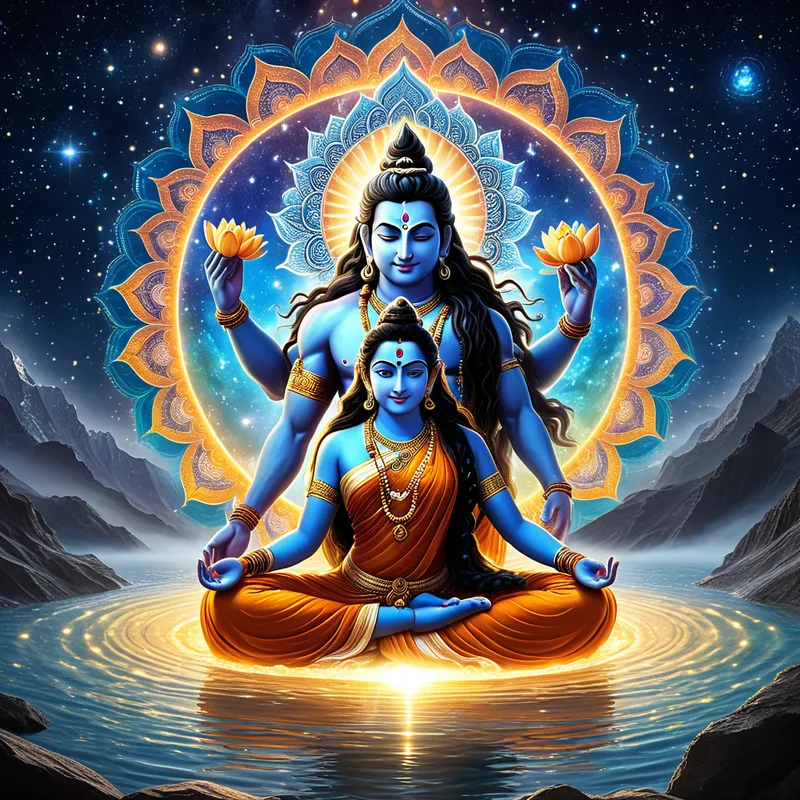
The Union of Shiva and Shakti Myth Meaning & Symbolism
The sacred marriage of consciousness (Shiva) and creative power (Shakti), whose union births the cosmos and symbolizes the ultimate state of inner completeness.
The Tale of The Union of Shiva and Shakti
In the beginning, before time had a name, there was a mountain that pierced [the veil between worlds](/myths/the-veil-between-worlds “Myth from Celtic culture.”/). Its peaks, sheathed in eternal snow, were the bones of [the earth](/myths/the-earth “Myth from Hindu culture.”/), and its name was Kailash. Upon its highest plateau, where the air was thin and silence had a texture, sat [Shiva](/myths/shiva “Myth from Hindu culture.”/). His body was smeared with the ash of burned universes, his eyes closed in a meditation so deep it was [the womb](/myths/the-womb “Myth from Various culture.”/) of potential. He was absolute stillness, pure consciousness, the unchanging witness. The cosmos pulsed around him, but within him was [the void](/myths/the-void “Myth from Buddhist culture.”/).
Far from that frozen stillness, in the palaces of the gods and the bustling plains of mortals, life teemed with furious color and sound. This was the dance of [Shakti](/myths/shakti “Myth from Hindu culture.”/). She was the thrum in the blood, the shoot breaking the soil, the thought birthing an empire. Yet, she was incomplete. A power without a purpose, a song without a listener. She took form as Sati, daughter of the proud king Daksha, and from her first breath, her soul yearned for the stillness on the mountain.
Driven by a love that was the universe seeking to know itself, Sati ascended to Kailash. She found Shiva immovable as a glacier, his trident planted in the rock. She served him, debated him, danced for him, her every action a ripple against his profound calm. For ages, she tended his silent abode, her vibrant energy a stark contrast to his ascetic void. Daksha, enraged by his daughter’s devotion to the “uncouth” ascetic, held a great yajna. He invited all the celestials but pointedly excluded Shiva.
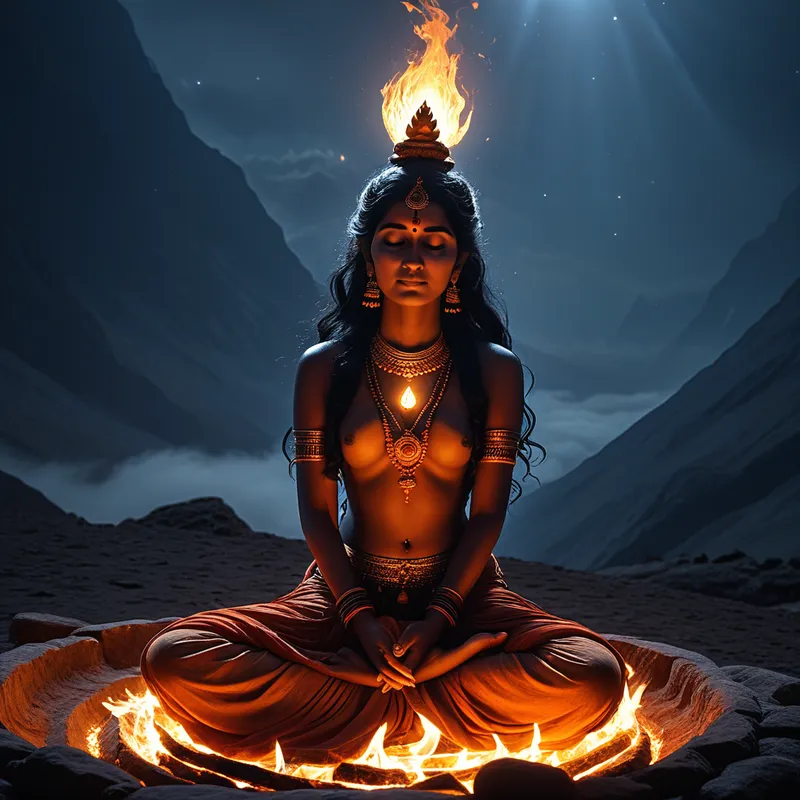
Sati, feeling the insult as a wound to the sacred truth she embodied, attended the sacrifice. Daksha heaped scorn upon Shiva, calling him a vagrant, a breaker of norms. Each word was a dagger. Sati’s form, the very vessel of cosmic energy, could not contain the contradiction. The insult to the absolute was a flaw in reality itself. With a declaration that a body born from one who disrespects the divine is unworthy, she sat in yogic posture and summoned her inner fire. Her physical form dissolved in a blaze of pure [tapas](/myths/tapas “Myth from Hindu culture.”/), leaving only the essence of Shakti—wounded, furious, and unbound.
The universe shuddered. On Kailash, Shiva’s meditation shattered. The stillness erupted. From his matted locks, a being of terrifying wrath was born: Virabhadra. The dance of destruction commenced. Virabhadra descended to Daksha’s realm, and the sacrifice was drowned in chaos. Daksha fell. In the aftermath, Shiva cradled the lifeless form of Sati. A sound emerged from him that was the cracking of [the world](/myths/the-world “Myth from Tarot culture.”/)-axis. He rose, and with Sati in his arms, began the Tandava, the dance of cosmic dissolution. The gods trembled as the rhythms threatened to unravel the threads of existence.
To preserve creation, [Vishnu](/myths/vishnu “Myth from Hindu culture.”/) took action. With his discus, he cut through Sati’s form. Her body fragmented, and fifty-one pieces fell to earth, each spot becoming a sacred Shakti Peetha. Released from the object of his grief, Shiva’s dance slowed. He returned to Kailash, withdrawing into a silence deeper than before, a consciousness now scarred by the memory of connection.
But Shakti was not gone. Energy cannot be destroyed; it only changes form. She was reborn as Parvati, daughter of the mountain king Himavat. Again, the pull was irresistible. She returned to the slopes of Kailash, but this time as an ascetic herself, performing austerities that rivaled Shiva’s own. She became the mountain, patient and enduring. Kama, the god of desire, was sent to stir Shiva’s heart, and was reduced to ashes by a glance from his [third eye](/myths/third-eye “Myth from Hindu culture.”/). Yet Parvati’s penance was not of desire, but of essence. She matched his stillness with her own, until his consciousness could no longer deny its own creative ground.
He opened his eyes. He saw not a petitioner, but his own other half. The still point and the dynamic force recognized each other. The marriage was not a conquest, but a homecoming. In their union, the cosmos found its stable rhythm. Shiva became Ardhanarishvara, the androgyne. From their bliss, the arts, the sciences, and the very breath of life flowed forth. The separated principles were no more. In their embrace, the still mountain and the flowing river became one.
Cultural Origins & Context
This myth is not a single story but a vast, living tapestry woven through millennia of Shaiva and Shakta thought. Its earliest threads appear in the epics like the Mahabharata and are fully elaborated in the Puranas, particularly the Shiva Purana, Devi Bhagavata Purana, and Kalika Purana. It was passed down by sages, temple storytellers (kathakars), and through iconography in countless temples across the Indian subcontinent.
Societally, it functioned on multiple levels. It modeled the ideal of spiritual partnership, where devotion (bhakti) could awaken even the most transcendent consciousness. It explained the origin of the sacred geography of India through the Shakti Peethas. Most profoundly, it provided a metaphysical framework for understanding reality itself: the universe is the play (lila) between pure awareness (Shiva) and its inherent creative power (Shakti). This was not just theology; it was a map of both the cosmos and the human [psyche](/myths/psyche “Myth from Greek culture.”/).
Symbolic Architecture
At its [heart](/symbols/heart “Symbol: The heart symbolizes love, emotion, and the core of one’s existence, representing deep connections with others and self.”/), this myth is the archetypal [blueprint](/symbols/blueprint “Symbol: A blueprint represents the foundational plan or design for something, often symbolizing potential, structure, and the mapping of one’s inner self or future.”/) for wholeness. Shiva represents pure, formless [consciousness](/symbols/consciousness “Symbol: Consciousness represents the state of awareness and perception, encompassing thoughts, feelings, and experiences.”/)—[the witness](/symbols/the-witness “Symbol: A figure observing events without direct participation, representing conscience, memory, or societal judgment.”/), the [space](/symbols/space “Symbol: Dreaming of ‘Space’ often symbolizes the vastness of potential, personal freedom, or feelings of isolation and exploration in one’s life.”/) in which phenomena arise. Shakti represents the dynamic [energy](/symbols/energy “Symbol: Energy symbolizes vitality, motivation, and the drive that fuels actions and ambitions.”/) that gives form to all phenomena—the power of becoming, of manifestation, of [life](/symbols/life “Symbol: The symbol of ‘Life’ represents a journey of growth, interconnectedness, and existential meaning, encompassing both the joys and challenges that define human experience.”/) itself.
One cannot exist without the other. Shiva without Shakti is shava (a corpse). Shakti without Shiva is chaos, energy without direction.
Their [separation](/symbols/separation “Symbol: A spiritual or mythic division between realms, states of being, or consciousness, often marking a transition or loss of connection.”/) is the state of duality that characterizes ordinary [human](/symbols/human “Symbol: The symbol of a human represents individuality, complexity of emotions, and social relationships.”/) experience: mind vs. [body](/symbols/body “Symbol: The body in dreams often symbolizes the dreamer’s self-identity, personal health, and the relationship they have with their physical existence.”/), thought vs. [action](/symbols/action “Symbol: Action in dreams represents the drive for agency, motivation, and the ability to take control of situations in waking life.”/), [stillness](/symbols/stillness “Symbol: A profound absence of motion or sound, often representing inner peace, creative potential, or existential pause in artistic contexts.”/) vs. [movement](/symbols/movement “Symbol: Movement symbolizes change, progress, and the dynamics of personal growth, reflecting an individual’s desire or need to transform their circumstances.”/), masculine vs. feminine principles within. Sati’s self-immolation is the ultimate sacrifice of [the ego](/myths/the-ego “Myth from Jungian culture.”/)-bound [identity](/symbols/identity “Symbol: Identity represents the sense of self, encompassing personal beliefs, cultural background, and social roles.”/). She cannot exist in a world where her essential counterpart is denied. This destruction is not an end, but a necessary deconstruction, a return to essence (Shakti) from form (Sati).
Shiva’s destructive dance is the terrifying but necessary process by which the old structures—the arrogant, divisive order represented by Daksha—must be torn down to make way for a new, integrated [reality](/symbols/reality “Symbol: Reality signifies the state of existence and perception, often reflecting one’s understanding of truth and life experiences.”/). The [fragmentation](/symbols/fragmentation “Symbol: The experience of breaking apart, losing cohesion, or being separated into pieces. Often represents disintegration of self, relationships, or reality.”/) of Sati’s body across the land symbolizes the divine feminine energy becoming immanent, accessible within the very fabric of the world.
The final union with Parvati is different from the first. It is not a merging of opposites, but a recognition of non-duality. Parvati wins Shiva not through external [pursuit](/symbols/pursuit “Symbol: A chase or being chased in dreams often reflects unresolved anxieties, unfulfilled desires, or internal conflicts demanding attention.”/), but through inner alignment—she becomes his equal in [austerity](/symbols/austerity “Symbol: Austerity in dreams symbolizes self-imposed restriction, discipline, or external hardship, often reflecting a need for purification, control, or a response to scarcity.”/). This signifies that the [path](/symbols/path “Symbol: The ‘path’ symbolizes a journey, choices, and the direction one’s life is taking, often representing individual growth and exploration.”/) to [integration](/symbols/integration “Symbol: The process of unifying disparate parts of the self or experience into a cohesive whole, often representing psychological wholeness or resolution of internal conflict.”/) is through inner work, where the dynamic psyche (Shakti) cultivates its own [depth](/symbols/depth “Symbol: Represents profound layers of consciousness, hidden truths, or the unknown aspects of existence, often symbolizing introspection and existential exploration.”/) and stillness to meet consciousness (Shiva) on its own ground.
The Dreamer’s Resonance
When this myth stirs in the modern dreamer, it signals a profound process of inner marriage. To dream of two powerful, distinct forces—one still and blue, the other fiery and active—locked in tension or moving toward embrace, points to a psyche seeking its own foundational unity.
This may manifest somatically as a felt sense of fragmentation: a hyper-active mind disconnected from a numb body, or a deep creative impulse (Shakti) feeling blocked by a rigid, over-analytical inner critic (Shiva). The dream of immolation might appear as scenarios of career burnout, relationship collapse, or the dissolution of a long-held identity. This is not a nightmare of failure, but the unconscious portraying the necessary death of an old, unsustainable way of being—the Daksha’s sacrifice within us that must be destroyed.
Conversely, dreams of a serene, androgynous figure or a sublime, balanced union often follow periods of intense inner work. They are the psyche’s confirmation of achieved, if fleeting, states of inner reconciliation. The dreamer is experiencing the relief and potency that comes when their capacity for focused awareness and their vital life energy begin to cooperate as one system.
Alchemical Translation
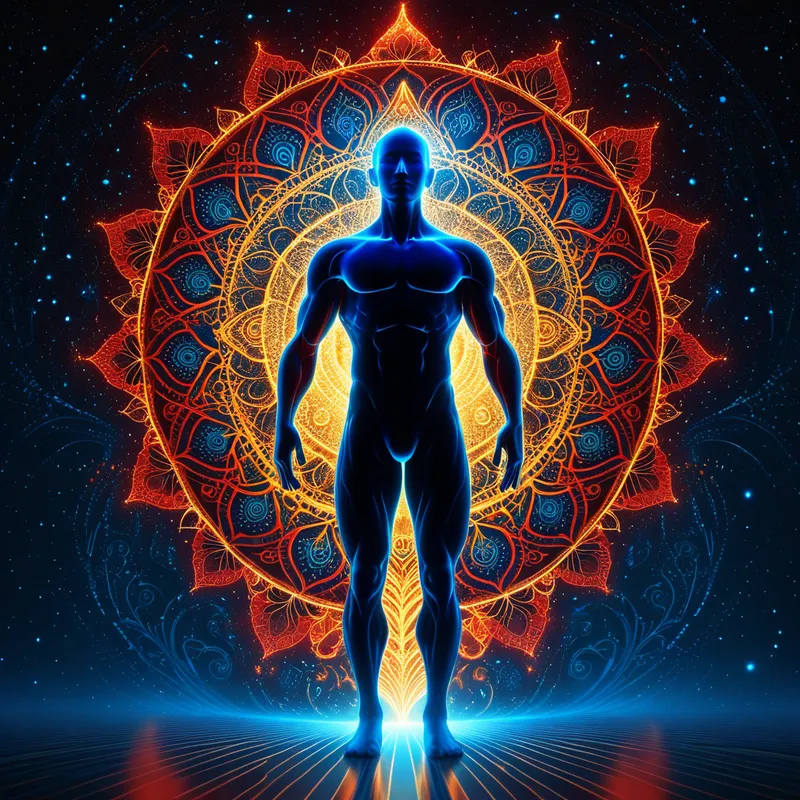
The alchemical journey modeled here is [the opus](/myths/the-opus “Myth from Alchemical culture.”/) of individuation—the creation of [the Self](/myths/the-self “Myth from Jungian culture.”/). [The prima materia](/myths/the-prima-materia “Myth from Alchemical culture.”/) is the divided human condition.
- Calcinatio (The Fire of Sati): This is the initial, often painful, burning away of the [persona](/myths/persona “Myth from Greek culture.”/) and ego-attachments. It is the moment we realize our current life structure denies a core part of our truth (our inner Shiva or Shakti). We may “burn down” a career, a relationship, or a belief system. This fire reduces us to our essential longing.
- Mortificatio (Shiva’s Grief & Dance): Following [the calcination](/myths/the-calcination “Myth from Alchemical culture.”/) comes a period of dissolution, depression, or chaotic deconstruction (Shiva’s Tandava). The old psychic order is dead, and the new one is not yet born. This is a crucial, dark phase where the conscious mind must fully confront the loss and the chaos of transformation.
- [Separatio](/myths/separatio “Myth from Alchemical culture.”/) (The Fragmentation): Here, the unified energy (Shakti) is distributed. Psychologically, this is the stage of analysis, where we piece apart our instincts, complexes, and talents. We locate our power (the Shakti Peethas) in different aspects of our life—our work, our relationships, our solitude.
- Coniunctio (The Union with Parvati): The final and supreme operation. This is not a forced fusion, but a [sacred marriage](/myths/sacred-marriage “Myth from Alchemy culture.”/) born of disciplined inner cultivation. The ego (Parvati) ceases its desperate pursuit and instead develops depth, patience, and self-containment (tapas). When the conscious mind achieves a quality of serene attention, it naturally attracts and recognizes the vital, creative libido. They unite not as master and servant, but as equal consorts.
The goal is to become the Ardhanarishvara of your own psyche: where stillness contains motion, and action arises from profound peace.
For the modern individual, this myth teaches that wholeness is not found by eliminating one principle in favor of the other, nor by a superficial “balance,” but through a sacred, internal courtship. We must allow our rigid structures to be burned by truth, grieve what is lost, and then patiently cultivate both the mountain of our consciousness and [the river](/myths/the-river “Myth from Buddhist culture.”/) of our life force until they reveal themselves to be, and always have been, one.
Associated Symbols
Explore related symbols from the CaleaDream lexicon: