The Unicorn Myth Meaning & Symbolism
A fierce, solitary beast, tamed only by a maiden's innocence, is captured and slain, its blood a paradoxical source of purification and power.
The Tale of The Unicorn
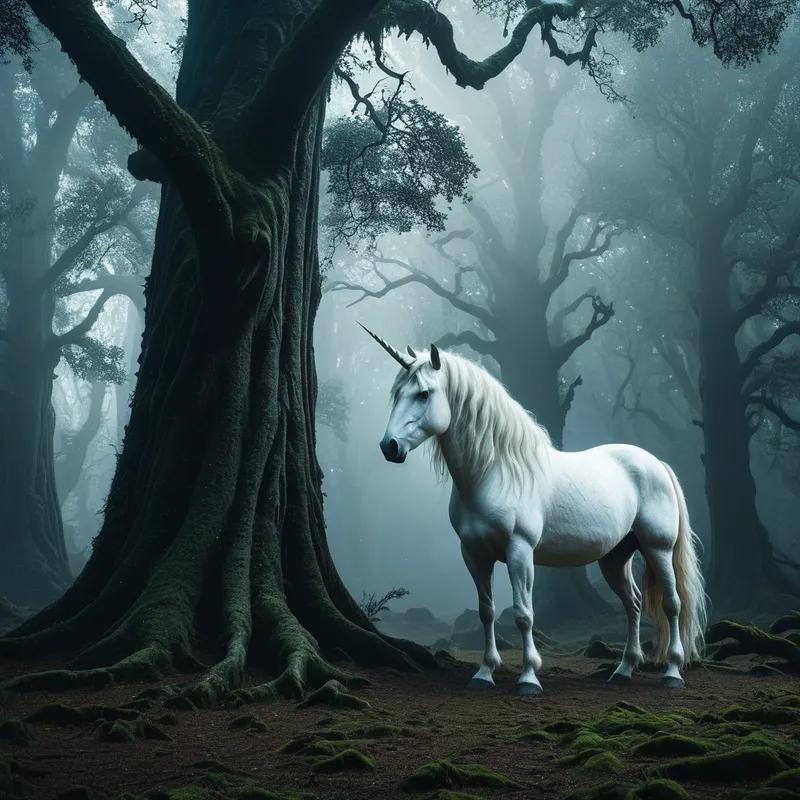
In the deep and trackless woods, where the light falls in shafts like cathedral pillars and the air hums with ancient silence, there dwells a creature that is more a rumour than a fact. It is the [Unicorn](/myths/unicorn “Myth from Medieval European culture.”/), a beast of terrible swiftness and untamable spirit. Its coat is whiter than the first winter snow, its hooves sharper than flint, and from its brow springs a horn, a long and spiraled lance of alabaster, said to hold the power to cleanse poison from [water](/myths/water “Myth from Chinese culture.”/) and sickness from the flesh.
No hunter, no matter how cunning or strong, can hope to lay hands upon it. Nets are torn, traps are sprung, and the sound of its flight is like [the wind](/myths/the-wind “Myth from Various culture.”/) sighing through the pines—there one moment, gone the next. It is a creature of the boundary, of [the sacred grove](/myths/the-sacred-grove “Myth from Celtic culture.”/) that exists just beyond the edge of the known world. It answers to no call but its own wild heart.
Yet, there exists one key to its fierce solitude. Not force, but innocence. When a pure maiden, one whose heart is a clear mirror without stain of guile or desire, enters the forest and sits alone in a quiet glade, a miracle unfolds. Sensing her presence, the unicorn will come. It approaches slowly, this embodiment of untamed power, and lays its formidable head gently in her lap. In that moment, the wild is becalmed. The creature sleeps, disarmed by a virtue it cannot possess but to which it is utterly bound.
This is the moment the hunters, hidden in the thicket, have waited for. At a signal, they burst from the shadows. The maiden may weep, but her role is complete. The unicorn, startled from its sacred slumber, is set upon. It fights with the fury of a storm, but it is betrayed at the altar of its own deepest nature. It is captured, or more often, slain. Its horn is taken, its blood spilled upon [the earth](/myths/the-earth “Myth from Hindu culture.”/)—a final, crimson sacrifice. The beast that could not be taken by might is undone by its own recognition of purity.

Cultural Origins & Context
The unicorn as we know it is a creature forged not in zoology, but in the symbolic crucible of the Medieval Bestiary. These were not scientific texts but theological and moral compendiums. Scribes and monks, drawing from earlier sources like the Greek Physiologus, copied and embellished descriptions of animals to illustrate Christian doctrine. The unicorn became a powerful allegorical figure within this framework.
Its primary function was didactic. The story was told from pulpits and illuminated on vellum to convey spiritual truths to a largely illiterate populace. The tale was passed down through the authoritative voice of the Church, a sanctioned myth used to explain the mystery of Christ’s incarnation and sacrifice. The unicorn represented Christ himself: fierce, singular, and unapproachable by sinful humanity (the hunters), yet drawn to and captured by the purity of [the Virgin Mary](/myths/the-virgin-mary “Myth from Christian culture.”/) (the maiden). Its death purified [the world](/myths/the-world “Myth from Tarot culture.”/), just as Christ’s blood redeemed it. In this context, the myth was not a fantasy but a sacred truth encoded in nature’s design.
Symbolic Architecture
The myth’s power lies in its stark, paradoxical [architecture](/symbols/architecture “Symbol: Architecture in dreams often signifies structure, stability, and the framing of personal identity or life’s journey.”/). It presents a [cluster](/symbols/cluster “Symbol: A dense grouping of similar elements, representing complexity, patterns, or interconnectedness within a larger system.”/) of irreducible symbols that clash and reconcile in the [psyche](/myths/psyche “Myth from Greek culture.”/).
The [Unicorn](/symbols/unicorn “Symbol: A mythical creature symbolizing purity, magic, and the unattainable. It represents spiritual awakening and rare, untamed beauty.”/) itself is the ultimate [symbol](/symbols/symbol “Symbol: A symbol can represent an idea, concept, or belief, serving as a powerful tool for communication and understanding.”/) of inviolable [spirit](/symbols/spirit “Symbol: Spirit symbolizes the essence of life, vitality, and the spiritual journey of the individual.”/). It is the integrated Self in its pristine, pre-conscious state—powerful, whole, and utterly separate from the compromises of the collective. Its [horn](/symbols/horn “Symbol: A horn symbolizes primal power, warning signals, and spiritual connection, often representing strength, alertness, or divine communication in dreams.”/), a phallic [spire](/symbols/spire “Symbol: A tall, tapering structure pointing skyward, symbolizing aspiration, spiritual connection, and reaching beyond earthly limits.”/) on a feminine, horse-like [body](/symbols/body “Symbol: The body in dreams often symbolizes the dreamer’s self-identity, personal health, and the relationship they have with their physical existence.”/), represents a transcendent unity of opposites, a spiritualized power that purifies.
The unicorn does not seek the maiden; it is compelled by her. The soul is not found by seeking, but by becoming the vessel that the sacred cannot ignore.
The Maiden represents not passive virginity, but active, unconscious wholeness. She is the state of being that has not yet been fractured by the [knowledge](/symbols/knowledge “Symbol: Knowledge symbolizes learning, understanding, and wisdom, embodying the acquisition of information and enlightenment.”/) of good and evil, of desire and corruption. She is the [anima](/symbols/anima “Symbol: The feminine archetype within the male unconscious, representing soul, creativity, and connection to the inner world.”/) mundi, the world [soul](/symbols/soul “Symbol: The soul represents the essence of a person, encompassing their spirit, identity, and connection to the universe.”/), in its innocent [aspect](/symbols/aspect “Symbol: A distinct feature, quality, or perspective of something, often representing a partial view of a larger whole.”/). Her lap is the receptive, containing [space](/symbols/space “Symbol: Dreaming of ‘Space’ often symbolizes the vastness of potential, personal freedom, or feelings of isolation and exploration in one’s life.”/) where the wild spirit can momentarily rest.
The Hunters and the violent capture introduce the necessary [shadow](/symbols/shadow “Symbol: The ‘shadow’ embodies the unconscious, repressed aspects of the self and often represents fears or hidden emotions.”/). They represent the worldly ego, the pragmatic force that seeks to possess and utilize spiritual power for its own ends—even holy ends. The myth acknowledges that the [integration](/symbols/integration “Symbol: The process of unifying disparate parts of the self or experience into a cohesive whole, often representing psychological wholeness or resolution of internal conflict.”/) of the sublime into [human](/symbols/human “Symbol: The symbol of a human represents individuality, complexity of emotions, and social relationships.”/) [life](/symbols/life “Symbol: The symbol of ‘Life’ represents a journey of growth, interconnectedness, and existential meaning, encompassing both the joys and challenges that define human experience.”/) is always, tragically, a form of capture and a kind of [death](/symbols/death “Symbol: Symbolizes transformation, endings, and new beginnings; often associated with fear of the unknown.”/). The pure spirit cannot survive unaltered in the [realm](/symbols/realm “Symbol: The symbol of ‘Realm’ often signifies the boundaries of one’s consciousness, experiences, or emotional states, suggesting aspects of reality that are either explored or ignored.”/) of [action](/symbols/action “Symbol: Action in dreams represents the drive for agency, motivation, and the ability to take control of situations in waking life.”/) and matter.
The Dreamer’s Resonance
To dream of the unicorn today is to encounter this archetypal drama within one’s own psyche. It seldom appears as a quaint fairy tale. More often, the dreamer is the maiden, sitting in a liminal forest (a state of inner transition), waiting with a mixture of dread and longing. Or they are [the hunter](/myths/the-hunter “Myth from African culture.”/), witnessing a breathtaking beauty they feel compelled to destroy or possess.
Somatically, this can feel like a tension between expansion and contraction—a feeling of radiant, potent energy (the unicorn’s presence) suddenly clashing with a sense of betrayal, capture, or piercing loss. It often surfaces during life phases where one’s core integrity or a newly discovered spiritual sensitivity feels threatened by the demands of the “real world”—a career, a relationship, or societal expectations. The dream signals a crisis of innocence: the painful recognition that to bring one’s true spirit into manifestation is to risk its corruption. The process is one of mourning the loss of a purely internal, idealized state of being.
Alchemical Translation
The unicorn myth is a perfect map for the alchemical stage of Albedo, the whitening. This is not the final gold, but the crucial purification that must precede it. [The ego](/myths/the-ego “Myth from Jungian culture.”/) (the hunters) must orchestrate a confrontation between the pure, unconscious spirit (the unicorn) and [the vessel](/myths/the-vessel “Myth from Alchemical culture.”/) of innocent potential (the maiden). Their meeting is the Coniunctio, a mystical union that renders the fierce spirit passive and vulnerable.
The killing of the unicorn is not the end of the work, but its true beginning. The spirit must die to its form to become efficacious in the world.
The capture and slaying represent the necessary mortificatio—the killing of [the thing](/myths/the-thing “Myth from Norse culture.”/) in its original form. The integrated Self cannot remain a wild, solitary ideal. It must be “slain” as a fantasy and its essence (the horn, the blood) extracted and put to use. This is the psychic transmutation: the raw power of [the Self](/myths/the-self “Myth from Jungian culture.”/) is sacrificed to become a functional tool for healing (the purifying horn) and a vitalizing force (the life-blood) that nourishes the psyche’s entire landscape.
For the modern individual, this translates to the agonizing but vital process of sacrificing a perfect, inner ideal—of love, creativity, or purpose—to the messy, compromised reality of actual living. We must allow our purest vision to be “captured” by our flawed human hands and “killed” as an abstract ideal, so that its essence may finally live, imperfectly but powerfully, in the world we inhabit. The myth teaches that purity is not preserved by isolation, but fulfilled through a sacred, tragic, and ultimately redemptive betrayal.
Associated Symbols
Explore related symbols from the CaleaDream lexicon: