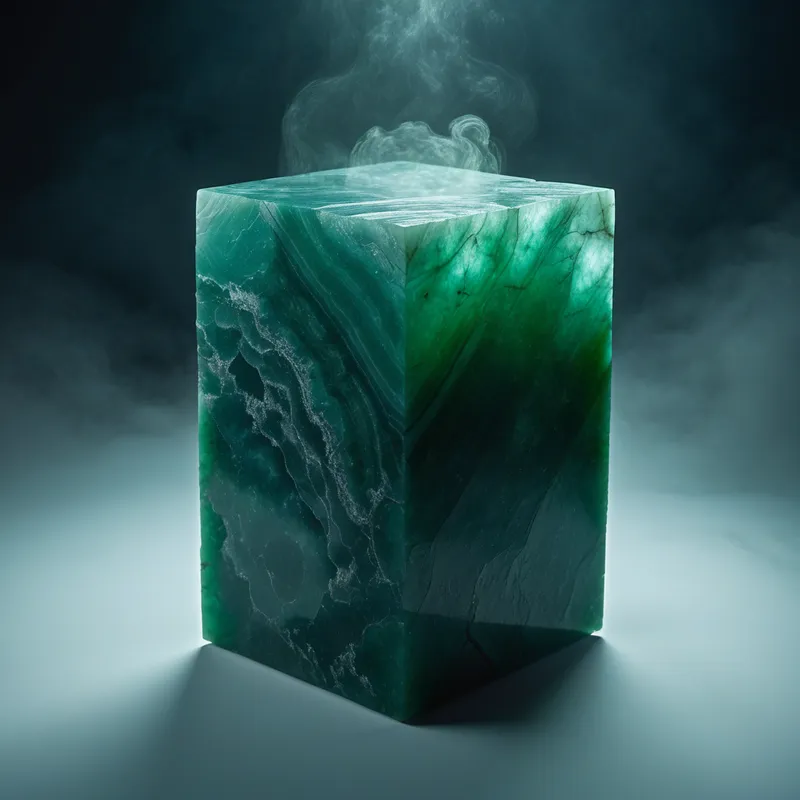
The Uncarved Block Myth Meaning & Symbolism
A myth of primordial wholeness, where the untouched, perfect state of being is the source of all power and the ultimate destination of the spiritual journey.
The Tale of The Uncarved Block
Before [the world](/myths/the-world “Myth from Tarot culture.”/) knew its own name, there was a silence so deep it was a kind of sound. In this silence, in the workshop of the cosmos before time was measured, there rested a block. It was not of wood, nor of stone, but of the very substance of the Tao itself—a primordial mass of pure, uncarved potential.
It sat upon the workbench of the [Laozi](/myths/laozi “Myth from Chinese culture.”/), who was not yet a master, but the first dreamer. He would sit for eons, not sleeping, but gazing upon its flawless surface. It held every shape within it: the curve of the mountain, the flow of [the river](/myths/the-river “Myth from Buddhist culture.”/), the flight of the sparrow, the sorrow and joy of humankind. Yet it held none of them. It was complete, whole, and terrifying in its perfection. To alter it was to create a world; to leave it be was to honor the source.
The impulse to carve arose not as a thought, but as a sigh from the block itself—a yearning to know what it contained. And so, the dreamer’s hand, guided by a compassion deeper than understanding, reached for [the first tool](/myths/the-first-tool “Myth from Various culture.”/). The air in the timeless workshop grew thick with anticipation. The first cut was not a violence, but a birth-cry. A sliver of potential fell away, and from it sprang the ten thousand things: the green shoot, the first note of music, the concept of “you” and “I.”
With each subsequent cut—each decision to be this and not that—the world gained detail, beauty, and complexity. A curve became a bowl to hold [water](/myths/water “Myth from Chinese culture.”/); a plane became a door to separate inside from outside; an angle became a roof to ward off the rain. The block, the Pu, was transformed. Its children were magnificent: palaces and chariots, rituals and laws, art and ambition.
But as the carving grew intricate, a melancholy settled over the dreamer. He saw that the bowl, once carved, could only hold. The door, once defined, could only open or close. The roof created the concept of “storm.” Each act of creation was also an act of limitation. The original, silent, all-possible wholeness was now scattered into a billion brilliant, specific fragments. The final cut was made not with a blade, but with a tear that fell upon the now-empty workbench, where only dust—the memory of the block—remained. The myth ends not with an ending, but with a question hanging in the newly carved air: having known the specific, can one ever return to the whole?
Cultural Origins & Context
The myth of the Uncarved Block is not a narrative with characters and plot in the Western sense, but a foundational philosophical metaphor woven into the fabric of Tao Te Ching. Its primary teller is the semi-legendary Laozi, and its audience was the individual seeker and the ruler alike, during the turbulent Warring States period of ancient China. In an era obsessed with social carving—with Confucian rituals, legalist laws, and martial strategies—the myth of Pu served as a radical counter-narrative.
It was passed down not in epic poetry, but in cryptic, poetic verses designed to bypass the intellect and speak directly to the intuitive mind. Its societal function was therapeutic and subversive. To a ruler, it whispered: “Your most powerful state is one of simplicity and non-interference ([Wu Wei](/myths/wu-wei “Myth from Taoist culture.”/)), not complex administration.” To the individual, it offered a map back from the exhausting complexities of social [persona](/myths/persona “Myth from Greek culture.”/) and ambition to a state of inner peace and spontaneous authenticity. It was the core myth of a culture that valued the source over the stream, the root over the branch.
Symbolic Architecture
The Uncarved Block is the ultimate [symbol](/symbols/symbol “Symbol: A symbol can represent an idea, concept, or belief, serving as a powerful tool for communication and understanding.”/) of primordial potential, the psychic state preceding [differentiation](/symbols/differentiation “Symbol: The process of distinguishing or separating parts of the self, emotions, or identity from a whole, often marking a developmental or psychological milestone.”/). It represents [the Self](/myths/the-self “Myth from Jungian culture.”/) in its pre-egoic, pre-conscious wholeness.
The Uncarved Block is not a thing to be achieved, but a place to remember; it is the original home of the psyche before it built its first wall.
Psychologically, the block is the totality of the individual before culture, [family](/symbols/family “Symbol: The symbol of ‘family’ represents foundational relationships and emotional connections that shape an individual’s identity and personal development.”/), and [trauma](/symbols/trauma “Symbol: A deeply distressing or disturbing experience that overwhelms the psyche, often manifesting in dreams as unresolved emotional wounds or psychological injury.”/) begin to “carve” out an [identity](/symbols/identity “Symbol: Identity represents the sense of self, encompassing personal beliefs, cultural background, and social roles.”/). Every cut represents a necessary [adaptation](/symbols/adaptation “Symbol: The process of adjusting to new conditions, often involving psychological or physical change to survive or thrive.”/)—learning [language](/symbols/language “Symbol: Language symbolizes communication, understanding, and the complexities of expressing thoughts and emotions.”/), adopting social roles, developing a [persona](/symbols/persona “Symbol: The social mask or outward identity one presents to the world, often concealing the true self.”/). These carvings are essential for survival and functioning in the world. However, the myth warns of the inherent [danger](/symbols/danger “Symbol: The symbol of ‘Danger’ often indicates a sense of threat or instability, calling for caution and awareness.”/): we begin to mistake the intricate, carved [statue](/symbols/statue “Symbol: A statue typically represents permanence, ideals, or entities that are revered.”/) (our ego-[personality](/symbols/personality “Symbol: Personality in dreams often symbolizes the traits and characteristics of the dreamer, reflecting how they perceive themselves and how they believe they are perceived by others.”/)) for our fundamental substance. We forget the solid, silent, and limitless block from which we were shaped. The block symbolizes the [pleroma](/symbols/pleroma “Symbol: In Gnostic cosmology, the Pleroma is the divine fullness or totality of spiritual powers, representing the realm of perfection beyond the material world.”/), the [fullness](/symbols/fullness “Symbol: A state of complete satisfaction, abundance, or completion, often representing emotional, spiritual, or physical fulfillment.”/) of being, while the carved artifacts represent the fragmented world of opposites and distinctions we inhabit.
The Dreamer’s Resonance
When this myth stirs in the modern unconscious, it often manifests in dreams of profound simplicity or frustrating limitation. One might dream of finding a perfectly smooth, warm stone by a river and feeling an overwhelming sense of peace and “rightness.” Conversely, one might dream of being trapped inside a complex, ornate piece of furniture—a beautifully carved cabinet—unable to move or breathe, symbolizing the suffocation of an over-defined life or a rigid identity.
Somatically, this process can feel like a deep, cellular yearning for rest, a fatigue not of the body but of the persona. It is the [psyche](/myths/psyche “Myth from Greek culture.”/)’s signal that the adaptations (the carvings) that once served are now constricting. The psychological process is one of de-identification. The dreamer is being invited by the deeper Self to loosen their grip on “who they think they are”—the successful professional, the perfect parent, the knowledgeable expert—and to reconnect with the raw, uncarved potential that exists beneath these roles. It is often a prelude to a midlife transition or a creative rebirth, where old structures must be softened to allow for new, more authentic forms to emerge.

Alchemical Translation
The alchemical work modeled by this myth is not about adding to the self, but about subtracting from it. It is [the opus](/myths/the-opus “Myth from Alchemical culture.”/) of solve, of dissolution. The modern individuation journey often begins with a proud admiration of one’s finely carved statue—one’s accomplishments, intellect, and refined personality. [The first stage](/myths/the-first-stage “Myth from Alchemical culture.”/) of transmutation is the painful, necessary realization that this statue is also a cage.
The journey back to the Uncarved Block is the alchemy of unlearning, a sacred subtraction where the goal is not a better shape, but the rediscovery of the original substance.
The process involves consciously examining each “cut”—each belief, habit, and self-concept—and asking: “Is this me, or is this a carving made by my parents, my culture, my trauma?” This is not an act of destruction, but of reverence. One learns to honor the bowl for its utility while remembering it was once part of the limitless tree. The ultimate [triumph](/myths/triumph “Myth from Roman culture.”/) is not regression to an infantile state, but the achievement of what the alchemists called the unio mentalis: a conscious integration where [the ego](/myths/the-ego “Myth from Jungian culture.”/), having fully acknowledged its carved nature, voluntarily aligns itself with the enduring, uncarved ground of being. One becomes like the sage-ruler who governs the complex kingdom (the carved world) while their heart-mind remains as simple, potent, and at rest as the Uncarved Block itself. The power is no longer in the form, but in the connection to the formless source.
Associated Symbols
Explore related symbols from the CaleaDream lexicon: