The Tribe of Thamud Myth Meaning & Symbolism
A powerful Arabian myth of a people who carved homes from mountains, defied a sacred she-camel, and were destroyed by their own arrogance.
The Tale of The Tribe of Thamud
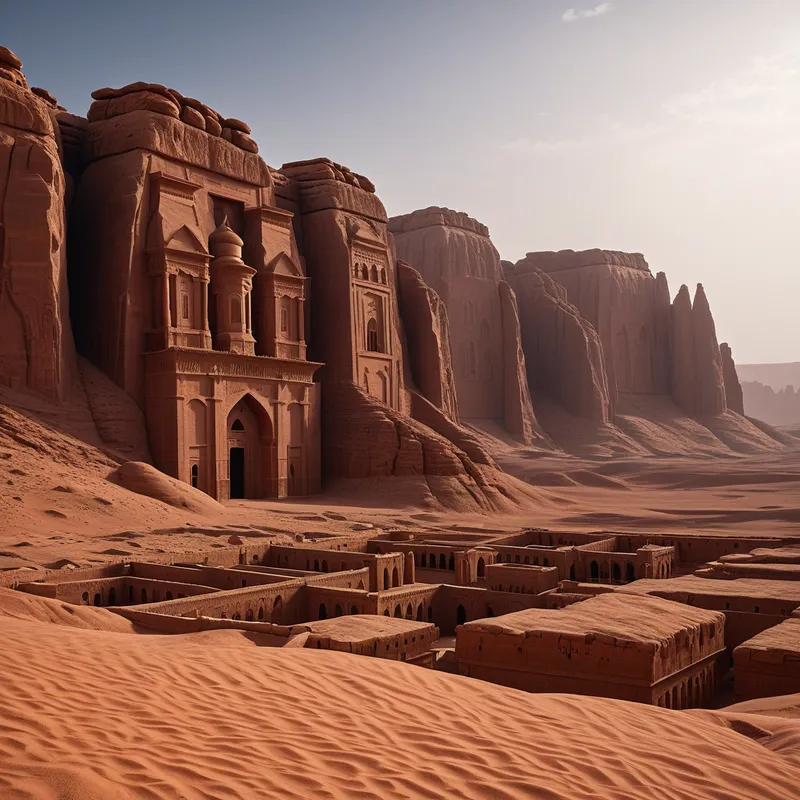
Listen, and let the wind from the Empty Quarter carry the tale. In the time after Hud, there arose the Thamud. They were not mere wanderers of the dunes; they were masters of stone. With hands that understood the whisper of granite and the sigh of sandstone, they carved not just shelters, but kingdoms from the very ribs of the mountains. Their cities, like Al-Hijr, were hymns to their own power, their facades staring across the plains with the imperious silence of gods.
They grew mighty, and their hearts grew heavy with pride. The land, they believed, bowed to their will. The rains came at their command, the pastures flourished by their grace. They forgot the older covenant, the understanding that the desert gives only to those who remember it can take away.
Then came Salih, one of their own, yet speaking with a voice that carried the chill of the open desert night. His words were simple, a call to turn from their arrogance and worship the One who shaped the mountains they merely inhabited. To test them—and to offer a final, undeniable sign—Salih brought forth a petition to the Divine. From the heart of a specific rock, urged by his prayer, there emerged a wonder: a she-camel.
But this was no ordinary beast. She was a Naqat Allah, the She-Camel of God, immense and serene, her eyes holding the deep stillness of ancient wells. Salih proclaimed the law of her presence: “This is God’s sign. She shall drink from the well on her day, and you shall drink on yours. Do her no harm, for a terrible punishment awaits if you touch her.”
For a time, the balance held. The camel would come, drink the valley’s water in a single day, leaving ample for the people on the morrow. She was a walking rhythm, a living reminder of a shared sustenance and a sacred boundary. But resentment festered in the hearts of the proud. To share their water, to have their order dictated by a beast? It was an insult to their carved majesty.
The tension coiled like a serpent in the sun. Nine men, leaders in darkness, plotted in the shadows of their magnificent tombs. They stoked the fires of outrage, twisting the sign into a curse. The sacred rhythm became a grating imposition. Finally, the resolve broke. A woman named Umm Ghaylan is said to have egged them on, and a man named Qudar ibn Salif took the ultimate step. With a swift, violent stroke, he hamstrung the magnificent creature, and she fell with a cry that echoed not just through the valley, but through the very foundations of their world.
They had severed the covenant. They celebrated their defiance, butchering the sign. Salih warned them: “Enjoy yourselves in your homes for three days. That is a promise not to be denied.” For three days, an eerie normalcy descended, heavy with doom. Then, on the fourth day, as the dawn was breaking, a single, piercing cry rent the air—a sound not of this earth. It was followed by a cataclysm. The very ground they had mastered convulsed. A Sayha, a terrible blast, seized them. Some accounts speak of an earthquake that turned their stone palaces into tombs, of a lightning bolt that scorched them where they stood. In an instant, the mighty Thamud were brought low, their bodies lifeless in their halls of pride, as if they had never lived there at all. Only Salih and those who believed with him were spared, departing from the place of ruin, leaving the wind to howl through the empty, ornate doorways.
Cultural Origins & Context
The story of Thamud is embedded deep in the Jahiliyyah consciousness and is powerfully affirmed in the Qur’an. They are presented as a historical people, successors to the equally doomed tribe of ‘Ad, forming a continuous moral and historical narrative. This myth was not mere entertainment; it was a foundational parable of identity and consequence, passed down by oral poets (sha’ir) and later Quranic reciters. It served as a potent etiological myth, explaining the awe-inspiring, abandoned stone ruins that early Arabs encountered in the deserts of Hijaz and Najd—who could have built these, and why were they empty? The answer was a warning etched in stone: a civilization that breaks its sacred covenant with the divine order and the natural world sows the seeds of its own annihilation. It functioned as a social stabilizer, preaching against the corrosive effects of collective hubris (istikbar) and emphasizing the fragility of human achievement without ethical and spiritual foundation.
Symbolic Architecture
At its core, the myth is a profound [drama](/symbols/drama “Symbol: Drama signifies narratives, emotional expression, and the exploration of human experiences.”/) of boundaries and balance. The Thamud represent the [pinnacle](/symbols/pinnacle “Symbol: The highest point or peak, representing achievement, culmination, or spiritual transcendence.”/) of the Ego [consciousness](/symbols/consciousness “Symbol: Consciousness represents the state of awareness and perception, encompassing thoughts, feelings, and experiences.”/)—the [human](/symbols/human “Symbol: The symbol of a human represents individuality, complexity of emotions, and social relationships.”/) will to dominate, shape, and immortalize itself in matter. Their [mountain](/symbols/mountain “Symbol: Mountains often symbolize challenges, aspirations, and the journey toward self-discovery and enlightenment.”/)-carved cities are monuments to this ego, impressive but ultimately [static](/symbols/static “Symbol: Static represents interference, disruption, and the breakdown of clear communication or signal, often evoking feelings of frustration and disconnection.”/) and isolating.
The Naqat Allah is the ultimate [symbol](/symbols/symbol “Symbol: A symbol can represent an idea, concept, or belief, serving as a powerful tool for communication and understanding.”/) of the Self intruding upon the ego’s domain. She is the incarnated “other,” the divine injunction made flesh. She is not a [warrior](/symbols/warrior “Symbol: A spiritual archetype representing inner strength, discipline, and the struggle for higher purpose or self-mastery.”/) or a [king](/symbols/king “Symbol: A symbol of ultimate authority, leadership, and societal order, often representing the dreamer’s inner power or external control figures.”/), but a nurturing, consuming, animal [presence](/symbols/presence “Symbol: Presence in dreams often signifies awareness or acknowledgment of something significant in one’s life.”/). Her law—the sharing of [water](/symbols/water “Symbol: Water symbolizes the subconscious mind, emotions, and the flow of life, representing both cleansing and creation.”/)—is [the law](/symbols/the-law “Symbol: Represents external rules, societal order, moral boundaries, and the tension between personal freedom and collective structure.”/) of the Self: a demand for recognition of a [rhythm](/symbols/rhythm “Symbol: A fundamental pattern of movement or sound in time, representing life’s cycles, emotional flow, and universal order.”/) larger than one’s own, for the [acceptance](/symbols/acceptance “Symbol: The experience of being welcomed, approved, or integrated into a group or situation, often involving validation of one’s identity or actions.”/) of a sacred limitation.
To kill the sacred animal is to murder the symbol of the transcendent function, the living bridge between human arrogance and divine order.
The well represents the [source](/symbols/source “Symbol: The origin point of something, often representing beginnings, nourishment, or the fundamental cause behind phenomena.”/) of [life](/symbols/life “Symbol: The symbol of ‘Life’ represents a journey of growth, interconnectedness, and existential meaning, encompassing both the joys and challenges that define human experience.”/), the psychic [energy](/symbols/energy “Symbol: Energy symbolizes vitality, motivation, and the drive that fuels actions and ambitions.”/) or libido. The [camel](/symbols/camel “Symbol: A symbol of endurance, survival, and journey through harsh conditions, representing the ability to carry burdens across difficult terrain.”/)‘s designated day is the day of the unconscious, the Self. The people’s day is the day of consciousness, the ego. [The covenant](/symbols/the-covenant “Symbol: A sacred, binding agreement between parties, often with divine or societal significance, representing commitment, obligation, and mutual responsibility.”/) ensures a flow. The murder represents the ego’s catastrophic attempt to claim all the [life](/symbols/life “Symbol: The symbol of ‘Life’ represents a journey of growth, interconnectedness, and existential meaning, encompassing both the joys and challenges that define human experience.”/)-force for itself, to silence the demands of the deeper psyche. The resulting destruction is not a [punishment](/symbols/punishment “Symbol: A dream symbol representing consequences for actions, often tied to guilt, societal rules, or internal moral conflicts.”/) from an external god, but the inevitable psychic [cataclysm](/symbols/cataclysm “Symbol: A sudden, violent upheaval or disaster of immense scale, often representing profound transformation, destruction, or the collapse of existing structures.”/) when the ego severs its [connection](/symbols/connection “Symbol: Connection symbolizes relationships, communication, and bonds among individuals.”/) to the nourishing, regulating Self. The proud, carved [city](/symbols/city “Symbol: A city often symbolizes community, social connection, and the complexities of modern life, reflecting the dreamer’s relationships and societal integration.”/) becomes a tomb because a psyche that will not bow to any higher law becomes its own [prison](/symbols/prison “Symbol: Prison in dreams typically represents feelings of restriction, confinement, or a lack of freedom in one’s life or mind.”/) and its own executioner.

The Dreamer’s Resonance
When this myth stirs in the modern soul, it often manifests in dreams of profound, self-created ruin. One might dream of living in a magnificent, self-designed home that suddenly develops cracks from within, or of a cherished, powerful machine (a symbol of modern Thamud-like mastery) that turns on its creator. The somatic feeling is one of terrifying, inescapable vibration—the Sayha translated into the body as a jolt that precedes awakening in a cold sweat.
Psychologically, this dream pattern signals a critical point in one’s relationship with personal power and boundaries. The dreamer is likely in a phase of life where their will, skill, or ambition (their “carving of mountains”) has brought significant success, but at the cost of ignoring a deeper, sacred law. This could be an inner voice (creativity, rest, relationship) or an outer ethical line that has been consistently hamstrung for convenience or pride. The dream is the psyche’s final warning blast: the structure of the personality, however impressive, is on the verge of seismic collapse because its foundation—the covenant with the whole Self—has been violated.
Alchemical Translation
The alchemical process mirrored here is not the gentle solve et coagula but the violent mortificatio—the necessary death that follows the inflation of the ego. The Thamud’s journey is a negative roadmap for individuation. For the modern individual, the myth models the peril of identifying solely with one’s achievements and will, symbolically “carving oneself in stone.” This is the stage of rigid, permanent identity, resistant to change and the fluid demands of the Self.
The arrival of the “sacred camel” in one’s life is the call to a humbling integration. It may appear as an illness that forces a slowdown, a failed project that exposes hubris, or a relationship that demands a surrender of control. It is the thing that drinks deeply from our resources on its own day, asking us to share the well of our attention and energy.
The transmutation occurs not in the killing of the beast, but in the agonizing choice to let it drink, to honor the covenant of shared sovereignty between the ego and the Self.
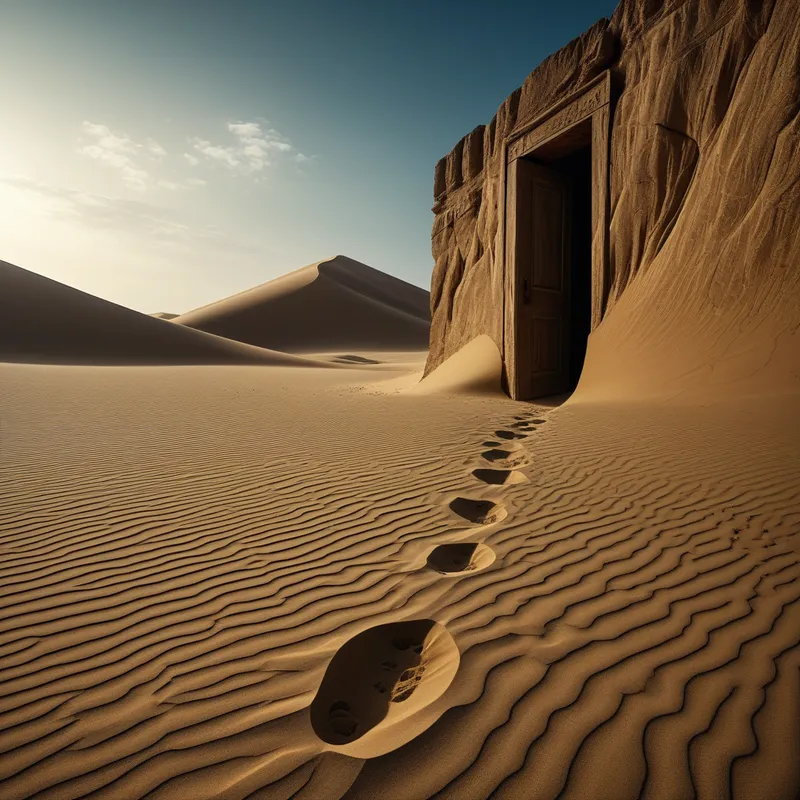
The individuation process demands we move from being proud architects of stone citadels to humble stewards of a living covenant. The “punishment” of the Thamud is, alchemically, the inevitable nigredo that follows the refusal of this call—a chaotic, painful dissolution of the old, rigid structure. For those who, like Salih and the believers, heed the warning, the destruction of the old city is not an end, but a liberation. They walk away from the ruins, carrying the living law within them, freed from the tomb of their own carving to find a new, more fluid relationship with the desert of the unknown.
Associated Symbols
Explore related symbols from the CaleaDream lexicon:
- Mountain — The symbol of the Thamud’s monumental ego and achievement, representing both their mastery and their ultimate, rigid tomb.
- Camel — The sacred she-camel embodies the divine sign, the Self as a nurturing yet demanding presence that requires a share of life’s essential resources.
- Water — The well’s water represents the source of life, psychic energy, and sustenance, over which the covenant of shared use is brutally broken.
- Stone — The medium of Thamud’s pride, symbolizing permanence, skill, and a civilization’s attempt to defy time and nature through rigid form.
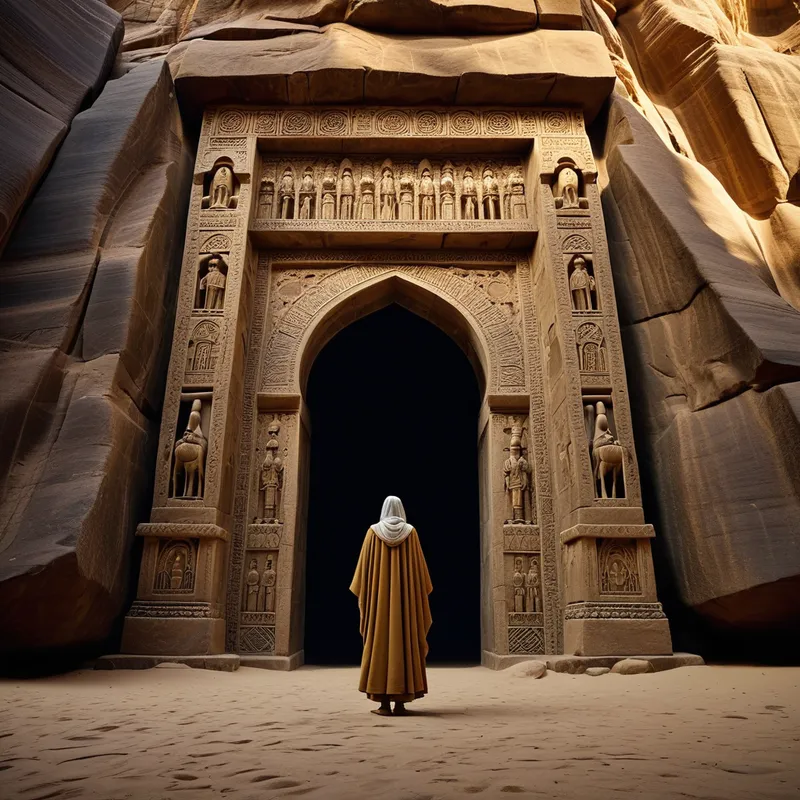
- Door — The intricately carved entrances to their cliff tombs symbolize both the grandeur of their achievement and the finality of their self-made entrapment.
- Earth — The desert earth that trembles and consumes them represents the foundational, chthonic power that ultimately reclaims those who forget their place within it.
- Thunder — The cataclysmic Sayha or blast embodies the shocking, unavoidable consequence of severing the sacred covenant, a divine or psychic retribution.
- Pride — The central psychological flaw of the Thamud, the hubris that leads them to believe their mastery of stone equates to mastery over divine law.
- Covenant — The sacred agreement, represented by the she-camel’s drinking schedule, symbolizing the necessary balance and respect between humanity and a higher order.
- Destruction — The inevitable end of the myth, representing the psychic collapse that occurs when the ego structure becomes too rigid and cut off from the Self.