The Tribe of Ad Myth Meaning & Symbolism
A legendary pre-Islamic Arabian tribe, blessed with immense power, who defied their prophet and were erased by a divine, scouring wind.
The Tale of The Tribe of Ad
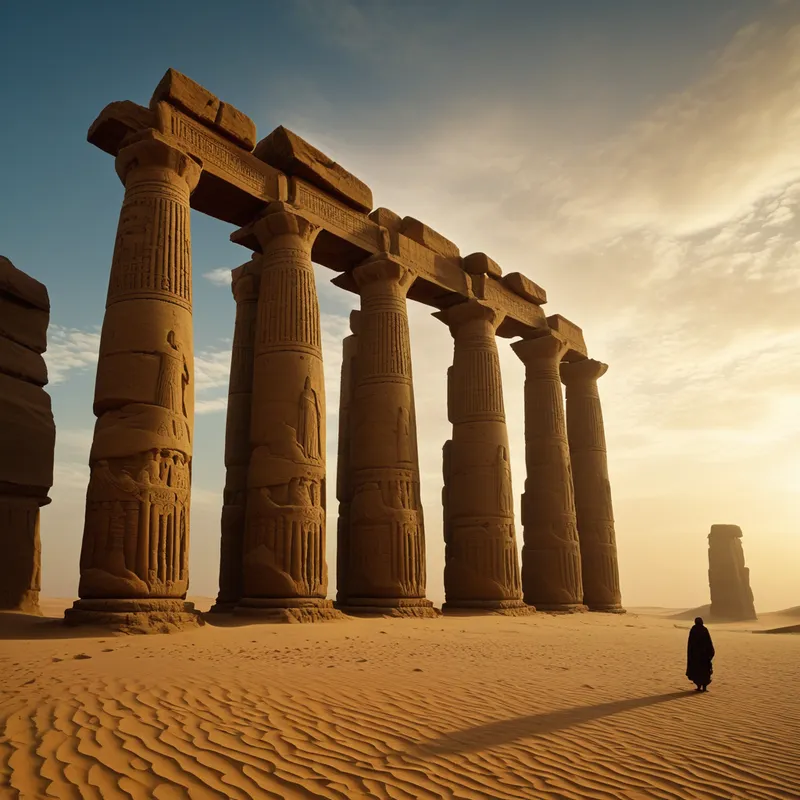
Listen, and hear the whisper in the sand. Before time was counted, in the Empty Quarter of the world, there lived a people whose name was Ad. They were not like the tribes that came after. The earth itself yielded to their will. They carved their homes not from wood or mud, but from the living rock of the mountains, hewing pillars that touched the low-hanging clouds, raising towers that laughed at the sun. Their gardens bloomed in the heart of the desert, fed by springs they commanded. Their strength was the strength of giants; a man of Ad could uproot a date palm with one hand. They believed themselves eternal, masters of all they surveyed, their laughter echoing in the halls of their arrogance.
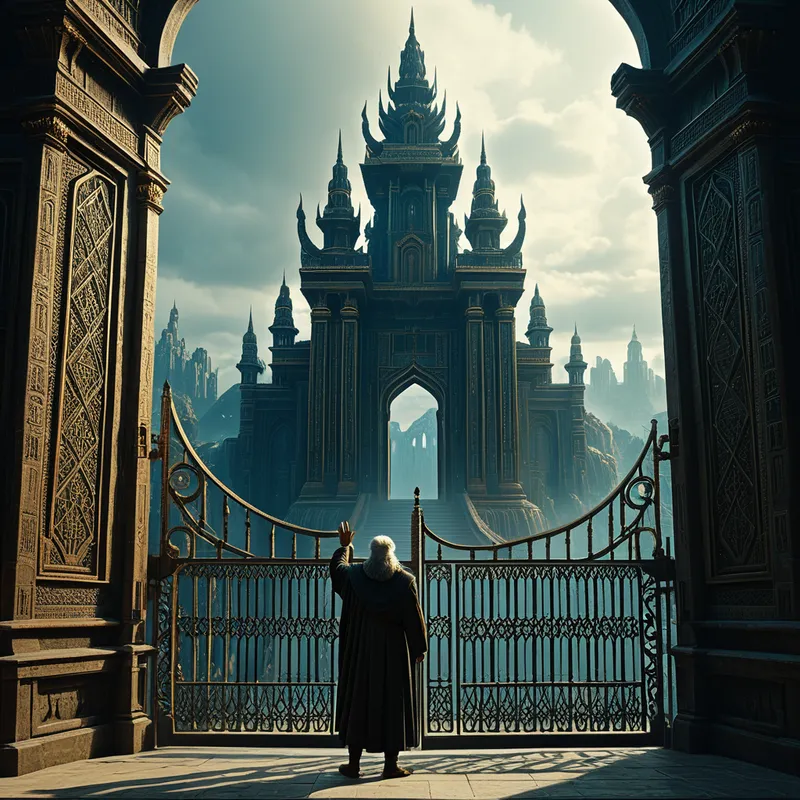
To them was sent a man from among their own, Hud. His voice was not thunderous, but carried the quiet of the deep desert. “O my people,” he cried, standing in their splendid marketplaces, “worship the One, Allah, who gave you this strength. Remember the source of your blessings. Turn from your idols of stone, from your pride that scrapes the sky. A reckoning comes upon those who forget.”
But the chieftains of Ad sneered from their high balconies. “Have you come to tell us that our mighty fathers were misguided?” they mocked. “We see no punishment you threaten. We are the greatest of beings! Our power is our god.” They pointed to their cyclopean architecture, their overflowing storehouses, their invincible armies. They called Hud a madman, a liar, a bringer of ill omen. The people, drunk on their own prowess, cast him out, their hearts harder than the mountains they dwelled in.
Then, a silence fell upon the land. A silence deeper than any well. The birds ceased their song. The wind died. For seven nights and eight days, the sun rose on a people holding its breath, waiting for a boast to be made flesh. Hud pleaded one final time, his words now dust in the still air.
On the horizon, a cloud appeared. Small, at first, like a promise. But it grew, not with the grace of rain, but with the purpose of a verdict. The sky darkened not with water, but with a gathering fury. A wind was summoned—a wind that had no name, for no living thing had known its like. It was not a single gust, but a roaring, scouring, screaming entity. It was the Samum.
It did not blow; it devoured. It found the towering pillars and ground them to grit. It found the proud faces and erased them. It entered the mouths of the mockers and filled them with sand. It peeled the flesh from the bone and the paint from the wall, reducing the glory of Ad to a shrieking, swirling chaos of particles. For seven nights and eight days, the wind performed its terrible alchemy, turning civilization into a memory, a mighty people into a caution etched upon the dunes.
When it passed, there was only the sigh of the empty desert. The pillars were stumps. The towers were mounds. The people were gone, as if they had been a dream the desert once had. Only Hud and those few who had heeded his whisper were spared, led away to become a seed for a new world. And the land of Al-Ahqaf became a place where the wind still tells the story, if you know how to listen.
Cultural Origins & Context
The myth of Ad is a cornerstone of the pre-Islamic Arabian narrative tradition, a foundational “story of the ancients” (akhbar al-awwalin) that served as a moral and existential compass. Primarily preserved and transmitted through the Qur’an and the accompanying exegetical literature (tafsir), its roots undoubtedly stretch back into the oral poetry and wisdom tales of the Peninsula. It functioned as an etiological myth, explaining the haunting, monumental ruins—often Nabatean or other ancient civilizations—that the Bedouin encountered in their travels. These were not merely old cities; they were the physical proof of a divine law.
The story was told by poets, storytellers, and later, by religious narrators, to inculcate the core Bedouin virtue of humility before the forces of nature and the divine. In a landscape where human life was perpetually balanced on the knife-edge of survival, the myth of Ad served as a powerful societal regulator against kibr (arrogant pride). It framed history as a cyclical drama of blessing, warning, ingratitude, and catastrophic correction, establishing the prophet-narrator (Hud) as the archetypal voice of conscience that a tribe must heed or perish.
Symbolic Architecture
At its [heart](/symbols/heart “Symbol: The heart symbolizes love, emotion, and the core of one’s existence, representing deep connections with others and self.”/), the myth is a profound mapping of the psyche’s confrontation with its own inflated [identity](/symbols/identity “Symbol: Identity represents the sense of self, encompassing personal beliefs, cultural background, and social roles.”/). The Tribe of Ad represents the ego in its state of identification with its own achievements and power.
The tower is not built to reach the divine; it is built to replace it.
Their monumental [architecture](/symbols/architecture “Symbol: Architecture in dreams often signifies structure, stability, and the framing of personal identity or life’s journey.”/) symbolizes the rigid, grandiose structures of a complex—a superiority complex built not on true self-[knowledge](/symbols/knowledge “Symbol: Knowledge symbolizes learning, understanding, and wisdom, embodying the acquisition of information and enlightenment.”/), but on a denial of dependency. The desert, often a [symbol](/symbols/symbol “Symbol: A symbol can represent an idea, concept, or belief, serving as a powerful tool for communication and understanding.”/) of the barren unconscious or the void, had been temporarily subdued by their will, mirroring how conscious ambition can repress the deeper, wilder aspects of the [soul](/symbols/soul “Symbol: The soul represents the essence of a person, encompassing their spirit, identity, and connection to the universe.”/).
Hud is the voice of the Self, the central [archetype](/symbols/archetype “Symbol: A universal, primordial pattern or prototype in the collective unconscious that shapes human experience, behavior, and creative expression.”/) of wholeness in Jungian terms. He is not an outsider, but “one of their own,” representing the innate, often ignored call from within the psyche to acknowledge a greater, integrating principle. His [rejection](/symbols/rejection “Symbol: The experience of being refused, excluded, or dismissed by others, often representing fears of inadequacy or social belonging.”/) is the ego’s refusal to submit to any [authority](/symbols/authority “Symbol: A symbol representing power structures, rules, and control, often reflecting one’s relationship with societal or personal governance.”/) beyond its own [logic](/symbols/logic “Symbol: The principle of reasoning and rational thought, often representing order, structure, and intellectual clarity in dreams.”/) and [strength](/symbols/strength “Symbol: ‘Strength’ symbolizes resilience, courage, and the ability to overcome challenges.”/).
The Samum is the inevitable, archetypal force of correction. It is not merely [punishment](/symbols/punishment “Symbol: A dream symbol representing consequences for actions, often tied to guilt, societal rules, or internal moral conflicts.”/), but a brutal, necessary act of psychic [dissolution](/symbols/dissolution “Symbol: The process of breaking down, dispersing, or losing form, often representing transformation, release, or the end of a state of being.”/). It represents the unconscious itself, rising up to scour away the petrified, inflated identity that has become maladaptive. It reduces everything to its essential, particulate state—a symbolic [death](/symbols/death “Symbol: Symbolizes transformation, endings, and new beginnings; often associated with fear of the unknown.”/) necessary for any possibility of future [life](/symbols/life “Symbol: The symbol of ‘Life’ represents a journey of growth, interconnectedness, and existential meaning, encompassing both the joys and challenges that define human experience.”/).
The Dreamer’s Resonance
When this myth stirs in the modern dreamer, it often manifests as dreams of profound, erasing cataclysm. One may dream of their home, their workplace, or their own body being dissolved by wind, sand, or a silent, consuming void. There is a somatic quality of being scoured, ground down.
Psychologically, this indicates a process where a long-held, rigid identity structure—perhaps built on professional success, intellectual pride, or a cherished self-image—has become unsustainable. The psyche is initiating a necessary deconstruction. The dreamer is not being punished, but is undergoing the terrifying, yet vital, work of the individuation process: the dismantling of the persona. The feeling of being erased is the ego’s experience of its own relative smallness before the totality of the Self. It is a dream of humility being forcibly administered by the deeper psyche.

Alchemical Translation
The journey of this myth models the alchemical stage of nigredo—the blackening, the dissolution, the descent into chaos. The Tribe of Ad in its glory represents the prima materia in its inflated, unrefined state, full of potential but corrupted by hubris.
The wind that destroys is the same breath that could have given life. The difference is in the vessel that receives it.
The individual’s parallel process begins with the inflation of a “tribe” within—a dominant complex that rules the inner kingdom. The call of the Hud archetype is the first, often-ignored symptom of unease, a feeling that this grandeur is hollow. The conscious mind’s refusal to heed this call forces the unconscious to act in a more total, catastrophic way. This might manifest as a sudden life crisis, a burnout, a collapse of a long-term project, or a deep depression—the personal Samum.
The alchemical work is to recognize this not as meaningless suffering, but as a brutal form of grace. The goal is not to rebuild the same towers. The few who followed Hud symbolize those nascent, humble parts of the psyche that remain connected to the Self. They are led to a new beginning. For the modern individual, the “transmutation” lies in surrendering the identification with one’s own monuments—achievements, status, a fixed identity—and allowing the scouring wind to reveal the bare, essential soul beneath. From that blank desert, something authentic can finally be seeded. The myth teaches that true power is not in defying the desert, but in learning its language and remembering one’s place within its vast, silent order.
Associated Symbols
Explore related symbols from the CaleaDream lexicon:
- Wind — The divine, scouring force of the Samum, representing both the breath of spirit and the agent of absolute dissolution and correction.
- Tower — The monumental, arrogant architecture of Ad, symbolizing the ego’s inflation and its attempt to reach heaven through worldly power alone.
- Mountain — The unyielding, ancient earth from which Ad carved their homes, representing both their formidable strength and the immutable divine law they defied.
- Stone — The primary material of Ad’s civilization, now reduced to rubble, symbolizing a heart hardened against wisdom and the inevitable return to dust.
- Prophet — The figure of Hud, representing the inner voice of conscience, the call of the Self, and the often-rejected messenger of truth.
- Desert — The vast, empty landscape of Al-Ahqaf, symbolizing the barren unconscious, the void, and the eternal witness that remains after civilization falls.
- Pride — The fatal flaw of Ad, the hubris that isolates the tribe from the divine source and triggers its catastrophic reintegration.
- Sand — The particulate, elemental state to which all of Ad’s works are reduced, representing the dissolution of complex forms into their basic, timeless essence.
- Voice — The persistent, warning call of Hud, contrasted with the mocking shouts of the tribe, symbolizing the struggle between soulful truth and collective arrogance.
- Rain — Conspicuously absent in the myth, its lack underscores the withdrawal of divine blessing and fertility, leaving only the barren, destructive wind.
- Shadow — The immense, collective shadow of Ad, a civilization so identified with its power and pride that it could not see its own fragility and dependence.
- Dream — The entire narrative exists as a collective dream-memory of the Arabian psyche, a warning etched into the cultural unconscious about the fate of those who forget.