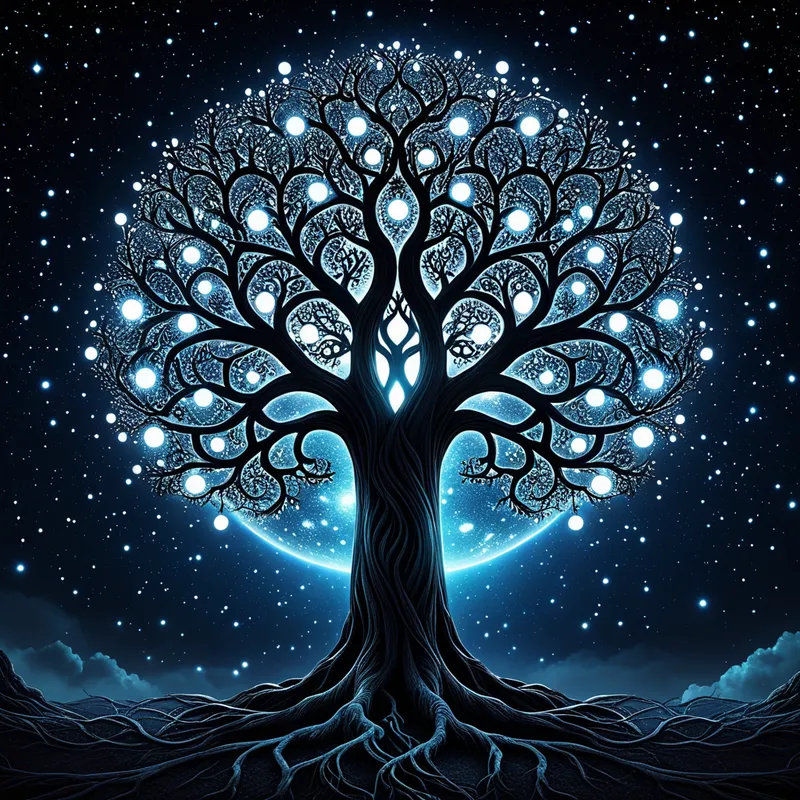
The Tree of Life Myth Meaning & Symbolism
A sacred diagram of ten spheres and twenty-two paths, mapping the descent of divine light into creation and the soul's path of return to its source.
The Tale of The Tree of Life
Before [the world](/myths/the-world “Myth from Tarot culture.”/) was a world, there was only Ein Sof—the Endless, the No-[Thing](/myths/thing “Myth from Norse culture.”/) that is Everything. It was a light so absolute, so unified, that there was no vessel to hold it, no eye to see it, no other to know it. It was a perfect, silent sea without a shore.
And from this boundless stillness, a desire arose—not a need, but a profound, creative will: the will to be known. And so, Ein Sof contracted. It withdrew its light into itself, creating a hollow, a womb of potential darkness. This was the [Tzimtzum](/myths/tzimtzum “Myth from Kabbalistic culture.”/), the great breath held in. Into this primordial emptiness, a single ray of light lanced forth—a line of divine will, a river of emanation.
This ray did not simply shine; it crystallized. At its point of origin, a vessel of pure intellect formed, a sphere of blinding white fire: Keter, [the Crown](/myths/the-crown “Myth from Various culture.”/). But the light was too potent, too fierce for [the vessel](/myths/the-vessel “Myth from Alchemical culture.”/). It overflowed, and from its overflow, a second sphere coalesced—Chokhmah, the flash of Wisdom, the father-principle. And from the union of the overflowing crown and the receptive point of wisdom, a third sphere poured forth: Binah, the mother-principle, the great sea of Understanding that gives shape to the flash.
Down, down the ray continued, a cascade of differentiated light. From the supernal triad, a pillar of Mercy formed on the right, blazing with love and expansion. A [pillar of Severity](/myths/pillar-of-severity “Myth from Kabbalistic culture.”/) formed on the left, dark with judgment and form. And between them, the pillar of Mildness, the path of balance. Upon these pillars, the light gathered into further vessels: Chesed and Gevurah, locked in eternal tension. Their child was Tiferet, the Beauty at the center, the sun-like king.
But the drama was not one of peaceful descent. As the light flowed into the lower spheres—Netzach, Hod, and Yesod—a great catastrophe echoed. The final vessel, Malkuth, the Kingdom, could not hold the influx. The vessels shattered. Sparks of divine light, shards of the original vessels, fell through [the abyss](/myths/the-abyss “Myth from Kabbalistic culture.”/), scattered and buried in the husks of material reality. The Tree was fractured, its harmony broken.
Yet the ray of light did not cease. It persisted, a thin, silver thread of connection through the chaos. The work then became not of emanation, but of repair—Tikkun Olam. The Tree now stood not as a tale of finished creation, but as a map of a broken world yearning for wholeness, its ten spheres like wounded stars, connected by twenty-two paths of potential return. The myth ends not with a resolution, but with a calling: the light is above, the sparks are below, and the paths are open.
Cultural Origins & Context
The myth of the [Tree of Life](/myths/tree-of-life “Myth from Kabbalistic culture.”/), or Etz Chaim, is not a folktale with a single author, but a living, esoteric framework that emerged from the heart of Jewish mystical thought. Its primary textual roots are in the Zohar, a seminal work that appeared in 13th-century Spain. This was not a myth for the public square, but a secret wisdom passed from master to initiated disciple, often in hushed tones and through complex allegory.
Its societal function was dual. For the community, it provided a profound theosophy—a way to reconcile an infinite, unknowable God with a finite, suffering world. It explained exile and fragmentation as cosmic events, making human suffering part of a vast, divine drama of shattering and repair. For the individual mystic, it was a rigorous psychological and spiritual map. The Tree was a guide for contemplative ascent, a meditative technology for “climbing” the paths through prayer, ethical action, and intense study, aiming to achieve devekut (cleaving to God) and participate directly in the work of Tikkun.
Symbolic Architecture
At its core, the [Tree](/symbols/tree “Symbol: In dreams, the tree often symbolizes growth, stability, and the interconnectedness of life.”/) is a symbolic [architecture](/symbols/architecture “Symbol: Architecture in dreams often signifies structure, stability, and the framing of personal identity or life’s journey.”/) of [consciousness](/symbols/consciousness “Symbol: Consciousness represents the state of awareness and perception, encompassing thoughts, feelings, and experiences.”/) itself. It is a diagram of how the One becomes the Many, and how the Many can remember the One.
The Tree of Life is not a story about gods on a mountain; it is the blueprint of the mountain of being, from its hidden peak in the clouds to its roots in the dark earth of manifestation.
The ten [Sephirot](/myths/sephirot “Myth from Kabbalistic culture.”/) are not places, but dynamic states of divine [energy](/symbols/energy “Symbol: Energy symbolizes vitality, motivation, and the drive that fuels actions and ambitions.”/) and, by [reflection](/symbols/reflection “Symbol: Reflection signifies self-examination, awareness, and the search for truth within oneself.”/), layers of the [human](/symbols/human “Symbol: The symbol of a human represents individuality, complexity of emotions, and social relationships.”/) [soul](/symbols/soul “Symbol: The soul represents the essence of a person, encompassing their spirit, identity, and connection to the universe.”/). Keter represents the transcendent spark of pure potential within us, the “I am” before thought. Chokhmah and [Binah](/symbols/binah “Symbol: In Kabbalah, the third Sephirah representing divine understanding, the feminine principle, and the womb of creation.”/) are the archetypal parents of our cognition—the flash of [insight](/symbols/insight “Symbol: A sudden, deep understanding of a complex situation or truth, often arriving unexpectedly and illuminating hidden connections.”/) and the [capacity](/symbols/capacity “Symbol: A measure of one’s potential, limits, or ability to contain, process, or achieve something, often reflecting self-assessment or external demands.”/) to [structure](/symbols/structure “Symbol: Structure in dreams often symbolizes stability, organization, and the framework of one’s life, reflecting how one perceives their environment and personal life.”/) it into understanding. The central [triad](/symbols/triad “Symbol: A grouping of three representing spiritual unity, divine completeness, and cosmic balance across many traditions.”/) of Chesed, Gevurah, and Tiferet models the [heart](/symbols/heart “Symbol: The heart symbolizes love, emotion, and the core of one’s existence, representing deep connections with others and self.”/)‘s eternal conflict between boundless [compassion](/symbols/compassion “Symbol: A deep feeling of empathy and concern for others’ suffering, often involving a desire to help or alleviate their pain.”/) and necessary boundaries, resolved only in the balanced [beauty](/symbols/beauty “Symbol: This symbol embodies aesthetics, harmony, and the appreciation of life’s finer qualities.”/) of the integrated Self.
The “Shattering of the Vessels” is perhaps the most psychologically potent [symbol](/symbols/symbol “Symbol: A symbol can represent an idea, concept, or belief, serving as a powerful tool for communication and understanding.”/). It represents the inevitable [trauma](/symbols/trauma “Symbol: A deeply distressing or disturbing experience that overwhelms the psyche, often manifesting in dreams as unresolved emotional wounds or psychological injury.”/) of incarnation—the [fragmentation](/symbols/fragmentation “Symbol: The experience of breaking apart, losing cohesion, or being separated into pieces. Often represents disintegration of self, relationships, or reality.”/) of the pristine, unified Self as it enters the pressures of [family](/symbols/family “Symbol: The symbol of ‘family’ represents foundational relationships and emotional connections that shape an individual’s identity and personal development.”/), culture, and personal [history](/symbols/history “Symbol: History in dreams often represents the dreamer’s past experiences, lessons learned, or unresolved issues that continue to influence their present.”/). Our wholeness is shattered; our divine sparks are buried under the “husks” (Kelipot) of [trauma](/symbols/trauma “Symbol: A deeply distressing or disturbing experience that overwhelms the psyche, often manifesting in dreams as unresolved emotional wounds or psychological injury.”/), conditioning, and ego.
The Dreamer’s Resonance
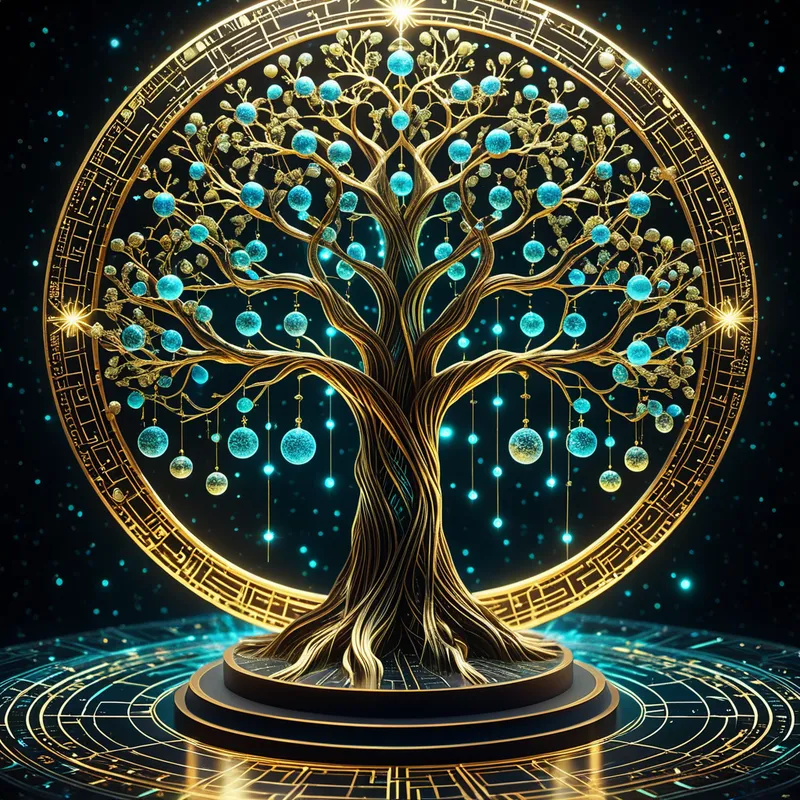
When this myth stirs in the modern unconscious, it rarely appears as a literal tree. Instead, one might dream of a brilliant, intricate machine or network that has suffered a catastrophic systems failure, with vital data (sparks) lost in corrupted sectors. One dreams of trying to reconnect severed wires, of following a schematic toward a central processor that holds the key to rebooting the whole system.
Somatically, this can feel like a profound tension between expansion and contraction—a chest that wants to open with love (Chesed) but is clamped by an old armor of defense (Gevurah). It is the process of feeling where in the body-mind one is “shattered”—disconnected from feeling, intuition, or will—and where a spark of vital energy lies trapped. The dreamwork is the work of Tikkun: to identify those lost sparks in our complexes and neuroses, and through conscious attention, redeem them.
Alchemical Translation
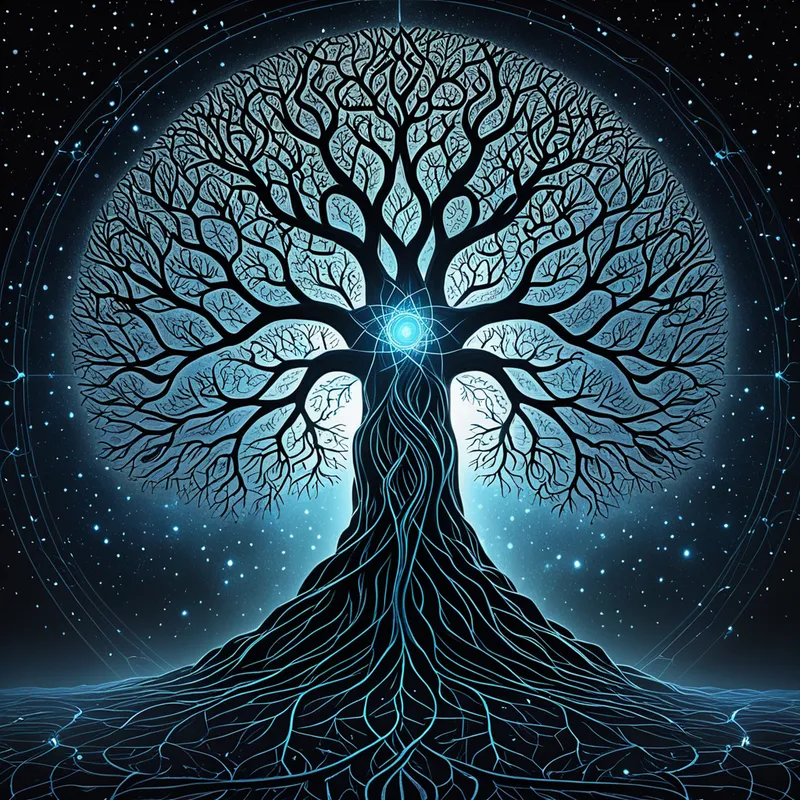
The alchemical process modeled by the Tree is [the opus](/myths/the-opus “Myth from Alchemical culture.”/) of individuation—the creation of the “Diamond Body” or [the Philosopher’s Stone](/myths/the-philosophers-stone “Myth from Alchemical culture.”/), which in Kabbalistic terms is the integrated Self anchored in Tiferet. It is a non-linear journey of descent and ascent.
The journey begins in Malkuth, the heavy reality of our identified lives. The first task is to recognize the “shattering”—to confront one’s own fragmentation, [the ego](/myths/the-ego “Myth from Jungian culture.”/)‘s isolated kingdom. This is the [nigredo](/myths/nigredo “Myth from Alchemical culture.”/), the blackening. The ascent up the paths is the albedo, the whitening, a purification where one confronts the dualities on the pillars: the tyranny of one’s own unchecked mercy (enabling, loss of self) and the cruelty of one’s own severity (harsh self-judgment, rigidity).
Individuation is the conscious enactment of Tikkun Olam on the personal plane. Each integrated complex, each healed split in the psyche, is a spark lifted from the husk and restored to the Tree.
The ultimate goal is not to abandon Malkuth for Keter, but to become the living channel that connects them—to ground the infinite in the finite. This is the [rubedo](/myths/rubedo “Myth from Alchemical culture.”/), the reddening, where the fully realized individual, having balanced the inner pillars, becomes a stable vessel. They can now hold the tension of the opposites and channel the divine light—not as a shattered receptacle, but as a conscious, compassionate conduit, completing the circuit of creation within their own soul. The repaired Tree then stands within, a testament that the world is mended one redeemed spark at a time.
Associated Symbols
Explore related symbols from the CaleaDream lexicon: