The Tree of Knowledge of Good and Evil Myth Meaning & Symbolism
An ancient story of a divine garden, a forbidden tree, and the fateful choice that forever changed humanity's relationship with innocence, knowledge, and the divine.
The Tale of The Tree of Knowledge of Good and Evil
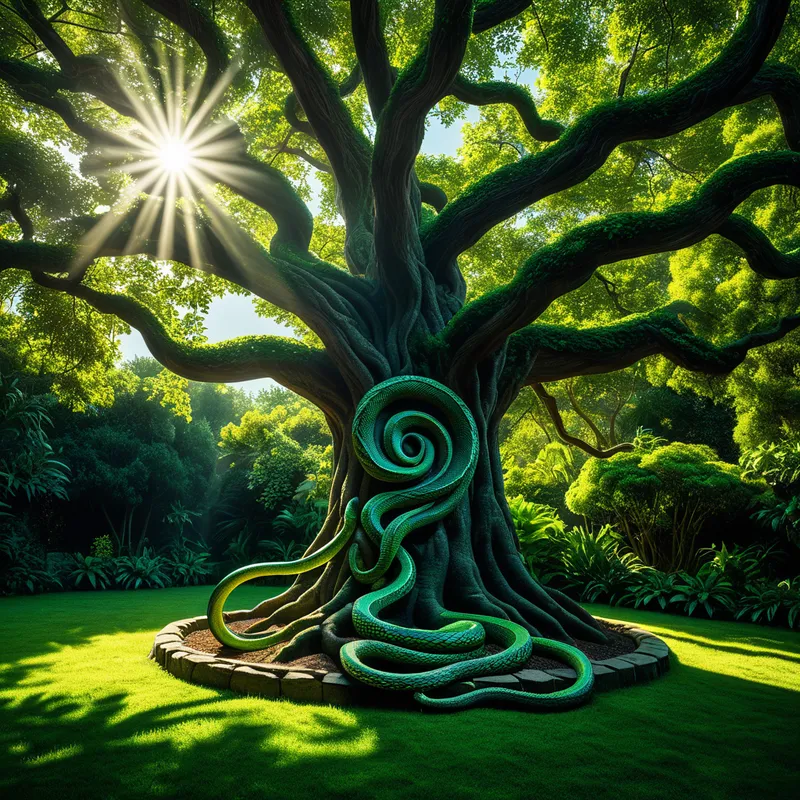
In the beginning, when the breath of Yahweh still stirred the deep, there was a garden. Not a garden as we know it, but a place of shimmering, unbroken harmony. The air hummed with a quiet music, and the light did not cast shadows, for there was nothing to hide. In the heart of this [Garden of Eden](/myths/garden-of-eden “Myth from Biblical culture.”/), between [the river](/myths/the-river “Myth from Buddhist culture.”/) that parted into four heads, stood two trees of singular note.
One was the [Tree of Life](/myths/tree-of-life “Myth from Kabbalistic culture.”/). The other was [the Tree of Knowledge](/myths/the-tree-of-knowledge “Myth from Jewish culture.”/) of Good and Evil. Its bark was like polished bronze, its leaves a tapestry of emerald and silver that whispered secrets to [the wind](/myths/the-wind “Myth from Various culture.”/). Its fruit hung heavy, luminous, and perfect—a sight that held both a promise and a profound silence.
Into this garden, Yahweh placed the human he had formed, Adam, and from his side, he fashioned a companion, Eve. They were naked and felt no shame, for their consciousness was a clear pool reflecting only the immediate present. Yahweh gave them dominion over the garden, with one boundary, spoken not as a threat but as a law of their being: “You may freely eat of every tree in the garden; but of the tree of the knowledge of good and evil you shall not eat, for in the day that you eat of it you shall surely die.”
The serpent was there, more cunning than any other creature. It did not slither in menace, but in a coiled, thoughtful grace. It found the woman by the forbidden tree and spoke into the quiet of her mind. “Did God actually say, ‘You shall not eat of any tree in the garden’?” It was a question that planted its own seed—the seed of a thought separate from divine instruction.
Eve corrected the serpent, but the correction itself made the prohibition present, tangible. The serpent whispered the true temptation: “You will not surely die. For God knows that when you eat of it your eyes will be opened, and you will be like God, knowing good and evil.”
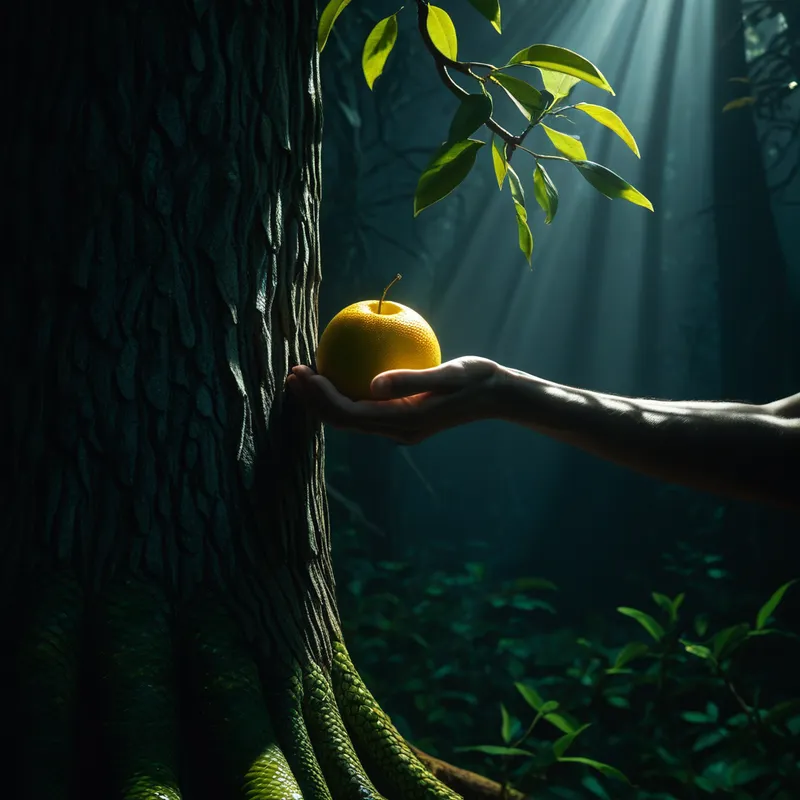
The words hung in the air. The woman looked at the tree anew. It was good for food, a delight to the eyes, and to be desired to make one wise. The desire was not for rebellion, but for completion, for a knowledge that lay just beyond [the horizon](/myths/the-horizon “Myth from Various culture.”/) of innocence. She reached out, took the fruit, and ate. She gave some to the man who was with her, and he ate.
In that moment, the unbroken music of the garden fractured. Their eyes were opened, and they knew they were naked. The first knowledge was not of cosmic mysteries, but of self-as-object, of separation, of vulnerability. They heard the sound of Yahweh walking in the garden in the cool of the day, and they hid among the trees, their hearts pounding a new, fearful rhythm.
The voice called out, “Where are you?”
And humanity, from its first breath of conscious shame, spoke its first excuse.
Cultural Origins & Context
This foundational narrative is found in the Book of Genesis, the first book of the Tanakh and the Christian Old Testament. Its origins are woven from the oral traditions of ancient Israel, likely crystallizing during the period of the Babylonian Exile (6th century BCE) or earlier. It is a etiological myth of the highest order, told not as mere history but as a profound exploration of the human condition.
The storytellers were priests and scribes seeking to answer perennial questions: Why do we die? Why do we labor? Why is there pain in childbirth? Why do we feel shame and alienation? The story functions as the bedrock of the Fall of Man, establishing the core dynamic of covenant, transgression, and consequence that structures much of the Biblical narrative. It was a story told to define a people’s relationship with a sovereign, law-giving God, explaining the painful realities of historical existence—famine, war, toil—as consequences of a primordial choice that shattered a primal unity.
Symbolic Architecture
The myth is a dense symbolic map of the [birth](/symbols/birth “Symbol: Birth symbolizes new beginnings, transformation, and the potential for growth and development.”/) of reflective [consciousness](/symbols/consciousness “Symbol: Consciousness represents the state of awareness and perception, encompassing thoughts, feelings, and experiences.”/). The Garden represents the original, unconscious unity of the [psyche](/myths/psyche “Myth from Greek culture.”/)—a state of undifferentiated being where the individual is seamlessly part of a nurturing whole. The Adam and Eve within it represent the nascent ego, the first [flicker](/symbols/flicker “Symbol: A brief, unstable light or movement suggesting transition, uncertainty, or the ephemeral nature of perception and reality.”/) of self-[awareness](/symbols/awareness “Symbol: Conscious perception of self, surroundings, or internal states. Often signifies awakening, insight, or heightened sensitivity.”/) that is still contained within the divine [parent](/symbols/parent “Symbol: The symbol of a parent often represents authority, nurturing, and protection, reflecting one’s inner relationship with figures of authority or their own parental figures.”/).
The Tree of Knowledge is not evil; it is the symbol of consciousness itself, which necessarily introduces duality, judgment, and the pain of self-awareness.
The [serpent](/symbols/serpent “Symbol: A powerful symbol of transformation, wisdom, and primal energy, often representing hidden knowledge, healing, or temptation.”/) is one of the most complex symbols. It is not a caricature of evil but represents the instinctual, chthonic wisdom of the unconscious that pushes toward [differentiation](/symbols/differentiation “Symbol: The process of distinguishing or separating parts of the self, emotions, or identity from a whole, often marking a developmental or psychological milestone.”/). It is the catalyst for growth, the necessary “[trickster](/symbols/trickster “Symbol: A boundary-crossing archetype representing chaos, transformation, and the subversion of norms through cunning and humor.”/)” who disrupts [stasis](/symbols/stasis “Symbol: A state of inactivity, equilibrium, or suspension where no change or progress occurs, often representing psychological or existential paralysis.”/). The [forbidden fruit](/symbols/forbidden-fruit “Symbol: The Forbidden Fruit represents temptation and the allure of vices that are often shunned or forbidden by society.”/) is the [fruit](/symbols/fruit “Symbol: Fruit symbolizes abundance, nourishment, and the fruits of one’s labor in dreams.”/) of discernment. To know good and evil is to acquire the [capacity](/symbols/capacity “Symbol: A measure of one’s potential, limits, or ability to contain, process, or achieve something, often reflecting self-assessment or external demands.”/) for moral judgment, for comparison, for the existential awareness of opposites—[life](/symbols/life “Symbol: The symbol of ‘Life’ represents a journey of growth, interconnectedness, and existential meaning, encompassing both the joys and challenges that define human experience.”/) and [death](/symbols/death “Symbol: Symbolizes transformation, endings, and new beginnings; often associated with fear of the unknown.”/), self and other, [innocence](/symbols/innocence “Symbol: A state of purity, naivety, and freedom from guilt or corruption, often associated with childhood and moral simplicity.”/) and experience.
The immediate consequence—the awareness of nakedness—is brilliantly precise. It symbolizes the [dawn](/symbols/dawn “Symbol: The first light of day, symbolizing new beginnings, hope, and the transition from darkness to illumination.”/) of self-consciousness, the feeling of exposure, and the [vulnerability](/symbols/vulnerability “Symbol: A state of emotional or physical exposure, often involving risk of harm, that reveals authentic self beneath protective layers.”/) that comes with being a subject who can be seen and judged. The expulsion from the garden is not merely a [punishment](/symbols/punishment “Symbol: A dream symbol representing consequences for actions, often tied to guilt, societal rules, or internal moral conflicts.”/), but the inevitable result of this new consciousness. One cannot stay in unconscious [paradise](/symbols/paradise “Symbol: A perfect, blissful place or state of being, often representing ultimate fulfillment, harmony, and transcendence beyond ordinary reality.”/) once one has tasted the [knowledge](/symbols/knowledge “Symbol: Knowledge symbolizes learning, understanding, and wisdom, embodying the acquisition of information and enlightenment.”/) of [separation](/symbols/separation “Symbol: A spiritual or mythic division between realms, states of being, or consciousness, often marking a transition or loss of connection.”/).

The Dreamer’s Resonance
When this myth pattern appears in modern dreams, it signals a critical threshold in the dreamer’s psychological development. Dreaming of a forbidden, tantalizing fruit or a central, significant tree often coincides with a life stage where an old, comfortable state of “innocence” or unconscious compliance is being challenged.
The somatic feeling is often one of simultaneous dread and irresistible attraction—a tightness in the chest, a quickening pulse. Psychologically, the dreamer is confronting the cost of awakening. This could relate to leaving a dependent relationship, questioning a long-held belief system, or embracing a truth about oneself that disrupts a familiar identity (the “garden”). The “serpent” in the dream may appear as a provocative friend, a taboo thought, or an intuitive voice from within, urging a necessary but frightening step into greater self-knowledge. The dream captures the painful, exhilarating moment when one chooses to “eat the fruit”—to accept a difficult truth, and in doing so, irrevocably change one’s inner world.
Alchemical Translation
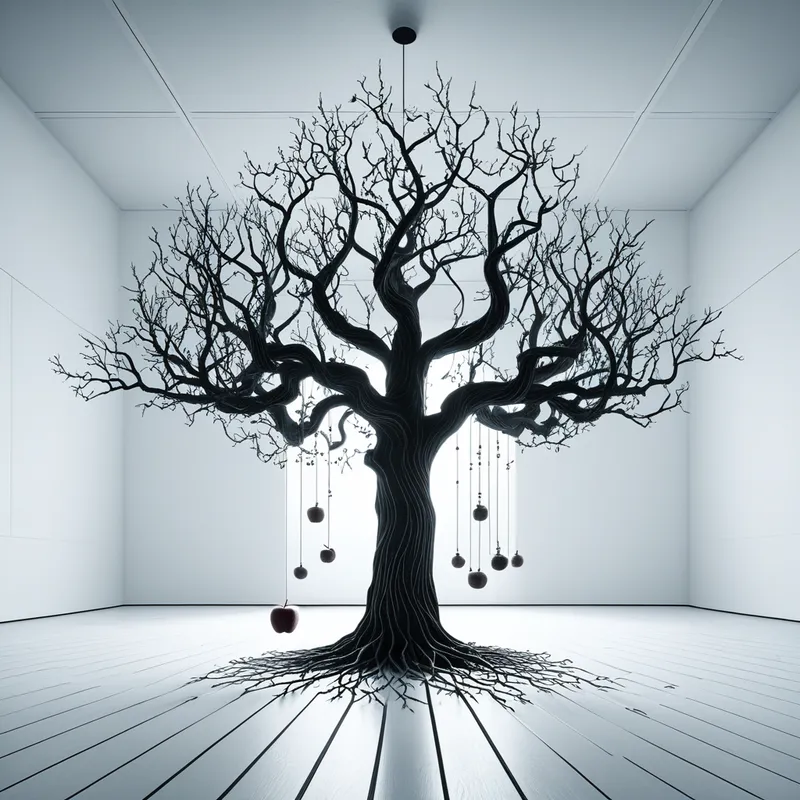
In the alchemy of the soul, this myth perfectly models the first, essential stage of individuation: the necessary separation from the unconscious matrix. The primal unity of the garden is the massa confusa, the undifferentiated state. The act of eating the fruit is the [nigredo](/myths/nigredo “Myth from Alchemical culture.”/), the darkening, the painful separation that feels like a “fall” or a death.
The exile from Eden is the birth of the individual psyche, the lonely but necessary ground upon which conscious life is built.
For the modern individual, the “garden” is any state of unconscious identification—with family, tribe, dogma, or a limited self-concept. The “fruit” is the disruptive insight, the therapy session, the life crisis, or the creative impulse that forces a distinction between “I” and “that which I was part of.” This is not a one-time event but a recurring pattern. Each time we outgrow a comfortable paradigm, we re-enact the Eden drama. We transgress an inner law, gain a new dimension of knowledge (often painful self-knowledge), and are expelled from a smaller world into a larger, more complex, and more conscious one. The goal of the psychic journey is not to return to the unconscious garden, but, having passed through [the wilderness](/myths/the-wilderness “Myth from Biblical culture.”/) of experience and self-knowledge, to approach the Tree of Life with conscious eyes—to integrate the knowledge of duality into a wiser, more embodied wholeness. The myth thus begins our story not with a curse, but with the terrifying, glorious burden of becoming conscious.
Associated Symbols
Explore related symbols from the CaleaDream lexicon: